

Gamma 4, the Local AI Revolution: How to Kill Your Subscription

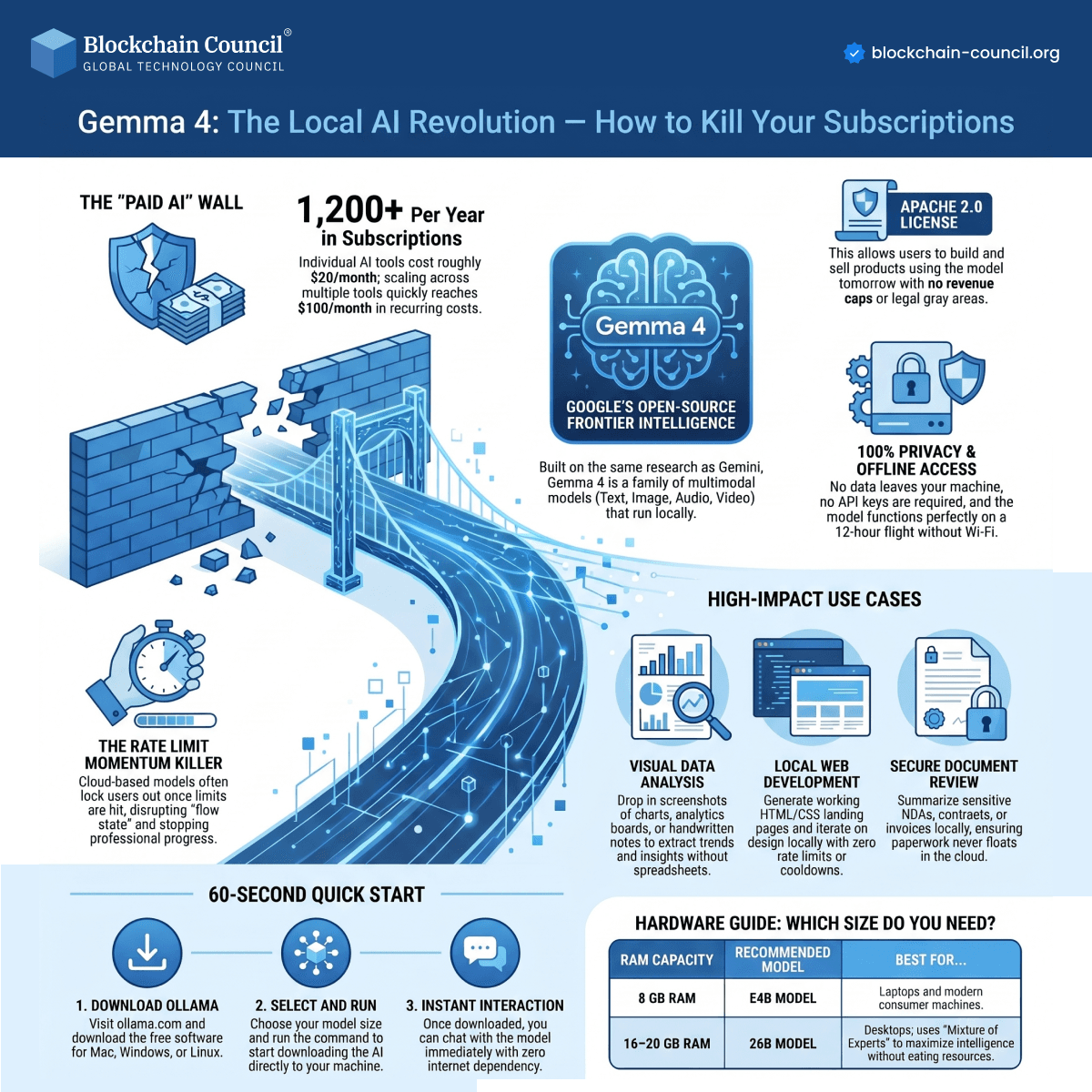
Artificial intelligence has become an essential part of modern workflows, powering everything from content creation to software development. However, most AI tools operate on subscription-based models, requiring continuous payments for access. This has led to growing interest in local AI solutions, where users can run powerful AI models directly on their own devices.
Gamma 4 represents a new wave in this movement, emphasizing efficiency, privacy, and independence from cloud-based systems. It is part of a broader shift toward decentralized AI usage, where control returns to the user rather than the service provider.

To fully understand and leverage these advancements, many professionals explore structured programs such as the AI expert certification and the Agentic AI Certification. These certifications provide a strong foundation in modern AI systems, including autonomous agents and local deployment strategies.
This article explores Gamma 4, the local AI revolution, and how it is enabling users to reduce or even eliminate reliance on subscription-based AI services.
What Is Gamma 4
Gamma 4 refers to a new generation of lightweight, efficient AI models designed to run locally on personal devices. Unlike traditional cloud-based AI systems, Gamma 4 prioritizes:
On-device processing
Reduced computational requirements
Enhanced privacy
Faster response times
It is part of a broader trend toward making AI more accessible and less dependent on centralized infrastructure.
Understanding the Local AI Revolution
Local AI refers to running artificial intelligence models directly on a user’s hardware, such as a laptop, desktop, or even a mobile device.
Key Characteristics
No reliance on cloud servers
Offline functionality
Greater data control
Lower long-term costs
This shift is driven by improvements in hardware and model efficiency, allowing advanced AI capabilities without massive server farms.
Why People Want to “Kill Subscriptions”
Subscription fatigue is real. Users are paying monthly fees for multiple tools, many of which overlap in functionality.
Common Pain Points
Rising costs
Limited customization
Data privacy concerns
Dependence on internet connectivity
Local AI offers a solution by providing a one-time setup with ongoing usage at minimal cost.
How Gamma 4 Enables Subscription Independence
Gamma 4 and similar models enable users to perform tasks typically handled by cloud AI services.
Capabilities
Text generation
Code assistance
Image processing
Data analysis
Example
A developer using a local AI model for code generation can avoid paying for multiple cloud-based coding assistants.
Cost Comparison: Subscription vs Local AI
Subscription Model
Monthly or yearly fees
Continuous payments
Limited ownership
Local AI Model
Initial setup cost
No recurring fees
Full control
Over time, local AI becomes significantly more cost-effective.
Privacy Advantages of Local AI
One of the biggest benefits of local AI is privacy.
Key Benefits
Data remains on device
Reduced risk of breaches
No third-party data access
Example
Businesses handling sensitive customer data can use local AI to ensure compliance with privacy regulations.
Performance and Speed
Local AI models like Gamma 4 offer faster response times because they eliminate network latency.
Benefits
Instant processing
Offline functionality
Consistent performance
However, performance depends on hardware capabilities, which is where reality sets in.
Hardware Requirements for Local AI
Running AI locally requires adequate hardware.
Typical Requirements
High-performance CPU or GPU
Sufficient RAM
Storage capacity
Example
A modern laptop with a dedicated GPU can handle many local AI tasks efficiently.
Role of AI Skills in the Local AI Era
Using local AI effectively requires technical knowledge. Programs like the Claude Ai Certification help professionals understand advanced AI systems and their applications.
Similarly, the AI Powered coding expert Course equips users with the skills to integrate and optimize AI models.
Because installing a model is one thing. Making it actually useful is another.
Real World Applications of Gamma 4 and Local AI
Software Development
Developers use local AI for code generation, debugging, and testing.
Content Creation
Writers and marketers generate content without relying on cloud services.
Business Automation
Companies automate workflows while maintaining data privacy.
Marketing
AI tools assist in campaign creation and analysis, supported by programs like the AI powered marketing course.
Challenges of Local AI Adoption
Hardware Limitations
Not all users have devices capable of running advanced models.
Setup Complexity
Installing and configuring local AI can be challenging.
Model Updates
Keeping models updated requires manual effort.
Performance Trade-offs
Local models may not match the scale of cloud-based systems.
So yes, you save money, but you trade convenience for control.
Recent Developments in Local AI
Model Optimization
New techniques are making AI models smaller and more efficient.
Edge Computing Integration
AI is being integrated into edge devices for real-time processing.
Open Source Growth
More open-source models are available for local deployment.
Improved User Interfaces
Tools are becoming more user-friendly, reducing technical barriers.
Comparing Gamma 4 with Cloud AI
Advantages of Gamma 4
Privacy
Cost savings
Offline access
Advantages of Cloud AI
Scalability
Ease of use
Continuous updates
The choice depends on user priorities.
Best Practices for Transitioning to Local AI
Start with lightweight models
Upgrade hardware if necessary
Learn basic configuration skills
Combine local and cloud solutions
A hybrid approach often works best.
Future of Local AI
The future of local AI looks promising.
Trends
More powerful local models
Better hardware integration
Increased adoption across industries
As technology improves, the gap between local and cloud AI will continue to shrink.
Conclusion
Gamma 4 and the local AI revolution represent a significant shift in how artificial intelligence is accessed and used. By enabling on-device processing, reducing costs, and enhancing privacy, local AI offers a compelling alternative to subscription-based services.
While challenges remain, the benefits are clear. For users willing to invest in setup and learning, local AI provides greater control and long-term value.
Killing your subscription may not be immediate, but it is increasingly realistic.
FAQs
1. What is Gamma 4
Gamma 4 is a lightweight AI model designed for local deployment, allowing users to run AI applications on their own devices. It focuses on efficiency, privacy, and reduced dependency on cloud services. This makes it a key part of the local AI movement.
2. What is local AI
Local AI refers to running artificial intelligence models directly on personal devices instead of cloud servers. It provides greater control and privacy. This approach is becoming more popular due to technological advancements.
3. How does local AI save money
Local AI eliminates recurring subscription fees by allowing users to run models on their own hardware. While there may be initial setup costs, long-term expenses are lower. This makes it cost-effective over time.
4. Is local AI better than cloud AI
Local AI offers privacy and cost advantages, while cloud AI provides scalability and convenience. The choice depends on user needs. Many users adopt a hybrid approach.
5. What hardware is needed for local AI
Running local AI typically requires a powerful CPU or GPU, sufficient RAM, and adequate storage. The exact requirements depend on the model. Better hardware improves performance.
6. Can beginners use local AI
Beginners can use local AI, but it may require some technical knowledge. User-friendly tools are making it easier. Learning basic concepts helps significantly.
7. Is local AI secure
Local AI is generally more secure because data remains on the user’s device. This reduces exposure to external threats. However, users must still follow security best practices.
8. What are the limitations of local AI
Limitations include hardware requirements, setup complexity, and potential performance constraints. These challenges can be managed with proper planning. Technology improvements are addressing these issues.
9. Can local AI work offline
Yes, one of the main advantages of local AI is its ability to function without an internet connection. This ensures accessibility in various environments. It also enhances privacy.
10. What industries use local AI
Industries such as software development, healthcare, and marketing use local AI. It helps automate tasks and protect data. Its applications are expanding rapidly.
11. How does Gamma 4 improve privacy
Gamma 4 processes data locally, preventing it from being sent to external servers. This reduces the risk of data breaches. It ensures better control over information.
12. What is the future of local AI
The future includes more efficient models, better hardware integration, and wider adoption. Local AI will become more accessible. Its role in technology will grow.
13. Can local AI replace subscriptions completely
Local AI can replace many subscriptions but may not eliminate all of them. Some cloud services still offer unique advantages. A balanced approach is often best.
14. What is edge computing in AI
Edge computing involves processing data closer to its source, such as on local devices. It improves speed and reduces latency. This is closely related to local AI.
15. How do I start using local AI
Start by choosing a suitable model and ensuring your hardware meets requirements. Follow installation guides and experiment with basic tasks. Gradual learning helps.
16. What are open source AI models
Open source AI models are freely available for use and modification. They support local deployment. This encourages innovation and accessibility.
17. How does local AI impact businesses
Local AI helps businesses reduce costs, improve privacy, and enhance efficiency. It allows greater control over operations. This can lead to competitive advantages.
18. Can local AI handle complex tasks
Yes, modern local AI models can handle complex tasks, depending on hardware capabilities. Continuous improvements are expanding their capabilities. They are becoming more powerful.
19. What skills are needed for local AI
Skills include basic programming, understanding AI concepts, and system configuration. These skills improve effectiveness. Learning resources are widely available.
20. Why is local AI gaining popularity
Local AI is gaining popularity due to cost savings, privacy benefits, and improved performance. Users want more control over their tools. This trend is expected to continue.
Related Articles
View All
Infographics
Digital Asset Investment Guide: Build a Smarter Strategy for the Future of Finance
Digital asset investing has become a key part of the modern financial landscape, offering opportunities in cryptocurrencies, tokenized assets, NFTs, and blockchain-based investments. Whether you're a beginner or an experienced investor, understanding market fundamentals, diversification, security, and risk management is essential for building a successful digital asset portfolio. This guide explores the core concepts, investment strategies, and best practices for navigating the digital asset market.

Infographics
Digital Asset Trading: A Complete Guide to Trading in the Digital Economy
Digital asset trading involves buying, selling, and exchanging cryptocurrencies, tokenized assets, NFTs, and other blockchain-based assets through centralized and decentralized trading platforms. As the digital economy expands, traders rely on market analysis, risk management, and advanced trading tools to navigate volatile markets. This guide explains the fundamentals of digital asset trading, key strategies, security considerations, and emerging trends shaping the future of digital finance.

Infographics
Digital Asset Infrastructure: The Foundation of the Next Era of Global Finance
Digital asset infrastructure is the technology backbone that enables the creation, storage, transfer, trading, and management of cryptocurrencies, tokenized assets, and other blockchain-based digital assets. It includes blockchain networks, digital wallets, custody solutions, exchanges, smart contracts, and security protocols. This guide explores the key components of digital asset infrastructure and their role in supporting the rapidly evolving Web3 and digital finance ecosystem.
Trending Articles
The Role of Blockchain in Ethical AI Development
How blockchain technology is being used to promote transparency and accountability in artificial intelligence systems.
How Blockchain Secures AI Data
Understand how blockchain technology is being applied to protect the integrity and security of AI training data.

Can DeFi 2.0 Bridge the Gap Between Traditional and Decentralized Finance?
The next generation of DeFi protocols aims to connect traditional banking with decentralized finance ecosystems.