

Digital Asset Infrastructure: The Foundation of the Next Era of Global Finance

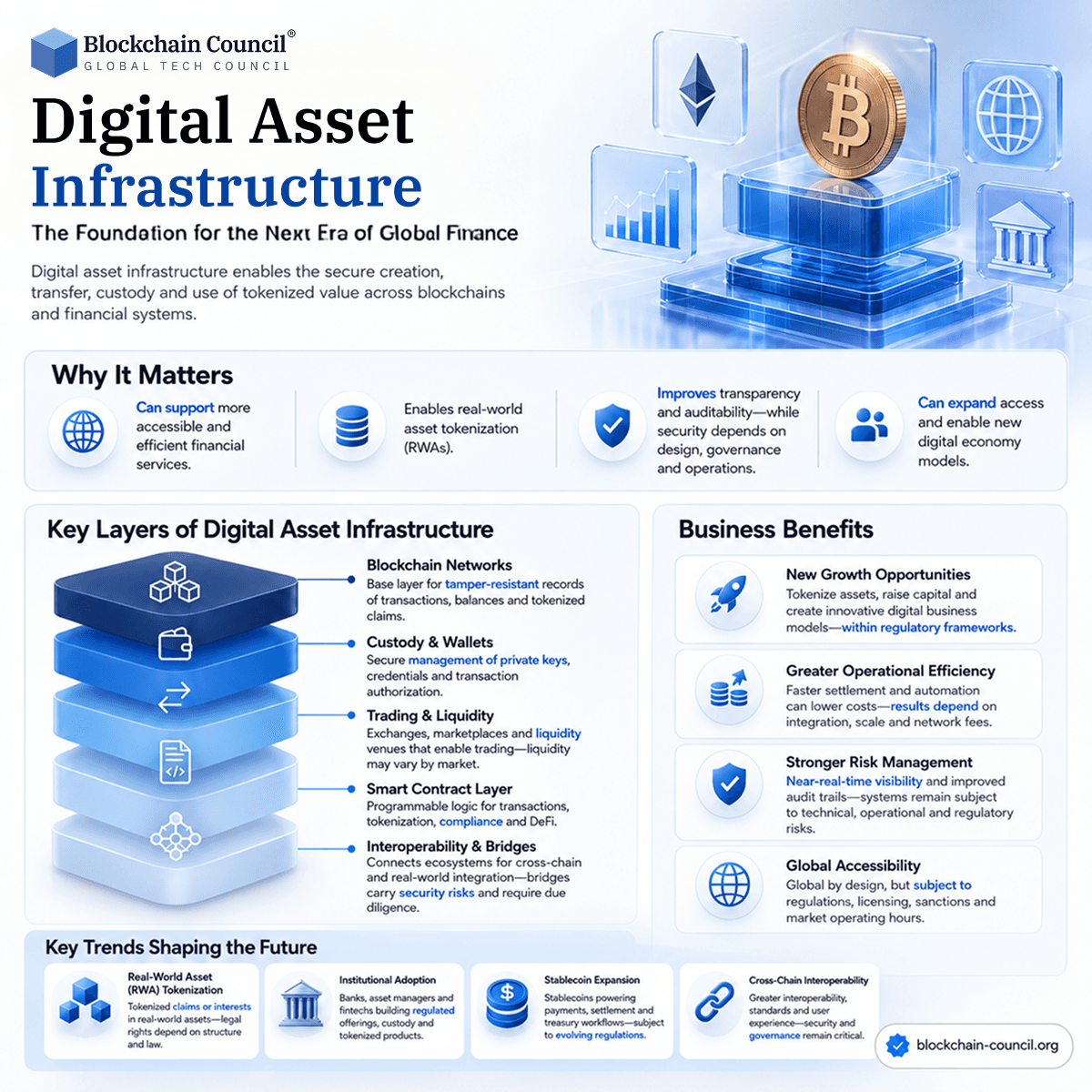
As blockchain technology continues to reshape financial services, digital commerce, and asset ownership, the need for reliable infrastructure has become increasingly important. While cryptocurrencies often receive the most attention, the systems that enable digital assets to be created, transferred, secured, and managed are what truly power the digital economy. Collectively, these systems are known as digital asset infrastructure.
From blockchain networks and digital wallets to custody solutions, smart contracts, exchanges, and interoperability protocols, digital asset infrastructure provides the foundation for secure and efficient digital asset ecosystems. As businesses, governments, and financial institutions embrace tokenization and decentralized technologies, understanding this infrastructure has become essential for blockchain professionals and technology leaders.

What Is Digital Asset Infrastructure?
Digital asset infrastructure refers to the technologies, platforms, protocols, and services that support the lifecycle of digital assets. It enables organizations and individuals to issue, store, transfer, trade, secure, and manage blockchain-based assets across multiple networks.
This infrastructure supports a wide range of digital assets, including cryptocurrencies, stablecoins, tokenized real-world assets (RWAs), non-fungible tokens (NFTs), central bank digital currencies (CBDCs), and other blockchain-based financial instruments.
Without robust infrastructure, blockchain ecosystems would lack the security, scalability, and interoperability required for widespread adoption.
Why Digital Asset Infrastructure Matters
Digital asset infrastructure is transforming how value moves across the global economy. It enables faster transactions, increased transparency, improved security, and greater financial accessibility.
Some of its most significant advantages include:
Supporting more efficient and accessible financial services
Enabling tokenization of real-world assets
Improving transparency through blockchain-based records
Expanding financial inclusion across global markets
Building trust through secure digital ownership
Supporting innovation across Web3, decentralized finance (DeFi), and enterprise blockchain
As organizations digitize financial products and services, infrastructure becomes the foundation that enables secure and scalable blockchain adoption.
Key Layers of Digital Asset Infrastructure
Digital asset infrastructure consists of several interconnected layers that work together to create a complete blockchain ecosystem.
Blockchain Networks
Blockchain networks form the foundational layer of digital asset infrastructure. They maintain distributed ledgers that record transactions, balances, and ownership while ensuring transparency and immutability through consensus mechanisms.
Popular blockchain networks include Ethereum, Solana, Bitcoin, Polygon, Avalanche, and enterprise platforms such as Hyperledger Fabric.
Custody and Digital Wallets
Custody solutions and digital wallets securely manage private keys, authorize transactions, and protect digital assets.
Organizations may use institutional custody platforms, while individuals typically choose between hardware wallets, software wallets, or multi-signature solutions depending on their security requirements.
Trading and Liquidity Infrastructure
Digital asset exchanges, brokers, liquidity providers, and market makers facilitate efficient trading and price discovery across cryptocurrency markets.
High liquidity improves trading efficiency and supports healthy digital asset ecosystems.
Smart Contract Layer
Smart contracts automate transactions and business logic without intermediaries. They enable decentralized finance applications, NFT marketplaces, token issuance, decentralized exchanges, and numerous Web3 services.
Programmable smart contracts continue expanding the capabilities of blockchain technology beyond simple asset transfers.
Interoperability and Cross-Chain Connectivity
Modern blockchain ecosystems increasingly require communication between different networks.
Cross-chain bridges and interoperability protocols enable assets and information to move across multiple blockchain ecosystems, supporting broader adoption while introducing additional security considerations.
Business Benefits of Digital Asset Infrastructure
Organizations across industries are investing in digital asset infrastructure because it provides measurable operational and strategic advantages.
New Business Opportunities
Businesses can tokenize assets, create innovative financial products, improve capital formation, and participate in decentralized markets while expanding customer offerings.
Greater Operational Efficiency
Blockchain-based infrastructure reduces settlement times, automates workflows through smart contracts, and minimizes manual reconciliation processes.
Enhanced Transparency
Distributed ledgers create immutable transaction records that improve auditability and operational visibility across organizations.
Improved Risk Management
Near real-time transaction visibility, automated compliance processes, and blockchain-based audit trails strengthen governance and operational oversight.
Global Accessibility
Digital asset infrastructure enables organizations to serve international markets with blockchain-based financial services while supporting cross-border transactions more efficiently.
Emerging Trends Shaping Digital Asset Infrastructure
Digital asset infrastructure continues evolving rapidly as blockchain adoption accelerates worldwide.
Real-World Asset Tokenization
Traditional assets such as real estate, bonds, commodities, and private equity are increasingly being tokenized, enabling fractional ownership and improved liquidity.
Institutional Adoption
Banks, investment firms, payment providers, and fintech companies continue expanding blockchain services, custody solutions, and tokenized financial products.
Stablecoin Growth
Stablecoins have become critical components of blockchain payments, settlements, treasury management, and decentralized finance applications.
Cross-Chain Ecosystems
Interoperability technologies continue improving communication between independent blockchain networks, supporting more connected digital ecosystems.
Enterprise Blockchain Integration
Organizations are increasingly integrating blockchain infrastructure into supply chains, identity management, healthcare systems, and financial services.
Strengthen Your Digital Asset Expertise
Understanding digital asset infrastructure provides valuable insight into how blockchain ecosystems operate, but mastering this field requires knowledge across multiple interconnected domains. Professionals should understand blockchain architecture, digital assets, tokenization, wallets, exchanges, decentralized finance (DeFi), NFTs, smart contracts, security, and enterprise blockchain applications.
The Certified Digital Assets Expert™ by Blockchain Council is designed to provide this comprehensive understanding. Through structured learning, the certification covers blockchain fundamentals, digital assets, wallet management, tokenization, exchange operations, decentralized finance, NFTs, blockchain security, and practical industry use cases. This progression helps learners connect technical concepts with real-world applications across the rapidly evolving digital asset ecosystem.
Learning Journey
Blockchain Fundamentals – Understand distributed ledger technology, consensus mechanisms, and blockchain architecture.
Digital Assets & Wallets – Learn how digital assets are created, stored, secured, and managed.
Digital Asset Infrastructure – Explore blockchain networks, custody solutions, exchanges, liquidity, smart contracts, and interoperability.
Certified Digital Assets Expert™ – Build practical expertise across tokenization, DeFi, NFTs, blockchain security, and digital asset ecosystems.
Advanced Web3 & Enterprise Blockchain – Expand into enterprise adoption, AI integration, blockchain governance, and next-generation decentralized technologies.
Conclusion
Digital asset infrastructure is becoming the backbone of the modern digital economy. From blockchain networks and digital wallets to custody platforms, smart contracts, and cross-chain interoperability, these technologies enable secure, transparent, and scalable digital financial systems.
As tokenization, decentralized finance, and enterprise blockchain adoption continue to grow, professionals who understand digital asset infrastructure will be well positioned to contribute to the next generation of financial innovation. Building expertise in these foundational technologies is an important step toward succeeding in the rapidly evolving world of blockchain and digital assets.
Frequently Asked Questions (FAQs)
1. What is digital asset infrastructure?
Digital asset infrastructure refers to the technologies, platforms, and services that enable the creation, storage, transfer, trading, and management of blockchain-based assets. It includes blockchain networks, digital wallets, custody solutions, exchanges, smart contracts, and interoperability protocols that support the digital economy.
2. Why is digital asset infrastructure important?
Digital asset infrastructure provides the foundation for secure, transparent, and efficient digital financial systems. It enables businesses and individuals to manage digital assets, process transactions, support tokenization, and build decentralized applications while ensuring reliability and scalability.
3. What are the main components of digital asset infrastructure?
The core components include blockchain networks, digital wallets, custody solutions, trading platforms, liquidity providers, smart contract platforms, interoperability protocols, and security systems. Together, these technologies create a complete ecosystem for managing digital assets.
4. How do blockchain networks support digital asset infrastructure?
Blockchain networks serve as the foundational layer by maintaining decentralized ledgers that record transactions, ownership, and balances. They provide transparency, immutability, and security while enabling the execution of smart contracts and decentralized applications.
5. What role do digital wallets play in digital asset infrastructure?
Digital wallets securely store private keys and allow users to send, receive, and manage cryptocurrencies and other digital assets. They act as the primary interface between users and blockchain networks while ensuring ownership and transaction authorization.
6. What is digital asset custody?
Digital asset custody refers to the secure storage and management of digital assets and private keys. Custody solutions can be self-managed by users or provided by specialized institutions that offer enterprise-grade security, compliance, and asset protection.
7. Why are cryptocurrency exchanges considered part of digital asset infrastructure?
Digital asset exchanges provide the marketplace where users can buy, sell, and trade cryptocurrencies and tokenized assets. They contribute to liquidity, price discovery, and accessibility, making them an essential component of the broader blockchain ecosystem.
8. What is the importance of liquidity in digital asset markets?
Liquidity ensures that digital assets can be bought or sold efficiently without causing significant price fluctuations. High liquidity improves market stability, reduces trading costs, and enables smoother transactions for both retail and institutional participants.
9. How do smart contracts contribute to digital asset infrastructure?
Smart contracts automate agreements and transactions without requiring intermediaries. They power decentralized finance (DeFi), NFT marketplaces, token issuance, decentralized exchanges, and many other blockchain-based applications by executing predefined rules automatically.
10. What is interoperability in blockchain infrastructure?
Interoperability enables different blockchain networks to communicate and exchange data or assets. Cross-chain technologies and interoperability protocols allow users and organizations to interact across multiple blockchain ecosystems without being limited to a single network.
11. What are real-world asset (RWA) tokenization platforms?
Real-world asset tokenization platforms convert physical or traditional financial assets, such as real estate, commodities, bonds, or artwork, into blockchain-based digital tokens. This process can improve liquidity, accessibility, and investment opportunities.
12. How does digital asset infrastructure improve business operations?
Businesses benefit from faster settlements, automated workflows, greater transparency, reduced operational costs, enhanced auditability, improved security, and new opportunities for digital financial products through blockchain-based infrastructure.
13. Which industries are adopting digital asset infrastructure?
Financial services, banking, insurance, healthcare, supply chain management, logistics, real estate, gaming, government organizations, and asset management firms are increasingly integrating digital asset infrastructure into their operations.
14. What security measures are important in digital asset infrastructure?
Strong infrastructure relies on secure wallet management, private key protection, encryption, multi-factor authentication (MFA), hardware security modules (HSMs), smart contract auditing, regular software updates, and continuous monitoring against cyber threats.
15. What challenges does digital asset infrastructure face?
Key challenges include regulatory compliance, scalability, interoperability, cybersecurity risks, cross-chain security, evolving standards, governance complexities, and balancing decentralization with enterprise requirements.
16. How is digital asset infrastructure supporting the future of finance?
Digital asset infrastructure enables tokenized financial products, decentralized finance (DeFi), programmable payments, digital identity, cross-border settlements, and more efficient financial services, making it a key driver of financial innovation.
17. How does the Certified Digital Assets Expert™ certification help professionals understand digital asset infrastructure?
The Certified Digital Assets Expert™ by Blockchain Council provides comprehensive training on blockchain fundamentals, digital assets, wallets, exchanges, tokenization, decentralized finance (DeFi), NFTs, blockchain security, and real-world infrastructure use cases. It helps learners understand how the different layers of digital asset infrastructure work together to support modern blockchain ecosystems.
18. Who should learn about digital asset infrastructure?
Digital asset infrastructure is valuable for blockchain developers, financial professionals, enterprise architects, technology consultants, cybersecurity specialists, compliance professionals, Web3 entrepreneurs, investors, and anyone interested in blockchain innovation.
19. What career opportunities are available for professionals with digital asset infrastructure expertise?
Professionals with expertise in digital asset infrastructure can pursue careers as Blockchain Developers, Digital Asset Consultants, Blockchain Solution Architects, Web3 Engineers, Enterprise Blockchain Specialists, Crypto Infrastructure Analysts, Blockchain Product Managers, Digital Asset Risk Analysts, and DeFi Solutions Consultants.
20. Why is continuous learning important in digital asset infrastructure?
Digital asset infrastructure continues to evolve with advancements in blockchain technology, tokenization, interoperability, decentralized finance, and regulatory frameworks. Continuous learning helps professionals stay current with emerging technologies, industry best practices, and new business applications, enabling them to remain competitive in the rapidly growing digital asset ecosystem.
Related Articles
View All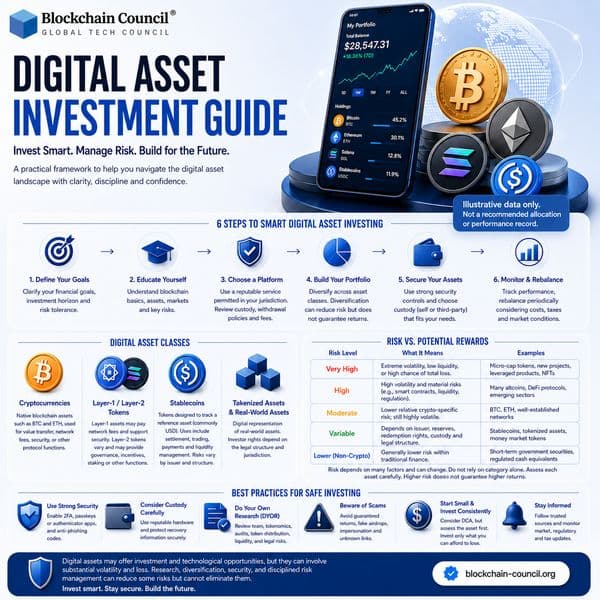
Infographics
Digital Asset Investment Guide: Build a Smarter Strategy for the Future of Finance
Digital asset investing has become a key part of the modern financial landscape, offering opportunities in cryptocurrencies, tokenized assets, NFTs, and blockchain-based investments. Whether you're a beginner or an experienced investor, understanding market fundamentals, diversification, security, and risk management is essential for building a successful digital asset portfolio. This guide explores the core concepts, investment strategies, and best practices for navigating the digital asset market.
Infographics
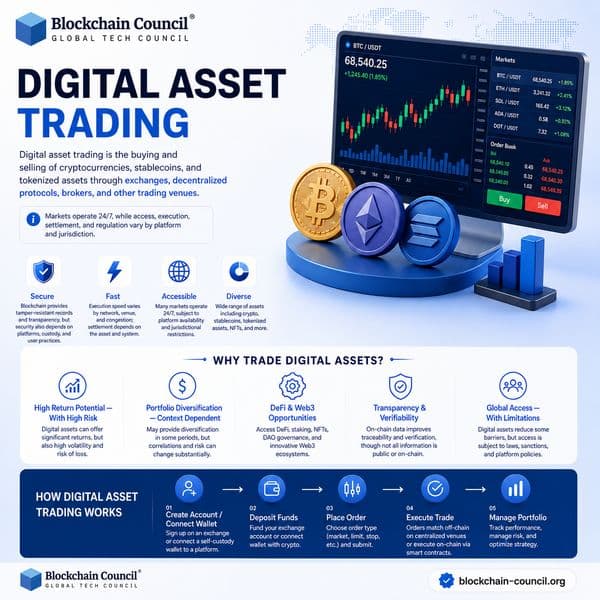
Digital Asset Trading: A Complete Guide to Trading in the Digital Economy
Digital asset trading involves buying, selling, and exchanging cryptocurrencies, tokenized assets, NFTs, and other blockchain-based assets through centralized and decentralized trading platforms. As the digital economy expands, traders rely on market analysis, risk management, and advanced trading tools to navigate volatile markets. This guide explains the fundamentals of digital asset trading, key strategies, security considerations, and emerging trends shaping the future of digital finance.
Infographics
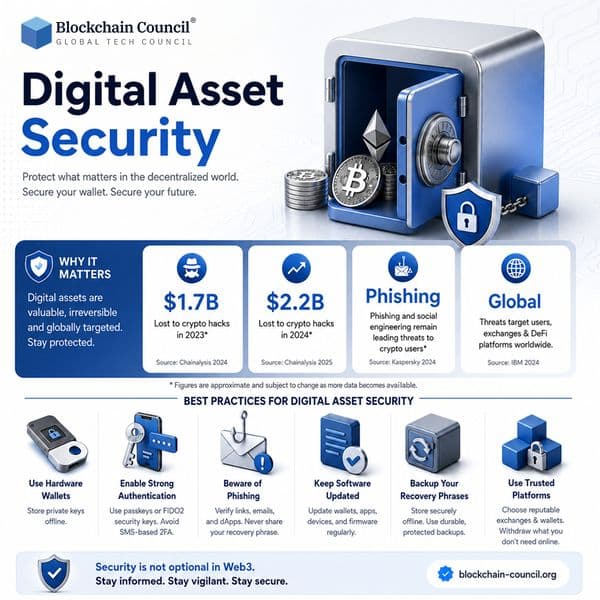
Digital Asset Security: Protecting Your Assets in the Decentralized World
As digital assets become increasingly valuable, securing them is more important than ever. From cryptocurrencies and NFTs to tokenized assets, effective security measures such as private key management, multi-factor authentication, hardware wallets, and threat awareness help safeguard investments in the decentralized world. This guide explores essential digital asset security practices, common risks, and strategies for protecting blockchain-based assets.
Trending Articles
The Role of Blockchain in Ethical AI Development
How blockchain technology is being used to promote transparency and accountability in artificial intelligence systems.
Claude AI Tools for Productivity
Discover Claude AI tools for productivity to streamline tasks, manage workflows, and improve efficiency.
Blockchain in Supply Chain Provenance Tracking
Supply chains are under pressure to prove not just efficiency, but also authenticity, sustainability, and fairness. Customers want to know if their coffee really is fair trade, if the diamonds are con