

Digital Asset Trading: A Complete Guide to Trading in the Digital Economy

Digital asset trading has become one of the fastest-growing segments of the global financial market. With the rise of cryptocurrencies, stablecoins, tokenized assets, and decentralized finance (DeFi), millions of individuals and institutions now participate in blockchain-powered markets that operate around the clock.
Unlike traditional financial markets that follow fixed trading hours, digital asset markets are accessible 24/7, offering continuous opportunities to buy, sell, and manage digital assets. However, successful trading requires more than simply purchasing cryptocurrencies. It involves understanding trading platforms, market dynamics, risk management, security, and blockchain technology.

Whether you're a beginner exploring cryptocurrency trading or a professional looking to deepen your blockchain expertise, understanding digital asset trading is essential in today's evolving digital economy.
What Is Digital Asset Trading?
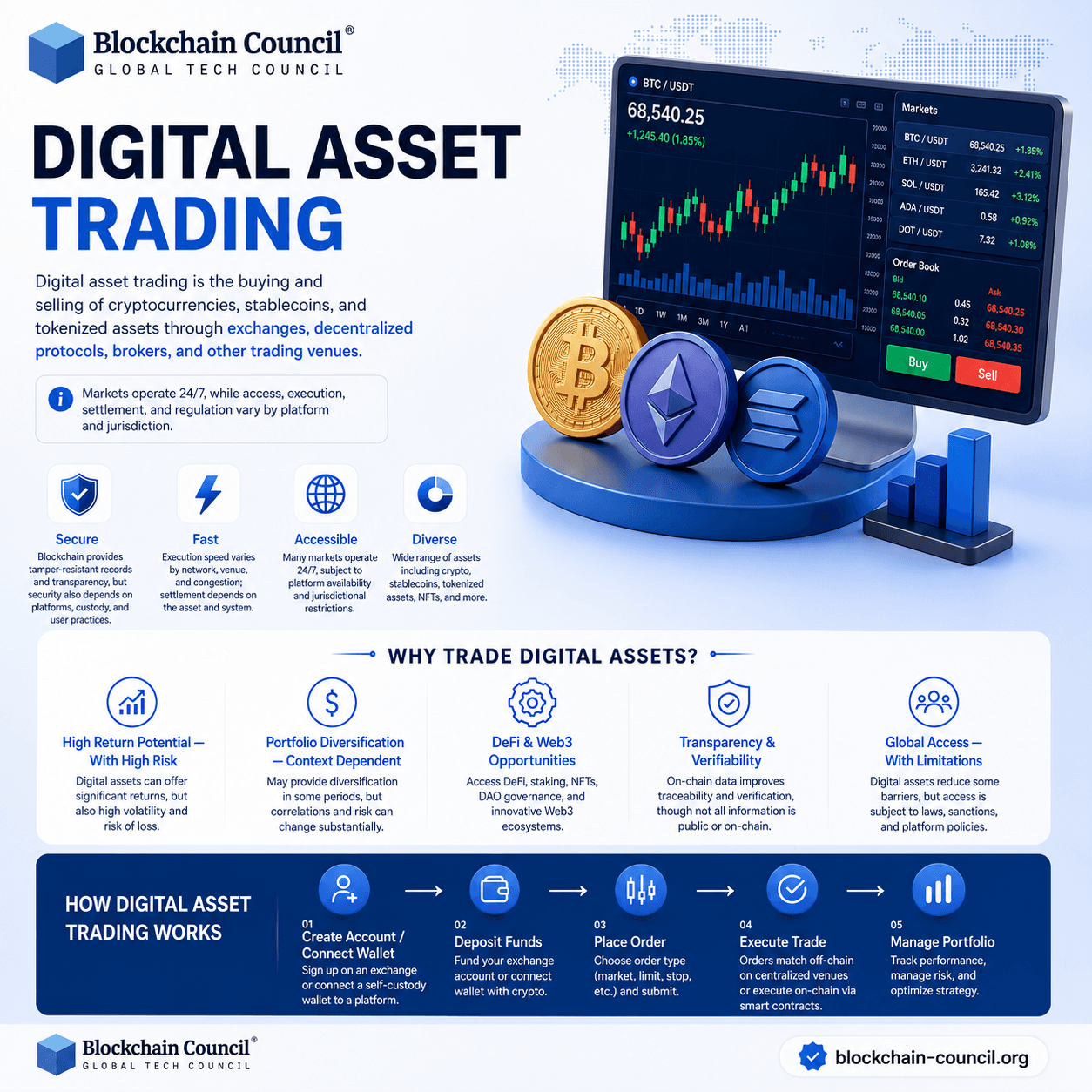
Digital asset trading refers to the buying, selling, and exchanging of blockchain-based assets through cryptocurrency exchanges, decentralized exchanges (DEXs), brokers, and other digital trading platforms.
Digital assets commonly traded include:
Cryptocurrencies such as Bitcoin and Ethereum
Stablecoins
Utility and governance tokens
Tokenized real-world assets (RWAs)
Non-Fungible Tokens (NFTs)
Security tokens
Digital asset markets use blockchain technology to facilitate secure and transparent ownership while allowing participants to trade globally.
Key Characteristics of Digital Asset Trading
Digital asset trading offers several unique advantages compared to traditional financial markets.
Secure Transactions
Blockchain technology records transactions on distributed ledgers, improving transparency and reducing the risk of unauthorized modifications. However, overall security also depends on the trading platform and the user's security practices.
Fast Market Access
Many blockchain networks enable transactions within minutes or even seconds. Trade execution speed depends on the blockchain network, liquidity, congestion, and the exchange being used.
Global Accessibility
Digital asset markets operate across multiple countries and are generally available 24 hours a day. However, access may vary depending on regional regulations and exchange availability.
Wide Range of Assets
Modern trading platforms support hundreds or even thousands of cryptocurrencies, stablecoins, NFTs, and tokenized assets, providing investors with diverse trading opportunities.
Why Do People Trade Digital Assets?
Digital asset trading attracts investors, institutions, and businesses for several reasons.
Portfolio Diversification
Digital assets can provide diversification by introducing exposure to blockchain-based markets alongside traditional investments.
Market Opportunities
Digital assets are known for significant price movements, creating opportunities for both short-term traders and long-term investors. However, higher potential returns often come with increased market volatility and risk.
Participation in Web3
Owning digital assets enables participation in decentralized finance (DeFi), staking, governance voting, NFTs, decentralized autonomous organizations (DAOs), and blockchain-based applications.
Transparency
Blockchain technology provides publicly verifiable transaction records, improving transparency compared to many traditional financial systems.
Global Financial Innovation
Digital asset trading enables cross-border participation in financial markets without relying entirely on conventional banking infrastructure.
How Digital Asset Trading Works
The trading process generally follows several key steps.
Step 1: Create an Account or Connect a Wallet
Users register with a centralized exchange or connect a self-custody wallet to a decentralized trading platform.
Step 2: Deposit Funds
Funds can be added using bank transfers, debit cards, credit cards, or cryptocurrency transfers from another wallet.
Step 3: Place a Trade
Users choose an asset, determine the quantity, and submit a market order, limit order, stop order, or another supported trading order.
Step 4: Execute the Transaction
Trades are executed either through centralized exchange matching engines or via blockchain smart contracts on decentralized exchanges.
Step 5: Manage Your Portfolio
After execution, traders monitor portfolio performance, rebalance investments, manage risks, and evaluate future opportunities.
Risks of Digital Asset Trading
Although digital asset trading offers exciting opportunities, understanding the associated risks is essential.
Market Volatility
Cryptocurrency prices can fluctuate significantly within short periods, creating both profit opportunities and substantial risks.
Regulatory Changes
Digital asset regulations continue evolving across different jurisdictions, potentially affecting market access and trading practices.
Cybersecurity Threats
Phishing attacks, exchange breaches, malware, and compromised wallets remain significant security concerns for traders.
Liquidity Risks
Some digital assets have limited trading volume, making it difficult to execute large transactions without affecting market prices.
Emotional Decision-Making
Fear of missing out (FOMO) and panic selling can negatively impact trading performance. Successful traders rely on disciplined strategies rather than emotions.
Best Practices for Successful Digital Asset Trading
To improve long-term success, traders should follow established best practices.
Research every asset before investing.
Diversify across multiple digital assets.
Never invest more than you can afford to lose.
Use trusted exchanges and wallets.
Enable multi-factor authentication (MFA).
Secure private keys and recovery phrases.
Monitor market news and regulatory developments.
Develop a disciplined trading strategy.
Regularly review portfolio performance.
Continue learning as blockchain technology evolves.
Strengthen Your Digital Asset Trading Knowledge
Learning how to trade digital assets is only one aspect of succeeding in the blockchain industry. Professionals also benefit from understanding blockchain fundamentals, digital wallets, tokenization, exchange infrastructure, decentralized finance (DeFi), NFTs, blockchain security, and market dynamics.
The Certified Digital Assets Expert™ by Blockchain Council provides a structured learning journey covering these essential concepts. The certification begins with blockchain fundamentals before exploring digital assets, wallets, exchanges, trading ecosystems, tokenization, decentralized finance, NFTs, blockchain security, and practical industry applications. This comprehensive approach helps learners understand not only how digital assets are traded but also how the underlying blockchain ecosystem functions.
Learning Journey
Blockchain Fundamentals – Learn distributed ledger technology, consensus mechanisms, and smart contracts.
Digital Assets & Wallets – Understand cryptocurrencies, tokenization, wallet management, and digital ownership.
Digital Asset Trading – Explore exchanges, trading strategies, liquidity, market structure, and risk management.
Certified Digital Assets Expert™ – Build expertise in digital assets, DeFi, NFTs, blockchain security, and real-world blockchain applications.
Advanced Web3 & Blockchain Finance – Expand your knowledge into enterprise blockchain, tokenized finance, AI integration, and emerging Web3 innovations.
Conclusion
Digital asset trading has become an integral part of the modern financial landscape, providing individuals and organizations with access to innovative blockchain-powered markets. While opportunities continue to grow, successful trading requires more than market participation—it demands a solid understanding of blockchain technology, risk management, security, and evolving digital asset ecosystems.
By continuously building knowledge and adopting responsible trading practices, professionals can confidently navigate digital asset markets while preparing for future opportunities in blockchain, Web3, and digital finance.
Frequently Asked Questions (FAQs)
1. What is digital asset trading?
Digital asset trading is the process of buying, selling, and exchanging blockchain-based assets such as cryptocurrencies, stablecoins, NFTs, and tokenized assets through centralized exchanges, decentralized exchanges (DEXs), brokers, and other trading platforms.
2. How is digital asset trading different from traditional stock trading?
Unlike traditional stock markets, digital asset markets typically operate 24/7 and include blockchain-based assets rather than company shares. Digital asset trading also involves decentralized technologies, digital wallets, and blockchain networks.
3. What types of digital assets can be traded?
Common digital assets include cryptocurrencies, stablecoins, utility tokens, governance tokens, security tokens, tokenized real-world assets (RWAs), and non-fungible tokens (NFTs).
4. Where can digital assets be traded?
Digital assets can be traded on centralized cryptocurrency exchanges, decentralized exchanges (DEXs), peer-to-peer (P2P) marketplaces, brokerage platforms, and institutional trading platforms.
5. What is the difference between centralized and decentralized exchanges?
Centralized exchanges are operated by companies that manage user accounts and execute trades, while decentralized exchanges use smart contracts to enable peer-to-peer trading without intermediaries, allowing users to retain control of their assets.
6. How do I start trading digital assets?
To begin trading, users typically create an account with a cryptocurrency exchange or connect a self-custody wallet to a decentralized platform, deposit funds, choose a digital asset, and place buy or sell orders.
7. What is a market order?
A market order executes immediately at the best available market price. It prioritizes speed of execution rather than guaranteeing a specific purchase or selling price.
8. What is a limit order?
A limit order allows traders to specify the exact price at which they want to buy or sell a digital asset. The trade executes only if the market reaches that price.
9. Why are digital asset markets so volatile?
Digital asset markets are influenced by market demand, investor sentiment, regulations, technological developments, macroeconomic events, liquidity, and global news, leading to higher price fluctuations compared to many traditional assets.
10. What are the biggest risks associated with digital asset trading?
Major risks include market volatility, cybersecurity threats, phishing attacks, exchange failures, regulatory uncertainty, liquidity challenges, and emotional trading decisions.
11. How can traders manage risk effectively?
Risk management strategies include diversifying investments, using stop-loss orders, researching projects before investing, avoiding overleveraging, maintaining realistic expectations, and never investing more than one can afford to lose.
12. Why is blockchain technology important for digital asset trading?
Blockchain provides transparent, immutable transaction records and enables secure ownership verification without relying entirely on centralized intermediaries.
13. What security measures should traders follow?
Traders should enable multi-factor authentication (MFA), use hardware wallets for long-term storage, protect private keys and recovery phrases, verify websites before logging in, and regularly update wallet software.
14. Can institutions participate in digital asset trading?
Yes. Banks, hedge funds, asset managers, fintech companies, payment providers, and corporations increasingly participate in digital asset markets through institutional trading platforms and regulated custody solutions.
15. Why is liquidity important in digital asset trading?
Liquidity determines how easily assets can be bought or sold without causing significant price changes. High liquidity generally results in faster execution and more stable pricing.
16. What skills are important for successful digital asset trading?
Successful traders benefit from understanding blockchain technology, market analysis, risk management, trading strategies, tokenomics, wallet security, decentralized finance (DeFi), and cryptocurrency regulations.
17. How does the Certified Digital Assets Expert™ certification support digital asset trading knowledge?
The Certified Digital Assets Expert™ by Blockchain Council provides structured learning on blockchain fundamentals, digital assets, wallets, exchanges, tokenization, decentralized finance (DeFi), NFTs, blockchain security, and real-world digital asset applications. It helps learners understand both the technical and practical aspects of digital asset trading.
18. Who should learn digital asset trading?
Digital asset trading knowledge is valuable for investors, blockchain professionals, financial analysts, Web3 developers, fintech professionals, entrepreneurs, technology consultants, and anyone interested in blockchain-based financial markets.
19. What career opportunities are available in digital asset trading?
Professionals with digital asset trading expertise can pursue careers as Cryptocurrency Traders, Digital Asset Analysts, Blockchain Consultants, DeFi Specialists, Crypto Researchers, Web3 Product Managers, Digital Asset Portfolio Managers, and Blockchain Investment Advisors.
20. Why is continuous learning important for digital asset traders?
The blockchain industry evolves rapidly with new technologies, market trends, trading platforms, regulations, and financial products. Continuous learning helps traders make informed decisions, adapt to market changes, and build long-term expertise in digital assets and Web3.
Related Articles
View All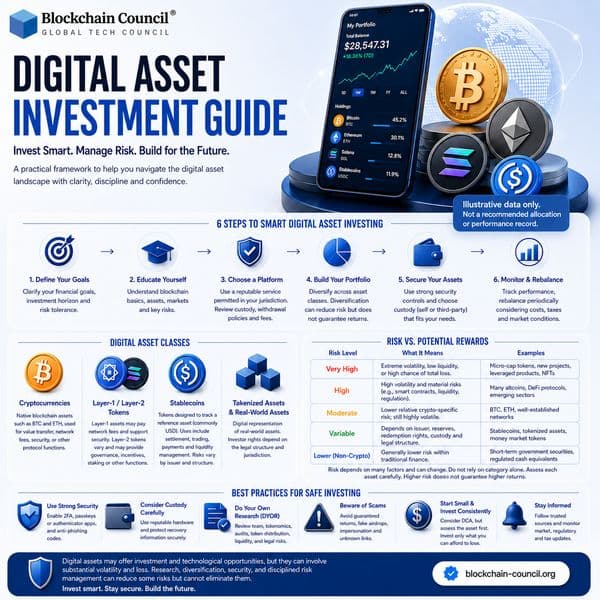
Infographics
Digital Asset Investment Guide: Build a Smarter Strategy for the Future of Finance
Digital asset investing has become a key part of the modern financial landscape, offering opportunities in cryptocurrencies, tokenized assets, NFTs, and blockchain-based investments. Whether you're a beginner or an experienced investor, understanding market fundamentals, diversification, security, and risk management is essential for building a successful digital asset portfolio. This guide explores the core concepts, investment strategies, and best practices for navigating the digital asset market.
Infographics
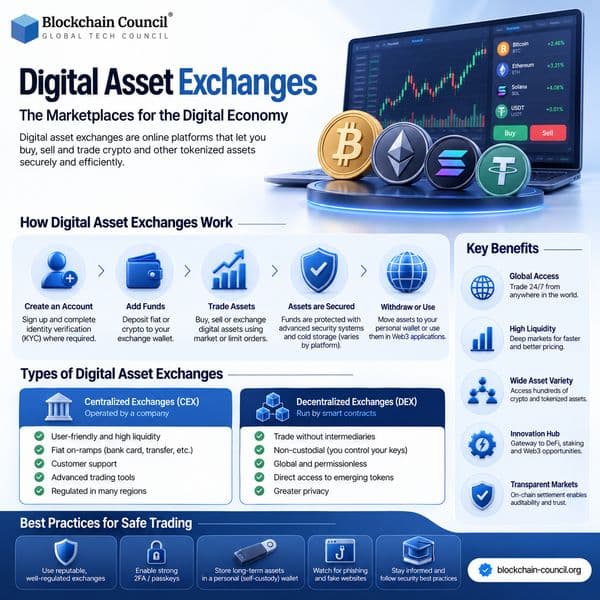
Digital Asset Exchanges: Understanding the Gateways to the Digital Economy
Digital asset exchanges are online platforms that enable users to buy, sell, trade, and manage cryptocurrencies and other tokenized assets. They serve as essential gateways to the digital economy by providing liquidity, secure transactions, and access to blockchain-based financial ecosystems. This guide explores how digital asset exchanges work, the different types available, their benefits, security considerations, and their impact on the future of digital finance.
Infographics
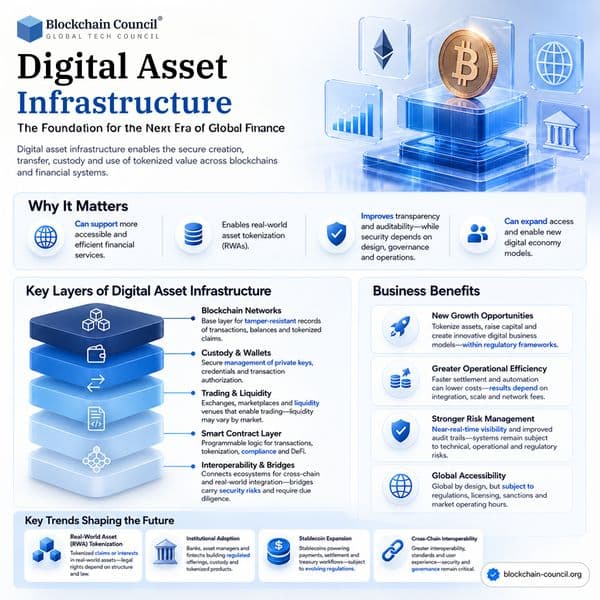
Digital Asset Infrastructure: The Foundation of the Next Era of Global Finance
Digital asset infrastructure is the technology backbone that enables the creation, storage, transfer, trading, and management of cryptocurrencies, tokenized assets, and other blockchain-based digital assets. It includes blockchain networks, digital wallets, custody solutions, exchanges, smart contracts, and security protocols. This guide explores the key components of digital asset infrastructure and their role in supporting the rapidly evolving Web3 and digital finance ecosystem.
Trending Articles
How Blockchain Secures AI Data
Understand how blockchain technology is being applied to protect the integrity and security of AI training data.
What is AWS? A Beginner's Guide to Cloud Computing
Everything you need to know about Amazon Web Services, cloud computing fundamentals, and career opportunities.

Can DeFi 2.0 Bridge the Gap Between Traditional and Decentralized Finance?
The next generation of DeFi protocols aims to connect traditional banking with decentralized finance ecosystems.