

Digital Asset Exchanges: Understanding the Gateways to the Digital Economy
 Suyash Raizada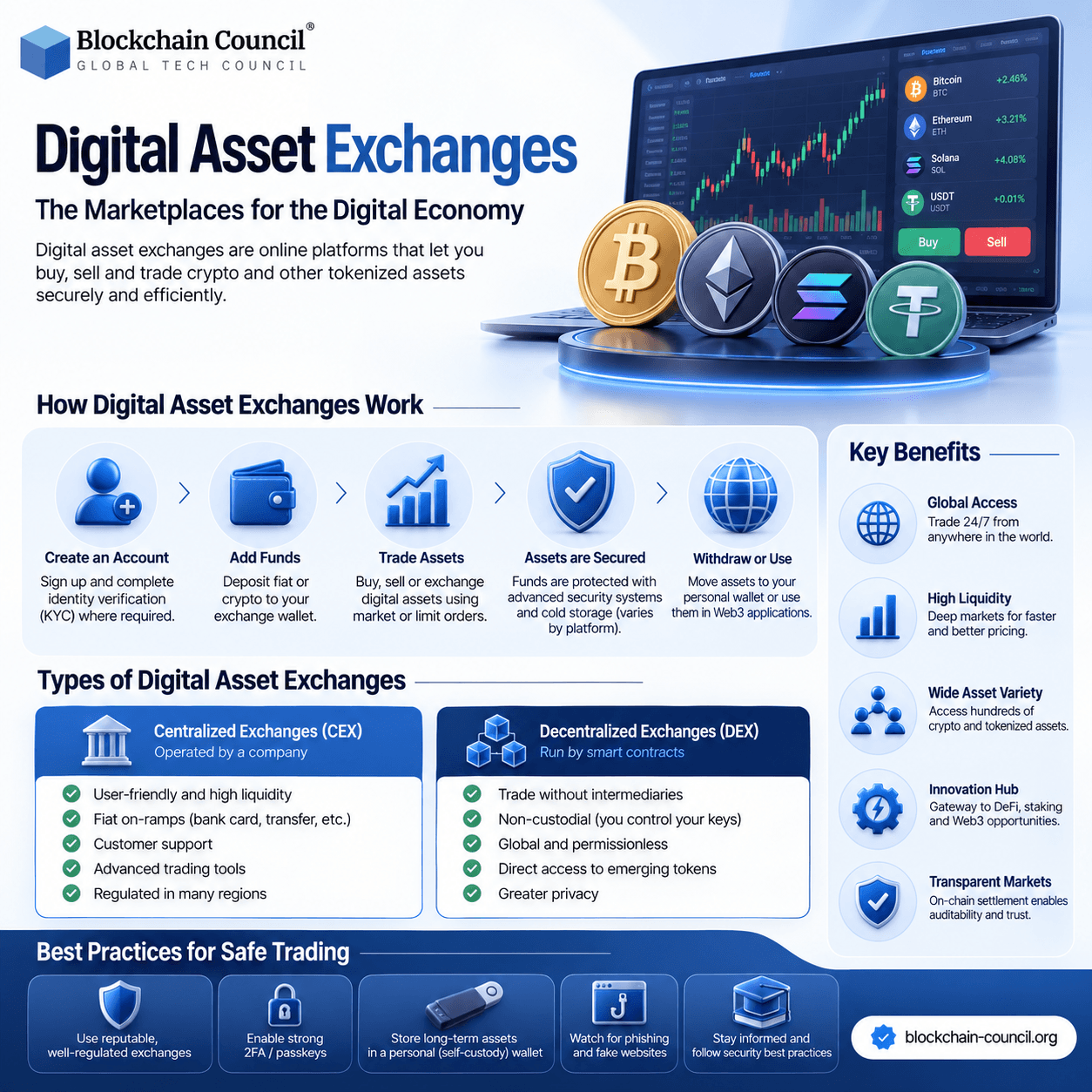
The digital asset ecosystem has grown rapidly over the past decade, transforming the way people invest, trade, and manage value online. From cryptocurrencies and tokenized assets to decentralized finance (DeFi) and Web3 applications, blockchain technology is driving a new era of digital innovation. At the center of this ecosystem are digital asset exchanges-platforms that enable users to buy, sell, and exchange blockchain-based assets securely and efficiently.
Whether you're purchasing Bitcoin for the first time, trading Ethereum, or exploring decentralized applications, digital asset exchanges serve as the primary gateway into the blockchain economy. Understanding how these platforms operate is essential for investors, traders, developers, and professionals looking to build expertise in digital assets.

What Is a Digital Asset Exchange?
A digital asset exchange is an online platform that allows users to trade cryptocurrencies and other blockchain-based digital assets. These platforms connect buyers and sellers, facilitate transactions, and often provide additional services such as digital wallets, portfolio management, staking, and market analytics.
As blockchain adoption continues to grow, digital asset exchanges play a crucial role in making blockchain technology accessible to individuals and businesses around the world.
How Digital Asset Exchanges Work
Although every exchange has its own features, the overall process is generally similar.
Create an Account
Users begin by registering on the platform. Many centralized exchanges require identity verification through Know Your Customer (KYC) procedures to comply with regulatory requirements.
Deposit Funds
Users can add funds using bank transfers, debit or credit cards, or by transferring cryptocurrency from another wallet.
Buy, Sell, or Trade Assets
Once funds are available, users can purchase, sell, or exchange digital assets using market orders, limit orders, or other trading options offered by the platform.
Secure Digital Assets
Most reputable exchanges protect customer funds through encryption, cold storage, multi-factor authentication (MFA), and other security measures designed to safeguard digital assets.
Withdraw or Utilize Assets
Users may keep their assets on the exchange, transfer them to private wallets for greater control, or use them within decentralized finance platforms, NFT marketplaces, and other Web3 applications.
Types of Digital Asset Exchanges
Digital asset exchanges generally fall into two categories.
Centralized Exchanges (CEX)
Centralized exchanges are operated by organizations that manage user accounts, provide liquidity, and facilitate transactions between buyers and sellers. They typically offer user-friendly interfaces and customer support, making them suitable for beginners and experienced traders alike.
Key Benefits
High liquidity
Easy onboarding process
Fiat currency support
Advanced trading tools
Customer support
Regulatory compliance in many jurisdictions
Decentralized Exchanges (DEX)
Decentralized exchanges use blockchain-based smart contracts to enable peer-to-peer trading without relying on a centralized intermediary. Users retain control of their private keys throughout the trading process.
Key Benefits
Non-custodial trading
Greater privacy
Permissionless access
Direct wallet connectivity
Reduced reliance on intermediaries
Access to emerging blockchain projects
Why Digital Asset Exchanges Matter
Digital asset exchanges are far more than trading platforms. They help drive blockchain adoption by providing:
Access to global cryptocurrency markets
Liquidity for digital assets
Secure trading infrastructure
Integration with decentralized finance (DeFi)
Support for tokenized assets and NFTs
Opportunities for investment and portfolio diversification
As blockchain technology continues to evolve, exchanges remain an essential component of the digital economy.
Best Practices for Safe Trading
While digital asset exchanges continue to strengthen their security infrastructure, users should also adopt responsible security practices.
Use trusted and reputable exchanges.
Enable multi-factor authentication (MFA).
Store long-term holdings in secure hardware wallets.
Keep recovery phrases and private keys offline.
Verify websites before logging in.
Stay informed about phishing attacks and online scams.
Regularly update passwords and security settings.
Following these practices can significantly reduce security risks and help protect digital assets.
Strengthen Your Digital Asset Expertise
Understanding digital asset exchanges is an excellent starting point, but they represent only one part of a much broader blockchain ecosystem. To build practical expertise, professionals should also understand blockchain fundamentals, cryptocurrencies, tokenization, digital wallets, NFTs, decentralized finance (DeFi), blockchain security, and emerging Web3 applications.
The Certified Digital Assets Expert™ by Blockchain Council is designed to help learners develop this comprehensive understanding through a structured learning journey. The certification begins with blockchain and digital asset fundamentals before progressing to wallet management, tokenization, exchange operations, decentralized finance, NFTs, digital asset security, and real-world industry applications. This progression helps learners connect foundational concepts with practical use cases across today's digital economy.
Whether you're a blockchain professional, finance expert, developer, investor, or someone exploring opportunities in Web3, this certification provides the knowledge needed to confidently navigate the evolving digital asset landscape.
Learning Journey
Blockchain Fundamentals - Understand distributed ledger technology, consensus mechanisms, and smart contracts.
Digital Assets & Wallets - Learn about cryptocurrencies, tokenization, wallet management, and digital ownership.
Digital Asset Exchanges - Explore centralized and decentralized exchanges, trading mechanisms, liquidity, custody, and security.
Certified Digital Assets Expert™ - Build comprehensive expertise in digital assets, DeFi, NFTs, blockchain ecosystems, and real-world applications.
Advanced Web3 Applications - Expand your knowledge into smart contracts, enterprise blockchain, AI integration, blockchain security, and emerging decentralized technologies.
Conclusion
Digital asset exchanges are the foundation of today's blockchain economy, enabling individuals and organizations to access, trade, and manage digital assets with greater efficiency. As blockchain adoption expands across industries, understanding how exchanges operate-and how they fit within the broader digital asset ecosystem-has become an increasingly valuable skill.
By combining practical knowledge of exchange operations with a deeper understanding of blockchain technologies, digital assets, and decentralized applications, professionals can position themselves for exciting opportunities in Web3, digital finance, and enterprise blockchain. Continuous learning and hands-on experience will be key to staying ahead in this rapidly evolving industry.
Frequently Asked Questions (FAQs)
1. What is a digital asset exchange?
A digital asset exchange is an online platform where users can buy, sell, and trade blockchain-based assets such as cryptocurrencies, stablecoins, NFTs, and tokenized assets. These exchanges facilitate transactions between buyers and sellers while offering services like digital wallets, market analysis, and asset management.
2. Why are digital asset exchanges important in the blockchain ecosystem?
Digital asset exchanges act as the primary gateway to the blockchain economy. They enable users to access cryptocurrency markets, participate in decentralized finance (DeFi), invest in tokenized assets, and interact with various Web3 applications, making blockchain technology more accessible to individuals and businesses.
3. How does a digital asset exchange work?
A digital asset exchange typically follows a simple process. Users create an account, complete identity verification if required, deposit funds, place buy or sell orders, and securely store or withdraw their digital assets. Transactions are recorded on blockchain networks, ensuring transparency and security.
4. What is the difference between centralized and decentralized exchanges?
Centralized exchanges (CEXs) are operated by organizations that manage user accounts, liquidity, and transactions. Decentralized exchanges (DEXs), on the other hand, use smart contracts to enable peer-to-peer trading without intermediaries, allowing users to retain full control of their private keys and assets.
5. Which type of exchange is better for beginners?
Centralized exchanges are generally more beginner-friendly because they offer intuitive interfaces, customer support, fiat currency deposits, and simplified account management. They also provide educational resources that help new users understand digital asset trading.
6. What are the advantages of decentralized exchanges?
Decentralized exchanges provide greater privacy, non-custodial asset management, permissionless access, and direct wallet connectivity. Since users control their own private keys, they maintain full ownership of their assets throughout the trading process.
7. What types of digital assets can be traded on these exchanges?
Depending on the platform, users can trade cryptocurrencies like Bitcoin and Ethereum, stablecoins, governance tokens, utility tokens, NFTs, tokenized real-world assets, and various blockchain-based digital assets.
8. Are digital asset exchanges secure?
Most reputable exchanges implement robust security measures such as encryption, cold wallet storage, multi-factor authentication (MFA), withdrawal verification, and continuous security monitoring. However, users should also follow best practices to protect their accounts and assets.
9. What security measures should users follow when using digital asset exchanges?
Users should enable multi-factor authentication, use strong passwords, avoid sharing private keys or recovery phrases, verify website URLs before logging in, utilize hardware wallets for long-term storage, and stay informed about phishing scams and fraudulent activities.
10. What is a digital wallet, and why is it important?
A digital wallet stores the cryptographic keys needed to access and manage blockchain assets. Wallets allow users to securely send, receive, and store cryptocurrencies while maintaining ownership of their digital assets.
11. Why is liquidity important on a digital asset exchange?
Liquidity refers to how easily digital assets can be bought or sold without causing significant price fluctuations. Exchanges with high liquidity generally offer faster transactions, tighter bid-ask spreads, and improved trading efficiency.
12. What role do smart contracts play in decentralized exchanges?
Smart contracts automate trading processes on decentralized exchanges. They execute transactions based on predefined conditions without requiring intermediaries, increasing transparency while reducing reliance on centralized organizations.
13. How are digital asset exchanges contributing to Web3?
Digital asset exchanges provide access to decentralized applications, blockchain-based financial services, NFTs, tokenized assets, and emerging Web3 ecosystems. They serve as essential infrastructure supporting the growth of decentralized technologies.
14. Can businesses benefit from digital asset exchanges?
Yes. Businesses use digital asset exchanges for treasury management, token issuance, cross-border payments, liquidity management, digital asset investments, and participation in blockchain-based financial ecosystems.
15. Why should professionals understand digital asset exchanges?
Understanding digital asset exchanges helps professionals gain practical knowledge of blockchain markets, cryptocurrency trading, digital asset custody, decentralized finance, and tokenized economies. These skills are increasingly valuable across finance, technology, and enterprise blockchain sectors.
16. What skills are needed to work in the digital asset industry?
Professionals should understand blockchain fundamentals, cryptocurrencies, digital wallets, tokenization, smart contracts, exchange operations, blockchain security, decentralized finance (DeFi), NFTs, and Web3 technologies.
17. How does the Certified Digital Assets Expert™ certification support learning?
The Certified Digital Assets Expert™ by Blockchain Council provides structured learning covering blockchain fundamentals, digital assets, wallet management, tokenization, exchange operations, decentralized finance (DeFi), NFTs, blockchain security, and real-world industry applications. It helps learners build practical expertise that extends beyond basic cryptocurrency trading.
18. Who should pursue the Certified Digital Assets Expert™ certification?
The certification is suitable for blockchain professionals, software developers, financial services professionals, technology consultants, investors, Web3 enthusiasts, entrepreneurs, students, and anyone looking to build comprehensive knowledge of the digital asset ecosystem.
19. What career opportunities are available after learning about digital asset exchanges?
Knowledge of digital asset exchanges can prepare professionals for roles such as Blockchain Developer, Digital Asset Analyst, Cryptocurrency Researcher, Web3 Consultant, Blockchain Product Manager, DeFi Specialist, Crypto Compliance Analyst, Digital Asset Strategist, and Enterprise Blockchain Consultant.
20. Why is continuous learning important in the digital asset industry?
The blockchain and digital asset landscape evolves rapidly with new technologies, regulations, protocols, and market innovations. Continuous learning helps professionals stay current, develop in-demand skills, adapt to industry changes, and remain competitive in blockchain, Web3, and digital finance careers.
Related Articles
View All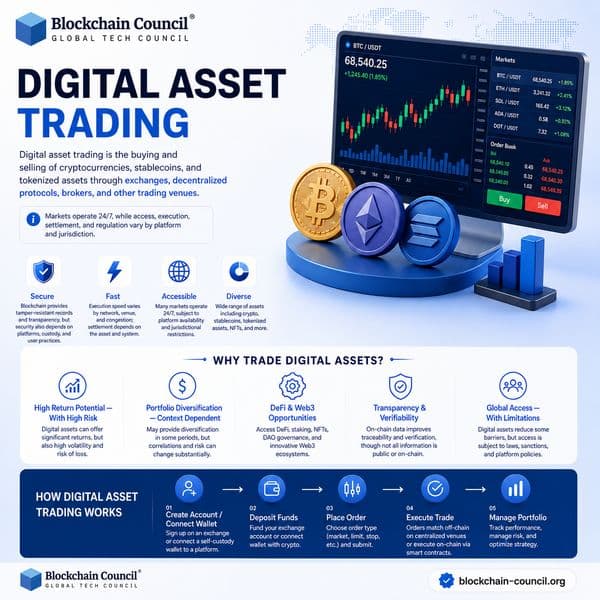
Infographics
Digital Asset Trading: A Complete Guide to Trading in the Digital Economy
Digital asset trading involves buying, selling, and exchanging cryptocurrencies, tokenized assets, NFTs, and other blockchain-based assets through centralized and decentralized trading platforms. As the digital economy expands, traders rely on market analysis, risk management, and advanced trading tools to navigate volatile markets. This guide explains the fundamentals of digital asset trading, key strategies, security considerations, and emerging trends shaping the future of digital finance.
Infographics
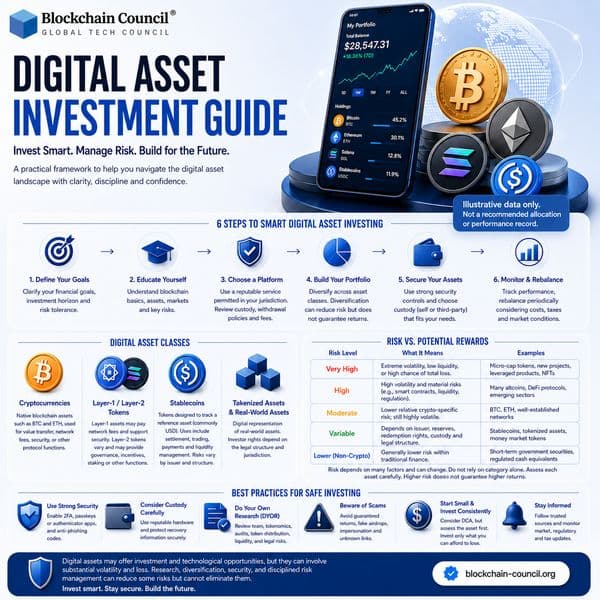
Digital Asset Investment Guide: Build a Smarter Strategy for the Future of Finance
Digital asset investing has become a key part of the modern financial landscape, offering opportunities in cryptocurrencies, tokenized assets, NFTs, and blockchain-based investments. Whether you're a beginner or an experienced investor, understanding market fundamentals, diversification, security, and risk management is essential for building a successful digital asset portfolio. This guide explores the core concepts, investment strategies, and best practices for navigating the digital asset market.
Infographics
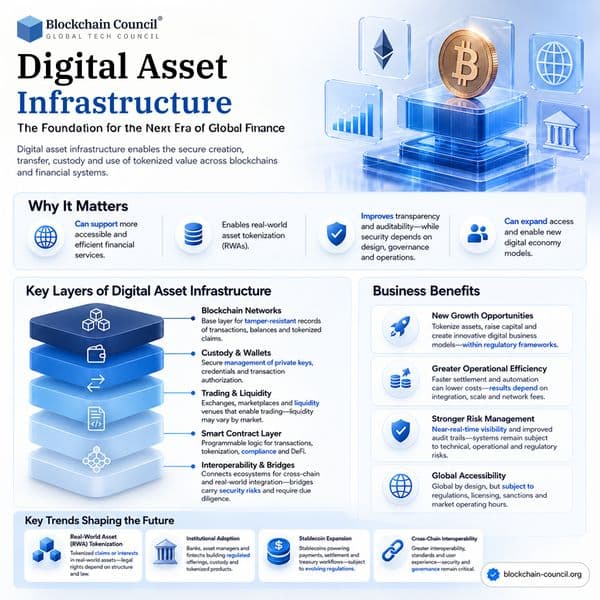
Digital Asset Infrastructure: The Foundation of the Next Era of Global Finance
Digital asset infrastructure is the technology backbone that enables the creation, storage, transfer, trading, and management of cryptocurrencies, tokenized assets, and other blockchain-based digital assets. It includes blockchain networks, digital wallets, custody solutions, exchanges, smart contracts, and security protocols. This guide explores the key components of digital asset infrastructure and their role in supporting the rapidly evolving Web3 and digital finance ecosystem.
Trending Articles
The Role of Blockchain in Ethical AI Development
How blockchain technology is being used to promote transparency and accountability in artificial intelligence systems.
AWS Career Roadmap
A step-by-step guide to building a successful career in Amazon Web Services cloud computing.
How Blockchain Secures AI Data
Understand how blockchain technology is being applied to protect the integrity and security of AI training data.