

Core Components of AI Agents
 Suyash Raizada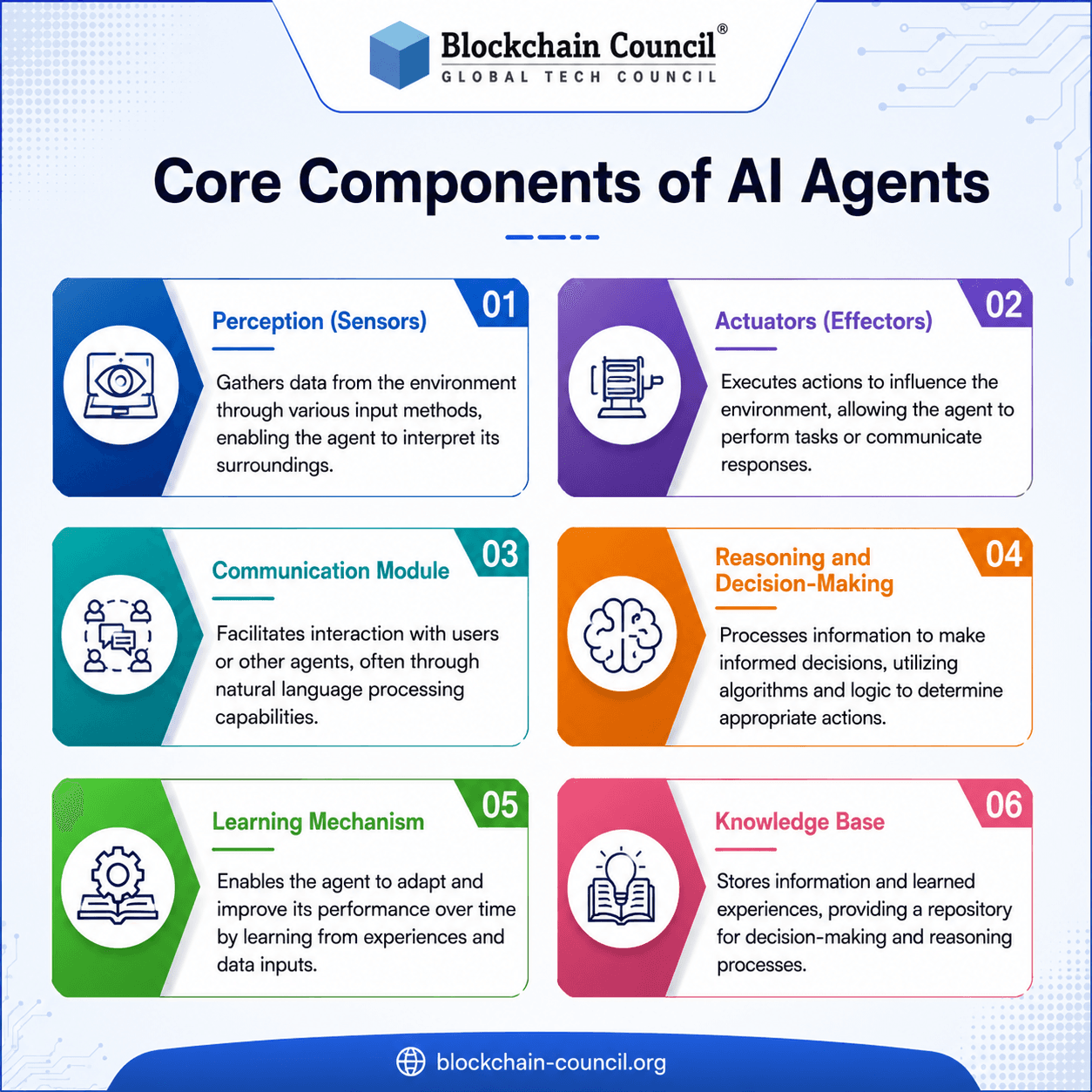
Artificial Intelligence (AI) agents are at the heart of modern intelligent systems, powering applications ranging from virtual assistants and autonomous vehicles to recommendation engines and enterprise automation tools. These agents are designed to perceive their environment, process information, make decisions, and act accordingly to achieve specific goals.
Understanding the core components of AI agents is essential for anyone looking to work in artificial intelligence, whether in development, research, or business implementation. Each component plays a critical role in ensuring that the agent operates efficiently, adapts to changes, and delivers meaningful outcomes.

For professionals aiming to specialize in this domain, certifications such as the Agentic AI Expert Certification provide in-depth knowledge of building and managing intelligent agents. Additional programs like the AI expert certification, Claude AI Certification, further enhance expertise in AI technologies.
What is an AI Agent?
An AI agent is a system that perceives its environment through sensors, processes information, and takes actions using actuators to achieve specific objectives. These agents can operate autonomously or semi-autonomously.
Key Characteristics
AI agents are goal-oriented systems that can learn from data, adapt to changes, and interact with users or other systems. They are widely used in industries such as healthcare, finance, retail, and transportation.
Overview of Core Components of AI Agents
The architecture of an AI agent typically includes six primary components:
Perception (Sensors), Actuators (Effectors), Communication Module, Reasoning and Decision-Making, Learning Mechanism, and Knowledge Base.
Each component contributes to the overall intelligence and functionality of the system.
Perception (Sensors)
Perception enables an AI agent to gather data from its environment through various input methods such as cameras, microphones, and sensors. This data allows the agent to interpret its surroundings and understand context.
For example, self-driving cars rely on cameras and radar systems to detect obstacles, traffic signals, and road conditions. Without perception, an AI agent would have no awareness of its environment, making decision-making impossible.
Actuators (Effectors)
Actuators are responsible for executing actions based on the agent’s decisions. These actions can be physical, such as moving a robotic arm, or digital, such as sending a response in a chatbot.
In manufacturing, robotic systems use actuators to assemble products with precision and efficiency. Actuators are essential because they allow AI agents to interact with and influence their environment.
Communication Module
The communication module allows AI agents to interact with users and other systems. It often uses natural language processing (NLP) to understand and respond to human language.
Virtual assistants and chatbots are prime examples of this component in action. In business applications, communication modules are widely used in customer engagement strategies. Professionals can strengthen their expertise through the AI powered digital marketing course.
Reasoning and Decision-Making
This component processes information and determines the best course of action using algorithms, logic, and data analysis. It ensures that AI agents make informed and effective decisions.
For instance, recommendation systems analyze user behavior to suggest products or content. Reasoning is critical for enabling intelligent responses and problem-solving.
Learning Mechanism
The learning mechanism allows AI agents to improve over time by learning from data and experiences. It uses techniques such as supervised learning, unsupervised learning, and reinforcement learning.
Streaming platforms use learning mechanisms to understand user preferences and provide personalized recommendations. This adaptability is what makes AI systems increasingly effective over time.
Knowledge Base
The knowledge base stores information, rules, and past experiences that the AI agent uses for reasoning and decision-making. It acts as a repository of structured and unstructured data.
For example, medical AI systems use knowledge bases to store patient data and treatment guidelines. A well-maintained knowledge base enhances the accuracy and reliability of AI agents.
Integration of Components
All components of an AI agent work together in a continuous cycle. The agent perceives its environment, processes information using its knowledge base, makes decisions, executes actions, and learns from the outcomes.
This integration ensures that AI agents operate efficiently and adapt to changing conditions.
Real-World Applications of AI Agents
AI agents are widely used in autonomous vehicles, healthcare systems, e-commerce platforms, and enterprise automation. They improve efficiency, reduce errors, and enhance user experiences.
Developers building such systems often rely on structured learning paths like the AI Powered coding expert Course to gain technical expertise.
Benefits of AI Agents
AI agents offer several advantages, including increased efficiency, improved accuracy, scalability, and adaptability. They automate repetitive tasks and enable data-driven decision-making.
These benefits make AI agents valuable across industries.
Challenges and Limitations
Despite their advantages, AI agents face challenges such as technical complexity, data dependency, ethical concerns, and high implementation costs. Addressing these issues is essential for successful deployment.
Recent Developments in AI Agents
Recent advancements include multi-agent systems, integration with generative AI, edge computing, and improved natural language capabilities. These developments are expanding the potential of AI agents.
Importance of AI Skills and Certifications
As AI agents become more advanced, the demand for skilled professionals continues to grow. Certifications like the Agentic AI Expert Certification, AI expert certification, Claude AI Certification, and ChatGPT Expert certification help individuals build expertise and stay competitive in the job market.
Future of AI Agents
The future of AI agents includes greater autonomy, improved reasoning, enhanced personalization, and integration with IoT devices. These systems will become more intelligent and widely adopted.
Best Practices for Developing AI Agents
Developers should focus on using high-quality data, maintaining ethical standards, updating models regularly, and monitoring system performance to ensure effectiveness.
Ethical Considerations
Ethical AI development involves transparency, data privacy, and minimizing bias. Responsible practices are essential for building trust in AI systems.
Conclusion
The core components of AI agents form the foundation of intelligent systems that are transforming industries worldwide. From perception and reasoning to learning and action, each component plays a vital role in enabling AI agents to function effectively.
By understanding these components and investing in continuous learning, professionals can leverage AI technologies to drive innovation and growth.
FAQs
1. What are the core components of an AI agent?
The core components include perception, actuators, communication module, reasoning, learning mechanism, and knowledge base. Each component plays a specific role in enabling intelligent behavior. They work together to process information and take actions. The integration ensures efficiency. These components form the foundation of AI systems. Understanding them is essential.
2. What is the role of perception in AI agents?
Perception allows AI agents to gather data from their environment. It uses sensors to collect information. This data is essential for decision-making. Without perception, the agent cannot function effectively. It is the first step in the workflow. It enables awareness.
3. What are actuators in AI agents?
Actuators execute actions based on decisions. They can perform physical or digital tasks. They allow the agent to interact with the environment. Without actuators, actions cannot be performed. They are essential for achieving goals. They complete the process.
4. How does the communication module work?
The communication module enables interaction with users or systems. It uses NLP for understanding language. It supports multi-agent communication. It improves user experience. It is essential for collaboration. It enhances functionality.
5. What is reasoning in AI agents?
Reasoning processes data and determines actions. It uses algorithms and logic. It ensures decisions are effective. It is a critical component. It improves accuracy. It drives intelligence.
6. What is the learning mechanism?
The learning mechanism allows AI to improve over time. It uses data and experiences. It adapts to changes. It enhances performance. Continuous learning is important. It ensures growth.
7. What is a knowledge base?
A knowledge base stores information and experiences. It supports decision-making. It provides data for reasoning. It improves efficiency. It is essential for intelligence. It enhances performance.
8. How do AI agents work?
AI agents gather data, process it, and take actions. They use multiple components. The process is continuous. Learning improves results. Integration ensures efficiency. They operate autonomously.
9. What industries use AI agents?
Industries such as healthcare, finance, and retail use AI agents. Applications are diverse. Growth is increasing. Adoption is widespread. Impact is significant. They support innovation.
10. What are the benefits of AI agents?
Benefits include efficiency, accuracy, and scalability. They automate tasks. They improve decision-making. They enhance productivity. They adapt over time. They are valuable.
11. What challenges do AI agents face?
Challenges include complexity and data dependency. Ethical concerns exist. Costs can be high. Continuous updates are needed. Limitations exist. Improvements are ongoing.
12. Can AI agents learn independently?
Yes, AI agents can learn using machine learning techniques. They adapt based on data. Performance improves over time. Learning is continuous. It enhances capabilities. It is essential.
13. What is the future of AI agents?
The future includes advanced capabilities and wider adoption. AI will improve autonomy. Integration will increase. Innovation will continue. Impact will expand. Growth is expected.
14. How can businesses use AI agents?
Businesses use AI agents for automation and decision-making. Efficiency improves. Costs decrease. Customer experience improves. Integration is important. Results are significant.
15. What skills are needed for AI agents?
Skills include programming and data analysis. Understanding AI concepts is important. Continuous learning is necessary. Certifications can help. Skills improve effectiveness. Demand is growing.
16. How does AI improve decision-making?
AI analyzes data and identifies patterns. It provides insights. Decisions become data-driven. Accuracy improves. Efficiency increases. It is effective.
17. Are AI agents secure?
Security depends on implementation. Data must be protected. Privacy measures are important. Systems should be monitored. Security is improving. Awareness is necessary.
18. Can beginners learn AI agents?
Yes, beginners can learn with proper resources. Courses and practice help. Learning is gradual. Accessibility is increasing. It is beginner-friendly. Skills can be developed.
19. Why are AI certifications important?
Certifications validate knowledge and skills. They improve job prospects. Employers value expertise. Learning becomes structured. Opportunities increase. They are beneficial.
20. How can I start learning AI agents?
Start with basic AI concepts and programming. Take courses and certifications. Practice regularly. Learn from experts. Stay updated. Skills will improve.
Related Articles
View All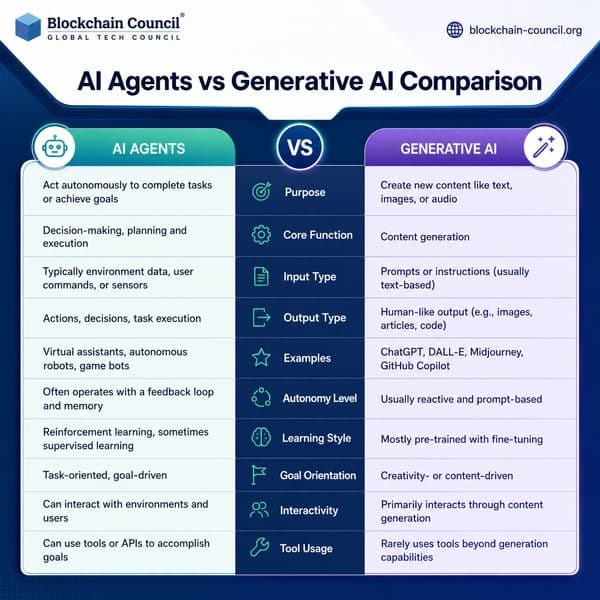
Infographics
AI Agents vs Generative AI Comparison
AI agents focus on autonomous decision-making and task execution, while generative AI specializes in creating content and responses.
Infographics
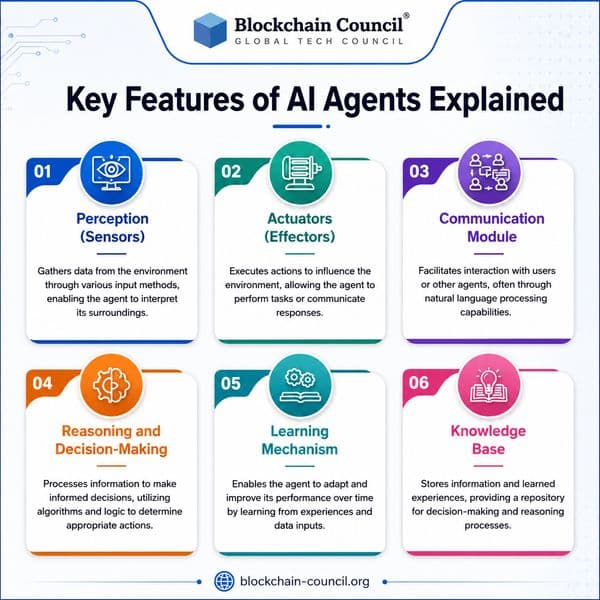
Key Features of AI Agents Explained
AI agents use autonomy, reasoning, memory, and task execution capabilities to automate workflows and perform intelligent actions independently.

Infographics
Digital Asset Investment Guide: Build a Smarter Strategy for the Future of Finance
Digital asset investing has become a key part of the modern financial landscape, offering opportunities in cryptocurrencies, tokenized assets, NFTs, and blockchain-based investments. Whether you're a beginner or an experienced investor, understanding market fundamentals, diversification, security, and risk management is essential for building a successful digital asset portfolio. This guide explores the core concepts, investment strategies, and best practices for navigating the digital asset market.
Trending Articles
How Blockchain Secures AI Data
Understand how blockchain technology is being applied to protect the integrity and security of AI training data.

Can DeFi 2.0 Bridge the Gap Between Traditional and Decentralized Finance?
The next generation of DeFi protocols aims to connect traditional banking with decentralized finance ecosystems.
Claude AI Tools for Productivity
Discover Claude AI tools for productivity to streamline tasks, manage workflows, and improve efficiency.