

Blockchain Cybersecurity Challenges and Solutions
 Suyash Raizada
Blockchain cybersecurity challenges are rising as blockchain adoption expands across finance, supply chains, and enterprise platforms. While cryptography and consensus mechanisms offer strong integrity guarantees, real-world incidents show that security failures often occur at the edges: private keys, smart contract logic, cross-chain bridges, and operational processes. Security researchers have documented more than 500 attacks on cryptocurrency systems with approximately $9 billion in losses, and crypto-related cybercrime reached $14 billion in 2021 alone. These figures underscore why blockchain security must be treated as a full risk management discipline, not simply a feature of the underlying protocol.
Address blockchain security risks such as smart contract vulnerabilities and network attacks by becoming a Cyber Security Expert, strengthening threat detection with a machine learning course, and promoting secure systems through a Digital marketing course.

Why Blockchain Security Is Not Secure by Default
Industry bodies and auditors consistently warn against assuming blockchain is automatically secure. The World Economic Forum has emphasized the need for structured cybersecurity assessments and ongoing education, noting that cryptography does not prevent phishing, flawed implementations, or unsafe governance practices. IBM frames blockchain security as risk management that combines proven cybersecurity frameworks with blockchain-specific controls addressing threats such as Sybil attacks, routing manipulation, and consensus attacks.
For most organizations, the practical goal is to ensure confidentiality, integrity, and availability across the entire stack, including cloud infrastructure. Enterprise frameworks such as Gartner's Blockchain Security Model and permissioned architectures like Hyperledger Fabric 2.0 are widely referenced for improving control, privacy, and operational assurance in enterprise deployments.
Common Blockchain Attack Vectors
Attacks commonly map to three layers: endpoints (users and keys), the network (peer-to-peer communications), and consensus (how the chain agrees on a valid state). The most frequently observed vectors include the following.
Phishing and Private Key Compromise
Private key theft remains one of the highest-impact risks because a stolen key typically results in irreversible asset loss. Attackers use phishing pages, malware, credential stuffing, dictionary attacks, and wallet software vulnerabilities to obtain keys. The Coincheck breach is a widely cited example, where inadequate key security contributed to approximately $500 million in losses.
Primary impact: unauthorized transfers and wallet takeover
Typical root cause: poor key handling, weak authentication, and unsafe device hygiene
51% Attacks and Consensus Manipulation
When an attacker controls a majority of hashing power or stake, they can attempt double-spending, transaction reordering, or chain reorganization. While full control is unlikely on large, well-established networks, smaller networks and certain sidechains carry greater exposure. Related tactics include selfish mining and exploiting weaknesses in decentralized validator sets.
Primary impact: double-spends, finality disruption, and trust erosion
Typical root cause: insufficient decentralization or inadequate economic security
Sybil and Routing Attacks
Sybil attacks flood a network with fake identities or nodes to influence peer discovery, degrade connectivity, or bias consensus inputs. Routing attacks can partition the network or delay block propagation, increasing the likelihood of reorganizations or transaction censorship in severe cases.
Primary impact: network instability and degraded consensus performance
Typical root cause: weak peer selection mechanisms and inadequate network-level protections
DDoS and Cryptojacking
Distributed denial-of-service attacks can overwhelm nodes, RPC endpoints, or related infrastructure such as block explorers and wallet services. Cryptojacking, typically delivered via malware, hijacks compute resources to mine cryptocurrency without authorization, creating measurable cost and performance risk for enterprises.
Primary impact: service downtime, elevated operating costs, and reliability failures
Typical root cause: exposed endpoints, weak monitoring, and insufficient system hardening
Bridge Hacks and Cross-Chain Exploits
Bridge hacks have become one of the most significant risks in multi-chain ecosystems. Bridges concentrate large amounts of value and rely on complex trust assumptions, validator sets, and message verification logic. These interoperability points are frequent targets for asset drainage and replay-style attacks.
Primary impact: large-scale theft spanning multiple chains
Typical root cause: flawed verification logic, weak validator security, and unsafe upgrade paths
Smart Contract Risks
Smart contract risk is fundamentally software risk, amplified by immutability and composability. Many vulnerabilities arise from business logic errors, access control mistakes, inadequate signature validation, and unsafe upgrade mechanisms. The DAO exploit remains the defining example: a reentrancy flaw enabled recursive withdrawals and drained approximately $60 million, ultimately prompting an Ethereum hard fork.
Cloud Security Alliance research documents nearly 200 distinct blockchain weaknesses and vulnerabilities, with a significant share linked to implementation and smart contract issues. Deloitte has noted that financial organizations should validate not only smart contract code but also connected components such as APIs, wallets, and asset custody workflows.
Practical Mitigation Strategies for Enterprises and Developers
Effective mitigation combines technical controls, secure development discipline, and governance. A sound approach treats blockchain security like any other critical system: define threat models, implement layered defenses, and continuously verify.
Technical Controls
Key protection: multi-signature wallets, hardware security modules where applicable, cold storage for treasury assets, and documented recovery policies.
Account security: multi-factor authentication, device posture checks, and least-privilege access for admin and deployment keys.
Infrastructure hardening: patch management, rate limiting and web application firewalls for RPC endpoints, DDoS protections, and network segmentation for validator and signing systems.
Privacy controls: selective ledger access in permissioned networks and privacy-enhancing techniques such as zero-knowledge proofs where appropriate.
Secure Development and Verification
Continuous audits: pre-deployment and post-upgrade code reviews, plus independent audits for high-value contracts.
Testing depth: unit tests, property-based tests, fuzzing, and adversarial scenario testing covering reentrancy, integer overflow, and access control bypasses.
Change control: formal upgrade procedures, timelocks, and staged rollouts to reduce fork and misconfiguration risk.
Monitoring, Detection, and Response
On-chain monitoring: anomaly detection for unusual withdrawals, privileged contract calls, and bridge message patterns.
Operational readiness: incident response runbooks, key rotation plans, and pre-established coordination paths with exchanges or custodians when theft is detected.
Framework Alignment and Skills Development
Organizations benefit from adopting established guidance such as Gartner's Blockchain Security Model and integrating standard cybersecurity frameworks with blockchain-specific controls, consistent with the risk management approach advocated by IBM. For teams building or auditing Web3 systems, internal capability development matters as much as tooling.
Build resilient blockchain applications with advanced cryptographic security and risk mitigation strategies by mastering decentralized systems through a Certified Blockchain Expert, implementing safeguards via Cyber security certifications, and driving adoption using an AI powered marketing course.
Building Resilient Blockchain Systems
Blockchain cybersecurity challenges are real, measurable, and continuing to evolve, particularly with multi-chain growth and high-value bridge infrastructure. The most damaging incidents repeatedly trace back to key compromise, smart contract defects, and weak operational controls - not failures in the underlying cryptography. The practical path forward is layered: protect keys, engineer secure contracts, harden infrastructure, adopt security frameworks, and monitor continuously. As regulations mature and enterprise-grade architectures become standard, teams that treat blockchain as part of a broader security program will be best positioned to reduce risk while scaling adoption.
FAQs
1. What are blockchain cybersecurity challenges?
Blockchain cybersecurity challenges refer to risks and vulnerabilities that can affect blockchain networks and applications. These include threats like hacking, smart contract bugs, and phishing attacks. Addressing these challenges is essential to ensure secure blockchain operations.
2. Is blockchain completely secure from cyberattacks?
Blockchain is highly secure due to decentralization and cryptography, but it is not completely immune. Vulnerabilities often exist in applications, smart contracts, or user behavior. Proper security practices are still required.
3. What are smart contract vulnerabilities in blockchain?
Smart contract vulnerabilities are flaws in the code that can be exploited by attackers. These can lead to financial losses or system manipulation. Regular audits and testing help reduce these risks.
4. How does private key theft impact blockchain security?
Private key theft allows attackers to access and control digital assets. Once compromised, funds can be transferred without permission. Secure storage and protection are critical.
5. What is a 51% attack in blockchain?
A 51% attack occurs when a group gains majority control over a blockchain network. This allows them to manipulate transactions. It can compromise network integrity.
6. How do phishing attacks affect blockchain users?
Phishing attacks trick users into revealing sensitive information like private keys. Attackers use fake websites or emails. Awareness and caution are important to avoid such attacks.
7. What role does cryptography play in blockchain security?
Cryptography secures transactions and protects data in blockchain systems. It ensures that information cannot be easily altered. This is a core feature of blockchain security.
8. Can blockchain applications be hacked?
Yes, while the blockchain itself is secure, applications built on it can have vulnerabilities. Weak code or poor design can be exploited. Secure development practices are essential.
9. What is the risk of malware in blockchain systems?
Malware can steal private keys or manipulate transactions. It can infect devices used for crypto operations. Using secure devices and antivirus tools helps reduce risk.
10. How can smart contract audits improve security?
Audits identify vulnerabilities in smart contract code before deployment. Experts review and test the code for weaknesses. This helps prevent exploits.
11. What are common solutions to blockchain security challenges?
Solutions include strong encryption, regular audits, and secure key management. Using trusted platforms also helps. Continuous monitoring improves protection.
12. How does multi-factor authentication improve blockchain security?
Multi-factor authentication adds an extra layer of security during login. It requires multiple verification steps. This reduces unauthorized access.
13. What is cold storage in blockchain security?
Cold storage keeps private keys offline to prevent hacking. It is one of the safest ways to store digital assets. It reduces exposure to online threats.
14. How can users protect their private keys?
Users should store keys securely and never share them. Using hardware wallets and backups is recommended. Awareness is key to preventing theft.
15. What is the role of decentralized systems in security?
Decentralization reduces single points of failure. Data is distributed across multiple nodes. This improves resilience against attacks.
16. Are blockchain networks vulnerable to insider threats?
Yes, insiders with access can misuse their privileges. Proper access control and monitoring are important. Security policies help reduce this risk.
17. How does blockchain improve cybersecurity overall?
Blockchain enhances security through transparency and immutability. It reduces fraud and unauthorized changes. It is widely used in secure systems.
18. What are the challenges of integrating blockchain with existing systems?
Integration can be complex and require technical expertise. Compatibility issues may arise. Proper planning is needed for smooth implementation.
19. What is the future of blockchain cybersecurity?
Blockchain security will evolve with advanced technologies like AI. New solutions will address emerging threats. Adoption will continue to grow.
20. How can businesses ensure blockchain security?
Businesses should follow best practices like audits, encryption, and monitoring. Partnering with security experts helps. Continuous improvement is essential.
Related Articles
View All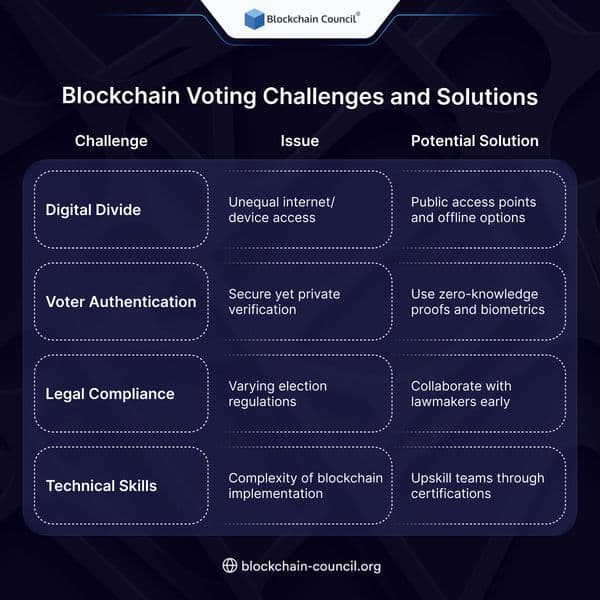
Infographics
Blockchain Voting Challenges and Solutions
Understand the challenges of blockchain voting systems and explore solutions for secure, transparent, and reliable elections.
Infographics
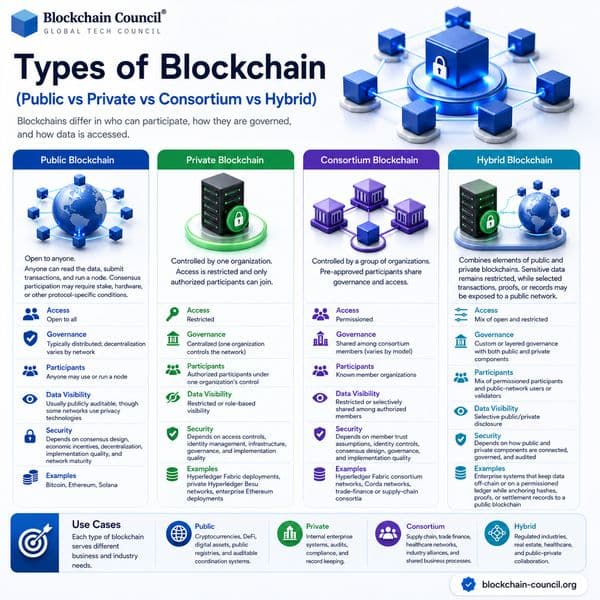
Types of Blockchain
Blockchain networks come in different forms, each designed to meet specific business and technical requirements. From fully decentralized public blockchains to permissioned private and consortium networks, understanding the different types of blockchain helps organizations choose the right solution for security, scalability, governance, and performance.
Infographics
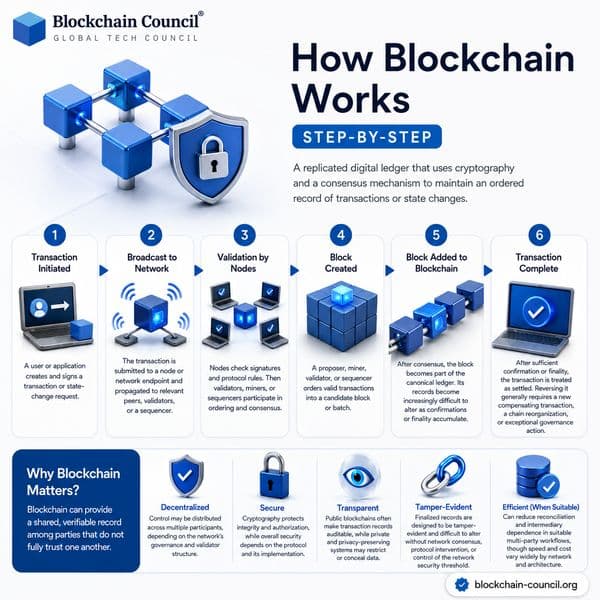
How Blockchain Works?
Blockchain works by recording transactions in blocks that are securely linked using cryptographic hashes. Each transaction is verified by network participants through consensus mechanisms before being added to an immutable ledger. This guide explains the blockchain process step by step, helping beginners understand how decentralized networks maintain transparency, security, and trust.
Trending Articles
What is AWS? A Beginner's Guide to Cloud Computing
Everything you need to know about Amazon Web Services, cloud computing fundamentals, and career opportunities.
Claude AI Tools for Productivity
Discover Claude AI tools for productivity to streamline tasks, manage workflows, and improve efficiency.
Blockchain in Supply Chain Provenance Tracking
Supply chains are under pressure to prove not just efficiency, but also authenticity, sustainability, and fairness. Customers want to know if their coffee really is fair trade, if the diamonds are con