

Edge AI vs On-Device AI: Understanding the Technical and Business Differences
 Suyash Raizada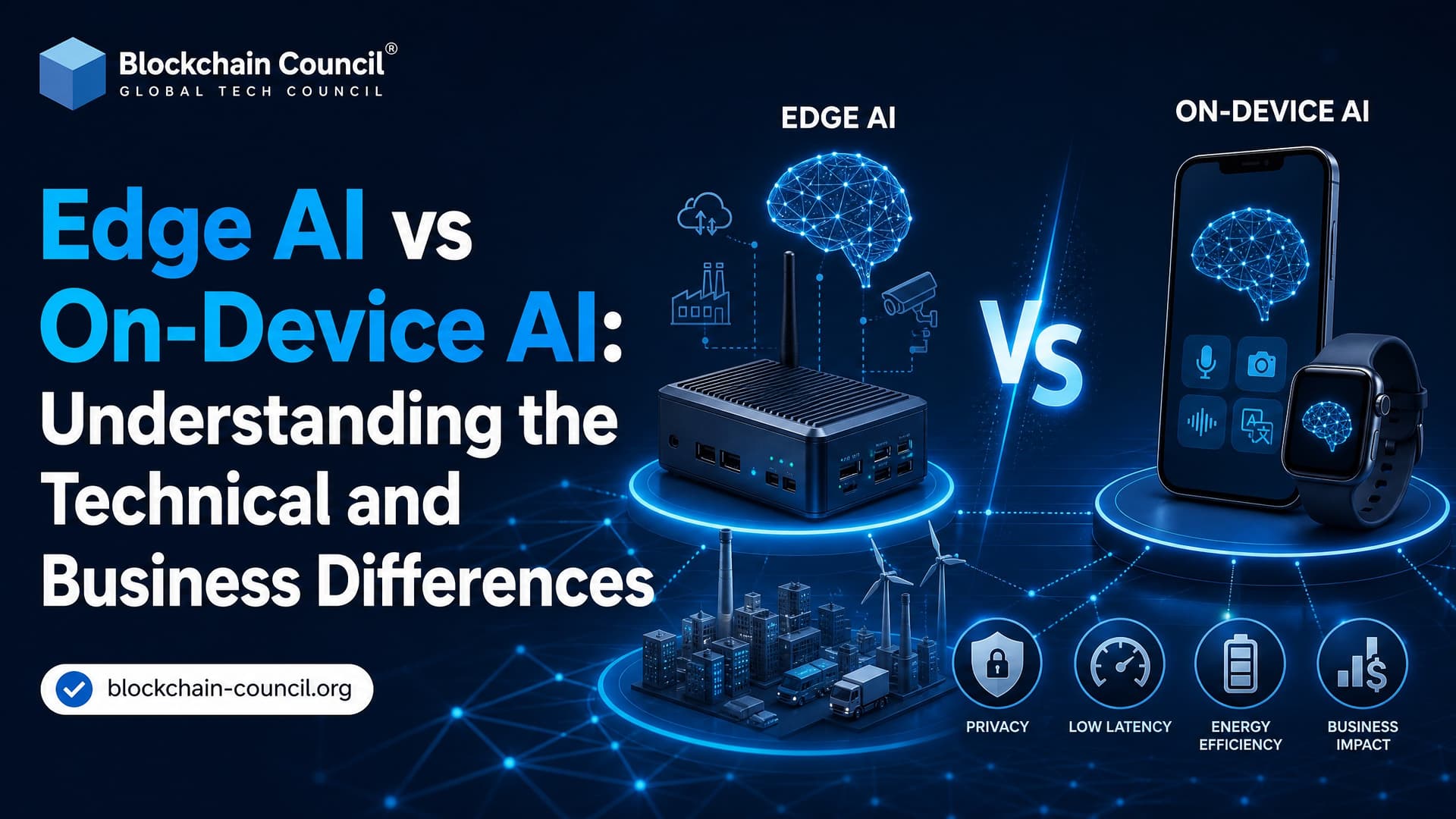
Edge AI vs On-Device AI comes down to where inference runs, how much infrastructure you control, and how tightly your model must fit into power, memory, and connectivity limits. Edge AI is the broader architecture. AI runs close to data sources across devices, gateways, local servers, and sometimes micro data centers. On-device AI is narrower. The model runs entirely on a single device, such as a phone, wearable, camera, thermostat, or embedded controller.
People often use the terms interchangeably. That is understandable, but not harmless. If you are budgeting a factory vision system, designing a privacy feature for a smartwatch, or preparing for an AI architecture role, the distinction affects cost, latency, compliance, and product design.

As organizations increasingly deploy intelligent systems outside traditional cloud environments, professionals with a Certified Edge AI Expert credential are helping design architectures that balance real-time performance, security, and scalability across diverse edge deployments.
What Is Edge AI?
Edge AI means deploying AI models near the place where data is created instead of sending every image, sensor reading, or audio stream to a centralized cloud. Arm describes edge AI as local inference and decision making without constant cloud connectivity. IBM frames it as a way to reduce network traffic and latency while keeping devices useful even when connectivity is poor.
Edge AI can run on:
Industrial IoT sensors and programmable controllers
Smart cameras, drones, robots, and autonomous vehicles
Hospital systems and diagnostic devices
Factory gateways and local edge servers
Telecom edge infrastructure and micro data centers
The key point is proximity. Compute sits close enough to the data source to cut delay and bandwidth use. It may still connect to the cloud for training, monitoring, model updates, and long-term storage.
What Is On-Device AI?
On-device AI means inference happens fully on the individual device. The device does not need to call a gateway, edge server, or cloud endpoint to produce a result. Training usually happens elsewhere, then an optimized model is shipped to the device.
You see this pattern in:
Smartphone photo enhancement and keyboard suggestions
Wearable health monitoring
Wake-word detection on smart speakers
Local object detection on security cameras
Embedded controllers in appliances and small machines
The wording matters here: training occurs in the cloud, while inference runs locally. A smartwatch cannot run the same workload as a rack-mounted edge GPU server. Battery, heat, memory, and storage force tough engineering choices.
Deploying optimized models across edge devices also requires disciplined version control, monitoring, rollout strategies, and lifecycle management. Professionals responsible for maintaining these production AI environments often strengthen their operational expertise through a Certified MLOps Expert program to ensure reliable and scalable model deployment.
Edge AI vs On-Device AI: The Architectural Difference
The cleanest way to think about it is this. On-device AI is a subset of edge AI. All on-device AI sits at the edge, but not all edge AI is on-device.
Edge AI Architecture
An edge AI system may spread work across several layers:
Device layer: Cameras, sensors, robots, phones, or machines capture data.
Gateway layer: Local boxes filter, batch, normalize, or run mid-sized models.
Edge server layer: More powerful local compute runs heavier models and coordinates multiple devices.
Cloud layer: Central systems handle training, fleet analytics, storage, governance, and updates.
This is common in manufacturing. A camera may detect defects locally, an edge gateway may correlate defect rates across a production line, and the cloud may retrain the model using approved data from several plants.
On-Device AI Architecture
On-device AI removes the middle layers from the live inference path. A model runs directly on the device. If the network disappears, the product still works.
That is ideal for a wake-word model, a glucose trend alert, a local face blur feature, or a vehicle control loop where even a small network delay is unacceptable.
Here is the trade-off. You gain speed and privacy, but you lose headroom. I have seen a TensorFlow Lite Micro model fail on an embedded board with the blunt error arena allocation failed. The model was fine on a laptop. On the microcontroller, the tensor arena was too small by a few kilobytes. That is the kind of detail that turns architecture diagrams into real engineering work.
Technical Differences That Matter
1. Compute and Memory
Edge AI has a wider compute envelope. You can run models on CPUs, GPUs, NPUs, edge servers, or industrial gateways. NVIDIA has repeatedly pointed to parallel GPU computing as a major reason edge AI became practical for workloads such as radiology, robotics, and autonomous driving.
On-device AI is stricter. A model may need quantization, pruning, distillation, or architecture changes before it fits. Converting a float32 model to int8 can cut model size by about 4x, but accuracy can drop if your representative calibration dataset is weak. That small shortcut often shows up later as bad predictions in poor lighting or noisy sensor conditions.
2. Latency
Both approaches reduce latency compared with cloud-only inference. On-device AI usually wins because there is no network hop at all.
Use on-device inference when response time is part of the user experience or safety case. Examples include keyboard prediction, wake-word detection, collision warning, and medical alerts. Use broader edge AI when the workload benefits from local coordination across several devices, such as traffic management or multi-camera inspection in a warehouse.
3. Connectivity
Edge AI often tolerates intermittent connectivity, but many enterprise deployments still expect periodic links to a local gateway or cloud management plane. On-device AI can be designed for full offline operation.
This difference affects support. Updating 50 edge servers in a controlled facility is one problem. Updating 5 million consumer devices with different OS versions, storage limits, and battery states is another.
4. Data Flow and Privacy
Edge AI reduces the need to ship raw data to the cloud. Instead, the system can send events, summaries, embeddings, or anonymized metrics. This lowers bandwidth and can improve compliance.
On-device AI goes further. Sensitive data can stay on the user's device. That is especially useful for biometrics, health signals, children's devices, and private audio. If your product promise is privacy, cloud inference is often the wrong default.
5. Model Lifecycle and MLOps
Both approaches usually train centrally and deploy optimized models outward. The hard part is operations.
Edge AI MLOps: Manage versions across gateways, servers, and device fleets. Monitor drift by site or region.
On-device AI MLOps: Package smaller models, support rollback, handle OS fragmentation, and minimize update size.
Hybrid MLOps: Split inference across device, edge, and cloud based on latency, cost, and privacy rules.
If you are building this skill set, Blockchain Council's Certified Artificial Intelligence (AI) Expert™ can be a useful learning path to pair with hands-on work in model deployment, while the Certified Blockchain Expert™ is relevant when edge devices need trusted audit trails or decentralized identity patterns.
Business Differences: Cost, Risk, and Product Strategy
Cost Model
Edge AI can reduce cloud inference and bandwidth costs because raw data is processed locally. But it adds hardware spending. You may need gateways, local servers, accelerators, physical maintenance, and fleet management tools.
On-device AI often uses compute that already exists in the product. A phone, watch, or camera already has a processor. The cost shifts to engineering: model compression, native integration, testing, and update design. For high-volume consumer products, avoiding per-request cloud inference can save real money.
Governance and Regulation
Local processing reduces exposure. Enterprises can keep sensitive data inside a factory, hospital, store, or region, sending only aggregated metrics centrally. This helps with data minimization principles found in privacy regulations such as GDPR.
On-device AI is stronger when the risk is personal data. If biometric templates or health readings never leave the device, the attack surface changes. Not disappears. Changes. You still need secure storage, model integrity checks, and clear user consent.
User Experience
On-device AI is felt directly by users. It makes features faster, available offline, and less dependent on network quality. That is why smartphones, wearables, and smart home products increasingly push speech, vision, and personalization tasks onto the device.
Edge AI often changes operations rather than a single user interaction. It improves production lines, logistics networks, hospitals, farms, roads, and energy systems. The business value comes from uptime, lower delay, better safety, and less data movement.
Market Momentum and Industry View
Industry estimates put the edge AI market at roughly USD 20.78 billion, with expected annual growth of around 22 percent from 2025 to 2030. The drivers are practical: lower latency, less bandwidth, real-time processing, improved privacy, and lower operating costs.
The vendor view is consistent. Arm highlights real-time local decisions. NVIDIA points to accelerated computing and mature neural network pipelines. IBM emphasizes workflow optimization in manufacturing and supply chain settings. Embedded practitioners point to better quantization, hardware acceleration, and deployment tooling as the reason small devices can now run useful models.
When Should You Choose Each?
Choose Edge AI When:
You need coordination across many sensors or machines
The model is too heavy for a single device
You can place gateways or servers near the data source
You need site-level governance and monitoring
Your use case is industrial, healthcare, logistics, smart city, or telecom infrastructure
Choose On-Device AI When:
The feature must work offline
Latency must be near instant
Raw personal data should not leave the device
The model can fit within battery, memory, and thermal limits
Your use case is consumer, wearable, embedded, biometric, or privacy-sensitive
Use a Hybrid Model When:
Most serious systems will use all three layers: device, edge, and cloud. Run immediate inference on-device. Send heavier local tasks to an edge server. Use the cloud for training, long-term storage, analytics, and fleet learning. To be blunt, arguing for only one layer is usually a sign that the architecture has not met production constraints yet.
What to Learn Next
If you want to work with edge AI and on-device AI professionally, build a small project first. Convert a PyTorch or TensorFlow model to TensorFlow Lite or ONNX, quantize it, deploy it to a phone or Raspberry Pi, and measure latency, memory, and accuracy before and after optimization. Numbers beat assumptions.
Then strengthen the theory behind deployment, governance, and AI architecture. Blockchain Council's Certified Artificial Intelligence (AI) Expert™ is a good next step for AI fundamentals and applied systems thinking. If your edge systems interact with trusted data sharing, device identity, or auditability, add the Certified Blockchain Expert™ to connect AI deployment with secure digital infrastructure.
As Edge AI and on-device AI continue moving from technical innovation to commercial products, professionals involved in product strategy, technology consulting, or business development can complement their technical expertise with a Marketing Certification to better communicate the business value of AI-powered solutions and support successful enterprise adoption.
FAQs
1. What is the difference between Edge AI and On-Device AI?
Edge AI is a broader concept that includes AI running anywhere near the data source, such as edge servers, gateways, IoT devices, industrial computers, or smart cameras. On-Device AI is a subset of Edge AI where AI models run directly on a single device, such as a smartphone, laptop, wearable, or embedded system, without relying on external edge infrastructure.
2. What is Edge AI?
Edge AI is the deployment of artificial intelligence models on distributed edge infrastructure to process data close to where it is generated. It reduces latency, minimizes bandwidth usage, improves privacy, and supports real-time decision-making across industries such as manufacturing, healthcare, retail, and transportation.
3. What is On-Device AI?
On-Device AI refers to AI processing that occurs entirely within an individual device. Examples include facial recognition on smartphones, voice assistants operating offline, AI-powered cameras, smart speakers, and wearable health devices that perform inference locally.
4. Is On-Device AI part of Edge AI?
Yes. On-Device AI is generally considered a specialized category within Edge AI. While all On-Device AI operates at the edge, not all Edge AI is limited to a single device because Edge AI may also involve gateways, edge servers, or distributed edge computing systems.
5. Which is faster: Edge AI or On-Device AI?
Both approaches offer low-latency processing because computation occurs close to the data source. On-Device AI may deliver the fastest response when a single device can perform the entire workload locally, while Edge AI can better support applications requiring coordination among multiple devices or more powerful local infrastructure.
6. How do Edge AI and On-Device AI differ technically?
On-Device AI performs inference entirely within one device using its processor, GPU, or neural processing unit (NPU). Edge AI can distribute workloads across connected edge devices, gateways, and edge servers, allowing larger AI models and more complex processing while remaining close to the source of the data.
7. What hardware is used for On-Device AI?
Common hardware includes smartphones with NPUs, tablets, laptops with AI accelerators, smartwatches, wearables, embedded processors, AI-enabled cameras, ARM processors, Qualcomm AI chips, Apple Neural Engine, and Google Tensor processors.
8. What hardware supports Edge AI?
Edge AI commonly uses industrial PCs, edge servers, NVIDIA Jetson platforms, Google Coral Edge TPU, Intel AI accelerators, IoT gateways, smart cameras, embedded systems, ARM processors, industrial controllers, and distributed edge computing infrastructure.
9. Which industries use Edge AI?
Manufacturing, healthcare, logistics, retail, automotive, agriculture, telecommunications, energy, financial services, industrial IoT, defense, and smart city projects widely deploy Edge AI to support real-time automation and intelligent operations.
10. Which industries rely heavily on On-Device AI?
Consumer electronics, mobile devices, wearable technology, healthcare devices, smart home products, automotive infotainment systems, personal productivity applications, and digital photography increasingly depend on On-Device AI capabilities.
11. How do Edge AI and On-Device AI improve privacy?
Both technologies process data locally, reducing the amount of sensitive information transmitted to cloud servers. This can improve privacy and support compliance with data protection regulations, although organizations must still implement appropriate security and governance controls.
12. Can both technologies work without internet access?
Yes. Both Edge AI and On-Device AI can continue performing AI inference without continuous internet connectivity. Some features, however, may still require cloud access for software updates, synchronization, model deployment, or centralized management.
13. What are the business benefits of Edge AI?
Edge AI supports enterprise-scale automation, predictive maintenance, industrial monitoring, distributed analytics, lower cloud costs, improved operational resilience, enhanced security, and scalable AI deployments across multiple connected locations.
14. What are the business benefits of On-Device AI?
On-Device AI enhances user experience by enabling faster response times, offline functionality, improved battery efficiency for certain workloads, stronger privacy, and personalized AI features on individual consumer or enterprise devices.
15. Which AI frameworks support both Edge AI and On-Device AI?
Popular frameworks include TensorFlow Lite, TensorFlow Lite Micro, ONNX Runtime, OpenVINO, NVIDIA TensorRT, PyTorch Mobile, Core ML, Qualcomm AI Stack, MediaPipe, Apache TVM, and Edge Impulse.
16. What are the biggest challenges of Edge AI?
Challenges include distributed device management, hardware diversity, AI model optimization, cybersecurity, software updates, scalability, network coordination, and integrating with legacy enterprise systems.
17. What are the biggest challenges of On-Device AI?
On-Device AI is limited by processing power, memory, storage, battery life, thermal constraints, and the size of AI models that can run efficiently on individual devices.
18. When should businesses choose Edge AI instead of On-Device AI?
Businesses should consider Edge AI when applications require multiple connected devices, industrial automation, fleet management, large-scale IoT deployments, real-time collaboration between systems, or greater computing resources than a single device can provide.
19. When is On-Device AI the better choice?
On-Device AI is well suited for smartphones, laptops, wearables, smart home devices, mobile applications, personal productivity tools, offline voice assistants, and situations where immediate local processing and user privacy are priorities.
20. Which technology represents the future of AI deployment?
Edge AI and On-Device AI are complementary rather than competing technologies. On-Device AI delivers intelligent experiences directly on individual devices, while Edge AI enables distributed intelligence across connected systems, gateways, and local infrastructure. As AI adoption expands across enterprises, IoT ecosystems, consumer electronics, and industrial environments, organizations are expected to use a combination of both approaches to balance performance, scalability, privacy, and operational efficiency.
Related Articles
View All
Edge Ai
TinyML vs Edge AI: Differences, Similarities, and When to Use Each
TinyML vs Edge AI explained clearly: learn how they differ, where they overlap, and how to choose the right architecture for edge systems.
Edge Ai
Edge AI vs Cloud AI: Key Differences, Benefits, and Use Cases
Edge AI vs Cloud AI explained for professionals: compare latency, privacy, compute, scalability, hybrid patterns, and practical enterprise use cases.

Edge Ai
Top Edge AI Frameworks and Tools for Developers and Enterprises
A practical guide to top edge AI frameworks and tools, including TensorFlow Lite, ONNX Runtime, Apache TVM, Edge Impulse, and enterprise MLOps platforms.
Trending Articles
AWS Career Roadmap
A step-by-step guide to building a successful career in Amazon Web Services cloud computing.
What is AWS? A Beginner's Guide to Cloud Computing
Everything you need to know about Amazon Web Services, cloud computing fundamentals, and career opportunities.
Claude AI Tools for Productivity
Discover Claude AI tools for productivity to streamline tasks, manage workflows, and improve efficiency.