

Edge AI Challenges and Solutions: Latency, Power, Scalability, and Security
 Suyash Raizada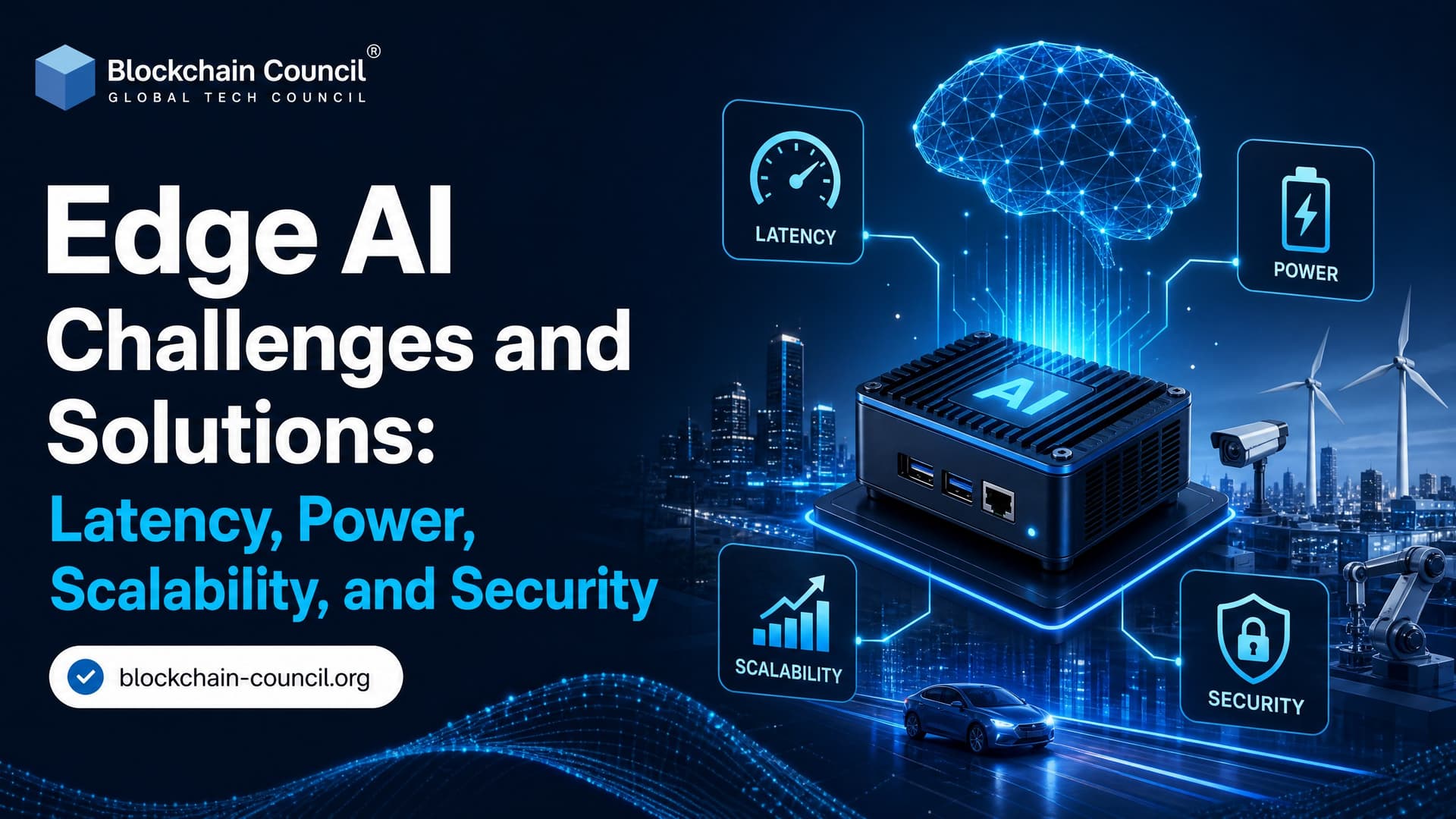
Edge AI challenges and solutions come down to four engineering constraints: latency, power, scalability, and security. Move inference from a cloud GPU cluster to a camera, gateway, robot, vehicle, or wearable, and you gain speed and privacy. You also inherit tight memory limits, battery budgets, patching headaches, and a much larger attack surface.
The trade-off is worth it when milliseconds matter. Edge AI typically targets latency around 10 to 50 ms, while cloud inference often lands closer to 100 to 300 ms because data must travel to remote servers and back. That gap changes design decisions in autonomous vehicles, industrial automation, healthcare monitoring, retail analytics, and augmented reality.

As enterprises expand AI beyond centralized cloud environments, professionals with a Certified Edge AI Expert background are increasingly helping organizations design, deploy, and optimize intelligent systems that deliver reliable performance across distributed devices and real-world operating conditions.
What Edge AI Means in Practice
Edge AI means running machine learning models on or near the source of data. That source might be a sensor, a mobile device, an industrial controller, a local server, a smart camera, or a vehicle compute unit. Instead of streaming every frame, waveform, or telemetry record to the cloud, the edge device processes data locally and sends only events, summaries, or exceptions upstream.
This is not a cloud replacement. It is a split of responsibilities. Put urgent inference at the edge. Keep model training, fleet analytics, long-term storage, and heavy retraining in the cloud or data center.
For professionals building this skill set, Blockchain Council's Certified Artificial Intelligence (AI) Expert™ is a useful learning path for AI foundations, while Certified Cybersecurity Expert™ is relevant when you move from prototypes to field deployments.
Latency Challenge: Fast Decisions Are Not Automatic
Edge AI reduces network delay. It does not remove latency. You still need to manage three separate delays:
Input latency: sensor capture, frame buffering, decoding, resizing, normalization, and feature extraction.
Processing latency: model inference, memory movement, batching, and accelerator execution.
Output latency: alerts, actuation, UI updates, or downstream communication.
Many teams obsess over model inference time and ignore pre-processing. Bad move. On a low-cost camera gateway, resizing 1080p frames and converting color formats can take longer than the neural network itself, especially if those steps run on the CPU.
Latency Solutions That Work
Run inference locally: Keep safety-critical decisions close to the device. A robot arm should not wait for a cloud round trip before stopping near a human operator.
Use smaller models: MobileNet, EfficientNet-Lite, YOLO-Nano style models, and task-specific architectures often beat oversized models on real devices.
Apply compression: Pruning removes unnecessary weights. Quantization converts weights and activations from FP32 to INT8 or similar formats. Knowledge distillation trains a smaller model to mimic a larger one.
Profile on the target device: A model that looks fast on a laptop can stall on an ARM CPU with limited cache. Test on the real board, with real camera input, not a clean benchmark tensor.
Use hardware acceleration: NPUs, GPUs, DSPs, and edge accelerators can cut inference time when the model uses supported operators.
Here is a practical gotcha. TensorFlow Lite full integer quantization needs a representative dataset. Skip it, and the converter may keep parts of the graph in float. On devices such as the Google Coral Edge TPU, that can break compilation or push operations back to the CPU. The result is not just slower inference. It can be an application that misses its latency target by 5x.
Delivering consistent performance at scale requires more than optimizing inference speed. Managing deployment pipelines, monitoring model health, coordinating updates, and maintaining distributed AI infrastructure are core MLOps responsibilities, which is why many practitioners pursue a Certified MLOps Expert program before managing production edge AI environments.
Power Challenge: Every Inference Has a Cost
Power is the constraint that turns a good demo into a hard product decision. Edge devices often run on batteries, solar power, vehicle power rails, or tightly limited industrial enclosures. Heat matters too. A model that runs well for ten minutes on a dev kit may throttle after one hour in a sealed box.
Power consumption comes from three places:
Sensor capture and pre-processing
Compute and memory access during inference
Network transmission to cloud or enterprise systems
Sending raw data can be surprisingly expensive. Continuous video streaming burns bandwidth, radio power, storage, and cloud processing. Local inference cuts that cost by sending only metadata such as person detected, defect found, or vibration anomaly above threshold.
Power Solutions for Edge AI
Select power-aware hardware: Low-power CPUs, NPUs, and MCUs often beat general-purpose compute for always-on inference.
Reduce memory movement: Memory access can drain more energy than arithmetic. Favor architectures that fit in cache or accelerator memory.
Quantize carefully: INT8 models usually consume less power than FP32 models, but validate accuracy on your own data.
Use event-driven inference: Do not run a heavy model every frame if a lightweight motion detector or threshold rule can trigger it.
Send less data: Transmit exceptions, embeddings, or summaries instead of raw streams.
To be blunt, pushing the biggest model that fits on the device is usually the wrong call. Start with the smallest model that meets the business or safety requirement, then improve accuracy only where failure analysis proves it is needed.
Scalability Challenge: One Device Is Easy, Ten Thousand Are Not
A lab prototype hides the hardest part of edge AI: fleet management. Scaling means handling more devices, more data, more model versions, and more failures without losing control.
The main scalability issues are:
Compute limits: Edge nodes cannot run unlimited workloads.
Data variation: Sensors drift. Lighting changes. Machines age. Hospitals, factories, and retail stores do not produce identical data.
Network variability: Some nodes have 5G, some have Wi-Fi, and some drop offline for hours.
Lifecycle management: You need deployment, rollback, monitoring, observability, and patching across the fleet.
Scalability Solutions for Edge AI
Use edge-to-cloud coordination: Keep low-latency inference at the edge and send heavy analytics, retraining data, and fleet reports to the cloud.
Orchestrate workloads: Kubernetes at the edge, lightweight container runtimes, and device management platforms help schedule workloads and push updates.
Plan for rollback: Every model update should have versioning, health checks, and a rollback path. A bad model is still a production incident.
Balance workloads: Use local gateways to aggregate sensor streams and distribute inference instead of overloading a single node.
Consider 5G network slicing: For telecom and industrial use cases, dedicated network resources can help critical edge workloads hold their service quality.
For AI engineers, this is where MLOps meets embedded systems. For enterprise architects, it is where cloud-native habits need adjustment. You cannot assume constant connectivity, unlimited storage, or uniform hardware.
Security Challenge: Local Data Helps Privacy, But Devices Are Exposed
Edge AI improves privacy because raw data can stay on the device. That matters for medical records, biometric data, financial activity, and video analytics. It also helps with policies tied to GDPR, HIPAA, and data residency.
But edge devices are physically distributed. Some sit in stores, vehicles, factories, streets, or remote infrastructure. Attackers can reach the hardware, probe ports, extract storage, or tamper with firmware. The attack surface grows with every deployed node.
Security Solutions for Edge AI
Use secure boot: Ensure devices run only signed firmware and trusted software.
Add hardware trust anchors: TPMs, secure elements, or hardware security modules can protect keys and identity.
Encrypt data: Protect data at rest and in transit. Use authenticated communication, not plain device-to-server calls.
Apply least privilege: Edge applications should have only the permissions they need.
Patch continuously: Model updates and security updates need a managed pipeline.
Monitor for drift and tampering: Sudden shifts in input distributions or output patterns may signal sensor failure, an environmental change, or an attack.
Federated learning helps when raw data cannot leave the device. Models train locally, and only updates are shared. It is useful, but not magic. You still need secure aggregation, device authentication, poisoning defenses, and privacy controls.
Where Edge AI Is Already Valuable
Autonomous vehicles and robotics: Local perception and control reduce reaction time when safety is involved.
Manufacturing: Edge AI supports anomaly detection, defect inspection, and predictive maintenance near production equipment.
Healthcare monitoring: Wearables and bedside devices can flag abnormal signals without sending continuous raw health data to the cloud.
Retail and surveillance: Smart cameras can identify events locally and transmit alerts instead of full video streams.
Augmented reality: Low latency is essential because delayed overlays can make applications unusable.
Remote infrastructure: Agriculture, utilities, and environmental sensors benefit from local decisions when connectivity is unreliable.
Future Outlook: Edge AI Will Become More Coordinated
The next phase of edge AI is not about putting every model on every device. It is about choosing the right execution point for each task. Expect tighter coordination between edge devices, local gateways, private clouds, and public clouds.
Hardware will keep improving. Low-power accelerators, better NPUs, and emerging memory-centric designs will raise performance per watt. Models will get more efficient through quantization, pruning, distillation, and architecture search built for edge constraints.
Security will move earlier in the design process. Secure boot, signed updates, encrypted channels, identity management, and privacy-preserving learning will become baseline requirements, not add-ons bolted on after deployment.
How to Build Edge AI Skills
If you are starting out, do not begin with a large model and a vague use case. Pick one measurable target: under 50 ms inference, one-watt average power, 99 percent update success across a test fleet, or no raw personal data leaving the device.
Train or fine-tune a small model for one task.
Convert it to TensorFlow Lite, ONNX Runtime, OpenVINO, or a vendor-supported runtime.
Benchmark latency, power, memory, and accuracy on the actual device.
Add secure device identity, encrypted communication, and signed updates.
Scale from one device to a managed pilot fleet.
For structured learning, pair AI fundamentals from the Certified Artificial Intelligence (AI) Expert™ with security depth from the Certified Cybersecurity Expert™. Then build a small edge deployment yourself. A working camera, sensor, or gateway prototype will teach you faster than another slide deck.
As edge AI increasingly enables connected products, intelligent retail experiences, and customer-facing digital services, professionals who complement their technical expertise with a Marketing Certification are better equipped to connect AI innovation with product strategy, customer value, and measurable business growth.
FAQs
1. What are the biggest challenges of Edge AI?
Edge AI faces several challenges, including limited computing power, restricted memory, energy efficiency, device security, model optimization, hardware compatibility, connectivity issues, and managing large numbers of edge devices. Overcoming these challenges is essential for building reliable and scalable Edge AI solutions.
2. Why is limited hardware a challenge for Edge AI?
Most edge devices have significantly less processing power and memory than cloud servers. Developers must optimize AI models to ensure they run efficiently without sacrificing accuracy or overloading device resources.
3. How can developers optimize AI models for Edge AI?
Developers can optimize models using techniques such as quantization, pruning, knowledge distillation, model compression, and hardware-specific optimization. These methods reduce model size and improve inference speed while maintaining acceptable accuracy.
4. What security challenges does Edge AI face?
Edge AI devices may be vulnerable to unauthorized access, data theft, malware, and physical tampering. Strong authentication, encryption, secure boot, firmware updates, and device monitoring help protect Edge AI deployments from security threats.
5. How does Edge AI address data privacy concerns?
Edge AI processes data locally on the device instead of continuously sending it to the cloud. This reduces data exposure, limits the transfer of sensitive information, and helps organizations meet privacy and regulatory requirements.
6. Why is power consumption a concern in Edge AI?
Many Edge AI devices operate on batteries or have limited power availability. Efficient AI models, hardware acceleration, and intelligent resource management help reduce energy consumption while maintaining performance.
7. What are the connectivity challenges in Edge AI?
Edge devices may operate in environments with unstable or limited internet connectivity. Applications must be designed to function offline or with intermittent connections while synchronizing with cloud services when connectivity is restored.
8. How do hardware compatibility issues affect Edge AI?
Different edge devices use different processors, operating systems, and AI accelerators. Developers must choose frameworks and optimization tools that support multiple hardware platforms to ensure broad compatibility.
9. What role does model compression play in Edge AI?
Model compression reduces the size of AI models, allowing them to run efficiently on resource-constrained devices. Smaller models improve inference speed, reduce memory usage, and lower storage requirements without significantly impacting performance.
10. How can businesses manage large-scale Edge AI deployments?
Organizations can use centralized device management platforms, remote monitoring tools, automated software updates, security management systems, and AI orchestration solutions to efficiently manage thousands of edge devices.
11. What are the latency challenges in Edge AI?
Applications such as autonomous vehicles, industrial automation, and healthcare require near-instant decision-making. Developers must optimize inference pipelines and hardware performance to minimize delays and ensure reliable real-time responses.
12. How do Edge AI frameworks help solve deployment challenges?
Frameworks such as TensorFlow Lite, ONNX Runtime, OpenVINO, NVIDIA TensorRT, and Edge Impulse provide tools for model optimization, hardware acceleration, deployment management, and cross-platform compatibility, simplifying Edge AI implementation.
13. Can Edge AI scale across enterprise environments?
Yes. With proper architecture, device management, monitoring, governance, and security controls, organizations can deploy and manage Edge AI solutions across multiple locations, manufacturing facilities, retail stores, and IoT networks.
14. What industries face the biggest Edge AI implementation challenges?
Healthcare, manufacturing, transportation, retail, agriculture, logistics, telecommunications, smart cities, and energy sectors often face challenges related to device management, security, connectivity, and real-time processing due to their distributed environments.
15. How can organizations improve Edge AI security?
Organizations should implement encryption, identity and access management, secure firmware updates, endpoint protection, network segmentation, continuous monitoring, vulnerability assessments, and zero-trust security principles to strengthen Edge AI deployments.
16. What is the role of cloud computing in Edge AI?
Cloud computing complements Edge AI by providing centralized model training, long-term data storage, analytics, device management, and software updates, while edge devices handle real-time inference close to where data is generated.
17. How can businesses reduce Edge AI deployment costs?
Businesses can lower costs by selecting appropriate hardware, optimizing AI models, using open-source frameworks, automating device management, minimizing cloud data transfers, and implementing scalable deployment strategies that maximize resource efficiency.
18. What are the best practices for maintaining Edge AI systems?
Regular software updates, performance monitoring, security patching, model retraining, remote device management, hardware maintenance, and continuous testing help ensure Edge AI systems remain secure, accurate, and reliable throughout their lifecycle.
19. What emerging technologies are helping solve Edge AI challenges?
Technologies such as AI accelerators, neuromorphic chips, 5G networks, TinyML, federated learning, edge orchestration platforms, and advanced model optimization techniques are improving the performance, scalability, and security of Edge AI systems.
20. Why is overcoming Edge AI challenges important for the future of AI?
Addressing Edge AI challenges enables organizations to build intelligent systems that are faster, more secure, and more reliable. As connected devices, autonomous systems, industrial IoT, and smart infrastructure continue to expand, solving these challenges will be essential for delivering scalable real-time AI applications that operate efficiently beyond the cloud.
Related Articles
View All
Edge Ai
Edge AI Security Best Practices for Devices, Data, Models, and Networks
Learn Edge AI security best practices for protecting devices, data, models, and networks with zero trust, encryption, attestation, and monitoring.

Edge Ai
Top Edge AI Frameworks and Tools for Developers and Enterprises
A practical guide to top edge AI frameworks and tools, including TensorFlow Lite, ONNX Runtime, Apache TVM, Edge Impulse, and enterprise MLOps platforms.

Edge Ai
TinyML vs Edge AI: Differences, Similarities, and When to Use Each
TinyML vs Edge AI explained clearly: learn how they differ, where they overlap, and how to choose the right architecture for edge systems.
Trending Articles
The Role of Blockchain in Ethical AI Development
How blockchain technology is being used to promote transparency and accountability in artificial intelligence systems.
AWS Career Roadmap
A step-by-step guide to building a successful career in Amazon Web Services cloud computing.
How to Install Claude Code
Learn how to install Claude Code on macOS, Linux, and Windows using the native installer, plus verification, authentication, and troubleshooting tips.