

Real-World Asset Tokenization and the Future of Finance
 Suyash Raizada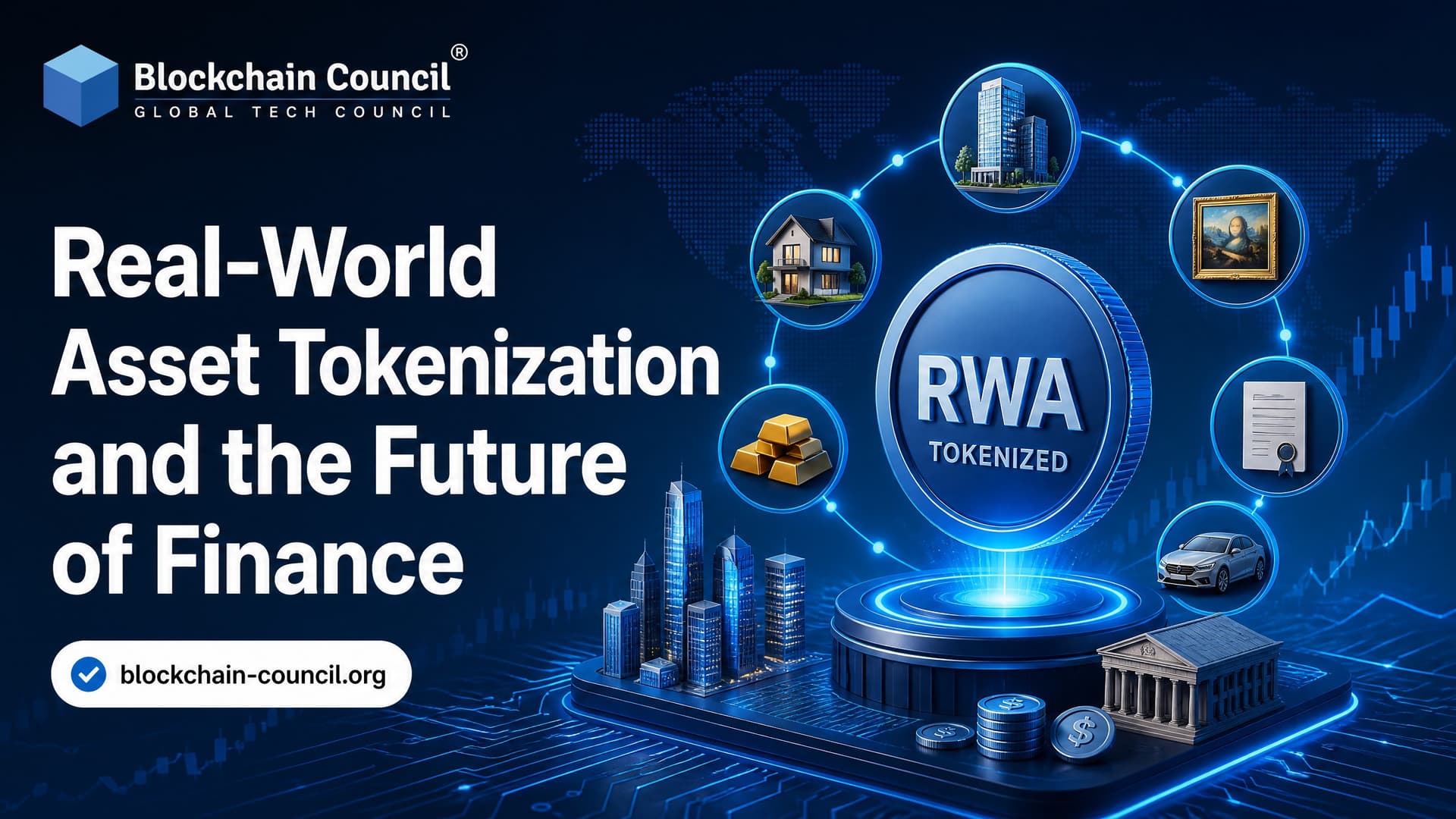
Real-World Asset Tokenization matters because it gives traditional assets a programmable, transferable, and auditable digital form. This is no longer a proof-of-concept topic. Tokenized US Treasuries, private credit, money market funds, invoices, and commodity-backed products have moved into production markets, with banks, asset managers, and DeFi protocols using them in live financial workflows. If you want a structured path into this specialization, the Certified RWA Tokenization Expert program is a reasonable place to start.
The practical idea is simple. A real asset or legal claim sits offchain. A blockchain token represents rights to that asset onchain. The hard part is everything around that token: legal structuring, custody, investor eligibility, oracle data, settlement, reporting, and risk controls. That is where serious finance starts.

What Is Real-World Asset Tokenization?
Real-world asset tokenization is the process of converting ownership rights, economic claims, or participation interests in physical or traditional financial assets into blockchain-based tokens.
Those tokens can be:
Fungible, such as units in a tokenized Treasury fund, shares of a loan pool, or fractions of a commodity reserve.
Non-fungible, such as a token tied to a specific property, artwork, certificate, or unique contractual claim.
In regulated markets, the token rarely owns the asset by itself. The usual structure is more traditional than many crypto decks admit. A special-purpose vehicle, trust, fund, or similar legal entity holds the underlying asset. The token then represents a beneficial interest, fund share, trust certificate, or contractual right. SPVs and trusts remain common structures for linking onchain tokens to offchain assets in the US.
That legal wrapper matters. Without it, a token may be only a database entry with weak enforceability. With it, the token can become part of a compliant capital market product.
The Market Has Moved Past Pilots
Since this market increasingly blends RWA tokens with stablecoins and other digital asset instruments, it is worth pairing this reading with a Certified Digital Assets Expert credential to cover that adjacent ground.
Several independent datasets point the same way: fast growth, heavier institutional involvement, and concentration in assets with clearer legal treatment.
Different dashboards count categories differently, so headline totals vary. RWA.xyz and Stobox track tokenized real-world assets in the tens of billions of dollars, roughly several times early 2025 levels. CoinGecko and Binance Research have reported similar growth curves through 2025 and into 2026. The exact figure depends on whether stablecoins and each asset class are included.
Whatever the count, the conclusion is consistent. Tokenized RWAs are not a niche experiment anymore.
Where the money is going
The current RWA market is not evenly spread across every asset class. Private credit and US Treasuries dominate.
Private credit made up the largest share of the non-stablecoin RWA market through 2025.
US Treasuries came next and reached multibillion-dollar scale through tokenized funds and short-duration government debt products.
Stablecoins are usually analyzed separately, but they show the same basic pattern: tokenized claims on real-world value. Fiat-backed stablecoins run into the hundreds of billions of dollars.
One useful point from recent analysis: US Treasuries are the only category that has reached production-grade maturity so far. That is a fair reading. Real estate tokenization gets more headlines than it deserves. Treasuries are where the cleaner product-market fit currently sits.
Why Real-World Asset Tokenization Matters
1. It creates liquidity in assets that are hard to trade
Traditional private markets are full of assets that are valuable but awkward to transfer. Think commercial real estate, trade receivables, private loans, industrial equipment, and infrastructure claims. Minimum ticket sizes are high. Settlement is slow. Ownership records sit in separate systems.
Tokenization can split economic exposure into smaller units and make secondary transfers easier. It does not magically create buyers. To be blunt, an illiquid asset can still be illiquid after tokenization. But a well-structured token can reduce operational friction, support 24/7 transfer, and make price discovery more visible.
2. It connects traditional yield to onchain markets
Tokenized Treasuries changed the conversation because they brought a familiar, regulated yield source into blockchain infrastructure. Products such as BlackRock's BUIDL fund, issued with Securitize, and Franklin Templeton's onchain money market fund showed that public and permissioned chains can carry serious financial instruments.
For DeFi, this is important. Onchain markets long depended on volatile crypto-native collateral. Tokenized Treasuries, tokenized money market shares, and invoice-backed credit pools introduce assets with different risk profiles. Maple Finance and Centrifuge are two examples of platforms that have worked on bringing private credit, invoices, and loan exposure into onchain lending markets.
3. It improves settlement and operational workflows
Many capital market processes still involve batch settlement, reconciliations, transfer agents, custodians, fund administrators, and manual reporting loops. Tokenization can compress parts of that workflow.
Smart contracts can automate:
Interest or coupon distributions
Investor allowlist checks
Transfer restrictions
Cap table updates
Collateral movement
Basic waterfall rules for asset pools
Here is a detail developers learn quickly: tokenized securities should not be treated like a plain ERC-20 meme token. If you integrate a restricted token into a DeFi pool and the recipient address is not allowlisted, the transfer can revert before balances move. Another common mistake is decimals. ERC-20 accounting is integer-based. If a tokenized cash product uses 6 decimals and your vault assumes 18, yield and share calculations can be wrong by orders of magnitude. Small default, expensive bug. Developers working through this level of implementation detail often reinforce their fundamentals with a general Tech Certification, since the underlying systems and API knowledge applies well beyond any single token standard.
4. It can widen access, but only within compliance boundaries
Fractional ownership is often described as democratization. Sometimes it is. A tokenized fund can lower operational minimums and reach qualified investors across more jurisdictions. Tokenized bonds or Treasury products can give smaller institutions access to instruments that once required larger accounts and heavier operational setup.
But compliance does not disappear because a token exists. Securities laws, KYC, AML checks, transfer restrictions, tax rules, and custody obligations still apply. The stronger tokenization projects build these controls into issuance, distribution, and secondary trading from the start.
5. It gives finance better real-time visibility
Public blockchains make ownership movements, token supply, and contract activity easier to inspect. Dashboards such as RWA.xyz, CoinGecko, and Stobox market reports have become useful because they can track tokenized asset growth close to real time.
This transparency is not perfect. The underlying asset is still offchain, so investors need audits, attestations, trustee reports, reserve disclosures, and reliable legal documentation. Still, onchain data gives risk teams a better starting point than static PDFs and delayed fund statements.
Major Use Cases for RWA Tokenization
Tokenized Treasuries and money market funds
This is the strongest live use case today. Tokenized Treasury products offer onchain access to short-duration government debt exposure, often used for cash management, collateral, and institutional liquidity. BlackRock and Securitize's BUIDL has held a large share of this segment.
Private credit, loans, and invoices
Private credit is the largest non-stablecoin RWA category in several datasets. Tokenized invoice pools and loan portfolios can connect borrowers to global liquidity while giving investors exposure to offchain credit. The trade-off is credit risk. You must understand borrower underwriting, collateral rights, servicing, defaults, and recovery processes.
Real estate
Real estate tokenization allows fractional exposure to residential, commercial, or fund-based property assets. It can reduce minimums and simplify ownership transfers. It is also one of the most overmarketed areas. Property law, local registration, tenant cash flows, maintenance, valuation, and foreclosure rules make real estate harder to scale than tokenized Treasuries.
Commodities and precious metals
Gold-backed tokens such as PAX Gold show how physical commodities can be represented onchain when custody and redemption rules are clear. Similar models are being tested for other metals and energy-linked assets.
Carbon credits, IP, and alternative assets
Carbon credits, intellectual property royalties, industrial equipment, agriculture assets, and healthcare equipment are early but interesting categories. The value is not just trading. Tokenization can support financing, provenance, traceability, and automated distributions.
What This Means for Professionals and Enterprises
If you work in finance, risk, law, product, or engineering, real-world asset tokenization changes the skill set you need.
Financial professionals need to understand SPVs, trusts, fund structures, custody, collateral quality, and investor eligibility.
Developers need skills in Solidity 0.8.x, ERC-20, ERC-721, restricted token designs such as ERC-1404 and ERC-3643, wallet integration, and contract testing with tools such as Hardhat or Foundry.
Enterprises need operating models for issuance, compliance, reporting, key management, and incident response.
Risk teams need to connect onchain analytics with offchain audits, legal documents, and asset servicing data.
For structured learning, Blockchain Council's Certified Blockchain Expert™ is a useful starting point for business and architecture fundamentals. Developers building issuance or compliance contracts should look at Certified Smart Contract Developer™. If your focus is lending, liquidity pools, or tokenized collateral, Certified DeFi Expert™ is the more direct fit. If part of your role involves pitching a tokenization platform to investors or explaining it to non-technical stakeholders, a Marketing Certification rounds out that side of the skill set, since even a well-structured RWA product still needs clear positioning to attract real investor demand.
Building the Next Generation of Tech Talent
Real-world asset tokenization is a good reminder that today's specialized finance and blockchain roles will need a steady pipeline of technically curious people coming up behind them. The World Tech Olympiad (WTO) is a global technology competition for students from Class 2 to Class 12. Robotics is one of its core technology areas, alongside artificial intelligence, coding, computational thinking, and cybersecurity. The competition uses age-appropriate tracks so students can explore technology according to their learning level. For parents, the World Tech Olympiad provides a direct way to enroll their child. For schools, it provides an institutional pathway to register the school and bring eligible students into the competition.
The Future of Finance Will Be Hybrid
The most realistic future is not all assets moving to public blockchains overnight. It is a hybrid model. Banks, asset managers, custodians, trustees, and regulated issuers will continue to control the legal and operational side of many assets. Blockchains will handle representation, transfer, settlement logic, transparency, and integration with digital markets.
That is why Real-World Asset Tokenization matters. It joins the enforceability of traditional finance with the programmability of blockchain infrastructure. Start by studying tokenized Treasuries, private credit, and stablecoins. Then build a simple restricted-token prototype, test transfers with allowlisted and non-allowlisted wallets, and map the legal rights behind each token before writing production code.
FAQs
1. What is real-world asset tokenization?
Real-world asset tokenization is the process of representing ownership or rights to physical or traditional financial assets, such as real estate, bonds, commodities, or artwork, as digital tokens on a blockchain. These tokens can enable more efficient ownership, transfer, settlement, and recordkeeping.
2. How does real-world asset tokenization work?
Asset tokenization typically involves identifying an asset, establishing legal ownership rights, creating digital tokens that represent those rights, and issuing them on a blockchain. Smart contracts can then manage transactions, transfers, and other predefined conditions.
3. What assets can be tokenized?
A wide range of assets can potentially be tokenized, including real estate, government bonds, corporate debt, commodities, private equity, investment funds, artwork, intellectual property, and other financial instruments.
4. Why is real-world asset tokenization important for the future of finance?
Tokenization could make financial markets more accessible, programmable, transparent, and efficient. By connecting traditional assets with blockchain infrastructure, it may reduce settlement friction, automate certain processes, and create new ways to distribute and manage investments.
5. What are the benefits of tokenizing real-world assets?
Key benefits can include fractional ownership, faster settlement, improved transparency, automated compliance, lower administrative costs, greater liquidity, and broader investor access. The actual benefits depend on the asset, legal structure, technology, and regulatory environment.
6. What is fractional ownership in asset tokenization?
Fractional ownership allows an asset to be divided into smaller digital units. For example, instead of purchasing an entire property, eligible investors could potentially own tokens representing fractional interests in that property.
7. How does blockchain support real-world asset tokenization?
Blockchain provides a digital infrastructure for recording token ownership and transactions. Its shared ledger can improve traceability, while smart contracts can automate specific rules and processes associated with tokenized assets.
8. Is real-world asset tokenization the same as cryptocurrency?
No. Cryptocurrencies are generally native digital assets, whereas tokenized real-world assets represent claims, ownership interests, or rights connected to assets that exist outside the blockchain. Their legal and economic structures can therefore be very different.
9. What is a tokenized real estate asset?
A tokenized real estate asset is a property or property-related investment represented digitally through blockchain-based tokens. Depending on the structure, the tokens may represent ownership, an economic interest, debt, or another legally defined claim.
10. Can bonds and securities be tokenized?
Yes. Bonds, funds, and other securities can be issued or represented using blockchain-based tokenization structures. Tokenized securities may support automated settlement, transparent recordkeeping, and programmable financial features, subject to applicable securities laws.
11. Does tokenization make real-world assets more liquid?
Tokenization can potentially improve liquidity, particularly by enabling smaller ownership units and digital transfer mechanisms. However, tokenization alone does not guarantee liquidity. Active markets, investor demand, regulatory compliance, and suitable trading infrastructure are also necessary.
12. What are the risks of real-world asset tokenization?
Major risks include regulatory uncertainty, smart contract vulnerabilities, cybersecurity threats, inaccurate asset valuation, custody issues, liquidity limitations, fraud, and uncertainty about the legal rights represented by a token.
13. Is real-world asset tokenization regulated?
Yes, tokenized assets can fall under existing financial, securities, property, tax, and consumer-protection regulations depending on their structure and jurisdiction. The regulatory treatment varies significantly across countries and asset classes.
14. How can tokenization reduce financial settlement times?
Traditional transactions can involve multiple intermediaries and reconciliation processes. Blockchain-based infrastructure can coordinate ownership records and transaction settlement digitally, potentially reducing delays and operational friction.
15. What role do smart contracts play in asset tokenization?
Smart contracts are blockchain-based programs that execute predefined rules. In tokenized finance, they can support functions such as transfers, payment distribution, compliance checks, voting, collateral management, and automated settlement.
16. Will tokenization replace traditional financial institutions?
Tokenization is unlikely to simply eliminate traditional financial institutions. Instead, it may change how banks, asset managers, brokers, custodians, exchanges, and other financial organizations issue, manage, and settle assets.
17. How could real-world asset tokenization affect investors?
Tokenization could give investors access to smaller investment units, new asset classes, potentially faster settlement, and digitally enabled investment processes. However, investor eligibility, minimum investment requirements, liquidity, and regulatory restrictions will continue to vary by product and jurisdiction.
18. What is the future of real-world asset tokenization?
The future of RWA tokenization is likely to involve greater integration between blockchain networks and traditional financial infrastructure. Potential developments include tokenized bonds, funds, real estate, private markets, and other financial products, alongside improved compliance, custody, interoperability, and settlement systems.
19. Is real-world asset tokenization a good investment?
Tokenization itself is a technology and financial-market structure, not an investment recommendation. Whether a tokenized asset is suitable depends on factors such as the underlying asset, valuation, expected returns, liquidity, legal rights, fees, risks, and regulatory status.
20. How will real-world asset tokenization shape the future of finance?
Real-world asset tokenization could contribute to a more digital, programmable, fractional, and interconnected financial system. Its long-term impact will depend on regulatory clarity, institutional adoption, blockchain infrastructure, interoperability, investor demand, and the ability to connect on-chain records with legally enforceable ownership in the real world.
Related Articles
View All
Digital Assets
RWA Tokenization in Institutional Finance: Use Cases for Banks and Asset Managers
RWA tokenization is moving into production across tokenized funds, collateral networks, deposits, bonds, private credit, and trade finance.

Digital Assets
The Role of Smart Contracts in Real-World Asset Tokenization
Smart contracts enforce issuance, compliance, settlement, and investor rights in real-world asset tokenization, making RWAs operational and auditable.

Digital Assets
CBDC and Real-World Asset Tokenization: Enabling Digital Securities and RWAs
CBDCs and real-world asset tokenization are converging to support digital securities, tokenized bonds, treasuries, and regulated on-chain settlement.
Trending Articles

Top 5 DeFi Platforms
Explore the leading decentralized finance platforms and what makes each one unique in the evolving DeFi landscape.

Can DeFi 2.0 Bridge the Gap Between Traditional and Decentralized Finance?
The next generation of DeFi protocols aims to connect traditional banking with decentralized finance ecosystems.
Claude AI Tools for Productivity
Discover Claude AI tools for productivity to streamline tasks, manage workflows, and improve efficiency.