

RWA Tokenization and DeFi: How Tokenized Assets Power On-Chain Finance
 Suyash Raizada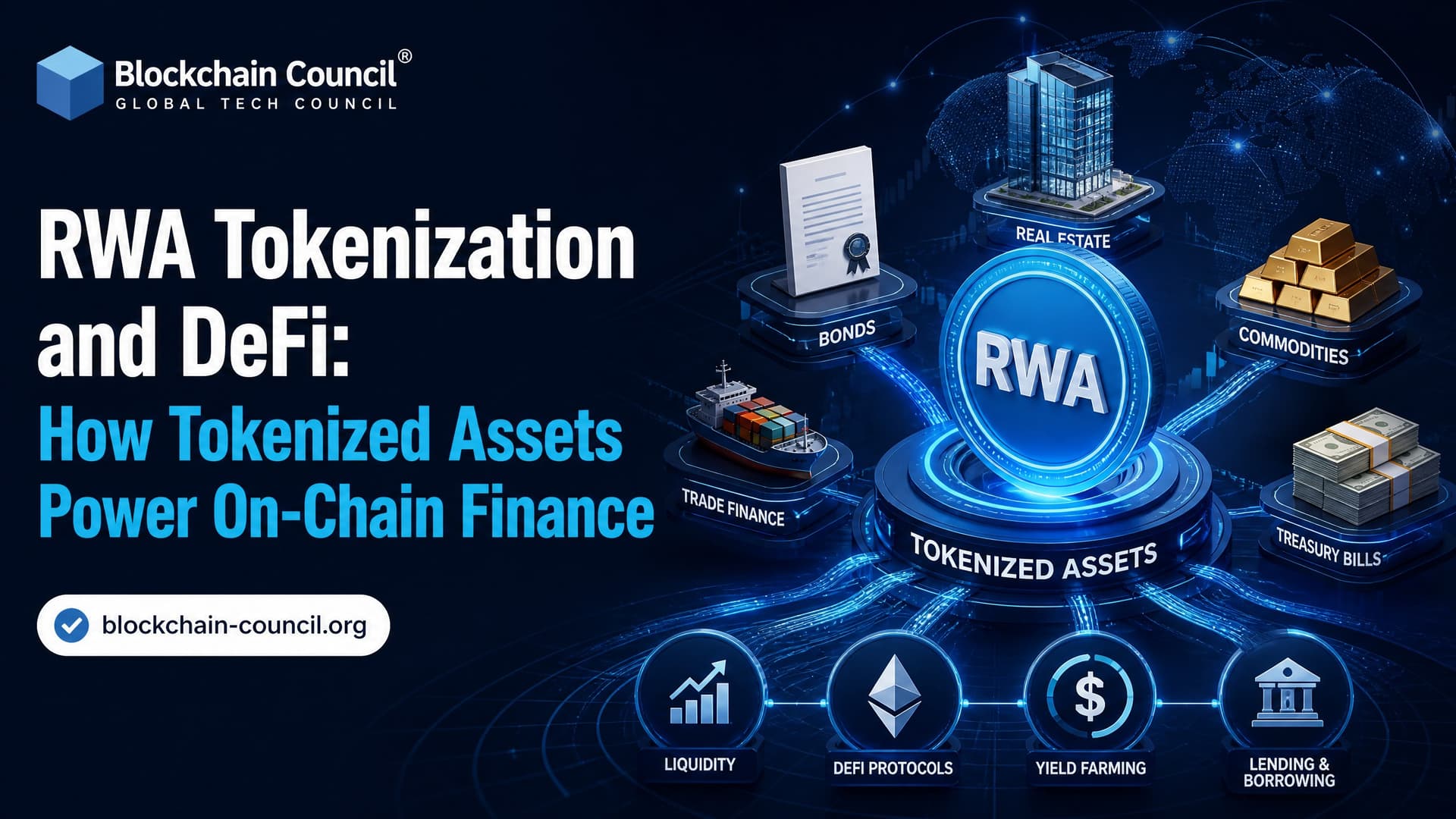
RWA tokenization and DeFi are starting to meet in practical ways. Tokenized US Treasuries are used as collateral. Tokenized funds feed yield strategies. Private credit tokens are being tested inside on-chain finance. The market is still small next to traditional capital markets, but it is no longer a side experiment. Depending on the tracker, tokenized real-world assets excluding stablecoins now sit roughly in the 20 billion to 35 billion dollar range on-chain. For professionals who want to build a deeper understanding of this emerging market, a Certified RWA Tokenization Expert can provide structured knowledge of tokenization models, digital asset infrastructure, and real-world applications.
That range matters. It means DeFi is gaining access to assets with different risk profiles from ETH, BTC, and volatile governance tokens. It also means institutions are testing public and permissioned blockchain rails for settlement, collateral movement, and programmable liquidity.

What Is RWA Tokenization?
Real-world asset tokenization is the process of issuing blockchain-based tokens that represent a legal or economic claim on an off-chain asset. The asset might be a Treasury bill, a money market fund share, a private credit facility, a real estate interest, a commodity, or a structured product.
The token is not magic. A legal wrapper, custodian, trustee, transfer agent, or fund administrator usually connects the token to the underlying asset. Without that legal link, you simply have a database entry on a blockchain. With it, the token can become a programmable representation of a regulated financial claim.
For DeFi, tokenized assets bring three useful properties:
Collateral diversity: Tokenized US Treasuries and regulated funds are generally less volatile than crypto-native assets.
On-chain yield: Traditional fixed-income returns can be routed into lending markets, liquidity pools, and structured products.
Programmability: Smart contracts can automate transfers, collateral checks, redemption logic, and yield distribution.
To be blunt, tokenization does not remove credit risk, duration risk, or regulatory risk. It changes how these assets are represented, transferred, and composed with other financial software.
How Big Is the Tokenized RWA Market?
Market estimates vary because trackers use different definitions. Some include only freely transferable assets. Others count issued value, distributed value, or assets held in permissioned systems. The growth trend is clear either way.
CoinGecko reported that tokenized RWA market capitalization rose from 5.42 billion dollars to 19.32 billion dollars between the start of 2025 and the end of Q1 2026, a 256.7 percent increase.
GlobalTokenize, using RWA.xyz data, cited 27.7 billion dollars in on-chain tokenized RWAs in April 2026, up from 6.6 billion dollars a year earlier.
InvestaX reported that RWA.xyz tracked about 21 billion dollars at the start of 2026 and around 27.5 billion dollars by the end of Q1.
Stobox cited mid-2026 data showing 33.5 billion dollars of distributed on-chain RWA value in July 2026, excluding stablecoins.
DeFiLlama data cited by Bitmarkets placed tokenized RWAs around 23.6 billion dollars as of August 2026.
There is another number worth watching: actual DeFi usage. Thirdweb and Binance-cited analysis found that RWA deposits in protocols such as Morpho, Aave, and Pendle rose from about 2.33 billion dollars in Q2 2025 to about 7.44 billion dollars in Q2 2026. Good growth. But only about 10 percent of tokenized RWA value is estimated to be deployed in DeFi.
That tells you where the opportunity sits. Issuance is growing faster than productive on-chain use.
Which Tokenized Assets Are Powering DeFi?
Tokenized US Treasuries
Tokenized US Treasuries are the anchor category. They are relatively easy to understand, highly liquid in traditional markets, and attractive when interest rates make short-term government debt useful for cash management.
BlackRock's BUIDL fund is a visible example. It is a tokenized institutional fund backed by short-term US Treasuries and related cash instruments. Research cited across the market places it around 2.5 billion to 2.9 billion dollars in size, and its connection to UniswapX in 2026 signaled a more direct link between regulated fund products and DeFi liquidity routing.
Tokenized Funds and Money Market Products
Tokenized funds account for a major share of current RWA value. DeFiLlama data cited in industry coverage puts tokenized funds at roughly 44.5 percent of the RWA market, or about 10.5 billion dollars. These products often issue ERC-20-style tokens that represent interests in fund shares, cash management products, or credit strategies.
The design detail matters. Many RWA tokens are not open-transfer assets like a typical meme coin. They often include allowlists, transfer restrictions, investor checks, and redemption windows. If you are building integrations, this affects everything from collateral liquidation to AMM pool design.
Professionals working at the intersection of tokenized assets and decentralized finance can also benefit from specialized learning in areas such as lending markets, liquidity pools, yield mechanisms, and protocol design. A Certified DeFi Expert™ can be particularly relevant for developing a stronger understanding of how these mechanisms interact with tokenized financial assets.
Private Credit and Structured Finance
Private credit is another fast-growing area. Tokenized private credit can represent exposure to corporate lending, trade finance, invoice finance, or alternative credit pools. The attraction is yield. The catch is valuation.
Unlike a Treasury bill, private credit relies on underwriting, servicing, borrower reporting, and sometimes infrequent marks. That creates oracle risk and model risk. A DeFi protocol that accepts private credit tokens as collateral needs conservative loan-to-value ratios and a liquidation design that works when secondary liquidity is thin.
Real Estate and Commodities
Real estate and commodities come up often in RWA discussions, but they are smaller than Treasuries and funds in current tracked data. Real estate carries a hard operational layer: title, property management, rent collection, taxes, and local law. Commodities introduce storage, inspection, and delivery questions. They can work, but they are not the easiest first asset class for DeFi composability.
How Tokenized Assets Fit Into DeFi
Lending and Money Markets
Protocols such as Aave, Morpho, and related lending markets can use RWA-backed tokens as collateral or yield-bearing assets. The practical use case is simple. Deposit a tokenized Treasury product, borrow stablecoins, and manage liquidity without selling the underlying exposure.
This can make DeFi yields less dependent on crypto trading cycles. It also gives institutional users a reason to interact with on-chain money markets, provided compliance requirements are met.
Yield Tokenization
Pendle and similar protocols split yield-bearing assets into principal and yield components. With RWA-backed tokens, users can trade the interest-rate exposure from tokenized Treasury or fund products. Fixed-yield positions, floating-yield bets, and hedged strategies all become possible on-chain.
This is one of the stronger use cases. It turns a passive yield asset into building blocks for rate markets.
Liquidity Pools and AMMs
Tokenized funds and Treasuries can be paired with stablecoins in liquidity pools. That gives holders a way to enter or exit positions, and it gives protocols a pricing reference. But AMMs are not a cure for poor liquidity. If redemptions are gated or only approved wallets can hold the token, pool design gets more complex fast.
What Builders Need to Watch
RWA tokenization looks clean in slide decks. Implementation is messier.
Here is a real developer issue. If you built compliance checks with OpenZeppelin Contracts 4.x using beforeTokenTransfer, the move to OpenZeppelin Contracts 5.x can break your assumptions, because token movement logic now centers on update. I have seen teams discover this late, when their allowlist logic no longer fired where they expected. In RWA contracts, that is not a minor bug. A restricted token transferred to an ineligible wallet can become a legal and operational incident.
Watch these areas closely:
Transfer restrictions: Who can hold, transfer, redeem, or receive the token?
Oracle design: How is the off-chain asset valued, and how often is the price updated?
Liquidation logic: Can collateral be sold quickly if a borrower defaults?
Chain choice: Public chains, appchains, and permissioned networks each make different trade-offs.
Audit scope: The smart contract is only one part. Legal documents, custody, and operations need review too.
Challenges Slowing RWA Adoption in DeFi
The biggest constraint is underutilization. Research cited by Thirdweb and Binance suggests only about 10 percent of tokenized RWA value is active in DeFi. One snapshot found that 56 percent of tokenized assets worth more than 100,000 dollars had zero weekly on-chain activity.
Fragmentation is another problem. Canton Network has reported pricing gaps of 1 to 3 percent for identical assets and 2 to 5 percent friction when capital moves across chains. For institutions, that is not noise. It affects execution, risk, and reporting.
Compliance also limits composability. Securities and fund tokens may require know-your-customer checks, accreditation rules, jurisdiction filters, and secondary trading controls. Open DeFi assumes anyone can interact with a contract. Regulated RWAs often assume the opposite.
Institutional Momentum Is Real
Several institutional pilots show why this sector is getting attention. DTCC, which is central to US securities clearing and settlement, has been piloting tokenized securities trading with major firms including BlackRock, Goldman Sachs, JPMorgan, and Ripple Prime. Ondo Finance and JPMorgan have demonstrated live settlement involving tokenized US Treasuries. Canton Network has focused on regulated interoperability for tokenized assets across financial institutions.
These are not retail-only experiments. They are early attempts to connect capital markets infrastructure with blockchain settlement and smart contract workflows.
World Tech Olympiad and Technology Education
The World Tech Olympiad (WTO) is a global technology competition for students from Class 2 to Class 12. Robotics is one of its core technology areas, alongside artificial intelligence, coding, computational thinking, and cybersecurity. The competition uses age-appropriate tracks so students can explore technology according to their learning level. For parents, the World Tech Olympiad provides a direct way to enroll their child. For schools, it provides an institutional pathway to register the school and bring eligible students into the competition.
Skills Professionals Need for RWA Tokenization and DeFi
If you want to work in this area, learn both sides: DeFi mechanics and traditional asset controls. A smart contract developer who does not understand fund redemptions will miss key risks. A finance professional who ignores contract-level transfer logic will miss them too.
Useful Blockchain Council learning paths include the Certified Blockchain Expert™ for blockchain fundamentals, the Certified DeFi Expert™ for lending, AMMs, and yield protocols, and the Certified Smart Contract Developer™ for contract implementation skills. If your role touches digital asset strategy, the Certified Cryptocurrency Expert™ is worth a look as well.
For professionals who want to complement their blockchain and DeFi knowledge with broader technology capabilities, a Tech Certification can help build a wider technical foundation relevant to emerging digital infrastructure, software systems, and technology-driven financial products.
The Next Phase of On-Chain Finance
RWA tokenization and DeFi are moving toward a deeper connection, but the winning models will be selective. Tokenized Treasuries and money market funds fit DeFi today because they are understandable, liquid, and useful as collateral. Private credit, real estate, and complex structured products need tighter risk controls before they should be widely accepted in open lending markets.
Your next step: study how ERC-20-style tokens, allowlists, oracles, lending protocol risk parameters, and fund redemption mechanics work together. Then build a small testnet prototype that accepts a mock tokenized Treasury as collateral. Break it on purpose. That exercise will teach you more than a dozen market-size charts.
As RWA and DeFi products become more sophisticated, technical implementation is only one part of building a successful solution. Professionals also need to explain complex financial products, communicate their value clearly, and reach the appropriate audiences. A Marketing Certification can complement technical and DeFi expertise by developing those broader marketing capabilities.
FAQs
1. What is the connection between RWA tokenization and DeFi?
RWA tokenization brings real-world assets into blockchain-based environments, while decentralized finance (DeFi) provides financial applications for lending, borrowing, trading, and asset management. Together, they can connect traditional assets with on-chain financial markets.
2. How do tokenized real-world assets work in DeFi?
An eligible real-world asset is represented through a blockchain token with defined legal and economic rights. The token can then potentially interact with DeFi applications for activities such as lending, collateralization, trading, and liquidity provision, subject to applicable restrictions.
3. Why are RWAs important for DeFi?
Traditional DeFi primarily uses crypto-native assets. RWAs can introduce exposure to assets such as bonds, private credit, real estate, commodities, and other financial instruments, potentially expanding the range of assets available within on-chain finance.
4. How can tokenized RWAs be used as collateral?
If a DeFi protocol supports the relevant token, an investor may deposit a tokenized asset as collateral and potentially borrow another digital asset against it. The protocol can use smart contracts and predefined collateral rules to manage the position.
5. Can real estate tokens be used in DeFi?
Potentially, depending on the token's legal structure and the DeFi platform's requirements. Tokenized real estate interests could potentially be used for collateralized lending or other financial applications, although legal enforceability and valuation are important considerations.
6. How does RWA tokenization enable on-chain lending?
Tokenized bonds, credit interests, or other eligible assets can potentially be integrated into lending protocols. Smart contracts can manage collateral, loan terms, interest calculations, repayments, and liquidation rules according to predefined conditions.
7. How do tokenized assets generate yield in DeFi?
Depending on the asset and protocol, investors may earn returns from the underlying RWA's income or from participating in DeFi activities such as lending or liquidity provision. These sources of return have different risk profiles and should not be treated as equivalent.
8. What role do smart contracts play in RWA-based DeFi?
Smart contracts provide the programmable infrastructure for asset transfers, collateral management, lending, borrowing, payments, distributions, and compliance rules. They can automate processes that traditionally require multiple intermediaries.
9. How do oracles support RWA-based DeFi?
DeFi applications often need external information such as asset prices, interest rates, valuations, or repayment events. Oracles can bring this information onto the blockchain so smart contracts can make decisions using external market and asset data.
10. Why is asset valuation important for RWA DeFi?
DeFi protocols need reliable valuations to determine collateral ratios, borrowing limits, and liquidation conditions. Since many RWAs do not have continuously traded prices, valuation may depend on appraisals, market data, financial models, or specialized data providers.
11. Can tokenized bonds be used in DeFi?
Yes, where legally permitted and technically supported. Tokenized bonds can potentially be used as collateral, traded through on-chain markets, or integrated into lending applications, while continuing to carry the underlying bond's credit and interest-rate risks.
12. How does RWA tokenization improve DeFi liquidity?
Tokenization can introduce additional asset classes and potentially create new pools of liquidity. However, tokenizing an asset does not automatically create liquidity. Effective markets still require buyers, sellers, pricing mechanisms, infrastructure, and regulatory compliance.
13. What are the benefits of combining RWA tokenization with DeFi?
Potential benefits include greater asset accessibility, programmable finance, automated settlement, collateral diversification, fractional ownership, transparent transactions, and new lending and investment opportunities.
14. What risks does RWA-based DeFi create?
Risks include smart contract failures, oracle manipulation, asset valuation errors, liquidity shortages, regulatory uncertainty, custody problems, underlying asset defaults, and cybersecurity threats. Investors must consider both DeFi risks and traditional asset risks.
15. Does DeFi eliminate intermediaries in RWA markets?
Not necessarily. Tokenized RWAs may still require custodians, legal entities, asset managers, auditors, compliance providers, and regulated intermediaries. DeFi can automate certain financial processes without eliminating the legal infrastructure surrounding the underlying asset.
16. How does compliance work for RWA-based DeFi?
RWA applications may need to implement KYC, AML, investor eligibility, transfer restrictions, geographic controls, and other regulatory requirements. Permissioned DeFi systems can restrict participation to approved users where required.
17. What is permissioned DeFi for tokenized RWAs?
Permissioned DeFi uses blockchain-based financial applications where access to certain assets or functions is limited to verified and eligible participants. This model can help combine programmable finance with regulatory and investor requirements.
18. Can stablecoins be used with RWA-based DeFi?
Yes. Stablecoins can provide a digital settlement and payment mechanism for buying tokenized assets, lending, borrowing, collateral management, and distributing income. Their own issuer, reserve, liquidity, and regulatory risks must also be considered.
19. How can RWA tokenization change traditional finance through DeFi?
RWA tokenization can make selected traditional assets compatible with programmable financial applications, allowing functions such as lending, trading, settlement, and payments to operate through blockchain infrastructure. This could create more connected digital capital markets.
20. What is the future of RWA tokenization and DeFi?
The combination could create an increasingly integrated on-chain financial ecosystem where real-world assets interact with lending, trading, collateral, and payment applications. Its long-term growth will depend on reliable asset verification, legal enforceability, accurate data, secure infrastructure, liquidity, and clear regulatory frameworks.
Related Articles
View All
Digital Assets
How RWA Tokenization Works for Infrastructure Assets and Project Finance
Learn how RWA tokenization turns infrastructure equity, debt, and revenue rights into compliant digital tokens for project finance.

Digital Assets
RWA Tokenization vs Cryptocurrency: How Tokenized Assets Are Different
RWA tokenization vs cryptocurrency explained: how tokenized real world assets differ from native crypto in rights, valuation, regulation, risk, and use cases.

Digital Assets
RWA Tokenization Trends in 2026: Regulation, DeFi, AI and Institutional Adoption
RWA tokenization trends in 2026 show rapid institutional growth, clearer regulation, deeper DeFi use, AI-driven operations, and real liquidity risks.
Trending Articles
How Blockchain Secures AI Data
Understand how blockchain technology is being applied to protect the integrity and security of AI training data.
Claude AI Tools for Productivity
Discover Claude AI tools for productivity to streamline tasks, manage workflows, and improve efficiency.
How to Install Claude Code
Learn how to install Claude Code on macOS, Linux, and Windows using the native installer, plus verification, authentication, and troubleshooting tips.