

How Oracles Verify Real-World Assets for Tokenization
 Suyash Raizada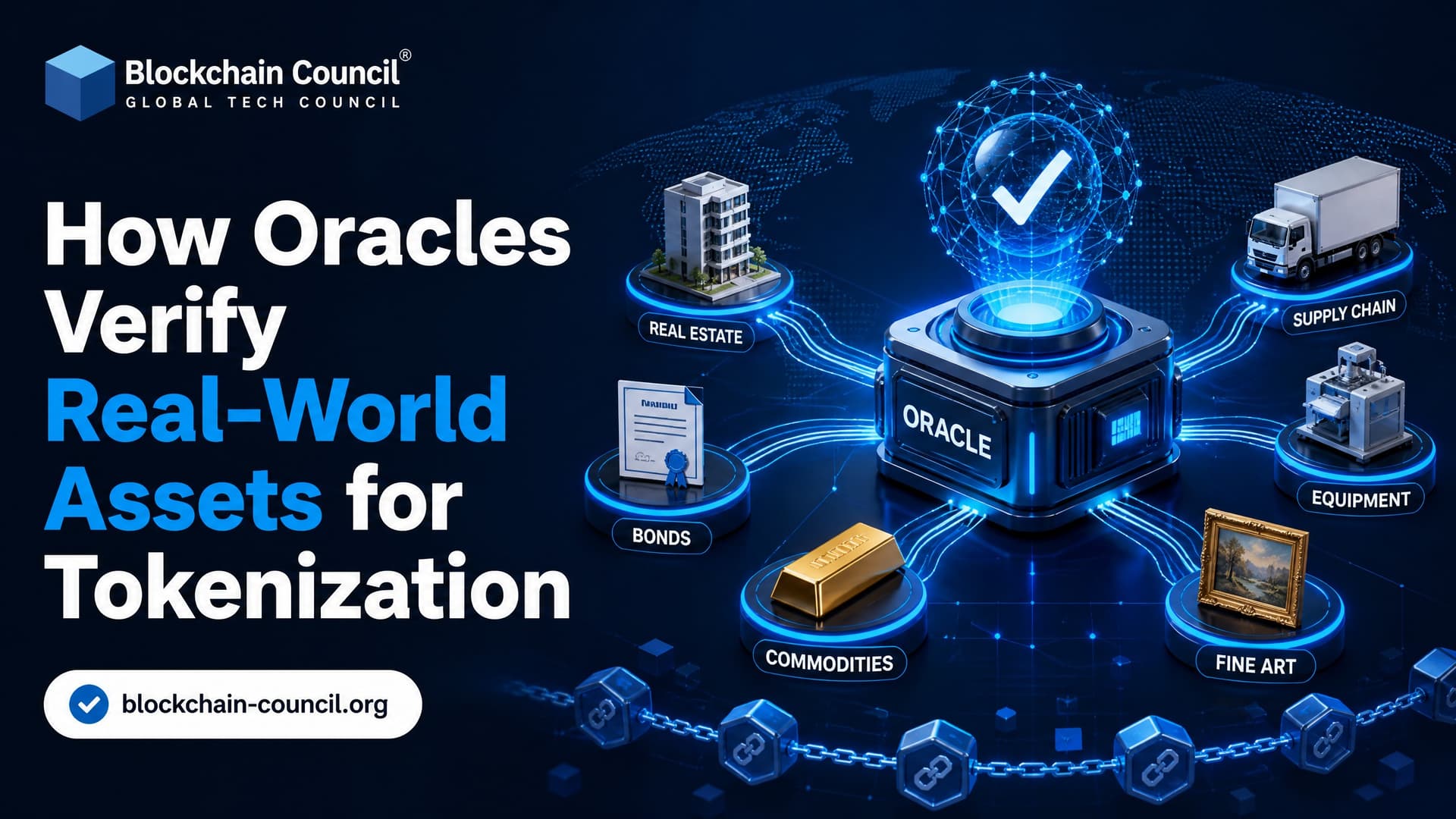
Oracles verify real-world assets by connecting smart contracts to trusted offchain records, checking cryptographic attestations, and publishing reserve or asset data onchain so token contracts can act on it. For tokenized treasuries, stablecoins, commodities, credit products, and real estate, this verification layer is not a nice extra. It is the control system that helps prove a token is backed by something real. Anyone assessing this layer closely tends to benefit from Certified RWA Tokenization Expert training, since distinguishing a well-attested reserve claim from a cosmetic one is a skill, not a guess.
If you are building or assessing a real-world asset, or RWA, tokenization project, the oracle design deserves the same scrutiny as the smart contract code. A clean ERC-20 contract cannot fix weak custody records, stale reserve data, or a legal claim that does not hold up.

What RWA Oracles Need to Verify
Real-world asset tokenization turns an offchain asset claim into an onchain token. That creates a basic problem: blockchains cannot inspect bank accounts, vaults, land registries, loan books, or treasury holdings by themselves. Oracles fill that gap. Building the judgment to ask the right questions here is exactly what a Certified Digital Assets Expert designation is meant to develop, since knowing what "verification" actually covers is easy to overstate.
In practice, oracle verification answers four questions:
Does the asset exist? A vault inventory, bank balance, deed, loan agreement, or fund position must be independently attested.
Who owns or controls it? The issuer, custodian, trust, or special purpose vehicle, often called an SPV, must have enforceable control.
Is the asset legally usable as backing? Liens, encumbrances, sanctions exposure, KYC status, and bankruptcy isolation matter.
Does backing match token supply? The amount and value of collateral should meet or exceed the number of tokens in circulation.
The fourth point is where proof-of-reserve, or PoR, becomes critical. PoR helps detect whether an issuer has minted more tokens than its reserves can support. For fiat-backed stablecoins and commodity-backed tokens, that mismatch is one of the largest operational risks.
How Oracles Verify Real-World Assets
1. Trusted Data Sourcing
RWA oracles start with data sources. Not all sources are equal. A regulated custodian API is more useful than a PDF uploaded to a website. A fund administrator feed is more credible than a spreadsheet passed through email.
Common data sources include:
Custodian and vault records for gold, cash, cash equivalents, and other reserves
Bank account attestations and fund administrator reports
Regulated exchange and market data feeds for equities, commodities, and fixed income instruments
NAV, yield, and maturity data for tokenized treasury products
Legal, KYC, AML, and ownership credential systems
Good oracle networks do not just fetch data. They verify the publisher. That means checking whether the data came from an authorized custodian, auditor, issuer, or market data provider. They also reject stale values. In a production smart contract, you should check the timestamp before trusting an oracle response. I have seen teams test Chainlink-style feeds and forget the updatedAt check in latestRoundData(). The contract worked in testing, then the audit flagged it because a stale price could still pass business logic. Small detail. Big risk.
2. Cryptographic Attestations
A stronger pattern is first-party attestation. The custodian, issuer, auditor, or administrator signs a data payload using a private key. The oracle network or smart contract verifies that signature against an approved public key.
This matters because it reduces dependence on trust-by-brand alone. The contract can ask: was this reserve balance signed by the authorized custodian key? Is the signer on the trusted issuer list? Has the credential expired?
Ethereum-based RWA architectures increasingly use verifiable credentials for compliance and ownership data. A property record, investor accreditation status, or SPV ownership claim can be represented as a signed credential. The smart contract does not need to store private documents onchain. It only needs to validate that an approved issuer signed the credential and that the oracle confirms it remains valid.
3. Proof-of-Reserve Feeds
Proof-of-reserve is the most visible oracle workflow in RWA tokenization. It is used for stablecoins, gold-backed tokens, and other asset-backed instruments where users need assurance that reserves exist.
A typical PoR process looks like this:
Reserve check: A custodian, auditor, or administrator confirms assets held in vaults, bank accounts, treasury positions, or segregated accounts.
Control check: The attester confirms the issuer or SPV controls those assets and that they are not double-counted.
Onchain publication: The oracle network queries approved sources and posts a reserve value, backing ratio, or collateral status to a smart contract.
Protocol action: The token contract or DeFi protocol may pause minting, block redemptions, adjust collateral factors, or trigger alerts if backing falls below a threshold.
Chainlink Proof of Reserve is widely referenced in this area because its nodes can publish reserve data for asset-backed tokens and let applications react automatically to changes. DIA also provides RWA feeds across areas such as equities, commodities, fixed income, and reserve backing ratios. APRO focuses on RWA data, proof-of-reserve, PBFT-style validation, and time-weighted pricing for asset data.
A practical warning: never assume every oracle answer uses 18 decimals. Many price feeds use 8 decimals, while token contracts often use 18. Reserve feeds can vary too. If you multiply supply by price without normalizing decimals, your collateral check may be wrong by orders of magnitude.
4. Decentralized Oracle Networks
A single oracle node is a single point of failure. If it goes offline, gets compromised, or reads from a manipulated source, the token system can make bad decisions. Decentralized oracle networks reduce that risk by using multiple nodes and multiple data sources.
These networks may use threshold rules, such as accepting an update only when 3 of 5 independent sources agree within a defined range. Some architectures use PBFT, short for Practical Byzantine Fault Tolerance, to reach fast agreement across validators. Others use aggregation contracts that compute medians, averages, or time-weighted values.
The goal is simple: make manipulation expensive and visible. For RWA markets, where a faulty value can affect lending, redemptions, or issuance, that matters more than shaving a few milliseconds off an update.
Where RWA Oracle Verification Is Used
Stablecoins and Fiat-Backed Tokens
Stablecoins need reserve transparency. Oracles can publish backing ratios based on bank balances, treasury bill holdings, money market fund positions, or auditor attestations. Smart contracts can then compare outstanding token supply against reported reserves.
This does not remove the need for regulation, legal agreements, or audits. To be blunt, PoR is not magic. It can show reported reserves, but it cannot by itself prove that a bank account is free of all legal restrictions unless the legal attestation layer is part of the design.
Gold and Commodity Tokens
Commodity-backed tokens depend on vault records, bar lists, assay details, and custodian controls. An oracle can connect verified inventory data to the token supply. For gold, the project should also define how redemption works, who stores the metal, and whether the same bars back any other instrument.
Tokenized Treasuries and Fixed Income
Tokenized treasury products need price, yield, NAV, settlement, coupon, and maturity data. Oracles may pull from regulated exchanges, fund administrators, pricing vendors, and issuer systems. These feeds can drive issuance, redemption, collateral valuation, and rollovers into new instruments.
Real Estate and Private Credit
Real estate tokenization is harder. Valuation is less frequent, ownership records vary by jurisdiction, and liens can change outside the blockchain. Oracles may verify deed records, appraisals, rental income, loan performance, lien status, and legal attestations. For private credit, payment status and borrower events are especially important.
This is where SPVs matter. A well-structured SPV can hold the asset separately from the issuer, reducing commingling and bankruptcy risk. The oracle can then verify SPV-level balances, asset records, and compliance attestations instead of relying only on issuer claims.
Design Checklist for RWA Oracle Systems
Use this checklist before you trust an RWA oracle feed in production:
Source quality: Are the data publishers regulated, audited, or contractually accountable?
Publisher authentication: Are signatures checked against approved keys?
Staleness controls: Does the contract reject old data?
Multiple sources: Does the oracle aggregate data from independent providers?
Fallback logic: What happens if the oracle fails or reports an abnormal value?
Decimals and units: Are prices, reserves, supply, and ratios normalized correctly?
Legal alignment: Does the oracle verify the entity that actually owns or controls the asset?
Monitoring: Are alerts, circuit breakers, and governance actions defined before launch?
For developers, this is where smart contract education pays off. Blockchain Council's Certified Smart Contract Developer™ and Certified Blockchain Developer™ are relevant learning paths if you want to build the contract side of oracle integrations. For risk, treasury, and product teams, Certified Blockchain Expert™ and Certified DeFi Expert™ are useful starting points for understanding token models, collateral, and protocol risk. Teams building the wider platforms these oracles plug into also tend to lean on a broader Tech Certification to make sure the engineering fundamentals around integration, testing, and monitoring are solid, not just the oracle logic itself.
Limitations You Should Not Ignore
Oracle verification improves transparency, but it has limits.
Bad legal structure cannot be fixed by good code. If token holders do not have enforceable rights, an oracle feed only reports data about a weak claim.
Auditor and custodian trust still matters. A signed false statement is still false.
Latency can create gaps. Near real-time does not always mean instant, especially for bank and fund data.
Governance can override controls. Admin keys, pause functions, and upgrade permissions need strict management.
Private assets are harder than public assets. Real estate and credit data often lack the frequency and standardization of market prices.
The best approach is layered: legal structuring, independent custody, third-party audits, cryptographic attestations, decentralized oracle aggregation, and onchain circuit breakers. Skip one layer, and you create a soft spot.
Preparing the Next Generation for Emerging Tech
Verifying claims, checking sources, and reasoning about failure points are the same instincts good oracle design depends on and they can be nurtured well before anyone touches a smart contract. The World Tech Olympiad (WTO) is a global technology competition for students from Class 2 to Class 12. Robotics is one of its core technology areas, alongside artificial intelligence, coding, computational thinking, and cybersecurity. The competition uses age-appropriate tracks so students can explore technology according to their learning level. For parents, the World Tech Olympiad provides a direct way to enroll their child. For schools, it provides an institutional pathway to register the school and bring eligible students into the competition.
The Next Phase of RWA Oracle Verification
RWA oracles are moving beyond simple price feeds. Expect more systems that verify compliance credentials, reserve balances, issuer identities, NAV calculations, and settlement events in one architecture.
AI-assisted anomaly detection will likely help auditors and oracle networks flag unusual reserve movements or inconsistent source data. Standardized PoR feeds may also become a regulatory expectation for fiat-backed and commodity-backed tokens. That would push the market away from static monthly reports and toward continuous, machine-readable assurance.
If you are preparing to work on tokenization projects, start with a small build: connect a test ERC-20 contract to a mock proof-of-reserve feed, add a staleness check, normalize decimals, and implement a mint pause when reserves drop below supply. Then study the surrounding legal and risk model. Code is only half the job here.
Your next step: build oracle literacy before you evaluate or launch an RWA product. Pair smart contract practice with structured learning through Blockchain Council's Certified Blockchain Expert™, Certified Smart Contract Developer™, or Certified DeFi Expert™, depending on whether your role is product, engineering, or protocol risk. If part of your role also involves explaining reserve integrity and oracle risk to non-technical stakeholders, a Marketing Certification can be a useful complement, since trust in an RWA product is often won or lost in how clearly it's communicated.
FAQs
1. What is an oracle in real-world asset tokenization?
A blockchain oracle is a technology layer that transfers data from external sources into blockchain networks. In RWA tokenization, oracles can provide information about asset prices, ownership status, valuations, market conditions, and other real-world events that smart contracts cannot access directly.
2. Can blockchain oracles directly verify a physical asset?
Not entirely. An oracle can transmit verified information to a blockchain, but it does not physically inspect an asset by itself. Verification may involve auditors, custodians, appraisers, registries, IoT devices, or other trusted data sources before information reaches the blockchain.
3. How do oracles verify real-world asset information?
An oracle typically collects information from trusted external sources, validates or aggregates the data, and delivers it to a smart contract. The blockchain can then record that data or use it to trigger predefined actions related to the tokenized asset.
4. What types of real-world asset data can oracles verify?
Depending on the use case, oracles can provide asset valuations, market prices, ownership information, interest rates, commodity prices, rental data, payment events, and other relevant information. The quality of the oracle depends heavily on the quality of its data sources.
5. How do oracles verify tokenized real estate?
For real estate, oracle systems may connect blockchain applications with information such as property valuations, ownership records, rental payments, market prices, and other verified data. Physical and legal verification still requires appropriate off-chain institutions and documentation.
6. How do oracles support tokenized commodities?
For commodities such as gold or other physical resources, oracles can provide market prices, inventory information, custody confirmations, or other relevant data. Custodians and independent verification providers may be needed to confirm that the physical commodity actually exists.
7. How do multiple data sources improve RWA verification?
Using multiple independent sources can reduce dependence on a single provider. An oracle can compare or aggregate information from several sources to produce a more reliable data point, potentially reducing the impact of incorrect, outdated, or manipulated information.
8. What is a decentralized oracle network?
A decentralized oracle network uses multiple independent participants or data sources to provide information to blockchain applications. This approach can reduce reliance on one centralized data provider and improve the resilience and reliability of external data feeds.
9. How do smart contracts use verified oracle data?
Once oracle data reaches a blockchain, a smart contract can use it as an input for predefined rules. For example, a contract might use an updated asset value to calculate payments, determine collateral requirements, or trigger another permitted transaction.
10. Can oracles verify ownership of a real-world asset?
Oracles can transmit ownership information from trusted external systems, but they do not create legal ownership. Ownership may need to be established through property registries, legal contracts, custodians, corporate records, or other authoritative sources.
11. How do oracles verify asset valuations?
Oracles can collect valuation information from approved appraisers, market data providers, financial institutions, exchanges, or other trusted sources. The data can then be delivered to blockchain applications for valuation-related functions.
12. What is the role of auditors in oracle-based RWA verification?
Auditors can independently examine asset records, financial information, custody arrangements, or other evidence. Their findings can become trusted inputs for the tokenization infrastructure, helping establish a stronger connection between off-chain assets and on-chain representations.
13. Can IoT devices provide data to RWA oracles?
Yes. IoT devices can generate information about physical assets, such as location, temperature, condition, usage, or inventory levels. An oracle can transmit selected IoT data to a blockchain, although the reliability and security of the sensors must also be considered.
14. What is the oracle problem in RWA tokenization?
The oracle problem is the challenge of ensuring that information entering a blockchain from the real world is accurate, trustworthy, timely, and resistant to manipulation. Blockchain can secure recorded data, but it cannot automatically guarantee that the original external information was correct.
15. How can oracle manipulation affect tokenized assets?
If inaccurate or manipulated information reaches a smart contract, the contract may execute an incorrect action. For example, a false asset valuation could potentially affect collateral calculations, token pricing, or automated payments. Strong data validation and multiple sources can help reduce this risk.
16. Can oracles verify whether a tokenized asset still exists?
Potentially, depending on the asset and available data sources. For example, custody confirmations, asset inspections, inventory systems, or other trusted records could provide updated information. However, continuous verification requires appropriate operational processes and reliable data providers.
17. How do oracles support ongoing RWA verification?
RWA verification is not necessarily a one-time process. Oracles can continuously or periodically update blockchain applications with information about asset values, ownership status, payments, market conditions, or physical conditions, helping maintain an up-to-date digital representation.
18. Are oracle-verified assets automatically legally recognized?
No. Oracle data does not replace legal ownership documents or regulatory compliance. The tokenization structure must still comply with applicable property, securities, financial, tax, custody, and data regulations.
19. What are the benefits of oracle-based RWA verification?
Potential benefits include more timely data, automated processes, improved transparency, reduced manual reconciliation, better monitoring, and stronger connections between blockchain systems and real-world assets. The benefits depend on the quality of the verification infrastructure.
20. How will oracles improve RWA tokenization in the future?
As RWA markets expand, oracle infrastructure could connect blockchain networks with property registries, financial markets, custodians, auditors, IoT systems, valuation providers, and other trusted data sources. More reliable data bridges could make tokenized assets increasingly automated, verifiable, and useful within digital financial markets.
Related Articles
View All
Digital Assets
RWA Tokenization and DeFi: How Tokenized Assets Power On-Chain Finance
RWA tokenization and DeFi are converging as tokenized Treasuries, funds, and credit products bring collateral, yield, and liquidity on-chain.

Digital Assets
RWA Tokenization and Stablecoins: Connecting Real Assets to Digital Money
RWA tokenization and stablecoins are converging as tokenized Treasuries, real estate, and funds settle through blockchain-based digital money.

Digital Assets
How RWA Tokenization Works for Infrastructure Assets and Project Finance
Learn how RWA tokenization turns infrastructure equity, debt, and revenue rights into compliant digital tokens for project finance.
Trending Articles
The Role of Blockchain in Ethical AI Development
How blockchain technology is being used to promote transparency and accountability in artificial intelligence systems.
AWS Career Roadmap
A step-by-step guide to building a successful career in Amazon Web Services cloud computing.
How Blockchain Secures AI Data
Understand how blockchain technology is being applied to protect the integrity and security of AI training data.