

Real-World Asset Tokenization: How RWAs Are Reshaping Finance
 Suyash Raizada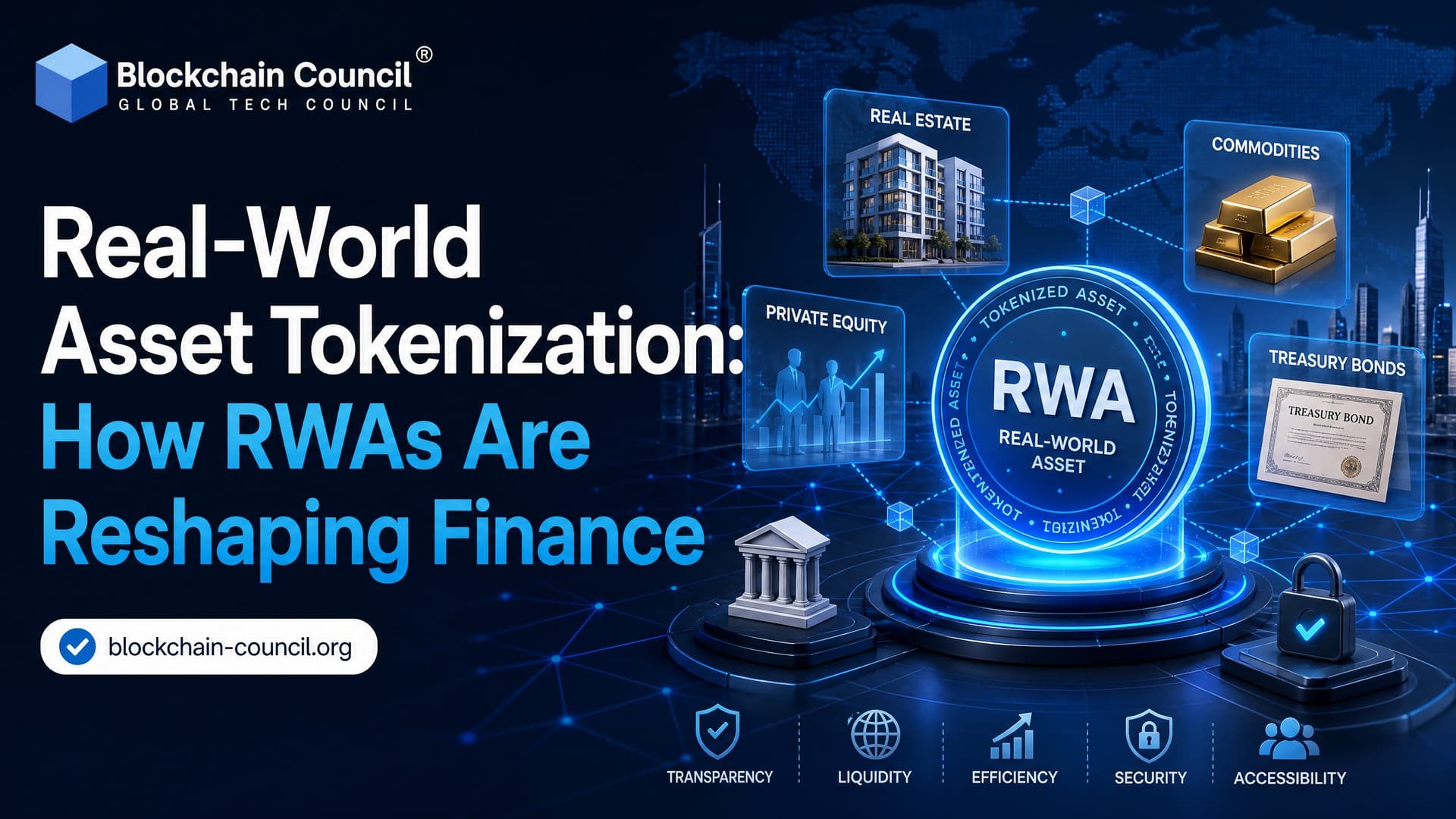
Real-world asset tokenization is no longer a side experiment for crypto teams. It is becoming a serious operating layer for bonds, funds, private credit, real estate, commodities, and other assets that used to sit inside slow, paper-heavy financial rails.
The numbers explain why. RWA.xyz data shows blockchain-based real-world assets rising from roughly 5.8 billion dollars in early January 2025 to more than 30 billion dollars by mid-2026. Coinbase reported tokenized RWAs, excluding stablecoins, at 13.5 billion dollars in December 2024 after growth above 60 percent. That is still small beside global capital markets, but the direction is clear.

As real-world assets increasingly move onto blockchain networks, professionals need a solid understanding of digital asset governance, tokenization frameworks, custody models, and regulatory considerations. A Certified Digital Assets Expert credential helps build these practical skills, enabling individuals to evaluate and manage digital asset ecosystems with greater confidence as institutional adoption accelerates.
What Is Real-World Asset Tokenization?
Real-world asset tokenization is the process of representing rights to an off-chain asset as a blockchain token. The asset may be a Treasury bill, a money market fund share, a commercial property, a gold bar, a private loan, or a portfolio of invoices.
The token does not magically place the building or bond on-chain. That distinction matters. The token records ownership, transfer history, and rules on a blockchain, while the underlying asset stays with a custodian, fund, trustee, or legal entity. In practice, the token is a claim on the asset or on its cash flows.
What Makes RWA Tokens Different?
Programmability: Smart contracts can automate transfers, coupon payments, whitelisting, lockups, and investor eligibility checks.
Fractional ownership: Large assets can be divided into smaller units, which can lower minimum investment sizes.
24/7 market access: Tokenized assets can move outside normal banking hours, subject to compliance rules and market liquidity.
Composability: Tokenized assets can be used in lending, collateral management, structured products, and treasury operations.
If you have deployed permissioned tokens before, you know the compliance layer is where beginners trip. A standard ERC-20 transfer is simple. A regulated RWA token usually needs allowlists, transfer restrictions, identity checks, and admin controls. In OpenZeppelin Contracts 5.x, even a basic Ownable contract can fail to compile if you forget the initial owner argument, throwing an error about no arguments passed to the base constructor. Small details get expensive fast in financial infrastructure.
Why RWAs Are Growing So Quickly
The RWA market is growing because it solves boring but expensive problems. Settlement delays. Reconciliation. Limited access. Fragmented custody. High minimums. None of these grab headlines, but institutions spend real money managing them.
On-chain RWA value grew from roughly 5 billion dollars in 2022 to about 24 billion dollars by mid-2025, based on industry analyses. By mid-2026, several market trackers placed the figure near 30 billion dollars. Reporting that draws on RWA.xyz data has separated distributed on-chain value from the much larger pool of underlying assets brought into tokenization structures. That difference is useful: one measures value live on-chain, the other captures the assets that sit behind those tokens.
Long-term projections vary widely. McKinsey has discussed a tokenized asset market around 2 trillion dollars by 2030. Boston Consulting Group has floated a 16 trillion dollar opportunity by 2030. Standard Chartered has estimated tokenized RWAs could reach about 30 trillion dollars by 2034. Treat those forecasts as scenarios, not promises. Even so, major institutions are acting as if tokenization will matter.
Tokenized Treasuries Are Leading the Market
Most serious RWA adoption is starting with the simplest institutional assets: government bonds, money market funds, and short-term cash products. That is the right place to start. Treasuries have clear pricing, deep liquidity, established custody models, and familiar regulation.
BlackRock BUIDL: BlackRock's BUIDL fund is widely viewed as the largest tokenized asset fund, with roughly 2 billion dollars in tokenized U.S. Treasury exposure.
Franklin Templeton BENJI: Franklin Templeton's tokenized money market fund has held hundreds of millions of dollars in U.S. government securities exposure.
VanEck VBILL: VanEck launched VBILL with Securitize to provide tokenized access to U.S. Treasury bills across multiple blockchains.
These products matter because they are not meme assets. They are regulated financial products using blockchain for issuance, ownership records, and settlement. To be blunt, tokenized Treasuries are the RWA use case with the cleanest product-market fit today.
Understanding why tokenized assets are gaining traction also requires familiarity with cryptocurrency markets, blockchain transactions, digital wallets, custody practices, and on-chain settlement. A Certified Cryptocurrency Expert credential equips professionals with the knowledge needed to connect real-world asset tokenization with the broader cryptocurrency ecosystem and digital finance infrastructure.
How RWA Tokenization Is Reshaping Finance
1. Faster Settlement and Lower Operational Friction
Traditional securities settlement often depends on multiple intermediaries, batch processing, and reconciliation across systems. Tokenized assets can support atomic delivery-versus-payment settlement, where asset transfer and payment happen together. That reduces failed settlement risk and shortens the gap between trade and final ownership.
This does not remove every intermediary. Custodians, transfer agents, administrators, and compliance providers still matter. The better argument is narrower: tokenization can cut duplicated recordkeeping and make ownership changes easier to verify.
2. Broader Access Through Fractional Ownership
Real estate, private credit, infrastructure, fine art, and commodities often require large minimum checks. Tokenization can divide economic exposure into smaller units. A commercial property, for example, can be represented by tokens that distribute rental income or sale proceeds according to investor rights.
Useful, but not magic. Fractional ownership still needs proper valuation, legal enforceability, investor disclosures, and secondary market liquidity. A token for an illiquid property does not suddenly become liquid just because it sits on a blockchain.
3. Stronger Links Between TradFi and DeFi
RWA tokens create a bridge between traditional finance and decentralized finance. Tokenized Treasuries can provide on-chain yield backed by government securities. Private credit tokens can become collateral in lending protocols. Tokenized fund shares can feed treasury strategies for crypto-native firms.
This is one reason DeFi teams care about RWAs. Earlier yield cycles were often driven by token incentives and speculation. Tokenized government securities and private credit introduce yield tied to off-chain economic activity. That changes the risk profile, though it also adds legal and counterparty risk.
4. More Transparent Reporting
On-chain records can show token supply, transfers, collateral positions, and wallet-level holdings in near real time. For regulators and investors, that can beat the visibility offered by opaque private structures.
But transparency has limits. You still need reliable off-chain data. If the custodian report is wrong, the oracle is compromised, or the legal claim is weak, the token record alone will not protect investors. Good RWA design combines blockchain audit trails with regulated custody, independent verification, and clear redemption rights.
Key Use Cases for Tokenized Assets
Government bonds and money market funds: The fastest-growing institutional segment, led by tokenized Treasury products.
Private credit: Platforms such as Centrifuge bring SME loans, trade finance, and revenue-based financing on-chain.
Real estate: Tokenized property can support fractional ownership and automated income distribution.
Commodities: Gold, oil, and agricultural products can be represented through on-chain certificates or claims.
Luxury goods and collectibles: Art, jewelry, and high-value collectibles can be split into tradable ownership units.
Private equity and startup shares: Tokenization can support controlled secondary markets, employee liquidity, and global investor access.
Regulation Is Becoming the Deciding Factor
Technology is not the main bottleneck anymore. Legal certainty is.
In the European Union, MiCA created a formal regime for asset-referenced tokens and e-money tokens. It does not answer every securities-law question, but it gives issuers and service providers a clearer framework than many jurisdictions had before.
In the United States, Senate passage of the GENIUS Act signaled growing political attention on digital asset rules, especially for stablecoins and related market infrastructure. Broader clarity for tokenized securities, funds, and private markets is still developing.
The IMF has described tokenization as a structural reconfiguration of finance, not a cosmetic technology upgrade. Its policy work focuses on legal certainty, safe settlement assets such as central bank money, consistent regulation for equivalent activities, interoperability standards, and central bank liquidity tools suited to tokenized markets.
Risks You Should Not Ignore
RWA tokenization cuts some risks and adds others. If you are building, investing, or advising in this space, watch these areas closely:
Smart contract risk: Bugs in transfer restrictions, redemption logic, or upgrade controls can freeze assets or allow unauthorized movement.
Oracle risk: Tokenized assets often depend on off-chain pricing, NAV, reserve, or collateral data.
Custody risk: The token is only as credible as the entity holding or administering the underlying asset.
Legal enforceability: Investors need a clear claim on assets, cash flows, or redemption rights.
Liquidity fragmentation: Assets issued across Ethereum, Solana, Polygon, Avalanche, Stellar, and other networks can split liquidity.
Compliance design: KYC, AML, sanctions screening, accreditation, and jurisdictional rules must be built into transfers from day one.
My view: public blockchains will win a large share of transparent, composable RWA markets, but permissioned environments will stay common for bank-grade settlement and regulated institutional flows. Choose the architecture based on the asset and investor base, not ideology.
Delivering secure and scalable tokenization platforms also depends on expertise in cybersecurity, cloud infrastructure, APIs, enterprise systems, automation, analytics, and software engineering. A Tech Certification helps professionals strengthen these complementary technical skills, supporting the successful deployment and long-term management of enterprise blockchain solutions.
What Professionals Should Learn Next
If you work in asset management, fintech, banking, compliance, or Web3 development, RWA tokenization is worth studying now. Start with three areas:
Token standards and smart contracts: Understand ERC-20, ERC-721, ERC-1155, permissioned token patterns, upgradeability, and Solidity 0.8.x security basics.
Financial market structure: Learn how funds, bonds, custody, settlement, NAV calculation, and transfer agency work.
Regulation and risk: Study KYC, AML, securities rules, custody obligations, and cross-border transfer restrictions.
For structured learning, consider Blockchain Council's Certified Blockchain Expert™ if you need a broad foundation, Certified Smart Contract Developer™ if you build token contracts, and Certified DeFi Expert™ if your focus is lending, collateral, and on-chain capital markets. Developers should also be comfortable with Hardhat or Foundry, MetaMask transaction flows, EIP-1559 gas mechanics, and Ethereum mainnet chain ID 1 before touching production assets.
Build one small project next: a permissioned ERC-20-style token with an allowlist, a mock custodian report, and a redemption function on a testnet. Then write down exactly what happens when a non-whitelisted wallet tries to transfer. That exercise teaches more than another market forecast.
As tokenized financial products become more common, organizations must also communicate their benefits, governance frameworks, and compliance practices effectively to investors, regulators, business leaders, and customers. A Marketing Certification helps professionals strengthen strategic communication and stakeholder engagement skills, making complex tokenization concepts easier to explain while supporting greater confidence in digital asset initiatives.
FAQs
1. What are Real-World Assets (RWAs) in blockchain?
Real-World Assets (RWAs) are physical or traditional financial assets that are represented as digital tokens on a blockchain. These assets may include real estate, government bonds, corporate debt, commodities, private credit, investment funds, invoices, infrastructure projects, and other tangible or financial assets that exist outside blockchain networks.
2. What is real-world asset tokenization?
Real-world asset tokenization is the process of creating blockchain-based tokens that represent ownership rights, economic interests, or other legally defined claims associated with real-world assets. The legal rights attached to a token depend on the governing contracts and applicable regulations in the relevant jurisdiction.
3. How does RWA tokenization work?
The tokenization process generally begins with identifying an eligible asset and establishing its legal structure. Smart contracts are then used to issue digital tokens on a blockchain, while custody, compliance, valuation, and ownership records are managed according to applicable laws and operational frameworks.
4. Why are RWAs becoming important in modern finance?
RWA tokenization has the potential to improve efficiency, transparency, and accessibility in financial markets. It may enable faster settlement, support fractional ownership, streamline recordkeeping, and create new opportunities for digital financial infrastructure while complementing existing financial systems.
5. Which assets can be tokenized as RWAs?
Many asset classes can potentially be tokenized, including commercial and residential real estate, government securities, corporate bonds, private equity, private credit, commodities, infrastructure investments, carbon credits, fine art, collectibles, intellectual property, and trade finance assets.
6. What are the benefits of RWA tokenization?
Potential benefits include improved operational efficiency, greater transparency, fractional ownership opportunities, programmable transactions through smart contracts, enhanced recordkeeping, and the possibility of broader market participation. Actual benefits depend on legal frameworks, market demand, and technological implementation.
7. How does fractional ownership work with RWAs?
Fractional ownership allows a single asset to be divided into multiple blockchain tokens, each representing a proportional ownership interest or economic claim. This structure can reduce investment barriers for eligible participants while improving portfolio diversification opportunities.
8. How do smart contracts support RWA tokenization?
Smart contracts automate processes such as token issuance, ownership transfers, dividend or income distributions where applicable, compliance verification, corporate actions, and settlement workflows. Automation can reduce manual processing while improving consistency and transparency.
9. How does blockchain improve RWA markets?
Blockchain provides an immutable and transparent ledger that records transactions and ownership changes. This can reduce reconciliation efforts, improve auditability, support faster settlement, and increase operational efficiency across financial markets.
10. Which industries are adopting RWA tokenization?
Industries exploring RWA tokenization include banking, asset management, insurance, commercial real estate, private equity, venture capital, trade finance, commodities, energy, healthcare, supply chain management, and government financial services.
11. How are financial institutions using tokenized RWAs?
Banks, asset managers, custodians, and financial market infrastructure providers are exploring tokenized bonds, money market funds, private credit, collateral management, treasury operations, cross-border settlements, and digital securities. Adoption varies by institution, regulatory environment, and business strategy.
12. How does AI complement RWA tokenization?
Artificial intelligence can assist with asset valuation, fraud detection, compliance monitoring, document verification, transaction analysis, portfolio optimization, risk assessment, and operational automation. AI is generally most effective when combined with established governance frameworks and human oversight.
13. What risks are associated with tokenized RWAs?
Potential risks include cybersecurity threats, smart contract vulnerabilities, custody challenges, legal uncertainty, liquidity limitations, valuation complexity, operational failures, and evolving regulatory requirements. Organizations should conduct appropriate legal, technical, and financial due diligence before launching tokenization initiatives.
14. How are tokenized RWAs regulated?
Regulatory treatment depends on the jurisdiction, asset type, and legal rights represented by the token. Applicable regulations may involve securities laws, anti-money laundering (AML), know-your-customer (KYC) requirements, taxation, financial reporting, consumer protection, and licensing obligations.
15. What role do custodians play in RWA ecosystems?
Custodians safeguard digital assets and the cryptographic keys that control them while supporting secure settlement, regulatory compliance, governance, reporting, and operational resilience. Institutional custodians often employ technologies such as hardware security modules (HSMs) and multi-party computation (MPC) to enhance security.
16. How can RWA tokenization improve market efficiency?
By digitizing ownership records and automating workflows, tokenization can reduce administrative costs, simplify settlement processes, improve transparency, and facilitate faster transfers where legally permitted. Efficiency gains vary depending on the underlying asset class and regulatory environment.
17. What trends are shaping RWA tokenization in 2025-2026?
Key trends include institutional adoption of tokenized funds and bonds, expanded use of stablecoins for settlement, AI-powered compliance monitoring, blockchain interoperability, decentralized identity integration, programmable financial products, enhanced custody solutions, and growing regulatory clarity in several major markets.
18. What are best practices for implementing RWA tokenization?
Organizations should establish a clear legal structure, conduct comprehensive smart contract audits, implement strong cybersecurity measures, maintain transparent governance, verify asset ownership, ensure regulatory compliance, select scalable blockchain infrastructure, and provide accurate disclosures to participants.
19. What should investors and organizations evaluate before participating in tokenized RWAs?
They should assess the legal rights attached to the tokens, the quality of the underlying assets, custody arrangements, liquidity expectations, valuation methods, technology infrastructure, governance standards, regulatory compliance, and operational risks. This information is educational and should not be interpreted as investment, legal, or financial advice.
20. What is the future of real-world asset tokenization?
Real-world asset tokenization is expected to play an increasingly significant role in the evolution of digital finance as blockchain infrastructure, AI-driven operations, institutional participation, and regulatory frameworks continue to mature. While widespread adoption will likely occur gradually, tokenized RWAs have the potential to reshape how assets are issued, traded, settled, and managed across global markets. Finance may become increasingly digital, but owning something valuable will still require trust, good governance, and occasionally a very patient legal team.
Related Articles
View All
Digital Assets
Real-World Asset Tokenization and the Future of Finance
Real-world asset tokenization is moving Treasuries, credit, real estate, and commodities onchain, reshaping liquidity, settlement, and digital finance.

Digital Assets
CBDC and Real-World Asset Tokenization: Enabling Digital Securities and RWAs
CBDCs and real-world asset tokenization are converging to support digital securities, tokenized bonds, treasuries, and regulated on-chain settlement.

Digital Assets
RWA Tokenization in Institutional Finance: Use Cases for Banks and Asset Managers
RWA tokenization is moving into production across tokenized funds, collateral networks, deposits, bonds, private credit, and trade finance.
Trending Articles
AWS Career Roadmap
A step-by-step guide to building a successful career in Amazon Web Services cloud computing.
How Blockchain Secures AI Data
Understand how blockchain technology is being applied to protect the integrity and security of AI training data.
How to Install Claude Code
Learn how to install Claude Code on macOS, Linux, and Windows using the native installer, plus verification, authentication, and troubleshooting tips.