

Institutional Digital Asset Adoption: Drivers, Barriers, and Market Outlook
 Suyash Raizada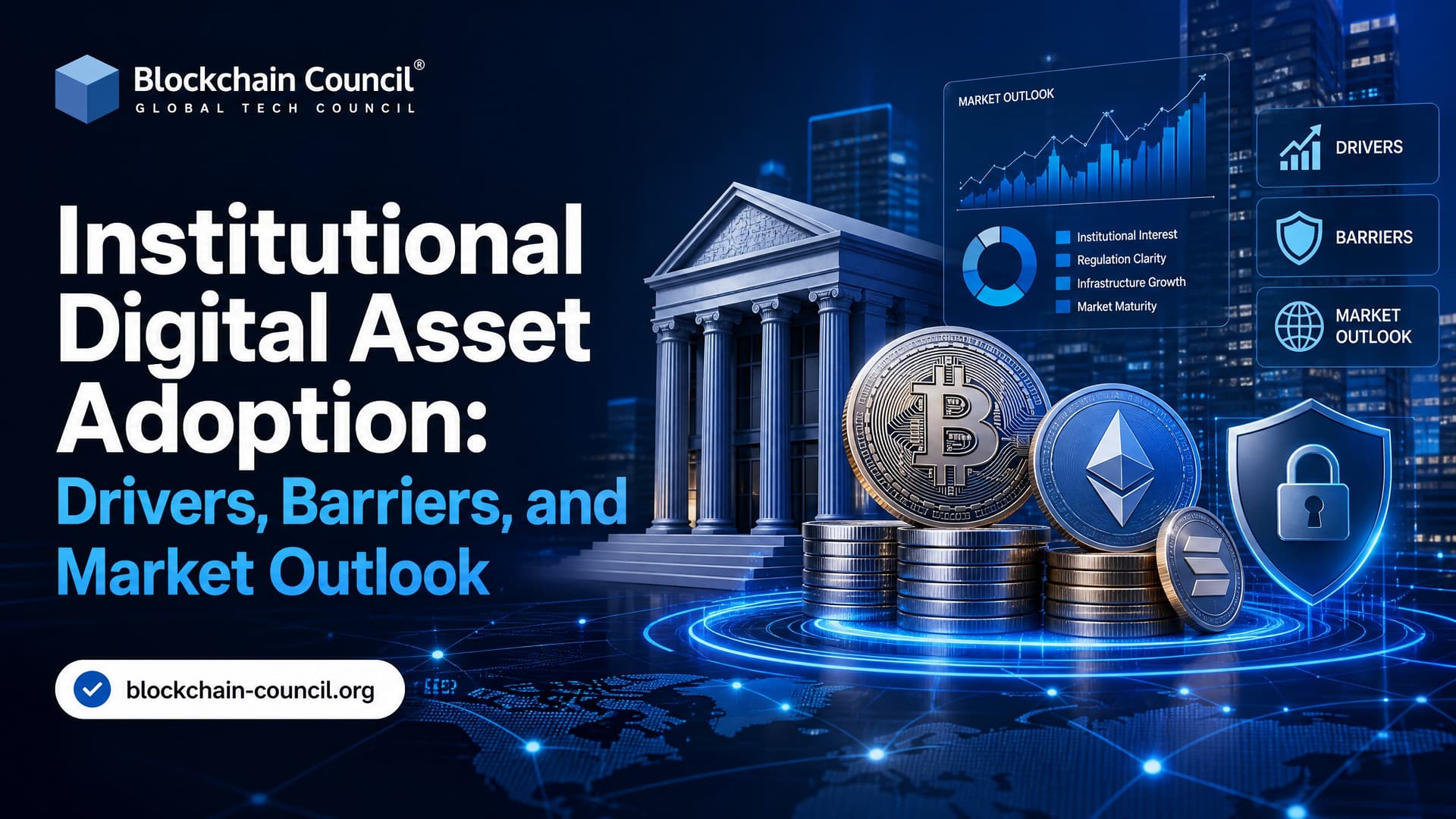
Institutional digital asset adoption has moved past the pilot phase. The real question is no longer whether banks, asset managers, pensions, and enterprises will touch digital assets. Many already do. The harder question is how fast allocations, tokenized products, stablecoin settlement, and compliant custody can fit inside existing risk, legal, and operational frameworks.
Recent surveys from EY, Fidelity Digital Assets, Morgan Stanley, State Street Global Advisors, and other market observers point the same way. Institutions are increasing exposure, but they are not moving blindly. They want regulated access, better custody, cleaner reporting, and infrastructure that can survive an investment committee review.

As institutional participation expands, professionals are expected to understand not only digital assets themselves but also the governance, custody, tokenization, compliance, and operational frameworks that support them. A Certified Digital Assets Expert credential provides practical knowledge across these areas, helping finance and technology professionals navigate institutional adoption with greater confidence.
Where Institutional Digital Asset Adoption Stands Now
The current market looks very different from the 2020 and 2021 cycle. Back then, many institutions treated crypto as a speculative side project. Today, adoption is tied to market structure, tokenization, settlement, and portfolio construction.
EY has reported that digital assets and blockchain are on firmer ground as an institutional asset class, supported by improving regulation in some jurisdictions and rising interest in tokenized instruments. In one EY survey, 83% of institutional investors said they intended to increase allocations to digital assets in the coming year. Another EY finding showed that 59% of surveyed investors planned to allocate more than 5% of assets under management to digital assets or related products.
Fidelity Digital Assets has found similar long-term conviction. Its June 2024 survey reported that 55% of institutional investors believe the asset class is here to stay, even with price volatility still high on the concern list.
The product side matters just as much. The approval of U.S. spot Bitcoin exchange traded funds in January 2024, followed by spot Ether ETFs later that year, gave institutions a familiar wrapper for exposure. That matters more than many crypto-native teams admit. A pension consultant may be comfortable with ETF due diligence, but direct wallet operations, private keys, and on-chain execution require a very different control environment.
Understanding institutional adoption also requires a solid grasp of the blockchain infrastructure that powers these financial products. A Certified Blockchain Expert credential helps professionals build expertise in blockchain architecture, consensus mechanisms, smart contracts, and enterprise blockchain applications, making it easier to evaluate how distributed ledger technology fits within modern capital markets.
Key Drivers Behind Institutional Digital Asset Adoption
1. Regulatory progress and compliant access
Regulatory clarity is the main driver. Not hype. Not conference panels. Clear rules let compliance teams, boards, auditors, and custodians define what is allowed and what is not.
EY has repeatedly identified regulatory clarity as the top catalyst for broader institutional adoption. WBR Research makes a similar point, noting that clear rules reduce regulatory risk and make product development easier. Grayscale has argued that clearer U.S. market structure rules could push blockchain-based finance deeper into capital markets.
This is why regulated vehicles matter. ETFs, qualified custody, registered funds, and compliant tokenization platforms fit into existing institutional workflows far better than informal spot exposure.
2. Portfolio diversification and macro demand
Institutions are not all buying digital assets for the same reason. Some view Bitcoin as a long-term inflation hedge. Others use digital asset exposure as a venture-style allocation to blockchain networks and financial infrastructure.
Morgan Stanley has noted that pension funds, endowments, and foundations have begun making small Bitcoin allocations. Small is the key word. For conservative institutions, a 1% to 3% allocation can be meaningful without putting the whole portfolio at risk.
Crypto allocations remain modest today. Research cited by XBTO suggests institutional allocations sit around 3% and could rise toward 6% to 7% by 2027. That is not a tidal wave. But it is a serious reweighting if it happens across large pools of capital.
3. Tokenization of real-world assets
Tokenization may turn out to be the bigger institutional story, bigger than direct crypto exposure. Tokenized money market funds, treasuries, private credit, bonds, and fund units can improve settlement speed, transparency, and transferability.
EY expects 65% of institutions to have more than 1% of their portfolios tokenized or based on distributed ledger technology by the end of 2028. That figure matters because it suggests tokenization is moving from proof of concept to portfolio plumbing.
Standards also matter. ERC-20 is still the default for fungible tokens. ERC-721 is common for unique assets. For regulated securities, institutions often need permissioning, transfer restrictions, identity checks, and compliance controls. That is where token standards and smart contract design stop being a developer detail. They become legal infrastructure.
4. Stablecoin settlement and treasury use
Stablecoins are becoming harder for enterprises to ignore. They can support 24/7 settlement, cross-border payments, programmable treasury flows, and faster reconciliation.
Vaultody has identified stablecoin settlement infrastructure as one of the clearest trends in institutional adoption since 2024. Morgan Stanley has also observed that many companies are adapting systems to accept or send payments in digital currencies.
The trade-off is simple. Stablecoins can cut settlement friction, but they introduce issuer risk, compliance requirements, wallet controls, sanctions screening, and jurisdiction-specific rules. You cannot treat them like ordinary bank deposits.
The Main Barriers Holding Institutions Back
Regulatory uncertainty
Progress is real, but regulation remains fragmented. A product that works in one jurisdiction may be restricted or treated differently in another. Asset classification, custody rules, market conduct, tax treatment, and reporting requirements still vary widely.
EY lists regulatory uncertainty as a top concern for institutions, alongside volatility and custody security. SBIDAH survey respondents also flagged regulatory ambiguity as a barrier to investment. For global asset managers, this creates a practical problem: a digital asset strategy cannot be designed only for one office if the firm operates across the U.S., Europe, Asia, and the Middle East.
Volatility and risk management
Volatility remains the most visible barrier. Fidelity reported that 48% of investors cited price volatility as the most common barrier to digital asset investment in 2024.
That concern is reasonable. Bitcoin can trade like a macro asset one month and like a high-beta technology position the next. Ether adds another layer because it is tied to network usage, staking economics, application activity, and protocol changes. Institutions need position limits, stress tests, liquidity plans, and clear rebalancing rules before they increase exposure.
Custody, security, and operations
This is where many digital asset plans slow down. Custody is not just where the asset sits. It covers signing policies, transaction approvals, wallet segregation, insurance, recovery procedures, audit trails, and vendor risk.
A small operational mistake can get expensive fast. Anyone who has tested institutional wallet flows has seen issues like a transaction stuck because the EIP-1559 max fee was set too low, or a failed transfer with the error replacement transaction underpriced after trying to speed up a pending Ethereum transaction. On a testnet it is annoying. In a production treasury process, it becomes an incident report.
The Trade has noted that firms cannot simply plug existing technology into digital asset markets. Connectivity, workflows, settlement timing, and reporting all need adjustment.
Supporting institutional digital asset operations also requires expertise beyond blockchain, including cybersecurity, cloud infrastructure, APIs, automation, analytics, enterprise systems, and AI-enabled monitoring. A Tech Certification helps professionals strengthen these complementary technical skills, enabling them to build and manage secure, scalable digital asset infrastructure.
Lack of trusted end-to-end infrastructure
SBIDAH found that investors see the absence of institutional-grade infrastructure and trusted distribution networks as barriers. For tokenized securities, many participants also point to the lack of a trusted end-to-end ecosystem.
This is not a minor complaint. A tokenized bond needs issuance, custody, secondary trading, compliance checks, settlement, corporate actions, tax reporting, and redemption. If any part is weak, large institutions hesitate.
Real-World Use Cases Gaining Traction
Institutional adoption is strongest where the use case maps to a known financial activity.
Crypto ETFs: Spot Bitcoin and Ether ETFs give investors regulated exposure through familiar brokerage and custody channels.
Tokenized treasuries and funds: Institutions are testing blockchain rails for fund shares, treasury exposure, and yield-bearing assets.
Stablecoin payments: Enterprises are exploring stablecoins for cross-border payments, treasury operations, and settlement outside banking hours.
Digital asset custody: Banks and specialist custodians are building services around wallet governance, key management, and reporting.
On-chain settlement: Capital markets firms are examining faster settlement and programmable compliance for securities workflows.
Market Outlook for the Next 3 to 5 Years
The base case is steady growth, not an instant replacement of traditional finance. Digital assets are likely to become a normal part of institutional portfolios and capital markets infrastructure, but adoption will differ by investor type.
Asset managers and wealth platforms may move faster because ETFs and model portfolios are easier to distribute. Banks may focus on custody, tokenized deposits, stablecoin services, and settlement infrastructure. Pensions and insurers will likely move slowly because their governance requirements are stricter.
Several signals support this outlook:
EY data shows most surveyed institutions intend to increase allocations.
Fidelity data shows long-term confidence despite volatility.
Morgan Stanley has described digital assets as a multi-trillion dollar market moving closer to global capital markets.
State Street Global Advisors sees tokenization, DeFi, and traditional finance integration as durable trends.
Tokenization forecasts suggest broader DLT-based portfolio exposure by 2028.
The winners, though, will be the firms that solve boring problems well: compliance, reporting, custody, liquidity, and governance. Not glamorous. Exactly what institutions need.
What Professionals Should Learn Next
If you work in asset management, banking, fintech, compliance, or enterprise technology, focus on the practical stack behind institutional adoption. Learn how wallets, custody models, token standards, smart contracts, ETFs, stablecoins, and tokenized securities connect to real financial workflows.
For structured learning, look at Blockchain Council programs such as Certified Blockchain Expert™, Certified Cryptocurrency Expert™, Certified Blockchain Developer™, and Certified Smart Contract Developer™. Each fits a different starting point, so pick the one that matches your role rather than collecting all four.
Your next step: take one institutional use case, such as tokenized treasuries or stablecoin settlement, and map it from front office decision to custody, compliance, execution, reporting, and audit. If you cannot explain each step, that is the skill gap to close before digital assets become part of your core business.
As institutional adoption accelerates, organizations also need professionals who can clearly communicate the value of digital asset initiatives to executives, clients, regulators, and other stakeholders. A Marketing Certification helps strengthen strategic communication, market positioning, and stakeholder engagement skills, complementing technical expertise while supporting broader enterprise adoption.
FAQs
1. What is institutional digital asset adoption?
Institutional digital asset adoption refers to the use of blockchain-based assets and technologies by organizations such as banks, asset managers, insurance companies, pension funds, hedge funds, payment providers, corporations, and government entities. Adoption may include investment activities, tokenization, custody services, payments, and enterprise blockchain implementations.
2. Why are institutions becoming interested in digital assets?
Institutions are exploring digital assets to improve operational efficiency, modernize financial infrastructure, enhance settlement processes, support tokenization initiatives, diversify eligible investment offerings, and develop innovative financial products. Adoption decisions are typically influenced by business objectives, regulatory developments, and client demand.
3. Which institutions are adopting digital assets?
Organizations participating in the digital asset ecosystem include commercial banks, investment banks, asset management firms, exchanges, custodians, fintech companies, insurance providers, payment processors, family offices, sovereign entities, and enterprise technology companies. Participation varies significantly across regions and regulatory environments.
4. What role do tokenized real-world assets (RWAs) play in institutional adoption?
Tokenized real-world assets enable traditional assets such as government bonds, private credit, real estate, commodities, and investment funds to be represented on blockchain networks. Institutions are evaluating tokenization to improve settlement efficiency, operational transparency, and asset management workflows while complying with applicable legal frameworks.
5. How are stablecoins supporting institutional use cases?
Stablecoins are being explored for cross-border payments, treasury operations, liquidity management, settlement, and programmable financial services. Institutional adoption depends on factors such as reserve transparency, regulatory compliance, operational resilience, and integration with existing financial systems.
6. How does blockchain improve institutional operations?
Blockchain can provide transparent transaction records, automated workflows through smart contracts, enhanced auditability, secure data sharing, and streamlined settlement processes. Organizations typically evaluate blockchain where it addresses identifiable operational or business challenges.
7. What are the primary drivers of institutional digital asset adoption?
Key drivers include advances in blockchain infrastructure, improved custody solutions, growing interest in tokenization, demand for payment innovation, enterprise automation, AI integration, operational efficiency, evolving regulatory frameworks, and increasing market maturity.
8. What barriers slow institutional adoption?
Challenges include regulatory uncertainty, cybersecurity risks, interoperability limitations, integration with legacy infrastructure, operational complexity, governance requirements, evolving accounting standards, talent shortages, and concerns about market volatility for certain digital assets.
9. How important is digital asset custody?
Institutional-grade custody is a foundational requirement for many organizations. Secure custody solutions often include hardware security modules (HSMs), multi-signature wallets, key management systems, disaster recovery procedures, insurance considerations, and comprehensive operational controls.
10. What role does compliance play in institutional adoption?
Compliance is central to institutional participation. Organizations generally establish programs covering anti-money laundering (AML), know-your-customer (KYC), sanctions screening, tax reporting, consumer protection, operational risk management, and applicable financial regulations based on the jurisdictions in which they operate.
11. How are financial institutions using digital assets today?
Financial institutions are exploring tokenized deposits, digital asset custody, blockchain-based settlement, cross-border payments, tokenized investment products, digital securities, blockchain research, and enterprise blockchain platforms. Adoption varies according to business strategy and regulatory requirements.
12. How does AI complement institutional digital asset strategies?
Artificial intelligence supports fraud detection, transaction monitoring, compliance automation, blockchain analytics, cybersecurity, operational efficiency, liquidity forecasting, and risk assessment. AI-generated insights are generally combined with governance processes and expert review.
13. What cybersecurity measures do institutions implement?
Institutions commonly deploy encryption, multi-factor authentication (MFA), zero-trust security architectures, continuous monitoring, access controls, penetration testing, smart contract audits, secure key management, and incident response planning to protect digital asset operations.
14. How are enterprise blockchain solutions contributing to adoption?
Enterprise blockchain platforms enable organizations to improve supply chain traceability, document verification, trade finance, digital identity management, healthcare record sharing, and secure collaboration. Many implementations focus on measurable efficiency gains and operational improvements.
15. What regulatory developments are influencing institutional adoption?
Regulators in many jurisdictions continue developing frameworks covering digital asset custody, stablecoins, securities, anti-money laundering (AML), know-your-customer (KYC), taxation, consumer protection, cybersecurity, and market integrity. Institutions generally monitor official guidance closely as regulations evolve.
16. What skills are important for institutional digital asset teams?
Professionals benefit from expertise in blockchain technology, cybersecurity, digital asset custody, financial markets, compliance, governance, enterprise architecture, cloud computing, artificial intelligence, risk management, and project leadership. Cross-functional collaboration is often essential for successful implementation.
17. What mistakes should institutions avoid when adopting digital assets?
Organizations should avoid implementing blockchain without a clear business case, underestimating cybersecurity risks, neglecting governance frameworks, overlooking regulatory obligations, failing to integrate with existing systems, or treating digital asset initiatives as purely experimental without defined operational objectives.
18. What trends are shaping institutional digital asset adoption in 2026?
Major trends include institutional tokenization of real-world assets (RWAs), AI-powered compliance, enterprise blockchain expansion, stablecoin infrastructure growth, digital identity adoption, blockchain interoperability, regulated custody services, programmable financial products, and enhanced operational governance.
19. How can organizations prepare for institutional digital asset adoption?
Organizations should conduct business case assessments, establish governance structures, strengthen cybersecurity, evaluate regulatory obligations, educate employees, select appropriate technology partners, implement pilot projects, and develop scalable operational processes before broader deployment.
20. What is the future outlook for institutional digital asset adoption?
Institutional participation is expected to expand as blockchain infrastructure, tokenization platforms, digital custody solutions, interoperability standards, and regulatory frameworks continue to mature. While adoption rates will differ across industries and jurisdictions, organizations that emphasize security, compliance, governance, and measurable business value are likely to be better positioned to benefit from digital asset innovation over the long term. Technology may capture the headlines, but institutions usually invest only after the spreadsheets, audits, and risk committees have all had their thoroughly unglamorous moment.
Related Articles
View All
Digital Assets
RWA Tokenization Trends in 2026: Regulation, DeFi, AI and Institutional Adoption
RWA tokenization trends in 2026 show rapid institutional growth, clearer regulation, deeper DeFi use, AI-driven operations, and real liquidity risks.
Digital Assets
RWA Tokenization: Market Outlook and Emerging Opportunities
RWA tokenization is moving from pilots to institutional deployment, led by Treasuries, funds, and credit, with trillion-dollar forecasts ahead.

Digital Assets
Tokenized Asset Custody: How Wallets, Trustees, and Institutional Custodians Work
Learn how tokenized asset custody combines wallets, trustees, qualified custodians, key management, and compliance for institutional and retail RWA holders.
Trending Articles
AWS Career Roadmap
A step-by-step guide to building a successful career in Amazon Web Services cloud computing.

Top 5 DeFi Platforms
Explore the leading decentralized finance platforms and what makes each one unique in the evolving DeFi landscape.
Blockchain in Supply Chain Provenance Tracking
Supply chains are under pressure to prove not just efficiency, but also authenticity, sustainability, and fairness. Customers want to know if their coffee really is fair trade, if the diamonds are con