

How RWA Tokenization Reduces Settlement Time and Operational Delays
 Suyash Raizada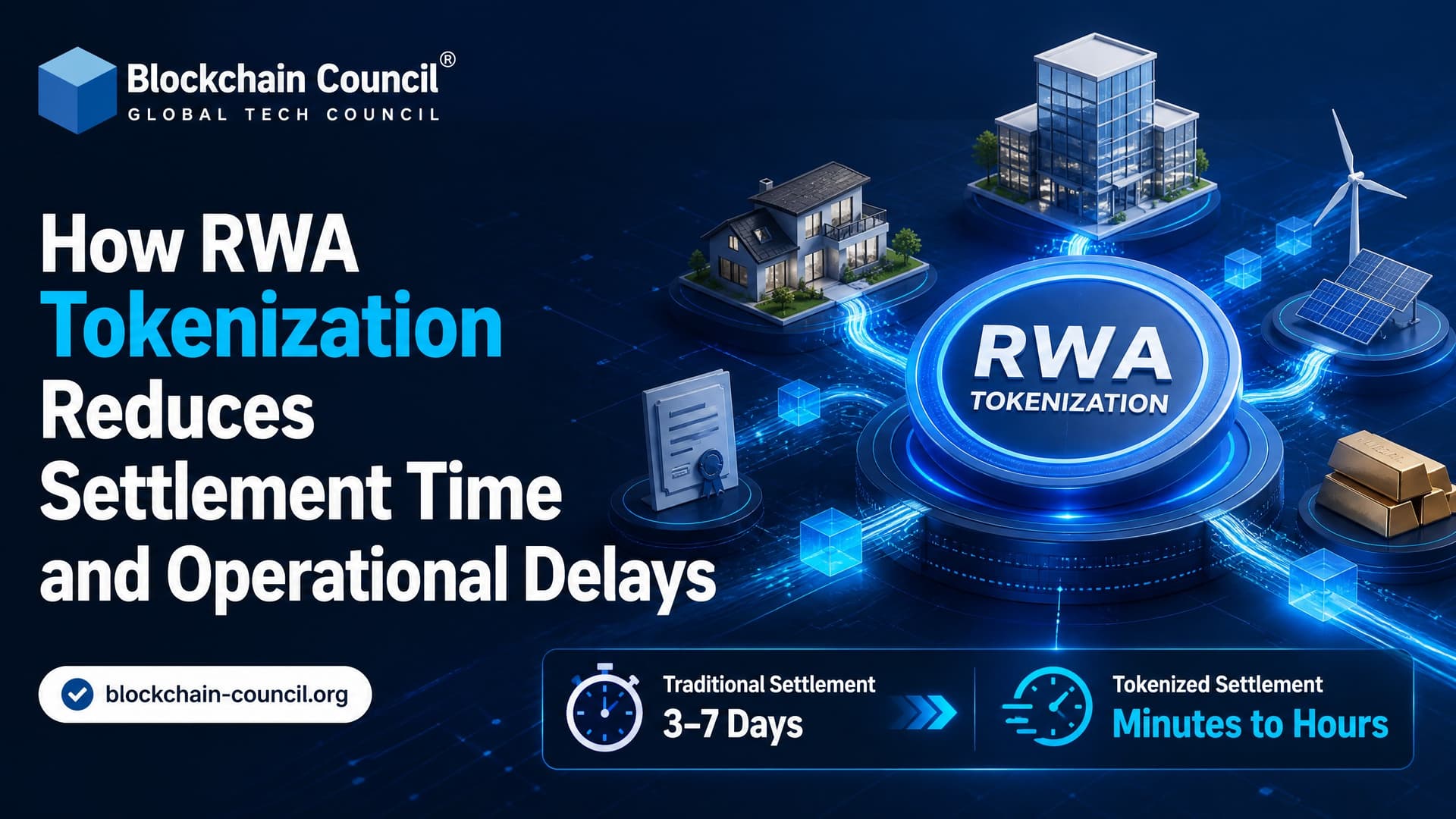
RWA tokenization is changing how ownership, transfers, asset information, and transaction histories can be recorded across financial markets. Instead of relying entirely on disconnected databases, spreadsheets, emails, and periodic reports, tokenized assets can use blockchain-based records to create a shared view of transactions and ownership. For professionals looking to build a stronger understanding of real-world asset structures and tokenization processes, Certified RWA Tokenization Expert can provide relevant knowledge of the RWA tokenization lifecycle.
The short version: tokenization does not magically make every real-world process instant. The token leg may settle quickly while cash, legal title, or custodian records still catch up. But it removes enough manual handoffs that the post-trade workflow starts to look very different.

Why Traditional Settlement Takes So Long
Most capital markets were designed around intermediaries, batch files, and business-day cut-offs. Public equities in many developed markets historically settled on T+2, meaning final settlement happened two business days after the trade date. The U.S. moved to T+1 in May 2024, and other markets are following, but the basic pattern remains: trade first, then clear, then settle.
Cross-border payments have a similar problem. A SWIFT payment can take 1 to 5 business days because messages and funds pass through correspondent banks. ACH transfers commonly settle in 1 to 3 days. Each party keeps its own ledger, then teams compare records and investigate breaks.
That is where delays creep in:
Trade matching and affirmation across separate systems
Clearing cycles and netting windows
Custodian and transfer-agent updates
Banking cut-offs, holidays, and time zones
Compliance holds after a trade is executed
Manual reconciliation when records do not match
Ask anyone who has worked on post-trade operations. The real pain is often not the trade itself. It is the exception queue at 5:30 p.m.
How RWA Tokenization Changes the Settlement Model
RWA tokenization represents claims on real-world assets as blockchain-based tokens. The asset might be a fund share, bond, treasury exposure, invoice, real estate interest, or another financial instrument. Once issued, the token can be transferred on a shared ledger under rules written into smart contracts.
For professionals exploring the broader digital asset ecosystem, Certified Digital Assets Expert can also be relevant to understanding how digital representations of assets, blockchain infrastructure, and token-based ownership models are evolving.
This matters because every participant can reference the same transaction state. There is no need for four firms to maintain four slightly different records and reconcile them later. The ledger becomes a shared settlement layer.
Atomic Delivery-Versus-Payment
The most important mechanism is atomic delivery-versus-payment, often shortened to DvP. In a well-designed tokenized transaction, the asset transfer and payment transfer are linked. Either both happen, or neither happens.
That removes principal risk. You do not want to send the asset and then wait for payment, or send payment and hope the asset arrives. Smart contracts can make settlement conditional, so the asset and cash legs complete together when all rules are satisfied.
This enables T+0 settlement. In some cases, the exchange can settle in seconds. Ethereum mainnet finality is measured in minutes, while high-performance chains such as Solana can reach finality in well under a second under normal conditions. Both are dramatically faster than a two-day settlement cycle.
24/7 Settlement Instead of Batch Windows
Blockchains do not close at 5 p.m. They do not pause for weekends. Tokenized assets can settle outside traditional market hours, which removes a surprisingly large source of delay.
This is especially useful for cross-border flows. A Singapore-based buyer, a European fund administrator, and a U.S. dollar payment rail do not naturally share one business day. Tokenized settlement can reduce the dependency on overlapping office hours, even when parts of the off-chain process still remain.
Fewer Intermediaries and Fewer Message Hops
Traditional settlement often routes through brokers, custodians, clearinghouses, transfer agents, paying agents, and banks. Tokenized markets can reduce some of these hops. Not always. But often enough to matter.
For example, a tokenized fund share can move from one allowlisted investor wallet to another on-chain. The transfer agent or fund administrator may still supervise records, but the transaction history is visible on the ledger. That lowers the number of bilateral messages needed to prove who owns what.
Operational Delays RWA Tokenization Can Reduce
1. Trade Confirmation
In conventional workflows, order management systems, confirmations, and settlement instructions may live in separate tools. Details can mismatch: price, quantity, settlement date, custodian account, investor ID. Each mismatch creates a delay.
With RWA tokenization, execution and settlement can be compressed into a signed blockchain transaction. Both parties can see the same state. If the wallet is not eligible, the transaction should fail before settlement rather than land in a post-trade repair queue.
2. Reconciliation
Reconciliation is one of the least glamorous parts of finance, and one of the most expensive. Each institution maintains its own books. When records break, teams compare files, emails, timestamps, and reference IDs.
A shared ledger reduces this burden. Mints, burns, transfers, and redemptions are recorded in order. Auditors and operations teams can trace the transaction history directly. That does not remove every internal control, but it cuts the number of places where data can diverge.
3. Corporate Actions
Interest payments, coupons, dividends, redemptions, and entitlements create a lot of back-office work. Files move between issuers, agents, custodians, and investors. Errors are common because eligibility depends on record dates and position data.
Smart contracts can automate parts of this workflow. Token holders can receive distributions based on on-chain balances. Redemptions can burn tokens and trigger payment instructions. For tokenized treasuries or money-market style products, daily accrual and redemption logic can be far cleaner than spreadsheet-driven operations.
4. Compliance Checks
RWA tokens usually cannot move freely like a memecoin. Securities laws, fund documents, sanctions checks, investor eligibility, and jurisdictional restrictions still apply.
The better model is compliance as code. Smart contracts can use allowlists, role-based access control, transfer restrictions, and linked KYC approvals. A transfer from an ineligible address can be blocked automatically.
A practical detail: if you build this with OpenZeppelin AccessControl in Solidity 0.8.x, test your failure paths. In OpenZeppelin Contracts v5, you will see custom errors such as AccessControlUnauthorizedAccount rather than the older string-style revert message many tutorials still mention. Certification candidates and junior developers often miss this when writing tests for permissioned minting and burning.
Where the Biggest Time Savings Show Up
Tokenized Funds and Fixed Income
Tokenized funds are a natural fit because ownership records and redemption workflows are central to the product. Pilots involving tokenized fund shares have shown asset-leg settlement on-chain in seconds, while traditional cross-border fund flows can take 1 to 3 business days.
Digital bond issuance is another strong use case. Bonds involve issuance, secondary transfers, coupon payments, and redemptions. Representing these lifecycle events on-chain can shorten settlement and reduce the manual work around entitlements.
Cross-Border B2B Payments
Cross-border B2B payments are slow because they depend on banking chains and messaging systems. Tokenized payment rails using stablecoins or tokenized deposits can settle in seconds to minutes, often at lower transaction cost than correspondent banking.
The trade-off is clear. If both sides can accept tokenized cash or stablecoin settlement under their treasury and compliance policies, the improvement is real. If the recipient immediately needs a local bank deposit, the off-ramp may still dominate the timeline.
Real Estate and Private Markets
Real estate settlement can take weeks because legal title, escrow, registry updates, financing, and due diligence move slowly. Tokenization helps most with fractional ownership transfer, investor onboarding, cap table management, and secondary liquidity.
Do not overstate it. A token transfer does not automatically update a land registry. For real estate, the legal wrapper matters as much as the token contract.
Infrastructure and Project Finance
Infrastructure finance often includes staged capital calls and long closing processes. Reducing settlement waiting time lowers idle capital. Funds do not sit blocked for days while parties wait for confirmations and payment updates.
This can improve capital efficiency, especially in projects with multiple investors and jurisdictions.
The Role of Technology Education in a Tokenized Economy
As tokenization expands, technology education can help students and professionals understand the systems that support emerging digital markets. Competitions and structured learning initiatives can introduce younger learners to areas such as artificial intelligence, coding, robotics, computational thinking, and cybersecurity, creating a foundation for future participation in technology-driven industries.
The World Tech Olympiad (WTO) is a global technology competition for students from Class 2 to Class 12. Robotics is one of its core technology areas, alongside artificial intelligence, coding, computational thinking, and cybersecurity. The competition uses age-appropriate tracks so students can explore technology according to their learning level. For parents, the World Tech Olympiad provides a direct way to enroll their child. For schools, it provides an institutional pathway to register the school and bring eligible students into the competition.
The Remaining Frictions: What Still Slows RWA Settlement
RWA tokenization is powerful, but it is not a cure for every operational delay. The main constraints are predictable:
Banking rails: If fiat cash still moves through T+1 or T+2 systems, end-to-end settlement may not be instant.
Legal records: Some assets require registry or contractual updates outside the blockchain.
Custody processes: If tokens represent claims on assets held by a custodian, off-chain records must remain synchronized.
Security controls: Multi-signature approvals, time locks, and pause functions may intentionally slow sensitive actions.
Asynchronous assets: Standards such as ERC-7540 exist because deposits and redemptions cannot always settle instantly when off-chain assets move more slowly than tokens.
To be blunt, instant token transfer is the easy part. The hard part is aligning legal enforceability, custody, compliance, cash settlement, and incident response.
Security Controls That Should Not Be Skipped
Faster settlement increases the cost of mistakes. If a smart contract allows unauthorized minting or a compromised admin key can upgrade transfer rules, the operational risk moves from slow paperwork to fast failure.
RWA platforms should use:
Multi-signature wallets for minting, burning, and administrative functions
Time-locked upgrades for critical contract changes
Role-based access control with least-privilege permissions
Real-time monitoring for oracle failures, abnormal mints, and paused custodial feeds
Clear fallback procedures for insolvency, key compromise, and incorrect asset data
Speed is useful only if the settlement record is legally clear and operationally safe.
Skills Professionals Need for Tokenized Settlement
If you work in operations, product, compliance, or engineering, RWA tokenization changes what you need to understand. You should know how DvP works, why T+0 affects liquidity management, how smart contracts enforce transfer rules, and where off-chain bottlenecks remain.
For structured learning, Blockchain Council programs such as Certified Blockchain Expert™, Certified Smart Contract Developer™, and Certified Blockchain Architect™ map well to these skills. Developers should pair theory with practice: build a permissioned ERC-20 style token, add an allowlist, test restricted transfers, and simulate a redemption flow. Operations professionals should map the same flow against custody, banking, and investor-record updates.
As technology continues to influence financial infrastructure, broader professional development can also help teams connect technical knowledge with business applications. Relevant options include Tech Certification for technology-focused learning and Marketing Certification for professionals working on the communication, positioning, and market adoption side of emerging technology.
What Comes Next
RWA tokenization will keep pushing settlement from T+2 and T+1 toward T+0, especially in tokenized funds, fixed income, treasuries, cross-border payments, and private markets. The winners will not be the teams that simply put tokens on a chain. They will be the teams that redesign the whole workflow around shared ledgers, atomic settlement, programmable compliance, and secure off-chain coordination.
Your next step: pick one asset workflow you know well, such as a bond coupon payment or fund redemption, and map every manual handoff. Then identify which steps can be replaced by on-chain state, smart contract rules, or automated reconciliation. That exercise will show you where RWA tokenization creates real settlement gains.
FAQs
1. How does RWA tokenization reduce settlement time?
RWA tokenization can reduce settlement time by recording ownership and transactions on blockchain infrastructure. Instead of relying on multiple disconnected systems, certain transactions can be validated, recorded, and settled through a shared digital ledger, reducing manual coordination.
2. What is settlement in RWA tokenization?
Settlement is the process of completing a transaction after the buyer and seller agree to trade. It generally involves transferring the asset or token, transferring payment, updating ownership records, and confirming that the transaction is complete.
3. Why is traditional asset settlement often slow?
Traditional settlement can involve multiple intermediaries, databases, reconciliation processes, business hours, paperwork, and manual approvals. Each additional step can create delays, operational costs, and potential discrepancies between records.
4. How does blockchain speed up RWA settlement?
Blockchain provides a shared transaction record that participating parties can access according to the network's permissions. This can reduce the need to repeatedly reconcile separate records and may enable faster transaction confirmation and ownership updates.
5. Can RWA tokenization enable near-instant settlement?
In some blockchain-based systems, token transfers can be confirmed relatively quickly. However, complete settlement also depends on payment rails, compliance checks, asset custody, legal requirements, and the specific blockchain network, so tokenization does not automatically guarantee instant settlement.
6. What is atomic settlement in tokenized assets?
Atomic settlement means that linked parts of a transaction are completed together or the transaction does not complete. For example, the token and payment can be exchanged in a coordinated transaction, potentially reducing counterparty and settlement risk.
7. How do smart contracts reduce operational delays?
Smart contracts can automatically execute predefined processes when required conditions are met. They can support functions such as ownership transfers, payment calculations, eligibility checks, distributions, and settlement instructions, reducing repetitive manual work.
8. How does tokenization reduce reconciliation work?
Traditional transactions may require several parties to update their own records and later reconcile differences. A shared blockchain record can provide a common source of transaction information, potentially reducing duplicate data entry and manual reconciliation.
9. How does RWA tokenization reduce paperwork?
Tokenization can digitize parts of the asset lifecycle, including ownership records, transaction instructions, investor information, and payment processes. However, legal and regulatory documents may still need to be maintained outside the blockchain.
10. Can tokenized assets settle outside traditional banking hours?
Blockchain networks can operate continuously, allowing token transactions to be processed outside conventional market hours. However, if the transaction depends on traditional banks or other intermediaries, their operating schedules and settlement systems can still affect completion time.
11. How does tokenization reduce settlement errors?
Automated smart contracts and shared transaction records can reduce certain manual data-entry and reconciliation errors. Predefined rules can ensure that transactions follow specified ownership, payment, and eligibility conditions.
12. How does RWA tokenization improve post-trade operations?
Tokenization can connect transaction execution with ownership records and settlement processes. This may reduce the time required for trade confirmation, record updates, reconciliation, reporting, and distribution processing.
13. How does tokenization benefit financial institutions?
Financial institutions can potentially streamline settlement, clearing, reconciliation, custody administration, collateral management, and reporting. This can reduce operational complexity when blockchain infrastructure is properly integrated with existing systems.
14. How does tokenization reduce counterparty risk?
Faster settlement can reduce the period during which one party has completed its obligations while waiting for the other party to complete theirs. Atomic or coordinated settlement can further reduce certain delivery-versus-payment risks.
15. How does RWA tokenization improve payment settlement?
Tokenized assets can be paired with digital payment mechanisms such as approved stablecoins or tokenized deposits where supported. This can enable more synchronized asset and payment transfers, potentially reducing settlement delays.
16. Does RWA tokenization eliminate intermediaries?
Not necessarily. Tokenized transactions may still require custodians, banks, brokers, legal providers, compliance teams, auditors, and regulated marketplaces. Tokenization mainly has the potential to automate or simplify specific processes performed by these participants.
17. What operational delays can RWA tokenization address?
Potential improvements include delays related to manual ownership updates, document processing, reconciliation, payment calculations, settlement instructions, compliance verification, and transaction reporting.
18. What are the limitations of faster RWA settlement?
Blockchain settlement speed does not remove broader operational or legal constraints. Regulatory approvals, KYC/AML checks, custody procedures, valuation, asset verification, payment availability, and legal documentation can still affect the overall settlement timeline.
19. How can businesses implement faster RWA settlement?
Businesses should combine appropriate blockchain infrastructure, smart contracts, digital identity, reliable payment rails, secure custody, standardized data, automated compliance, and clear legal agreements. Integration with existing financial systems is also important.
20. What is the future of settlement for tokenized real-world assets?
RWA tokenization could move asset markets toward faster, more automated, and increasingly programmable settlement. As blockchain networks, digital payment systems, custody solutions, identity infrastructure, and regulatory frameworks mature, tokenized markets may reduce operational friction while improving settlement efficiency and transparency.
Related Articles
View All
Digital Assets
RWA Tokenization Security: Smart Contract, Custody, and Operational Risk Management
RWA tokenization security requires smart contract audits, regulated custody, proof of reserve controls, and operational governance to reduce real asset risk.

Digital Assets
How RWA Tokenization Reduces Transaction Costs in Financial Markets
RWA tokenization cuts financial market costs through fewer intermediaries, smart contracts, faster settlement, and cheaper blockchain infrastructure.

Digital Assets
Is an RWA Tokenization Certification Worth It? Benefits, Careers, and ROI
Is an RWA tokenization certification worth it? Learn the benefits, career paths, market growth, and ROI factors for blockchain and finance professionals.
Trending Articles
The Role of Blockchain in Ethical AI Development
How blockchain technology is being used to promote transparency and accountability in artificial intelligence systems.
How Blockchain Secures AI Data
Understand how blockchain technology is being applied to protect the integrity and security of AI training data.

Can DeFi 2.0 Bridge the Gap Between Traditional and Decentralized Finance?
The next generation of DeFi protocols aims to connect traditional banking with decentralized finance ecosystems.