

How Blockchain Powers Digital Assets: Ownership, Provenance, and Transferability
 Suyash Raizada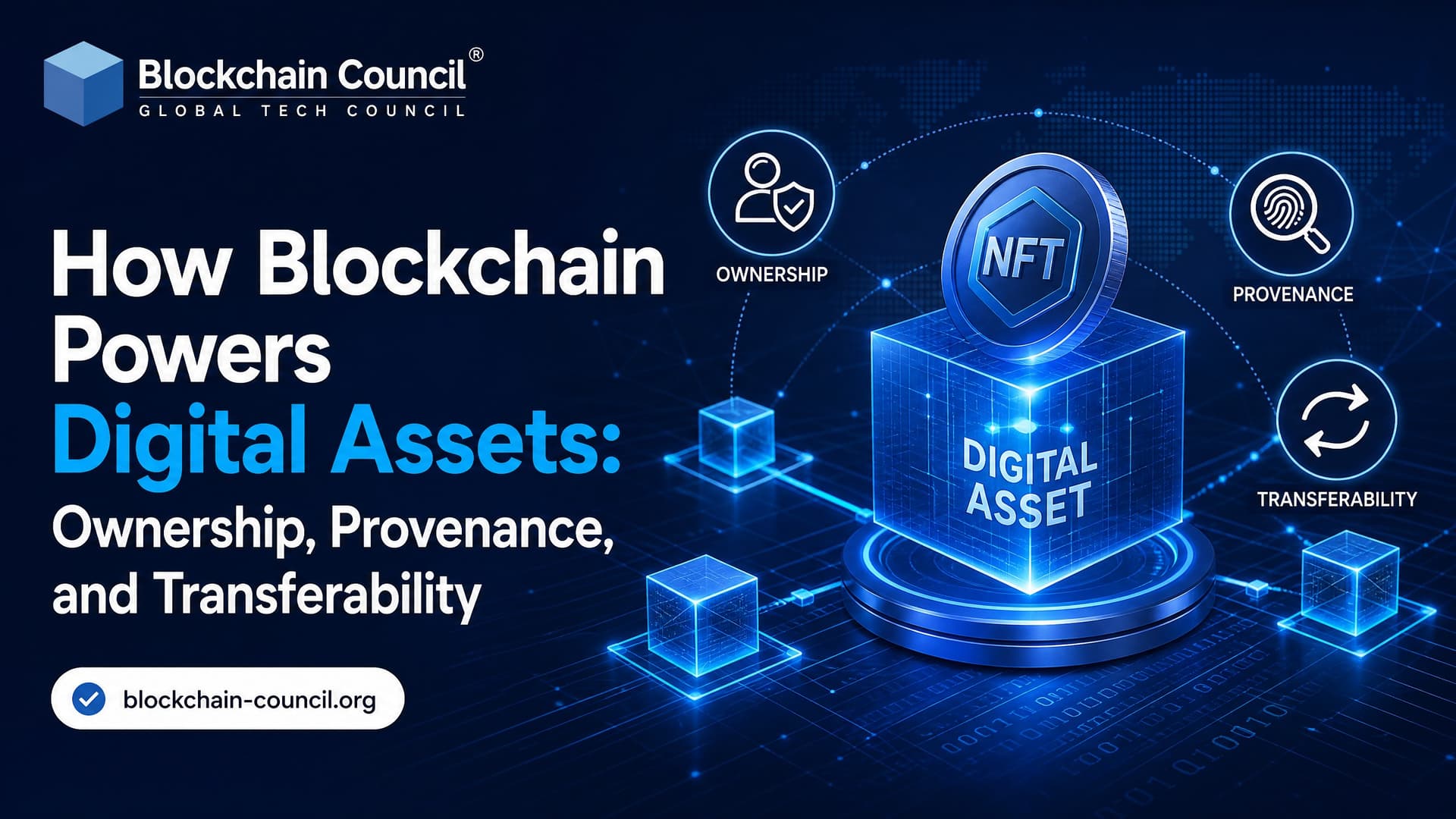
Blockchain powers digital assets by turning ownership, history, and transfer rules into records that software can verify instead of paperwork you have to trust. A token, wallet, or smart contract can show who controls an asset, where it came from, what happened to it, and whether it can move. Sounds simple. It is not. This changes how digital art, intellectual property, data, credentials, supply chain records, and tokenized financial assets get issued and managed.
The core idea: blockchain gives digital assets a shared source of truth. Not perfect truth, and not automatic legal ownership in every country, but a tamper-evident technical record that professionals can build on.

As blockchain adoption expands across industries, professionals increasingly need expertise in digital asset governance, ownership models, custody, compliance, and tokenization. A Certified Digital Assets Expert credential helps build these practical skills, providing a strong foundation for understanding how digital assets are created, managed, and secured within modern blockchain ecosystems.
What Makes Blockchain Useful for Digital Assets?
A digital file can be copied endlessly. A blockchain token cannot be duplicated the same way, because ownership is tracked by a distributed ledger and changed only through valid transactions. That is the foundation.
1. A decentralized ledger
Transactions are recorded across a network of nodes rather than inside one company database. This lowers the risk that a single administrator, platform outage, or database edit can rewrite asset history. Public chains such as Ethereum make the record visible to anyone. Permissioned ledgers can restrict access while still giving approved participants a shared audit trail.
2. Immutability
Once transactions are confirmed on most public blockchains, changing them without detection is economically and technically hard. For digital assets, this matters because provenance depends on time. Who minted the token? Who transferred it? Was a license assigned before or after a dispute? The ledger gives you a chronological record.
3. Programmability
Smart contracts define the rules. They can mint tokens, enforce transfer restrictions, split royalty payments, hold assets in escrow, or require approvals before a sale. On Ethereum, developers commonly use ERC-20 for fungible tokens and ERC-721 or ERC-1155 for non-fungible assets.
A practical warning: beginners often think an NFT stores the artwork on-chain. Usually it does not. Many ERC-721 tokens store a tokenURI that points to JSON metadata, and that metadata often points to an IPFS CID or a web URL. If the metadata server disappears, the token still exists, but the user experience breaks. Store critical hashes on-chain when proof matters.
Ownership: From Platform Permission to Cryptographic Control
Blockchain ownership is based on control of private keys. If your wallet can sign a valid transaction for a token, you can usually transfer or interact with that asset. That is a sharp break from platform-owned digital items, where a company account database decides what you have.
For professionals, this creates both power and risk.
Power: users can hold assets directly without depending on a marketplace, custodian, or publisher account.
Risk: if a private key is lost or stolen, recovery may be impossible unless the system was designed with account abstraction, multisignature custody, or recovery controls.
Auditability: ownership changes can be verified on-chain by wallets, explorers, indexers, and enterprise systems.
This is why key management is not a side topic. It is the product. If you are building a digital asset platform, decide early whether users will self-custody, use a custodian, use multisig wallets such as Safe, or use smart contract accounts.
Designing secure digital asset platforms also requires a deeper understanding of blockchain architecture, consensus mechanisms, smart contracts, token standards, and enterprise blockchain implementations. A Certified Blockchain Expert credential equips professionals with the technical knowledge needed to evaluate blockchain-based ownership systems and build reliable digital asset solutions.
Does Blockchain Prove Legal Ownership?
Not always by itself. A blockchain record proves that a wallet controlled a token at a given time. Legal ownership depends on the asset terms, jurisdiction, contract language, consumer rules, and, in some cases, securities or property law. Blockchain can record ownership and transfers of property or rights without a third-party intermediary, but courts and regulators still decide how those records apply in a dispute.
For intellectual property, the strongest designs connect on-chain events to off-chain legal documents. A copyright license can reference a token ID, content hash, licensor wallet, license scope, and payment terms. The blockchain record then supports evidence of creation, assignment, licensing, and payment.
Provenance: The Asset History That Buyers Can Verify
Provenance is the history of an asset from origin to current state. In digital markets, it answers the hard questions:
Who created this asset?
Was it minted by the original artist or an impersonator?
Which wallets owned it before?
Was it altered, wrapped, bridged, burned, or reissued?
Which licenses or rights events are tied to it?
For NFTs, provenance can show the mint transaction, contract address, token ID, ownership transfers, and marketplace events. For data assets, it can record dataset origin, transformations, approvals, and access rights. For supply chains, it can track product origin, custody changes, and authenticity checks.
That last point matters beyond crypto culture. Food safety, pharma, luxury goods, and manufacturing teams use traceability to find the source of a defect or counterfeit. Some blockchain traceability platforms can backtrack product source data in seconds rather than days, which is valuable during recalls and fraud investigations.
Provenance Is Only as Good as the Inputs
To be blunt, blockchain does not magically verify reality. If someone uploads false origin data, the chain preserves that false record very well. Good systems use signed attestations, IoT data, audits, identity checks, tamper-resistant labels, and governance rules. The ledger is the evidence trail, not the entire evidence system.
Transferability: Assets That Move by Code
Transferability is where blockchain becomes operationally useful. A digital asset can move peer-to-peer when the owner signs a transaction and the network confirms it. No registrar needs to update a private spreadsheet. No clearing window is required for the technical transfer.
Smart contracts also support conditional transfers:
Atomic swaps: either both sides of a trade happen, or neither does.
Escrow: funds or assets release when predefined conditions are met.
Royalty routing: revenue can be split among creators, contributors, or rights holders.
Transfer controls: regulated assets can require allowlists, holding periods, or jurisdiction checks.
Developers should test these flows carefully. In older OpenZeppelin ERC-721 contracts, a common deployment surprise is the revert message ERC721: transfer to non ERC721Receiver implementer when using safeMint or safeTransferFrom to send an NFT to a contract that does not implement the receiver hook. In OpenZeppelin Contracts 5.x, many of those checks moved to custom errors, so tests that expect the old revert string will fail. Small version changes matter.
Real-World Use Cases Already Taking Shape
Digital art, music, and media
NFTs give creators a way to issue scarce digital objects with visible provenance. The useful part is not the JPEG. It is the tokenized claim, metadata, and transfer history. Royalty enforcement is messier than early NFT marketing suggested, because marketplaces can choose whether to honor off-chain royalty norms. Even so, smart contracts still help automate primary sales, splits, and certain controlled transfers.
Intellectual property and licensing
Blockchain can record creation timestamps, rights assignments, license grants, and royalty payments. This supports audits and can reduce disputes over who owned what and when. For SaaS, media libraries, patents, and data products, programmable licensing is a serious use case when paired with legal terms.
Supply chain authenticity
Tokens or on-chain records can represent batches, certificates, serial numbers, or custody events. Enterprises use this to verify ethical sourcing, spot counterfeits, and share data among parties that do not fully trust each other. Permissioned access is often the right choice here, because suppliers may not want all commercial data visible on a public chain.
Tokenized financial and real-world assets
Institutional tokenization has moved from pilots to live products. BlackRock's BUIDL fund, issued on Ethereum, crossed several hundred million dollars in assets soon after launch, showing that regulated products can use blockchain for issuance and lifecycle management. Tokenized treasuries, gold products, commodities, and green bonds all point the same way: ownership records, settlement, and cash-flow rights can be represented digitally.
Metaverse assets and credentials
Virtual land, avatar items, game assets, and digital credentials can be tokenized so users can verify ownership and move assets across compatible environments. The catch is compatibility. A sword token from one game does not automatically work in another. Standards help, but application-level integration still has to be built.
Design Principles for Professionals Building Digital Asset Systems
If you are designing a digital asset product, start with the asset model before picking a chain.
Define what the token actually represents. Is it ownership, access, membership, a license, a claim on cash flows, or proof of authenticity?
Separate technical control from legal rights. Put clear terms around what token holders can and cannot do.
Record provenance events deliberately. Minting, transfers, metadata updates, licensing events, burns, and bridges should be easy to inspect.
Plan key recovery. Use multisig, custodial options, smart accounts, or recovery procedures where appropriate.
Choose the right token standard. ERC-20 fits interchangeable units. ERC-721 fits unique assets. ERC-1155 fits mixed collections and gaming-style inventories.
Do not overuse public data. Put hashes, proofs, and events on-chain. Keep sensitive data off-chain or encrypted.
Test transfer edge cases. Check failed transfers, approvals, paused contracts, allowlists, metadata updates, and bridge behavior.
Building scalable digital asset platforms also depends on expertise in cybersecurity, cloud infrastructure, APIs, enterprise systems, automation, analytics, and secure software development. A Tech Certification helps professionals strengthen these complementary technical skills, supporting the deployment, integration, and long-term security of blockchain-powered applications.
Where Blockchain Is the Wrong Fit
Not every digital asset needs a blockchain. If one trusted organization controls all users, all rules, and all transfers, a normal database may be faster and cheaper. Blockchain earns its place when multiple parties need a shared record, transferability matters, provenance has value, or users need stronger control than a platform account can provide.
Gas fees, wallet usability, smart contract bugs, regulatory uncertainty, and oracle problems are real constraints. Ignore them and your project will suffer.
Skills to Build Next
For developers, learn Solidity 0.8.x, ERC standards, Hardhat or Foundry, wallet signing, event indexing, and smart contract security. For business and legal professionals, focus on token design, custody, compliance, IP licensing, and digital asset governance.
Use this topic as a bridge into related learning paths such as the Certified Blockchain Expert™, Certified Blockchain Developer™, and Certified Smart Contract Developer™ programs. If your work touches NFTs, IP, tokenization, provenance, or Web3 product design, build a small ERC-721 or ERC-1155 project next. Mint an asset, store a content hash, transfer it, inspect the events, and write down exactly what the token proves. That exercise teaches more than a dozen theory slides.
As blockchain-based digital assets become more widely adopted, organizations must also communicate ownership models, governance practices, and the value of decentralized technologies clearly to customers, investors, partners, and regulators. A Marketing Certification helps professionals strengthen strategic communication and stakeholder engagement skills, making complex blockchain concepts easier to explain while supporting broader adoption of digital asset solutions.
FAQs
1. What is blockchain, and how does it power digital assets?
Blockchain is a decentralized digital ledger that records transactions across a distributed network of computers. It provides the infrastructure for creating, storing, transferring, and verifying digital assets by maintaining a transparent, tamper-resistant record of ownership and transaction history.
2. What are digital assets on a blockchain?
Digital assets are blockchain-based representations of value, ownership, rights, or utility. They include cryptocurrencies, stablecoins, non-fungible tokens (NFTs), tokenized real-world assets (RWAs), digital securities, governance tokens, utility tokens, and decentralized identity credentials.
3. How does blockchain establish digital ownership?
Blockchain establishes ownership by associating digital assets with cryptographic wallet addresses controlled by private keys. Transactions recorded on the blockchain provide a transparent history of ownership transfers, while the legal rights associated with an asset depend on applicable laws and contractual agreements.
4. What is provenance in blockchain?
Provenance refers to the documented history and origin of a digital asset. Blockchain creates an immutable record of asset creation, ownership changes, and significant transactions, helping organizations and users verify authenticity and trace an asset's lifecycle.
5. Why is provenance important for digital assets?
Provenance enhances transparency and trust by allowing stakeholders to verify where an asset originated and how it has changed hands over time. This can be valuable for digital art, collectibles, supply chain records, intellectual property, tokenized assets, and regulated financial products.
6. How does blockchain enable secure ownership transfers?
Blockchain uses cryptographic signatures to verify that only authorized parties can initiate transactions from a wallet. Once validated through the network's consensus mechanism, ownership transfers are recorded on the blockchain, creating a permanent and auditable transaction history.
7. What role do private keys play in ownership?
Private keys allow wallet owners to authorize blockchain transactions and demonstrate control over digital assets. Protecting private keys is essential because unauthorized access may allow others to transfer assets associated with the wallet.
8. How do smart contracts improve digital asset management?
Smart contracts automate predefined actions such as ownership transfers, royalty distributions, compliance checks, governance voting, escrow arrangements, and settlement processes. This automation can improve operational efficiency while reducing manual intervention.
9. How does blockchain prevent double spending?
Blockchain networks use consensus mechanisms to verify transactions before they are permanently added to the ledger. This process helps ensure that the same digital asset cannot be spent or transferred multiple times in conflicting transactions.
10. How does blockchain improve transparency?
Every validated transaction is recorded on a shared ledger that authorized participants or the public, depending on the blockchain, can inspect. This transparency supports auditing, compliance, reconciliation, and verification without relying solely on centralized recordkeepers.
11. How does blockchain support transferability across borders?
Blockchain enables digital assets to be transferred between compatible wallets across geographic boundaries without depending entirely on traditional financial intermediaries. Cross-border transfers remain subject to applicable laws, sanctions, regulatory requirements, and network-specific rules.
12. How does AI complement blockchain-powered digital assets?
Artificial intelligence can assist with fraud detection, blockchain analytics, transaction monitoring, compliance automation, cybersecurity, risk assessment, portfolio analysis, and operational forecasting. AI enhances blockchain ecosystems by improving decision support and identifying unusual activity, while human oversight remains important.
13. Which industries benefit from blockchain ownership records?
Industries using blockchain ownership records include financial services, real estate, healthcare, supply chain management, insurance, gaming, intellectual property management, energy, government services, education, and digital identity platforms.
14. What are the security advantages of blockchain?
Blockchain offers cryptographic protection, distributed recordkeeping, immutable transaction histories, and reduced reliance on centralized databases. However, overall security also depends on secure wallet management, smart contract quality, cybersecurity practices, and operational governance.
15. What challenges affect blockchain-based ownership?
Challenges include scalability limitations, interoperability between blockchain networks, evolving regulatory frameworks, cybersecurity threats, private key management, transaction costs, governance complexity, and varying legal recognition of blockchain-based ownership records.
16. How is blockchain ownership regulated?
Regulatory treatment varies by jurisdiction and depends on the nature of the digital asset and the rights it represents. Applicable regulations may include securities laws, anti-money laundering (AML) requirements, know-your-customer (KYC) obligations, consumer protection rules, taxation, privacy laws, and digital asset custody standards.
17. What trends are shaping blockchain-powered digital assets in 2025-2026?
Major trends include institutional adoption of tokenized real-world assets, decentralized identity solutions, AI-powered blockchain analytics, account abstraction, cross-chain interoperability, programmable financial products, expanded digital custody services, and increasing regulatory clarity in several markets.
18. What are best practices for managing blockchain-based digital assets?
Best practices include protecting private keys and recovery phrases, using reputable wallet providers, enabling available security features, conducting smart contract audits where applicable, monitoring transactions, maintaining secure backups, and following relevant regulatory and organizational policies.
19. What should organizations consider before adopting blockchain for digital assets?
Organizations should evaluate business objectives, legal and regulatory obligations, blockchain platform selection, interoperability, scalability, governance, cybersecurity, custody solutions, integration with existing enterprise systems, operational costs, and long-term maintenance requirements. A structured implementation strategy can improve both security and operational effectiveness.
20. What is the future of blockchain-powered digital assets?
Blockchain is expected to remain a foundational technology for digital assets as tokenization, decentralized identity, AI-assisted operations, and institutional adoption continue to evolve. Improvements in scalability, interoperability, regulatory frameworks, and enterprise infrastructure may expand blockchain's role in ownership management, provenance tracking, and secure asset transfers across industries. The technology can permanently record who owns what, but it still cannot explain where that missing office charger disappeared to.
Related Articles
View All
Digital Assets
RWA Tokenization and Stablecoins: Connecting Real Assets to Digital Money
RWA tokenization and stablecoins are converging as tokenized Treasuries, real estate, and funds settle through blockchain-based digital money.

Digital Assets
How Asset Tokenization Creates Verifiable Digital Ownership
Asset tokenization turns rights to real world and financial assets into blockchain tokens, giving authorized parties a verifiable record of ownership, provenance, and compliance.

Digital Assets
Real-World Assets vs Digital Assets: Key Differences Investors Should Know
Understand Real-World Assets vs Digital Assets, including value, legal rights, regulation, liquidity, yield, and investor due diligence.
Trending Articles
AWS Career Roadmap
A step-by-step guide to building a successful career in Amazon Web Services cloud computing.

Can DeFi 2.0 Bridge the Gap Between Traditional and Decentralized Finance?
The next generation of DeFi protocols aims to connect traditional banking with decentralized finance ecosystems.
How to Install Claude Code
Learn how to install Claude Code on macOS, Linux, and Windows using the native installer, plus verification, authentication, and troubleshooting tips.