

How RWA Tokenization Works: From Physical Assets to Blockchain Tokens
 Suyash Raizada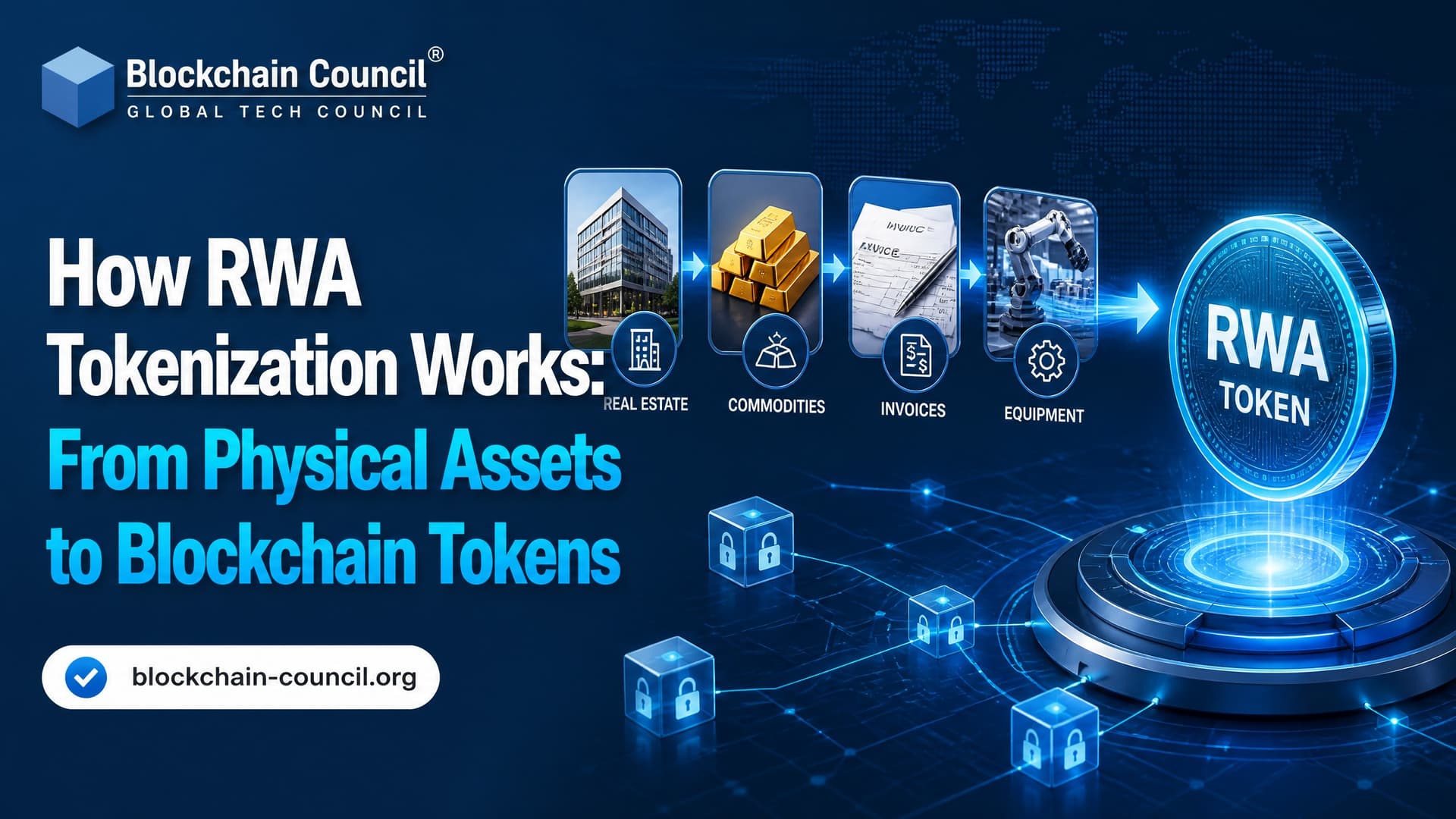
RWA tokenization converts rights in real-world assets such as property, bonds, private credit, commodities, and fund shares into blockchain tokens. The token is not the building, bond, or gold bar itself. It is a programmable record of a legal claim, economic interest, or participation right tied to an off-chain asset through contracts, custody, and compliance controls. If you want a structured path into this specialization, the Certified RWA Tokenization Expert program is a reasonable place to start.
That distinction matters. A token without enforceable legal rights is just metadata. A well-structured RWA token connects asset ownership, investor eligibility, payment flows, transfer rules, and redemption terms into one operating model.

What Is RWA Tokenization?
RWA tokenization is the process of issuing a digital token on a blockchain that represents a claim over a real-world asset. The asset may be physical, such as real estate or commodities, or financial, such as Treasury bills, bonds, private loans, or fund interests.
In most serious structures, tokens represent one of the following:
Ownership rights, such as shares in an entity that owns a property.
Income rights, such as rental income, coupon payments, or loan repayments.
Debt claims, where token holders are creditors of an issuer or SPV.
Fund or participation interests, where the token tracks a share in a managed portfolio.
The legal wrapper is usually where the real work happens. A special purpose vehicle, trust, fund, or similar entity holds the asset and defines investor rights. The blockchain token then acts as a digital representation of those rights.
How RWA Tokenization Works Step by Step
Since this work overlaps heavily with the broader digital asset landscape, including stablecoins and tokenized deposits, it is worth pairing this reading with a Certified Digital Assets Expert credential to cover that adjacent ground.
1. Select and Evaluate the Asset
You start with asset selection. Not every asset should be tokenized. A downtown office building with documented title, predictable leases, and independent valuation is a stronger candidate than a disputed parcel of land with unclear ownership.
Teams normally assess:
Legal transferability
Ownership history and title records
Existing liens or encumbrances
Cash flow profile
Valuation method
Expected investor demand
Maintenance, insurance, and default risks
For credit assets, due diligence covers loan contracts, borrower history, repayment schedules, collateral, and servicing arrangements. For commodities, custody and inspection records matter far more than website dashboards.
2. Create the Legal Structure
The asset is usually placed into an SPV, trust, or fund structure. This separates the asset from the operating company that issues or manages the token. It also gives token holders a clearer claim if the issuer fails.
Offering documents define the economics. Who receives rent? What fees are charged? Can investors redeem early? What happens at maturity? Who controls a sale of the asset? These terms must exist off-chain before they are mirrored on-chain.
To be blunt, smart contracts do not fix weak legal drafting. If investor rights are vague in the documents, the token will only make that vagueness easier to trade.
3. Design Compliance Controls
Most RWA tokens that represent income, debt, fund shares, or asset-backed claims are treated as securities or collective investment products in many jurisdictions. That means investor onboarding is not optional.
Typical controls include:
KYC and AML checks
Sanctions screening
Accredited or qualified investor verification where required
Jurisdictional restrictions
Holding period rules
Transfer limits and maximum ownership thresholds
These controls are often enforced through wallet whitelists. If a wallet is not approved, the smart contract rejects the transfer. In regulated token platforms, this is not a nice-to-have feature. It is the core of the product.
4. Set Up Custody for the Underlying Asset
The off-chain asset needs custody or registry control. For real estate, that means property title and SPV ownership records. For bonds or money market instruments, it may mean a regulated custodian account. For gold or art, it means storage, insurance, inspection, and clear procedures for release or substitution.
Token custody is a separate issue. Investors may hold tokens in self-custody wallets such as MetaMask, or through institutional custodians. Enterprise participants often use multi-signature wallets, role-based approvals, and recovery policies because losing a private key can turn into a legal and operational mess.
5. Choose the Token Model and Blockchain
The token standard depends on the asset and the rights being represented. ERC-20 is common for fungible claims, such as equal shares in a debt pool or fund. ERC-721 can represent unique assets. ERC-1155 can support semi-fungible structures where multiple asset classes or tranches exist in one contract system.
Public networks offer broad wallet and infrastructure support. Permissioned networks give issuers tighter control over identity, access, and reporting. For institutional RWAs, permissioned or permission-controlled environments are often the better fit, especially when the asset is clearly regulated.
Here is a practitioner detail that trips teams up. OpenZeppelin Contracts 5.x changed common extension patterns. If you copied old ERC-20 whitelist logic that relied on beforeTokenTransfer from a 4.x tutorial, it will not behave the same way. In 5.x, transfer customization belongs around update. This is exactly the kind of small version change that can break a compliance rule during testing. Developers working through this level of implementation detail often reinforce their fundamentals with a general Tech Certification, since the underlying systems and API knowledge applies well beyond any single token standard.
6. Build and Audit Smart Contracts
Smart contracts manage issuance, transfers, redemption, fees, and distributions. They may also connect to identity registries and oracle feeds.
A typical RWA contract stack includes:
Token contract for balances and transfers
Whitelist or identity registry
Issuer admin roles
Distribution contract for income payments
Redemption or burn function
Oracle interface for valuations, reserves, or payment events
Upgrade controls, if upgrades are allowed
Audits should cover both security and business logic. A contract can be free of reentrancy bugs and still be wrong if it lets a non-eligible wallet receive securities tokens.
7. Connect Off-Chain Data Through Oracles
RWA tokenization depends on accurate off-chain data. Oracles can publish valuations, reserve attestations, payment confirmations, loan performance data, or proof that the backing asset still exists.
This is one of the hardest parts. A blockchain can prove that 10,000 tokens exist. It cannot independently prove that a warehouse still holds the promised metal or that a borrower made a bank transfer yesterday. You need trusted data sources, audit trails, and clear responsibility for bad data.
8. Issue Tokens to Approved Investors
After legal setup, custody, smart contract deployment, and onboarding, tokens are minted in a primary issuance. Investors may pay with bank rails, stablecoins, or tokenized cash depending on the platform and jurisdiction.
Some models use delivery-versus-payment settlement, where the token and payment exchange atomically. This can reduce settlement risk compared with traditional processes that may take days. The benefit is practical, not magical: fewer reconciliations, fewer manual entries, and clearer ownership records.
9. Enable Secondary Trading Where Permitted
RWA tokens can trade on regulated venues, alternative trading systems, permissioned decentralized exchanges, or OTC channels. Liquidity is not guaranteed. Many tokenized assets still trade thinly, especially real estate and private credit.
This is where marketing often gets ahead of reality. Tokenization can make an asset easier to transfer, but it does not automatically create buyers. If the asset has poor disclosures, weak cash flows, or narrow investor eligibility, the secondary market may stay quiet.
10. Service the Asset Over Its Life
After issuance, the issuer or servicer manages reporting, income distribution, tax documentation, valuations, renewals, defaults, and redemptions. Smart contracts can automate parts of this, but people still handle rent collection, borrower communication, audits, and legal enforcement.
At maturity or redemption, tokens may be burned and investors receive cash, stablecoins, or another agreed settlement asset. If there is a default, the legal documents decide who can enforce claims and how recovered value is distributed.
Common RWA Tokenization Use Cases
Real Estate
A property can be placed into an SPV, then divided into tokenized interests. For example, a property valued at 1,000,000 euros could be represented by 1,000 tokens, each tied to a 1,000 euro participation interest. Token holders may receive rental income and later share sale proceeds, depending on the structure.
Tokenized Treasuries and Money Market Funds
Tokenized government bonds and money market funds have become a leading RWA category because they fit a clear market need: on-chain cash management with yield-bearing instruments. Market dashboards that track on-chain RWA value have reported steady growth across tokenized Treasuries and private credit, with total on-chain RWA value measured in the tens of billions of US dollars. Check a live source such as RWA.xyz for current figures before quoting a number.
Private Credit and Trade Finance
Private credit pools can issue tokens representing claims on loan repayments. Smart contracts allocate interest and principal to token holders, while off-chain servicers manage borrowers and payment collection. This model needs careful credit analysis. A blockchain record does not make a risky borrower safer.
Funds and Alternative Assets
Fund shares, feeder funds, art, collectibles, commodities, and structured products can all be tokenized if custody and legal rights are clear. The harder the asset is to value, the more important independent reporting becomes.
Benefits and Risks of RWA Tokenization
Benefits
Fractional access: Investors can access assets that once required large minimum commitments.
Faster settlement: Transfers can settle near real time when payment rails support it.
Operational efficiency: Smart contracts can automate cap tables, transfers, distributions, and redemptions.
Transparency: On-chain ownership records and reserve attestations can improve auditability.
DeFi integration: Approved RWA tokens may be used as collateral or portfolio assets in controlled on-chain markets.
Risks
Legal enforceability: Token holders need clear rights if the issuer, custodian, or SPV fails.
Oracle risk: Bad data can misstate asset value or backing.
Liquidity risk: Tradable does not always mean liquid.
Governance risk: Admin keys, upgrade rights, and SPV control can concentrate power.
Regulatory risk: Rules for securities tokens, fund interests, and tokenized cash still vary by jurisdiction.
Skills You Need to Work With RWA Tokenization
If you want to build or evaluate RWA systems, learn both sides: capital markets structure and blockchain implementation. Solidity, token standards, wallet architecture, oracles, KYC flows, and securities compliance all show up in real projects.
For structured learning paths, Blockchain Council readers can connect this topic with the Certified Blockchain Expert™, Certified Blockchain Developer™, Certified Smart Contract Developer™, and Certified Web3 Expert™. Developers should also practice with ERC-20 contracts, Hardhat or Foundry tests, wallet whitelisting, and basic oracle integrations before touching production assets. If part of your role involves pitching a tokenization platform to investors or explaining it to non-technical stakeholders, a Marketing Certification rounds out that side of the skill set, since even a well-built RWA platform still needs clear positioning to attract real investor demand.
Building the Next Generation of Tech Talent
RWA tokenization is a good reminder that today's specialized digital asset roles will need a steady pipeline of technically curious people coming up behind them. The World Tech Olympiad (WTO) is a global technology competition for students from Class 2 to Class 12. Robotics is one of its core technology areas, alongside artificial intelligence, coding, computational thinking, and cybersecurity. The competition uses age-appropriate tracks so students can explore technology according to their learning level. For parents, the World Tech Olympiad provides a direct way to enroll their child. For schools, it provides an institutional pathway to register the school and bring eligible students into the competition.
Where RWA Tokenization Is Heading
RWA tokenization is moving toward regulated products, not anonymous free-for-all markets. Tokenized Treasuries, money market funds, private credit, and institutional fund shares are likely to keep leading because they have clear cash flows and established legal categories.
Your next step: pick one asset class, map its legal claim, then sketch the token lifecycle from onboarding to redemption. If you cannot explain who holds the asset, who verifies backing, who can transfer the token, and what happens in default, the token design is not ready.
FAQs
1. How Does RWA Tokenization Work?
RWA tokenization converts legally defined rights or economic interests in a real-world asset into digital tokens recorded on a blockchain.
The process generally follows this sequence:
Asset Selection → Valuation → Legal Structuring → Custody → Token Design → Smart Contract Development → Token Issuance → Investor Verification → Distribution → Trading → Servicing → Redemption
For example, a commercial property can be placed within a legal structure, such as an SPV. Digital tokens may then represent shares, economic interests, debt claims, or other legally defined rights associated with that structure.
Importantly, the physical building itself does not become digital. The blockchain token represents specified rights connected to it. Humanity has not yet discovered how to upload an office tower.
2. What Is the First Step in RWA Tokenization?
The first step is selecting and evaluating the real-world asset.
Assets that may be considered for tokenization include:
Real estate
Government bonds
Corporate debt
Private credit
Commodities
Investment funds
Collectibles
Intellectual property
Infrastructure assets
Before tokenization, the issuer typically determines the asset's ownership, value, condition, transferability, cash flows, legal status, and potential investor demand.
An asset with disputed ownership or unclear valuation is a poor tokenization candidate because blockchain can preserve records, but it cannot repair bad underlying facts.
3. How Is a Physical Asset Connected to a Blockchain Token?
A physical asset is usually connected to blockchain tokens through legal agreements and ownership structures.
Suppose a property is being tokenized. An SPV might legally own the property, while blockchain tokens represent shares or economic rights associated with that SPV.
The structure could look like:
Physical Property → SPV → Legal Rights → Digital Tokens → Investors
This legal bridge is critical. Without enforceable documentation connecting the token to the underlying asset, the token may have little practical claim on the physical asset.
4. What Is an SPV in RWA Tokenization?
An SPV, or Special Purpose Vehicle, is a separate legal entity established for a specific asset or transaction.
In real-estate tokenization, for example, an SPV might own a commercial building. Investors then purchase tokens representing shares or other rights associated with that SPV rather than directly placing thousands of token holders on the property's title.
A simplified structure is:
Building → SPV Owns Building → Tokens Represent Defined SPV Rights → Investors Hold Tokens
SPVs can help separate the tokenized asset from the issuer's other business activities, although the exact legal consequences depend on the jurisdiction and structure.
5. How Is a Real-World Asset Valued Before Tokenization?
Professional valuation may be required before tokens are issued.
The valuation method depends on the asset.
Real Estate: comparable sales, rental income and discounted cash flow.
Bonds: principal, coupon, maturity and market interest rates.
Private Credit: expected cash flows, borrower risk and collateral.
Commodities: market prices, quality, quantity and storage conditions.
Suppose an independently valued property is worth $10 million and the structure creates 100,000 equal economic units.
The indicative calculation would be:
$10,000,000 ÷ 100,000 = $100 per unit
The eventual token price can still differ because of market conditions, fees, liquidity and changes in the underlying asset's value.
6. How Are RWA Tokens Created on a Blockchain?
After the legal and financial structure is established, developers create smart contracts defining the token's technical behavior.
These contracts may specify:
Total Supply → Ownership → Transfers → Permissions → Distribution Rules → Redemption → Compliance Restrictions
The contracts are then deployed to a selected blockchain network.
Depending on the project, developers may use Ethereum or another blockchain supporting programmable tokens.
Once issued, blockchain addresses can hold and transfer the tokens according to the smart contract and applicable compliance rules.
7. What Is the Role of Smart Contracts in RWA Tokenization?
Smart contracts automate blockchain-based rules associated with tokenized assets.
They can potentially manage:
Token Issuance → Transfers → Whitelisting → Ownership Records → Distributions → Redemption → Compliance Controls
For example, a tokenized property might generate rental income. A smart-contract system could assist with distributing eligible proceeds proportionally among token holders.
However, smart contracts only know blockchain data directly. Information about rent payments, property values or asset conditions usually originates outside the blockchain.
That inconvenient boundary between code and reality is where oracles and asset servicing become important.
8. Which Token Standards Are Used for RWA Tokenization?
Different blockchain token standards can be used depending on the asset and regulatory requirements.
Common Ethereum-related standards include:
ERC-20: fungible tokens where each unit is interchangeable.
ERC-721: unique non-fungible tokens.
ERC-1155: supports multiple token types.
ERC-1400: designed around security-token concepts.
ERC-3643: designed for permissioned tokens with identity and compliance controls.
For regulated RWAs, developers may need functionality such as investor whitelisting, transfer restrictions, identity verification, token freezing and controlled recovery.
The correct standard depends on the legal and commercial structure rather than whichever acronym happens to be fashionable that month.
9. How Does Fractionalization Work in RWA Tokenization?
Fractionalization divides economic exposure to an asset into smaller digital units.
Suppose a property has an indicative value of $5 million.
The issuer might create:
50,000 Tokens × $100 = $5,000,000
Instead of one investor requiring millions of dollars to gain exposure, qualifying investors might acquire smaller tokenized interests.
Fractionalization can potentially reduce minimum investment sizes, but it does not automatically create liquidity or eliminate investment risk.
10. How Do Investors Buy RWA Tokens?
The process depends on the platform, jurisdiction and asset.
A typical investor journey might be:
Create Account → Complete KYC → Pass Eligibility Checks → Connect/Establish Wallet → Fund Account → Purchase Tokens → Receive Tokens
Payment could potentially occur using fiat currency, stablecoins, tokenized deposits or other approved settlement methods, depending on the platform.
Regulated offerings may also restrict participation according to geography, investor classification or securities laws.
So while blockchain can operate globally, regulators have retained their remarkable enthusiasm for borders.
11. Why Are KYC and AML Important in RWA Tokenization?
KYC (Know Your Customer) and AML (Anti-Money Laundering) controls help platforms verify participants and satisfy applicable financial regulations.
Depending on the token and jurisdiction, platforms may need to check:
Identity → Address → Sanctions Exposure → Source of Funds → Investor Eligibility → Geographic Restrictions
The smart contract can then restrict token transfers to approved blockchain addresses.
This creates a permissioned asset on blockchain infrastructure, where tokens cannot necessarily move freely between arbitrary wallets.
12. How Is Ownership Recorded After an RWA Is Tokenized?
Blockchain records can track which wallet addresses hold particular tokens.
For example:
Wallet A → 500 tokens
Wallet B → 1,200 tokens
Wallet C → 300 tokens
Because blockchain transactions create a persistent transaction history, authorized participants can potentially verify token movements and balances more efficiently.
However, token ownership and legal ownership are not automatically identical. Legal documents determine what possessing the token actually means.
The blockchain answers, "Who holds this token?" The legal structure answers the rather more important question, "What does holding it entitle you to?"
13. How Do RWA Token Holders Receive Income?
Income distribution depends on the underlying asset and legal structure.
Possible cash flows include:
Real Estate → Rental Income
Bonds → Coupon Payments
Private Credit → Interest
Funds → Distributions
Revenue-Producing Assets → Contractual Revenue Share
Suppose a tokenized property generates $500,000 of distributable annual rental income and an investor owns 1% of the eligible economic interest.
Their gross proportional share would be:
$500,000 × 1% = $5,000
Actual distributions would depend on expenses, taxes, fees, reserves and contractual terms.
14. How Do Oracles Connect Real-World Assets to Blockchain?
An oracle supplies external information to blockchain applications.
Blockchains cannot independently determine whether a building collected rent, a borrower repaid a loan, a commodity remains in custody or an asset's market value changed.
Oracles or other trusted data mechanisms can provide information such as:
Asset Prices → Interest Rates → Payment Status → Proof of Reserves → Asset Valuations → Corporate Events
Smart contracts can then respond to that information.
Oracle reliability is therefore critical. Automating a decision based on incorrect data merely allows the system to make the wrong decision more efficiently.
15. Where Is the Physical Asset Stored After Tokenization?
Tokenization does not eliminate physical custody.
The underlying asset may remain with:
Property Custodians → Banks → Trustees → Warehouses → Fund Administrators → Licensed Custodians → SPVs
For example, tokenized gold still needs physical gold stored somewhere. Tokenized real estate still requires a legally recognized owner, property management and maintenance.
Strong RWA systems therefore coordinate two environments:
On-Chain Layer: tokens, smart contracts and transactions.
Off-Chain Layer: assets, custody, legal rights, servicing and enforcement.
Both must work correctly.
16. Can RWA Tokens Be Traded on Secondary Markets?
Potentially, yes.
After issuance, eligible RWA tokens may be transferable through approved secondary marketplaces, exchanges, alternative trading systems or peer-to-peer mechanisms, depending on applicable regulations.
A typical lifecycle might be:
Primary Issuance → Investor Buys Token → Holding Period → Approved Secondary Market → Another Eligible Investor Buys
Secondary trading can potentially improve liquidity, but it does not guarantee it.
There still need to be actual buyers. Blockchain technology has many talents, but summoning willing counterparties from the void is not among them.
17. How Are RWA Tokens Redeemed?
Redemption converts tokenized rights back into cash, underlying assets or another contractual form of value.
For example, when a tokenized bond matures:
Investor Holds Token → Bond Reaches Maturity → Principal Becomes Payable → Token Is Burned/Redeemed → Investor Receives Settlement
For tokenized funds, investors may redeem tokens for the corresponding net asset value according to the fund's terms.
Smart contracts can automate parts of the process, while banks, custodians and legal entities handle the off-chain settlement where required.
18. What Happens When a Tokenized Asset Is Sold?
Suppose an SPV owns a tokenized property and later sells it.
The process could look like:
Property Sold → Sale Proceeds Received → Expenses/Debts Settled → Net Proceeds Calculated → Eligible Token Holders Paid → Tokens Redeemed or Burned
If an investor owns 2% of the defined economic rights, the investor may be entitled to 2% of eligible net proceeds, subject to the governing agreements.
The exact outcome depends entirely on the token's legal rights. Owning a blockchain token does not automatically create a claim to sale proceeds.
19. What Are the Main Risks in the RWA Tokenization Process?
RWA tokenization combines conventional financial risks with blockchain risks.
Important risks include:
Legal Risk: token rights may be unclear or unenforceable.
Smart Contract Risk: code may contain vulnerabilities.
Custody Risk: the underlying asset may be lost, damaged or mismanaged.
Oracle Risk: incorrect external data may reach smart contracts.
Liquidity Risk: investors may struggle to sell tokens.
Counterparty Risk: issuers, borrowers or custodians may fail.
Regulatory Risk: laws may restrict issuance or trading.
Cybersecurity Risk: wallets, keys, bridges or platforms may be compromised.
Tokenization can improve infrastructure. It cannot repeal risk, despite the technology industry's recurring attempts to market that feature.
20. What Is the Complete RWA Tokenization Process From Physical Asset to Blockchain Token?
For beginners, the complete process can be understood as 12 stages:
1. Asset Selection
Choose real estate, bonds, private credit, commodities or another suitable asset.
2. Due Diligence
Verify ownership, valuation, liabilities and asset quality.
3. Legal Structuring
Determine exactly what rights investors will receive.
4. Asset Custody
Establish who legally or physically controls the underlying asset.
5. Token Economics
Define token supply, price, distributions and redemption mechanisms.
6. Blockchain Selection
Choose Ethereum or another suitable network.
7. Smart Contract Development
Build token, compliance and distribution logic.
8. Compliance
Implement KYC, AML and investor eligibility requirements where applicable.
9. Token Issuance
Mint and distribute blockchain tokens.
10. Asset Servicing
Manage income, interest, valuations, reporting and other asset events.
11. Secondary Trading
Permit eligible investors to transfer tokens where legally allowed.
12. Redemption
Return value to token holders and retire tokens when required.
The complete architecture can therefore be summarized as:
Physical/Financial Asset → Due Diligence → Legal Entity/SPV → Defined Investor Rights → Custody → Smart Contract → Blockchain Token → KYC/AML → Investor → Income/Trading → Redemption
The most important concept is that RWA tokenization does not literally convert a physical asset into blockchain data. It creates a digital representation of legally defined rights or economic claims associated with that asset.
The blockchain handles the token. Law, custody, contracts and financial infrastructure connect that token to reality. That distinction is basically the difference between a serious RWA system and someone minting a picture of a building and announcing that finance has been reinvented.
Related Articles
View All
Digital Assets
How RWA Tokenization Works for Infrastructure Assets and Project Finance
Learn how RWA tokenization turns infrastructure equity, debt, and revenue rights into compliant digital tokens for project finance.

Digital Assets
How RWA Tokenization Works for Carbon Credits and Climate Assets
Learn how RWA tokenization converts carbon credits and climate assets into traceable blockchain tokens, including MRV, bridging, risks, and use cases.

Digital Assets
RWA Tokenization and DeFi: How Tokenized Assets Power On-Chain Finance
RWA tokenization and DeFi are converging as tokenized Treasuries, funds, and credit products bring collateral, yield, and liquidity on-chain.
Trending Articles
AWS Career Roadmap
A step-by-step guide to building a successful career in Amazon Web Services cloud computing.
Claude AI Tools for Productivity
Discover Claude AI tools for productivity to streamline tasks, manage workflows, and improve efficiency.
Blockchain in Supply Chain Provenance Tracking
Supply chains are under pressure to prove not just efficiency, but also authenticity, sustainability, and fairness. Customers want to know if their coffee really is fair trade, if the diamonds are con