

Digital Assets in Banking: Custody, Payments, Tokenization, and Compliance

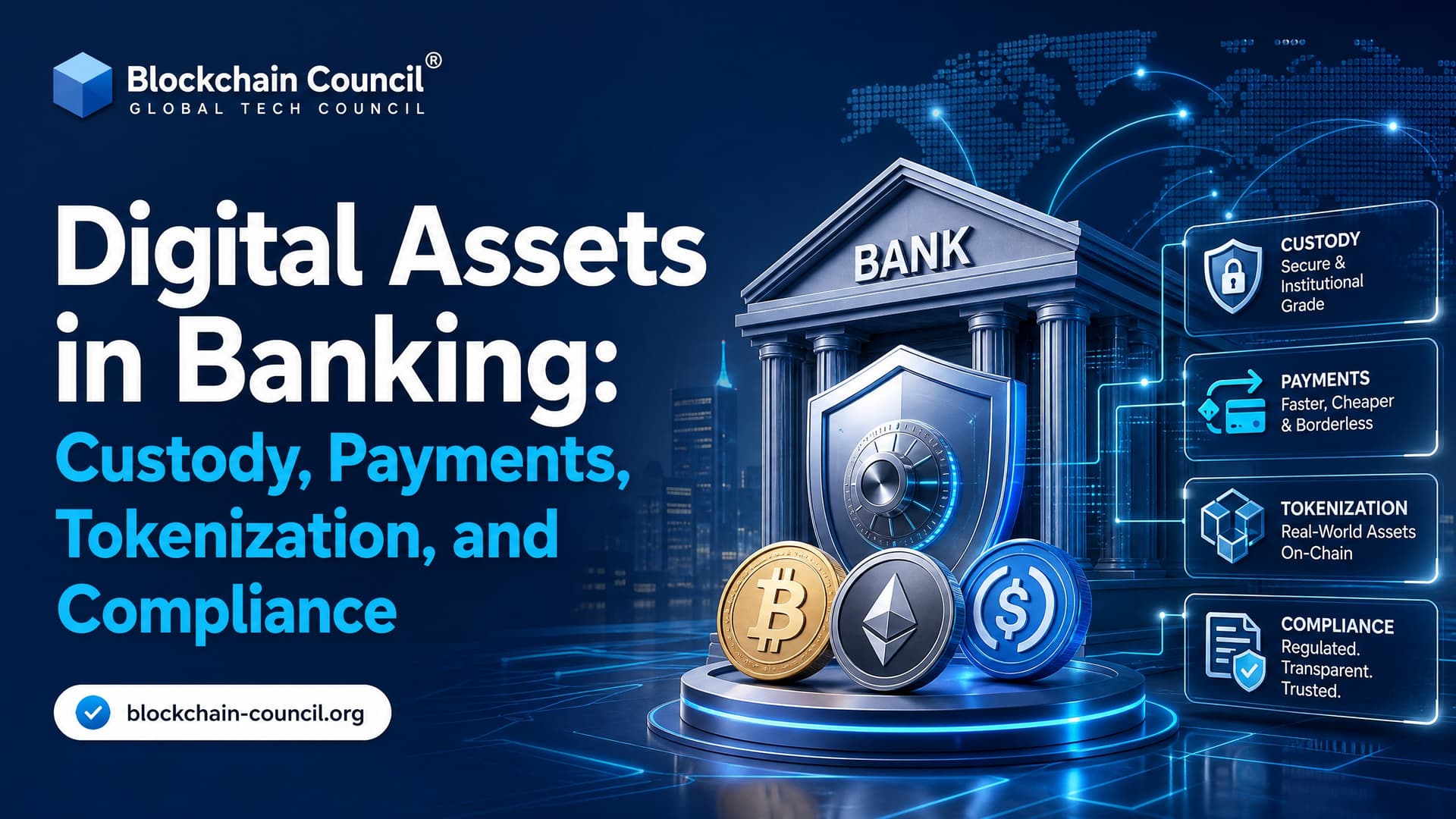
Digital assets in banking have moved past pilots. The serious work now sits in custody design, payment rails, tokenized funds, deposit tokens, and compliance controls that can survive a regulator's review. If you work in banking technology, treasury, risk, or product, the question is no longer whether digital assets matter. It is which model fits your balance sheet, your clients, and your jurisdiction.
What Digital Assets Mean for Banks
Banks are dealing with five broad categories of digital asset:

- Cryptoassets, such as bitcoin and ether, usually treated as higher-risk exposures.
- Tokenized traditional instruments, including tokenized money market funds, Treasuries, bonds, and fund shares.
- Tokenized deposits, which represent commercial bank deposits on distributed ledger infrastructure.
- Stablecoins, usually designed to hold a fixed value against a fiat currency.
- CBDC and unified ledger models, where central bank money, bank deposits, and securities may share programmable settlement rails.
The direction is clear. HSBC, BNY Mellon, Citi, Morgan Stanley, Societe Generale, JPMorgan, and BlackRock are not treating this as a lab project. They are building custody, payment, and tokenization services inside regulated businesses.
To be blunt, the winning banks will not be the ones that simply announce a blockchain unit. They will be the ones that make legal finality, key management, AML controls, accounting treatment, and client reporting work together.
Digital Asset Custody in Banking
Why custody is the first banking problem
Every digital asset banking service starts with custody. If you cannot safely control private keys, segregate client assets, recover from operational failures, and prove ownership, you cannot run payments or tokenized securities at scale.
Institutional custody is now shifting toward banks, trust companies, and regulated specialist providers. BNY Mellon has received approval to offer crypto custody beyond ETF structures. HSBC has planned custody for tokenized traditional assets using Metaco's Harmonize platform. SG Forge, part of Societe Generale, has obtained licensing in France and under MiCA to provide custody, transfer, and execution services for cryptoassets.
The custody market is growing for a simple reason. Institutions do not want a retail wallet with a nicer dashboard. They want segregation, audit trails, insurance, service level commitments, and clear liability terms.
Regulatory expectations for custody
Regulators are now much more specific. The Hong Kong Monetary Authority's custody guidance requires banks to segregate client digital assets at both account and wallet level, avoid rehypothecation without explicit consent, and use controls such as hardware security modules and key sharding. It also expects roughly 98 percent of client assets to be held in cold storage, with insurance or compensation arrangements for cold and hot storage losses.
MiCA in the European Union requires cryptoasset service providers, including banks offering custody, to segregate client cryptoassets legally and technically. That means clear on-chain and off-chain records. You cannot rely on a spreadsheet and a multisig address named "client wallet 1" and call that institutional custody.
In the United States, the OCC's Interpretive Letters 1183 and 1184 confirm that national banks and federal savings associations may provide digital asset custody, use distributed ledger technology, and engage in certain stablecoin-related activities when they manage risk properly. The rescission of SEC Staff Accounting Bulletin 121 also removed a major accounting blocker that had made custody expansion harder for banks.
Payments, Stablecoins, and Tokenized Deposits
Deposit tokens are different from stablecoins
Many people group stablecoins and tokenized deposits together. That is a mistake. A tokenized deposit is a digital representation of a commercial bank deposit. It does not usually change the bank's balance sheet. A stablecoin is typically issued by a non-bank or special purpose issuer and backed by reserves such as cash, Treasuries, or money market funds.
The distinction matters for deposit insurance, prudential treatment, settlement finality, and the singleness of money. The BIS and the ECB have both stressed that non-bearer tokenized deposits may preserve par value better than freely traded payment tokens.
JPM Coin and institutional payments
JPM Coin is one of the clearest live examples of digital assets in banking. It represents dollar deposits at JPMorgan and is used for institutional payments, intraday liquidity, collateral movements, and programmable settlement. JPMorgan's Kinexys platform has processed more than USD 1.5 trillion in notional value across payments and tokenized repo, with daily volumes above USD 2 billion, according to JPMorgan disclosures.
The practical value is not that a payment carries a blockchain label. The value is that a treasury team can move liquidity across time zones, post collateral, and reconcile settlement events without waiting for batch processes built around old cut-off times.
Other models are emerging too. VersaBank has introduced Real Bank Deposit Tokens, including USDVB, described as a tokenized deposit issued by a nationally licensed bank in the United States. In Thailand, the central bank's Programmable Payment Sandbox is testing THB-pegged units for programmable payments, escrow, and asset tokenization under strict reserve and redemption rules.
Tokenization of Assets and Securities
Money market funds and Treasuries are leading
Tokenization is gaining the most traction where the underlying asset is familiar and operational friction is high. That is why tokenized money market funds and Treasury products have grown faster than tokenized public equities.
BlackRock's USD Institutional Digital Liquidity Fund, known as BUIDL, launched in March 2024 with Securitize and tokenizes shares of a US dollar institutional liquidity fund. It is backed by short-term US Treasuries and repos and has become one of the largest tokenized fund products. JPMorgan Asset Management has also moved into tokenized money market products aimed at short-term Treasury and repo exposure.
On-chain US Treasury holdings grew from about USD 760 million to USD 2.6 billion during 2024. That is still tiny compared with global fixed income markets, but it is large enough for banks to care. Corporate treasurers and stablecoin issuers are interested because tokenized cash instruments can support settlement, collateral, and reserve management without leaving regulated structures.
Tokenization beyond cash products
Tokenized collateral and repo are far more bank-relevant than tokenized meme assets. JPMorgan's Tokenized Collateral Network and Kinexys activity show how tokenized fund shares or deposits can be used in collateral workflows. DTCC has also tested tokenized securities processes and has signaled readiness work for broader tokenized market adoption.
Public stock tokenization remains small. For most banks, it is not the best first use case. Start with tokenized cash, Treasuries, fund shares, collateral mobility, or internal settlement. These have clearer legal wrappers and more obvious operational payback.
Compliance and Prudential Treatment
Basel rules shape what banks can hold
The Basel Committee's cryptoasset standard divides exposures into Group 1 and Group 2. Group 1 includes tokenized traditional assets and stablecoins that meet strict conditions, with capital treatment aligned to the underlying exposure. Group 2 includes higher-risk cryptoassets, with much tougher capital treatment. Certain Group 2 holdings can attract a 1250 percent risk weight, and exposures above defined thresholds can create severe capital costs.
This is why banks are more comfortable with tokenized Treasuries, tokenized deposits, and regulated money market fund shares than with speculative crypto inventory. Capital matters. So does reputational risk.
MiCA, the GENIUS Act, and bank operating models
MiCA's rules for asset-referenced tokens and e-money tokens took effect on June 30, 2024, while the full cryptoasset service provider framework applied from December 30, 2024. Existing providers have a transitional period that runs to mid-2026 in many member states, subject to authorization requirements. Banks can often notify regulators under Article 60 rather than seek a completely separate CASP license, but they still need governance, cybersecurity, client asset segregation, and conduct controls.
In the United States, the GENIUS Act created guardrails for payment stablecoins, including one-to-one backing, transparency, and oversight. It also supports a market where tokenized money market funds can serve as reserve assets, which explains why asset managers are competing to offer regulated tokenized Treasury products.
Technical Details That Trip Teams Up
On paper, tokenization looks clean. In deployment, small defaults cause expensive problems.
- Decimals are not a legal term. ERC-20 tokens commonly use 18 decimals, but USDC uses 6. If your reconciliation engine assumes 18, your balances will be wrong.
- Chain IDs matter. Ethereum mainnet is chain ID 1. Sepolia is 11155111. A signer pointed at the wrong network can create failed operations or misleading test evidence.
- Solidity 0.8.x changed arithmetic behavior. Overflows revert by default and return panic code 0x11. Older training material that leans on SafeMath patterns without explaining this confuses developers.
- Custody approval rules are product rules. In MPC platforms, a missing policy approval can block settlement even when the wallet has assets and gas. Operations teams need runbooks, not just smart contracts.
If you are building bank-grade digital asset systems, test treasury workflows the same way you test smart contracts. Include failed redemptions, wrong-chain deposits, delayed oracle updates, revoked signer access, and sub-custodian outage scenarios.
Skills Banks Need Now
Digital assets in banking demand blended skills. A developer needs to understand ERC-20 and ERC-721 standards, but a bank product lead also needs Basel capital treatment, MiCA custody obligations, wallet segregation, travel rule processes, and operational resilience.
For structured learning, Blockchain Council's Certified Blockchain Expert™ is a solid starting point for strategy and architecture teams. Developers working on tokenization or custody integrations should look at the Certified Blockchain Developer™ and Certified Smart Contract Developer™ programs. Risk, compliance, and product teams dealing with crypto services may also benefit from the Certified Cryptocurrency Expert™ for deeper study.
What Comes Next for Banks
The next phase will not be about banks buying crypto for the sake of it. It will be about regulated tokenized cash, tokenized funds, collateral mobility, round-the-clock institutional payments, and shared settlement infrastructure. Custody will consolidate around large banks, trust companies, and a small number of specialist providers with strong controls. Tokenized Treasuries and money market funds will keep expanding because they solve real treasury problems.
Your next step is practical. Map one banking workflow where settlement, reconciliation, collateral movement, or client asset safekeeping is slow today. Then assess whether custody, tokenized deposits, stablecoins, or tokenized securities genuinely improve that workflow under your regulatory perimeter. If you need the foundations first, start with a blockchain certification path and build a small ERC-20 settlement prototype on a testnet before touching production policy design.
Related Articles
View All
Digital Assets
Cross-Border Payments with Digital Assets: Faster Settlement and Lower Costs
Digital assets are turning cross-border payments into faster, lower-cost settlement rails through stablecoins, CBDCs, and tokenized money.

Digital Assets
Digital Assets in Supply Chain: Traceability, Tokenization, and Operational Transparency
Digital assets in supply chain systems improve traceability, tokenization, and transparency, but adoption depends on data standards and legal clarity.

Digital Assets
Digital Asset Risk Management: Market, Technology, Custody, and Compliance Risks
Learn how digital asset risk management covers market volatility, cyber threats, custody controls, and compliance under frameworks such as MiCA.
Trending Articles
The Role of Blockchain in Ethical AI Development
How blockchain technology is being used to promote transparency and accountability in artificial intelligence systems.
What is AWS? A Beginner's Guide to Cloud Computing
Everything you need to know about Amazon Web Services, cloud computing fundamentals, and career opportunities.
Claude AI Tools for Productivity
Discover Claude AI tools for productivity to streamline tasks, manage workflows, and improve efficiency.