

Tokenization of Digital Assets Explained: Process, Benefits, and Use Cases
 Suyash Raizada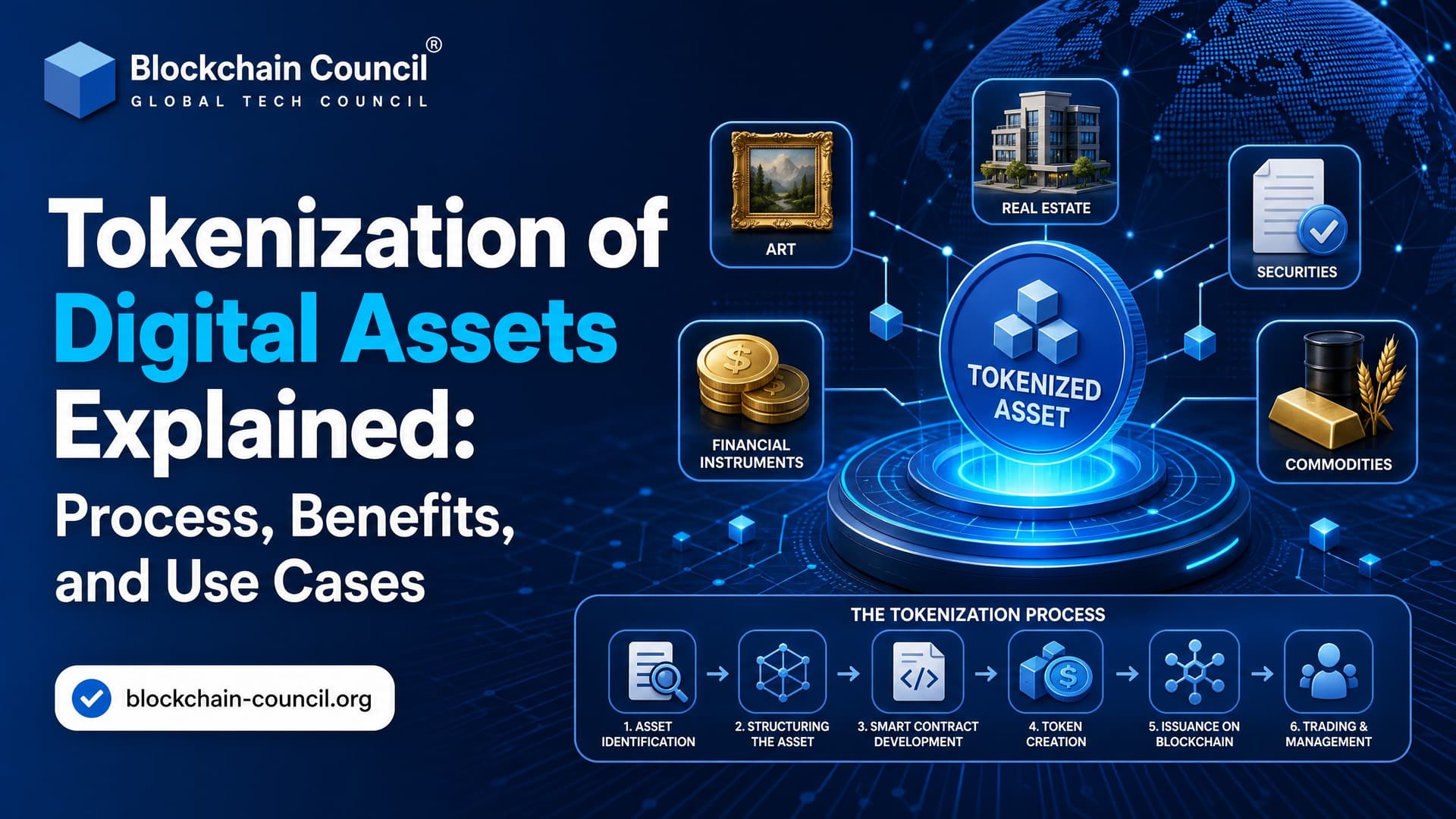
Tokenization of digital assets means turning ownership rights, cash-flow claims, access rights, or proof of ownership into blockchain-based tokens. The idea is simple. The execution is not. A token can represent a money market fund share, a bond, a fraction of a building, a carbon credit, a loan tranche, or a unique digital collectible. What matters is the legal link between the token and the asset, plus the technical rules that govern transfers, settlement, reporting, and compliance.
This is no longer a lab experiment. McKinsey estimates that tokenized market capitalization could reach about 2 trillion USD by 2030, excluding major cryptocurrencies and large stablecoins. It has also cited analyst forecasts of 4 to 5 trillion USD in tokenized digital securities by 2030. Production systems already exist. Broadridge's Distributed Ledger Repo platform processes more than 1 trillion USD in tokenized repurchase agreements monthly, and tokenized money market funds crossed 1 billion USD in assets by the first quarter of 2024.

As tokenization becomes an important part of modern financial infrastructure, professionals need a strong understanding of digital asset governance, tokenization frameworks, custody models, and regulatory compliance. A Certified Digital Assets Expert credential helps build these practical skills, enabling individuals to evaluate and manage digital asset ecosystems as blockchain adoption continues to expand across industries.
What Is Tokenization of Digital Assets?
Tokenization of digital assets is the process of creating tokens on a blockchain or distributed ledger to represent an asset or a defined right. The World Economic Forum describes asset tokenization as creating a digital representation of a real-world asset on a blockchain or distributed ledger. McKinsey defines it as creating a unique digital representation of an asset on a blockchain network. PwC describes it as a digital representation of ownership for tangible or intangible assets.
The scope is broad. Tokenization can apply to:
Financial instruments: deposits, bonds, loans, mutual funds, money market funds, ETFs, and securitized products.
Real-world assets: real estate, commodities, carbon credits, infrastructure, and private equity interests.
Alternative assets: artwork, collectibles, intellectual property, sports-related rights, and other non-traditional assets.
Native digital assets: stablecoins, NFTs, and other blockchain-native representations of value.
Do not confuse tokenization with uploading a PDF to a blockchain. The token has to map to enforceable rights. If the legal structure is weak, the token is only a database entry with better branding.
How the Tokenization Process Works
Most serious tokenization projects follow a similar lifecycle. The exact workflow changes by jurisdiction, asset class, and investor type, but the building blocks stay consistent.
1. Select the Asset and Define the Rights
Start with the asset. Is it a building, a bond, a fund share, a loan portfolio, or a carbon credit? Then define what the token holder actually gets. That could be equity ownership, a claim on cash flows, voting rights, redemption rights, usage rights, or proof of ownership.
This sounds basic, but it is where many weak projects fail. A token that says it represents real estate must point to a legal structure that owns or controls the property. Otherwise, secondary buyers may have no practical claim.
2. Create the Legal and Compliance Structure
Tokenization sits between code and law. Issuers often use a special purpose vehicle, trust, fund structure, or contractual wrapper to connect on-chain tokens with off-chain rights. This stage also covers securities law, investor eligibility, KYC, AML, custody, tax reporting, and transfer restrictions.
The OECD has repeatedly stressed that tokenization can improve liquidity, transparency, and efficiency, but only when regulatory safeguards and investor protections are handled properly. That is the right caution. A tokenized security is still a security in most jurisdictions.
3. Choose the Blockchain and Token Standard
The technical architecture depends on the market. Public chains offer openness and composability. Permissioned ledgers give institutions more control over identity, governance, and data access. Hybrid models are common in regulated finance.
Common token standards include ERC-20 for fungible tokens, ERC-721 for unique assets, and ERC-1155 for mixed fungible and non-fungible assets. Regulated securities may use permissioned transfer logic, whitelisting, or standards such as ERC-3643. Pick the standard based on the asset and compliance needs, not because it is fashionable.
A practical detail from real deployments: if your team uses OpenZeppelin Contracts 5.x, the Ownable contract now requires an initial owner in the constructor. Developers upgrading from older versions often hit the error No arguments passed to the base constructor. Specify the arguments or mark.... Small version changes like this can delay audits and testnet deployments. Read the changelog before you mint anything tied to investor money.
4. Build Smart Contracts and Mint Tokens
Smart contracts define supply, divisibility, ownership records, transfer conditions, governance, fee logic, redemption, and payment distribution. For a bond, the contract may track coupon dates. For a fund, it may support subscriptions and redemptions. For real estate, it may distribute rental income according to token holdings.
Security matters here. Contract bugs, poor private-key management, and flawed oracle feeds can create real losses. Use code audits, formal testing where appropriate, multisignature controls, and clear incident procedures.
5. Connect Off-Chain Data and Financial Systems
Many tokenized assets depend on external data. Interest rates, NAV calculations, property valuations, payment schedules, carbon credit retirement records, and corporate actions often sit outside the blockchain. Oracles and controlled data feeds bring that information on-chain.
Institutions also need integration with custody systems, accounting tools, investor portals, settlement networks, and reporting engines. This is less glamorous than minting a token. It is also where production projects win or lose.
6. Distribute, Trade, and Manage the Asset Lifecycle
Tokens may be distributed through private placements, regulated exchanges, alternative trading systems, or closed institutional networks. After issuance, lifecycle events continue: interest payments, redemptions, transfers, votes, collateral updates, compliance checks, and audits.
The ledger provides a shared ownership record. That reduces reconciliation across fragmented systems, one of the biggest operational pain points in traditional finance.
Successfully managing tokenized assets also requires a solid understanding of cryptocurrency markets, blockchain transactions, wallets, digital asset custody, and on-chain settlement. A Certified Cryptocurrency Expert credential equips professionals with the practical knowledge needed to connect tokenized financial products with the broader cryptocurrency ecosystem and its operational requirements.
Key Benefits of Tokenization
Liquidity and Fractional Ownership
Tokenization can make traditionally illiquid assets easier to trade. Real estate, private credit, art, and infrastructure assets often have high minimum ticket sizes and slow transaction cycles. Fractional tokens can lower entry thresholds and support secondary market trading, subject to regulation.
Be careful, though. Fractionalization does not magically create demand. A tokenized property with no buyers is still illiquid. Liquidity depends on market access, trusted issuance, custody, disclosures, and active trading venues.
Faster Settlement and Operational Efficiency
Blockchain-based settlement can cut manual reconciliation, paperwork, and intermediary handoffs. McKinsey has noted that tokenization can support 24/7 operations and atomic settlement, where asset transfer and payment happen together. In some repo and fund redemption workflows, settlement can move from traditional T+2 timelines to minutes.
JPMorgan has also emphasized 24/7 settlement and shared visibility as key advantages for tokenized assets and on-chain cash, especially in cross-border markets and liquidity management.
Transparency and Auditability
Distributed ledgers can provide a shared view of ownership and transaction history. That helps auditors, issuers, custodians, and investors work from the same record. It can reduce fraud risk and improve reporting quality.
Public transparency is not always suitable, especially for institutional securities. In those cases, permissioned access or privacy layers may be used so regulators and approved participants see what they need without exposing sensitive positions to everyone.
Programmability
Programmable tokens can execute rules automatically. Examples include dividend distributions, coupon payments, transfer restrictions, collateral checks, vesting schedules, and governance votes. This is one of the strongest reasons to tokenize assets that have repeated lifecycle events.
Programmability is also where poor design hurts. Do not automate a bad process. Fix the process first, then encode it.
Real-World Use Cases
Tokenized Money Market Funds
Tokenized money market funds are among the clearest live examples. Products from firms such as BlackRock, WisdomTree, Franklin Templeton, Ondo Finance, Superstate, and Maple Finance have shown that fund shares can exist as tokens with improved settlement and composability.
Repo and Wholesale Funding
Broadridge's Distributed Ledger Repo platform shows tokenization at institutional scale. By representing collateral and cash on ledger, repo workflows can settle faster and reduce operational friction. This is not a retail use case. It is plumbing. But financial markets run on plumbing.
Real Estate
Tokenized real estate can split property interests into smaller units, support secondary trading, and automate income distribution. It is a useful model for large assets with steady cash flows. It is a poor fit when property rights, valuation, or local transfer laws are unclear.
Bonds, Loans, and Securitization
Bonds and loans are strong candidates because they have defined cash flows, schedules, and documentation. Tokenization can help track ownership, automate coupons, and manage loan pools or tranches. McKinsey expects growth in areas such as warehouse lending and securitization of on-chain loans.
Carbon Credits and Environmental Assets
Tokenized carbon credits can improve traceability around issuance, ownership, and retirement. The hard part is not minting the token. The hard part is verifying that the underlying environmental claim is real and not double counted.
NFTs and Unique Digital Items
NFTs are tokenized representations of unique items. They can represent digital art, collectibles, certificates, memberships, or links to physical goods. ERC-721 remains the best-known NFT standard, while ERC-1155 is often used for collections that need both unique and semi-fungible items.
As tokenization platforms continue to evolve, organizations also rely on expertise in cybersecurity, cloud infrastructure, APIs, enterprise systems, automation, analytics, and secure software development. A Tech Certification helps professionals strengthen these complementary technical skills, supporting the successful integration, security, and scalability of enterprise tokenization solutions.
Risks and Challenges You Should Not Ignore
Legal enforceability: token holders need clear rights in the traditional legal system.
Regulatory fragmentation: securities, payments, custody, and tax rules differ by jurisdiction.
Smart contract risk: bugs can freeze assets, misroute payments, or bypass transfer restrictions.
Key management: lost or compromised private keys remain a serious operational risk.
Data integrity: bad oracle data can trigger bad on-chain outcomes.
Market fragmentation: different chains and standards can split liquidity across isolated venues.
For professionals building in this area, the learning path should cover both blockchain engineering and financial market structure. Blockchain Council's Certified Blockchain Expert™ is a useful starting point for the business and architecture view. Developers should look at Certified Blockchain Developer™ and Certified Smart Contract Developer™. If your focus is tokenized funds, lending, or collateral, the Certified DeFi Expert™ is a relevant next step.
What Comes Next for Digital Asset Tokenization?
Near-term growth will likely come from assets that already have standardized legal documentation and repeatable workflows: cash, deposits, funds, bonds, loans, and repo. That is where tokenization solves real operational problems instead of chasing novelty.
Real estate, carbon markets, private equity, and collectibles will keep growing, but adoption will stay uneven. The winners will be projects that combine enforceable rights, credible custody, clean data, strong compliance, and well-tested smart contracts.
If you want to work in this field, build a small ERC-20 or ERC-3643-style proof of concept, write the legal rights it is meant to represent in plain English, then test the transfer restrictions. You will learn quickly where tokenization is powerful, and where it is just a token wrapped around an unresolved business problem.
As tokenized assets become more widely adopted, organizations must also communicate their value, governance frameworks, and compliance practices effectively to investors, customers, regulators, and internal stakeholders. A Marketing Certification helps professionals strengthen strategic communication and stakeholder engagement skills, making complex tokenization concepts easier to explain while supporting greater confidence in digital asset initiatives.
FAQs
1. What is the tokenization of digital assets?
The tokenization of digital assets is the process of representing ownership, rights, or utility associated with an asset as blockchain-based tokens. These tokens can represent native digital assets, financial instruments, intellectual property, digital collectibles, tokenized securities, or other assets, depending on their legal and technical structure.
2. How does digital asset tokenization work?
Digital asset tokenization generally begins by identifying the asset and determining its legal and operational framework. Smart contracts are then used to create blockchain-based tokens, define ownership or usage rules, and manage transfers while maintaining transparent transaction records on a distributed ledger.
3. What types of digital assets can be tokenized?
A wide variety of digital assets may be tokenized, including cryptocurrencies, NFTs, stablecoins, digital securities, intellectual property rights, digital art, music royalties, software licenses, gaming assets, tokenized real-world assets (RWAs), and digital identity credentials.
4. Why is digital asset tokenization important?
Tokenization can improve efficiency, transparency, interoperability, and automation across digital ecosystems. It also supports programmable ownership, simplifies recordkeeping, and enables innovative business models while leveraging blockchain technology for secure transaction management.
5. What role do smart contracts play in tokenization?
Smart contracts automate functions such as token issuance, transfers, compliance checks, ownership updates, voting rights, royalty payments where applicable, and other predefined business rules. Once deployed, they execute according to their programmed logic on the blockchain.
6. What is fractional ownership in tokenization?
Fractional ownership allows a digital or tokenized asset to be divided into multiple smaller units, enabling several participants to hold proportional interests. This approach can improve accessibility and flexibility for certain asset classes, subject to legal and regulatory requirements.
7. What are the main benefits of digital asset tokenization?
Potential benefits include improved transparency, faster settlement, enhanced liquidity for eligible assets, lower administrative overhead, increased automation, better auditability, and support for global digital transactions. Actual outcomes depend on the underlying technology, governance, and applicable regulations.
8. What industries use digital asset tokenization?
Industries adopting tokenization include financial services, banking, insurance, healthcare, real estate, gaming, entertainment, supply chain management, manufacturing, energy, education, intellectual property management, and enterprise technology.
9. How does tokenization improve security?
Blockchain networks use cryptographic techniques to help protect transaction integrity and ownership records. While tokenization can strengthen transparency and traceability, overall security also depends on wallet protection, private key management, smart contract quality, cybersecurity practices, and operational controls.
10. How does blockchain support digital asset tokenization?
Blockchain provides a decentralized ledger that records token ownership and transactions in a transparent and tamper-resistant manner. This shared infrastructure helps reduce reconciliation efforts, improves traceability, and supports programmable asset management.
11. What is the difference between tokenization and digitization?
Digitization converts information from physical to digital form, such as scanning paper documents into electronic files. Tokenization goes further by creating blockchain-based tokens that represent ownership, rights, value, or access associated with an asset, often enabling programmable transactions and automated workflows.
12. How does AI complement digital asset tokenization?
Artificial intelligence can support tokenization by improving fraud detection, document verification, compliance monitoring, asset valuation, blockchain analytics, transaction monitoring, portfolio analysis, and workflow automation. AI is generally most effective when combined with sound governance and human oversight.
13. What are the risks of digital asset tokenization?
Potential risks include cybersecurity threats, smart contract vulnerabilities, regulatory uncertainty, operational failures, interoperability challenges, custody risks, market volatility, and legal disputes over ownership rights. Organizations should conduct thorough due diligence before implementing tokenization projects.
14. How is digital asset tokenization regulated?
Regulatory treatment depends on the jurisdiction and the characteristics of the tokenized asset. Applicable regulations may involve securities laws, anti-money laundering (AML), know-your-customer (KYC) requirements, taxation, consumer protection, financial reporting, and digital asset custody standards.
15. How are enterprises using digital asset tokenization?
Enterprises are exploring tokenization for treasury management, digital securities issuance, supply chain tracking, loyalty programs, intellectual property licensing, cross-border payments, asset management, decentralized finance (DeFi) integrations, and tokenized real-world assets.
16. How does tokenization affect investors and businesses?
Tokenization may create new ways to manage, transfer, and track ownership while supporting operational efficiency and broader market participation. Businesses can automate certain processes, and investors may gain access to new asset classes, although participation remains subject to legal, regulatory, and market considerations.
17. What trends are shaping digital asset tokenization in 2025-2026?
Major trends include institutional adoption of tokenized real-world assets, AI-powered compliance and analytics, decentralized identity integration, programmable financial products, blockchain interoperability, expanded digital custody solutions, tokenized funds, and increased regulatory clarity across several jurisdictions.
18. What are best practices for implementing digital asset tokenization?
Organizations should establish a clear legal framework, conduct independent smart contract audits, implement robust cybersecurity controls, select scalable blockchain infrastructure, maintain transparent governance, verify asset ownership, document operational procedures, and monitor regulatory developments continuously.
19. What should organizations evaluate before tokenizing digital assets?
Organizations should evaluate the asset's suitability for tokenization, legal ownership structure, compliance obligations, technology platform, custody arrangements, scalability, interoperability, governance model, implementation costs, and long-term business objectives. This information is educational and should not be interpreted as legal, financial, or investment advice.
20. What is the future of digital asset tokenization?
Digital asset tokenization is expected to continue expanding as blockchain technology, AI-powered automation, institutional adoption, and regulatory frameworks evolve. Increasing interoperability, stronger custody solutions, and standardized digital asset infrastructure may enable broader enterprise adoption across industries while improving efficiency and transparency. The technology keeps getting smarter, but someone will still eventually ask where they wrote down the recovery phrase.
Related Articles
View All
Digital Assets
Real Estate Tokenization Explained: Benefits, Process, and Compliance
Real estate tokenization turns property rights into blockchain tokens. Learn the benefits, process, compliance risks, and skills needed in 2026.

Digital Assets
Best RWA Tokenization Platforms: Features, Use Cases, and Selection Criteria
Compare the best RWA tokenization platforms, including Securitize, Ondo Finance, Franklin Templeton, Centrifuge, Maple, Paxos, Tether, and Tokeny.

Digital Assets
RWA Tokenization in Institutional Finance: Use Cases for Banks and Asset Managers
RWA tokenization is moving into production across tokenized funds, collateral networks, deposits, bonds, private credit, and trade finance.
Trending Articles
AWS Career Roadmap
A step-by-step guide to building a successful career in Amazon Web Services cloud computing.
What is AWS? A Beginner's Guide to Cloud Computing
Everything you need to know about Amazon Web Services, cloud computing fundamentals, and career opportunities.
Claude AI Tools for Productivity
Discover Claude AI tools for productivity to streamline tasks, manage workflows, and improve efficiency.