

Digital Assets in Supply Chain: Traceability, Tokenization, and Operational Transparency
 Suyash Raizada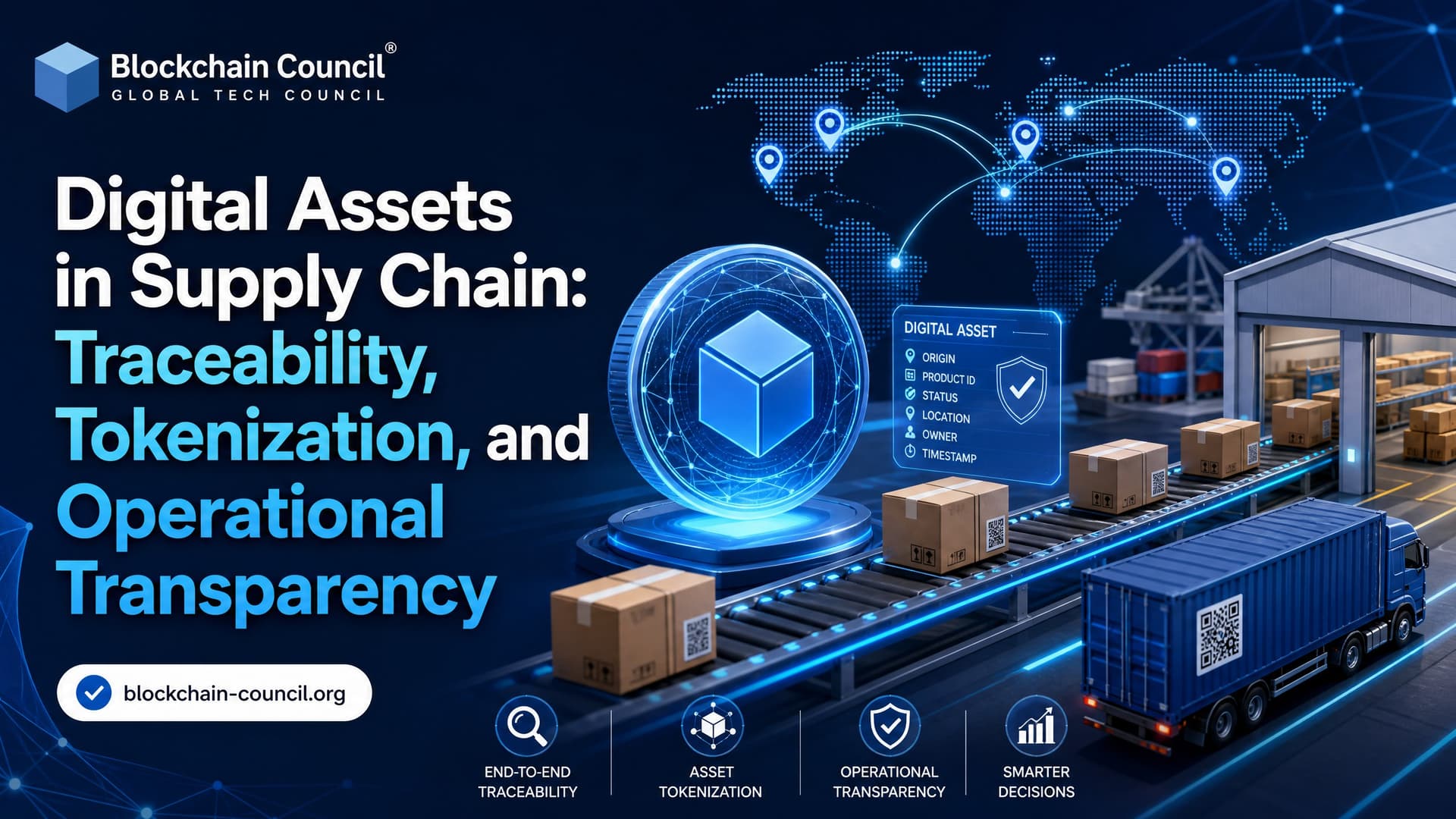
Digital assets in supply chain systems earn their place where the pain is obvious: proving origin, tracking custody, cutting invoice fraud, and giving partners a shared record instead of endless reconciliation. Traceability is already mature in food, luxury goods, pharmaceuticals, and commodities. Tokenization of inventory and logistics assets shows promise, but it still needs better standards, legal clarity, and clean integration with existing ERP systems.
Here is the short version. Use blockchain where several parties need to trust the same operational history. Do not use it as a slower database for one company. That single mistake still kills most pilots.

As supply chains become more digital, organizations need professionals who understand how tokenization, asset governance, digital ownership, compliance, and blockchain-enabled traceability work together. A Certified Digital Assets Expert credential helps build this practical knowledge, making it easier to evaluate and implement digital asset strategies across complex supply chain networks.
What Are Digital Assets in Supply Chain?
In supply chain work, digital assets are not just cryptocurrencies. They usually mean digital records that represent, control, or verify real-world goods and documents.
Tokenized physical goods: inventory, commodities, luxury items, spare parts, or batches represented by blockchain tokens.
Tokenized documents: invoices, bills of lading, certificates of origin, warehouse receipts, and inspection records.
Digital twins: digital identities for products, containers, pallets, machines, or shipments that track state, location, ownership, and events.
Programmable assets: tokens or records governed by smart contracts for payment release, quality checks, custody transfer, or compliance rules.
In practice, a digital twin rarely stores every sensor reading on-chain. That would be expensive and messy. A better pattern is to keep event data in a system aligned with GS1 EPCIS 2.0, then anchor hashes, custody changes, or certificate proofs on-chain. If you have ever tried matching a pallet ID from an RFID gate with a manually typed ASN in an ERP, you already know why data discipline matters more than which blockchain logo sits on the slide.
The Three Pillars: Traceability, Tokenization, and Transparency
Traceability
Traceability records the journey of goods from origin to final destination. A blockchain-backed model adds a tamper-evident event trail: farm harvest, processing, cold storage, customs clearance, warehouse receipt, retail scan, and recall action.
Walmart has reported that blockchain-based food tracking can trace certain products in seconds rather than days. That matters during a contamination event. The faster you isolate the affected batch, the fewer safe products get destroyed and the sooner retailers can act.
Building reliable traceability systems also requires a strong understanding of blockchain architecture, consensus mechanisms, smart contracts, and enterprise blockchain networks. A Certified Blockchain Expert credential equips professionals with these foundational skills, helping them design secure and scalable solutions for multi-party supply chain environments.
Tokenization
Tokenization turns a real asset or document into a digital token. The token may represent ownership, a claim, a right to use an asset, or proof that a document exists and has not been altered.
Common targets include:
Invoices: useful for financing and fraud reduction.
Inventory: useful for stock visibility and collateral-based lending.
Commodities: useful for ownership transfer without physically moving goods.
Luxury goods: useful for authenticity, resale, and provenance.
There is a trade-off. Tokenizing a warehouse receipt can pay off if the legal system recognizes the token-linked claim. Tokenizing every carton in a low-margin supply chain is usually overkill. Start where the asset is high value, fraud risk is real, and counterparties already spend money on verification.
Operational Transparency
Operational transparency means partners can verify key facts without seeing everything. A supplier can prove a product meets a sustainability standard without exposing pricing, customer names, or full production volumes.
This is where permissioned data sharing, selective disclosure, and well-designed access controls matter. Public blockchains are useful for neutral verification, but not every shipment detail belongs in public view. For most enterprise networks, a hybrid model is more realistic.
Where Digital Assets Are Already Working
Food and Agriculture
Food traceability is one of the strongest use cases for digital assets in supply chain management. IBM Food Trust and Walmart showed how blockchain records can support faster origin checks for products such as mangoes. Other food networks track batch numbers, processing steps, certifications, and shipping events.
The operational value is clear. Recalls, audits, sustainability claims, and supplier accountability all become easier to verify. Consumers can scan a QR code, while regulators and retailers pull deeper event data.
Diamonds, Wine, and Luxury Goods
De Beers has used blockchain tracking to support diamond provenance and ethical sourcing claims. In wine, projects such as dVIN connect bottles with tokens that record vineyard, vintage, storage history, and ownership changes.
This category works because authenticity carries direct financial value. A fake luxury item is not just a compliance issue. It damages resale markets and brand trust.
Product Passports
Digital product passports attach verifiable data to a physical item. Provenance, a social enterprise, has built systems that help brands publish origin, certification, and impact data in a form consumers and auditors can check.
This model is getting more relevant as regulators push for sustainability reporting and product-level accountability. Fashion, electronics, food, and batteries are likely to see more passport-style systems.
Tokenized Gold and Commodities
Tokenized gold has grown into a multi-billion dollar market, with tokens backed by physical reserves held in vaults. The supply chain angle matters here: mine, refinery, vault, and trade records can be linked to tokenized ownership claims.
Commodity tokenization can cut paperwork and support faster settlement, but only if custody, audits, and redemption rules are clear. A token that cannot be reconciled to real inventory is just a digital promise.
Invoices, Inventory, and Trade Finance
Invoice tokenization can help small and mid-sized suppliers access financing earlier. If an invoice is verified, tokenized, and linked to delivery evidence, lenders can price risk with better data.
Inventory tokenization has similar potential. A lender can extend credit against verified stock in a warehouse, especially when custody events, insurance status, and inspection data are visible. The hard part is not minting the token. It is proving the goods are real, not double-pledged, and still in the stated condition.
How Smart Contracts Add Value
Smart contracts can automate simple but high-friction workflows:
Release payment after delivery confirmation.
Flag a shipment if IoT temperature readings exceed agreed limits.
Transfer ownership after customs clearance and warehouse receipt validation.
Block settlement if a certification has expired.
Create an audit trail for service-level agreement disputes.
Keep smart contracts boring. That is a compliment. For supply chain, the best contracts encode narrow business rules and emit clean events. If you are building an ERC-721 digital twin for high-value assets, test the lifecycle states carefully. A common developer mistake is transferring a token before the physical custody event is confirmed. In OpenZeppelin-based contracts, you may also hit errors such as ERC721NonexistentToken in newer versions when your off-chain system references an ID that was never minted. That is not a blockchain problem. It is a data synchronization problem.
Market Signals and Adoption Reality
The global blockchain market was valued at roughly 20 billion US dollars in 2024, and various enterprise blockchain reports forecast strong double-digit annual growth through the early 2030s. Much of that projected growth is tied to traceability, provenance, asset tracking, settlement, and compliance-heavy workflows. Treat any single long-range figure with caution; the estimates vary widely by source.
Global supply chain inefficiencies are often estimated in the trillions of dollars each year. Tokenization will not fix port congestion or poor demand planning by itself. It can, though, reduce avoidable losses caused by blind spots, duplicate financing, forged documents, and slow reconciliation.
To be blunt, traceability is production-ready in many sectors. Broad tokenization of logistics assets is earlier stage. It needs common data standards, legal recognition, trusted custodians, better oracle design, and real interoperability between legacy systems and blockchain networks.
Implementation Checklist for Enterprises
If you are evaluating digital assets in supply chain operations, run through this checklist before choosing a platform:
Define the asset: Is it a batch, item, invoice, container, warehouse receipt, or certificate?
Define the legal claim: Does the token represent ownership, custody, access, payment rights, or proof?
Map real-world events: Identify who can create, verify, update, and challenge each event.
Use data standards: Align with GS1 identifiers, EPCIS event structures, and existing ERP fields where possible.
Decide what goes on-chain: Store proofs, hashes, ownership events, and critical state changes. Keep sensitive operational data off-chain.
Design for exceptions: Lost QR tags, damaged RFID labels, split shipments, rejected goods, and returned items are normal.
Audit custody: Token ownership must match physical control, warehouse records, and insurance documents.
Plan integration: Connect ERP, WMS, TMS, IoT, identity, and compliance systems before scaling.
Successful digital asset implementations also rely on expertise beyond blockchain, including cybersecurity, cloud infrastructure, APIs, enterprise integration, automation, analytics, and AI-driven operational systems. A Tech Certification helps professionals strengthen these complementary technical capabilities, enabling more resilient and scalable supply chain solutions.
Risks and Limitations
Digital assets improve verification, but they do not make bad input data true. The classic problem remains: garbage in, garbage out. If a supplier falsely claims origin, the blockchain faithfully preserves the false claim unless verification controls exist.
Watch for these risks:
Oracle risk: Off-chain events must be captured by trusted devices, people, or institutions.
Interoperability gaps: Partners may use different identifiers, data formats, and compliance systems.
Privacy exposure: Shipment volumes, routes, and supplier relationships can reveal commercial secrets.
Regulatory uncertainty: Tokenized documents and assets may be treated differently across jurisdictions.
Operational mismatch: A token transfer without physical delivery creates disputes instead of reducing them.
Skills Professionals Need
If you work in logistics, procurement, trade finance, compliance, or enterprise architecture, you do not need to become a protocol engineer overnight. You do need to understand token design, smart contract risk, identity, data governance, and business process mapping.
For structured learning, look at Blockchain Council programs such as the Certified Blockchain Expert™, Certified Blockchain Developer™, Certified Smart Contract Developer™, and Certified Web3 Expert™. Developers should go deeper into Solidity 0.8.x, ERC-20, ERC-721, access control, event indexing, and oracle patterns. Business leaders should focus on use-case selection, compliance, and implementation governance.
What Comes Next for Digital Assets in Supply Chain?
The next wave will not be generic blockchain pilots. It will be targeted systems for product passports, invoice financing, commodity tokenization, verified sustainability claims, and automated settlement tied to trusted shipment events.
Your best next step is simple. Pick one high-value asset flow and map its custody events from origin to settlement. If the process involves multiple parties, repeated reconciliation, fraud risk, or slow audit trails, digital assets may fit. If it is just an internal database problem, fix the database first.
As digital asset initiatives expand across global supply chains, organizations also need professionals who can clearly communicate their value to suppliers, customers, regulators, and executive stakeholders. A Marketing Certification helps strengthen strategic communication, stakeholder engagement, and change management skills, supporting successful adoption of supply chain innovation.
FAQs
1. What are digital assets in supply chain management?
Digital assets in supply chain management include blockchain-based records, digital certificates, tokenized goods, electronic bills of lading, product passports, inventory data, smart contracts, and digital identities used to track products and processes. These assets help organizations improve visibility, data integrity, and collaboration across supply chain networks.
2. Why are digital assets becoming important in supply chains?
Global supply chains involve numerous suppliers, manufacturers, logistics providers, distributors, and retailers. Digital assets can improve data sharing, reduce manual documentation, strengthen product traceability, and support more efficient operations through secure and verifiable digital records.
3. What is supply chain traceability?
Supply chain traceability is the ability to track the movement, origin, processing, and ownership of products throughout their lifecycle. Digital technologies help organizations record events from raw material sourcing to manufacturing, transportation, warehousing, retail distribution, and end-of-life management.
4. How does blockchain improve supply chain traceability?
Blockchain creates tamper-evident records of supply chain transactions and product movements. Rather than replacing enterprise systems, blockchain often complements existing platforms by providing a shared, auditable record of key events among authorized participants.
5. What is tokenization in supply chains?
Tokenization is the process of representing physical goods, inventory, shipping documents, or ownership rights as digital tokens on a blockchain. Tokenized assets can simplify tracking, automate transfers, and improve transparency throughout supply chain operations.
6. What are digital product passports?
Digital product passports are electronic records containing information about a product's origin, materials, manufacturing process, certifications, maintenance history, and sustainability characteristics. They support greater transparency for manufacturers, regulators, businesses, and consumers.
7. How do smart contracts support supply chain operations?
Smart contracts automate predefined business processes such as shipment verification, payment releases, inventory updates, customs documentation, compliance checks, and supplier agreements. Automation can reduce manual intervention and improve operational efficiency when business conditions are met.
8. What industries benefit most from blockchain-based supply chains?
Industries including manufacturing, pharmaceuticals, food and agriculture, automotive, aerospace, healthcare, luxury goods, retail, electronics, mining, and energy are exploring blockchain-based supply chain solutions to improve visibility and operational resilience.
9. How do digital assets improve operational transparency?
Digital assets provide shared access to verified transaction records, shipment milestones, certification data, and inventory updates. This transparency helps supply chain participants identify bottlenecks, improve reporting, strengthen collaboration, and support audit processes.
10. How are digital identities used in supply chains?
Digital identities authenticate organizations, suppliers, logistics providers, equipment, products, and connected devices. Trusted digital identities help verify participants, reduce fraud risks, and strengthen secure communication throughout the supply chain ecosystem.
11. What role does AI play alongside digital assets?
Artificial intelligence complements digital assets by forecasting demand, optimizing inventory, identifying supply chain risks, detecting anomalies, improving logistics planning, automating documentation, and generating operational insights from large datasets. AI is often integrated with blockchain platforms to improve decision-making.
12. How do IoT devices enhance supply chain digital assets?
Internet of Things (IoT) sensors can automatically collect information such as temperature, humidity, location, vibration, and handling conditions. When combined with blockchain records, IoT data supports continuous monitoring of sensitive shipments and improves product traceability.
13. What cybersecurity risks affect digital supply chains?
Potential risks include ransomware, phishing, unauthorized system access, compromised supplier accounts, smart contract vulnerabilities, API attacks, insider threats, and supply chain software compromises. Organizations should implement layered cybersecurity controls and continuously monitor digital infrastructure.
14. How can organizations secure digital supply chain assets?
Organizations typically use encryption, multi-factor authentication (MFA), role-based access controls, secure APIs, network segmentation, continuous monitoring, vendor risk management, blockchain security assessments, and incident response planning to protect digital supply chain operations.
15. What regulatory considerations apply to digital supply chains?
Organizations may need to comply with regulations related to product safety, customs documentation, consumer protection, environmental reporting, import and export controls, data privacy, cybersecurity, and industry-specific standards. Compliance obligations vary by jurisdiction and sector.
16. What challenges limit digital asset adoption in supply chains?
Challenges include legacy system integration, interoperability across platforms, implementation costs, organizational change management, inconsistent data quality, supplier onboarding, cybersecurity concerns, governance complexity, and varying levels of digital maturity among supply chain partners.
17. How do digital assets support sustainability initiatives?
Digital assets can improve the tracking of raw material sourcing, carbon emissions, recycling activities, product lifecycle information, ethical sourcing certifications, and environmental reporting. Greater transparency supports sustainability reporting and responsible sourcing initiatives.
18. What supply chain trends are shaping digital assets in 2026?
Key trends include AI-powered supply chain analytics, blockchain interoperability, digital product passports, tokenized inventory, IoT-enabled traceability, predictive logistics, automated compliance reporting, decentralized identity, and stronger cybersecurity governance across global supply networks.
19. How can businesses prepare for digital asset adoption in supply chains?
Businesses should identify operational challenges, establish governance frameworks, strengthen cybersecurity, evaluate interoperability standards, engage supply chain partners, conduct pilot programs, train employees, and measure outcomes against clearly defined business objectives before broader implementation.
20. What is the future of digital assets in supply chain management?
Digital assets are expected to play a growing role in improving traceability, operational transparency, compliance, sustainability reporting, and supply chain resilience. As blockchain, AI, IoT, and interoperability standards continue to mature, organizations may gain greater visibility and efficiency across increasingly complex global supply networks. The humble shipping container may never become glamorous, but knowing exactly where it is beats guessing every single time.
Related Articles
View All
Digital Assets
RWA Tokenization and Stablecoins: Connecting Real Assets to Digital Money
RWA tokenization and stablecoins are converging as tokenized Treasuries, real estate, and funds settle through blockchain-based digital money.

Digital Assets
RWA Tokenization Security: Smart Contract, Custody, and Operational Risk Management
RWA tokenization security requires smart contract audits, regulated custody, proof of reserve controls, and operational governance to reduce real asset risk.

Digital Assets
RWA Tokenization and Digital Securities: Similarities, Differences, and Regulations
RWA tokenization and digital securities overlap, but differ in asset scope, regulation, trading venues, liquidity, and DeFi integration.
Trending Articles
What is AWS? A Beginner's Guide to Cloud Computing
Everything you need to know about Amazon Web Services, cloud computing fundamentals, and career opportunities.
How to Install Claude Code
Learn how to install Claude Code on macOS, Linux, and Windows using the native installer, plus verification, authentication, and troubleshooting tips.
How to Create Claude Skills?
Claude Skills are one of the most important features Anthropic has introduced for users who want automation that is structured, consistent and reusable. Instead of giving Claude long instructions ever