

Digital Asset Risk Management: Market, Technology, Custody, and Compliance Risks
 Suyash Raizada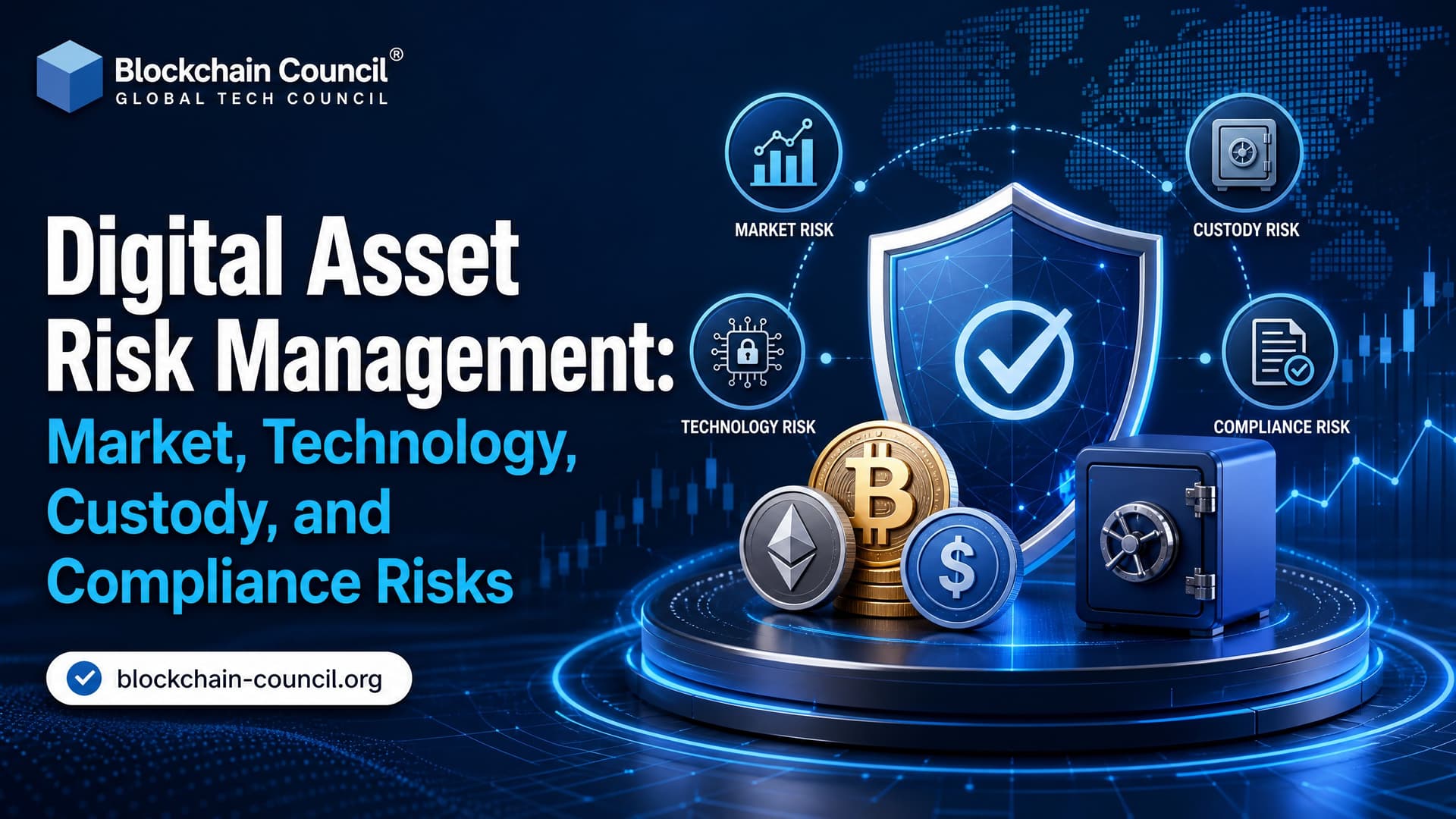
Digital asset risk management is no longer a side task for the security team or the trading desk. If you hold crypto, issue tokens, run custody, build smart contracts, or advise clients, you need one risk program that connects market exposure, technology controls, custody governance, and compliance obligations.
The reason is simple. Losses are real, regulation is tighter, and institutional activity has grown. Chainalysis reported roughly 2.2 billion dollars stolen through crypto hacks in 2024, across more than 300 incidents. The EU Markets in Crypto-Assets Regulation, known as MiCA, now gives crypto-asset service providers a much clearer rulebook. At the same time, banks and asset managers are treating digital assets as a formal risk class, not an experiment.

Building an effective risk management program requires more than understanding market movements. Professionals must also be familiar with digital asset governance, tokenization, custody models, compliance, and enterprise blockchain adoption. A Certified Digital Assets Expert credential helps develop these practical capabilities, enabling organizations to build stronger and more resilient digital asset strategies.
What Digital Asset Risk Management Covers
A mature framework should not treat digital asset risk as one bucket. Separate the risk types, assign owners, then bring them back into a single risk view.
Market risk: price volatility, liquidity gaps, basis risk, correlation with broader markets, and forced selling.
Technology risk: smart contract bugs, oracle manipulation, bridge exploits, infrastructure failure, and cyber attacks.
Custody risk: private key compromise, weak approval workflows, poor segregation of assets, and failed recovery processes.
Compliance risk: licensing, AML controls, sanctions screening, client asset rules, disclosures, and cross-border obligations.
Institutional surveys show why this matters. Many large investors now use crypto-specific risk frameworks, derivatives for hedging, AI-supported monitoring, and real-time on-chain analytics. Still, tools do not replace judgement. A dashboard can flag a wallet movement. It cannot decide whether your treasury policy allows that transfer at 2:13 a.m. on a Sunday.
Market and Liquidity Risks
Volatility Is the Obvious Risk, Liquidity Is the Painful One
Bitcoin and Ether are more liquid than most digital assets, but even they can move sharply during macro stress. Smaller tokens are different. A token can show a large mark-to-market value on a screen, then lose depth the moment you try to exit. That is where risk reports often lie by accident.
For professional portfolios, do not rely only on daily value-at-risk. Add practical stress tests:
What happens if Bitcoin drops 15 percent in one trading session?
Can you exit a position without moving the market by more than 3 percent?
What if your main exchange freezes withdrawals during the same period?
How much stablecoin exposure sits with one issuer or banking partner?
FTX made this lesson hard to ignore. Counterparty risk can become liquidity risk in minutes. If assets are trapped on a venue, the theoretical hedge does not help much.
Useful Controls for Market Risk
Use derivatives carefully for major assets where markets are deep enough. Futures and options can reduce directional risk, but they add margin, basis, and counterparty risk. For smaller tokens, position limits and liquidity haircuts are often better than fancy hedges.
A practical market risk policy should include:
Approved venues with minimum standards for audits, governance, and client asset segregation.
Token concentration limits by asset, issuer, protocol, and venue.
Liquidity tiers based on real order book depth, not just reported volume.
Stress tests for correlated sell-offs and stablecoin de-pegging.
Clear authority for emergency liquidation decisions.
Managing digital asset risk also requires a solid understanding of blockchain architecture, consensus mechanisms, smart contracts, and enterprise blockchain infrastructure. A Certified Blockchain Expert credential equips professionals with these technical foundations, making it easier to evaluate blockchain-related risks alongside traditional financial and operational controls.
Technology and Cybersecurity Risks
Smart Contracts Fail in Specific Ways
Technology risk is not abstract. It shows up as reentrancy, broken access control, oracle manipulation, unsafe upgrades, compromised private keys, and bridge design errors. DeFi losses in 2024 again showed that attackers do not need to break blockchains themselves. They usually attack the surrounding code, infrastructure, or people.
A small practitioner detail. When a team sees execution reverted: Ownable: caller is not the owner during testing, it is tempting to treat it as a normal developer mistake. In production, the same access-control misunderstanding can become a governance failure. OpenZeppelin v5 also moved several patterns toward custom errors, so older test assumptions can miss permission failures if teams copy checks from old tutorials. These version details matter.
Controls That Actually Reduce Technology Risk
Audits are useful, but they are not a shield. You need layered controls before and after deployment.
Secure development life cycle: threat modelling, peer review, test coverage, static analysis, fuzzing, and formal review for critical contracts.
Independent audits: use reputable firms, fix findings, then retest. Publishing an audit while ignoring high-severity issues is worse than no audit.
Bug bounties: set clear scope, realistic rewards, and fast triage.
Oracle risk controls: use trusted feeds, circuit breakers, and fallback logic for abnormal price moves.
Upgrade governance: add timelocks, multi-signature approval, and public change logs for material upgrades.
On-chain monitoring: track abnormal approvals, large withdrawals, contract ownership changes, and bridge flows.
If your team builds smart contracts, Blockchain Council's Certified Smart Contract Developer™ and Certified Blockchain Developer™ give developers structured training on contract design, security, and blockchain architecture.
Custody and Key Management Risks
The Private Key Is the Asset
Custody risk is unforgiving because blockchain settlement is usually irreversible. A mistaken bank transfer may be recalled. A signed crypto transaction generally cannot be undone.
Major 2024 incidents, including large exchange and platform breaches, showed recurring weaknesses: key compromise, unsafe multi-signature workflows, social engineering, poor contract upgrade controls, and weak separation between operational teams. North Korean-linked groups have also become a major threat actor in crypto theft, according to Chainalysis reporting.
Here is the hard truth. Custody is not about buying the most expensive wallet system. It is about proving that no single person, laptop, vendor admin, or emergency process can move assets without detection and authorization.
Institutional Custody Controls
For enterprises and funds, a defensible custody model should include:
Segregation of client and house assets: legal ownership must be clear, especially in insolvency scenarios.
Multi-signature or MPC: no single actor should control a complete signing capability.
Hardware security modules: use controlled environments for key generation and signing where appropriate.
Approval workflows: define who can approve what, at what threshold, and under which conditions.
Key lifecycle management: document generation, storage, rotation, backup, succession, and destruction.
Logging and monitoring: preserve tamper-resistant logs for signing events and policy changes.
Incident playbooks: rehearse key compromise, signer loss, vendor outage, and suspicious withdrawal scenarios.
Qualified custodians and regulated trust companies can reduce operational burden, but they do not remove fiduciary responsibility. You still need due diligence on insurance, audits, service organization controls, withdrawal policy, bankruptcy treatment, and jurisdiction.
Compliance, Legal, and Regulatory Risks
MiCA Raises the Bar in Europe
MiCA is one of the most important regulatory frameworks for crypto businesses operating in or serving the European Union. Its stablecoin provisions began applying in 2024, and the wider crypto-asset service provider rules now shape licensing, governance, disclosure, market abuse controls, and prudential requirements.
MiCA classifies crypto assets into categories such as asset-referenced tokens, e-money tokens, and other crypto assets. It also regulates crypto-asset service providers, including exchanges, custodians, and trading platforms. Existing providers may have transitional periods in some EU jurisdictions, but the direction is clear: informal operations are becoming harder to defend.
Compliance Risks to Track
Licensing risk: offering exchange, custody, lending, or token services without required authorization can lead to enforcement or forced exit.
Disclosure risk: token whitepapers, marketing, and risk statements must be accurate and not misleading.
AML and sanctions risk: transaction monitoring, wallet screening, travel rule processes, and suspicious activity reporting need to be built into operations.
Client asset risk: firms must explain where assets are held, how they are protected, and whether client assets are segregated.
Cross-border risk: DeFi protocols, token issuers, and exchanges often touch several jurisdictions at once.
For compliance, governance, and risk teams, Blockchain Council's Certified Cryptocurrency Expert™, Certified Blockchain Expert™, and Certified Cybersecurity Expert™ map well to these roles. Teams working with AI-based monitoring may also benefit from the Certified AI Expert™.
Building an Integrated Risk Framework
The best digital asset risk management programs connect controls across teams. Trading cannot own liquidity risk alone. Security cannot own custody risk alone. Legal cannot fix a bad token design after launch.
Use this operating model:
Map assets and activities: list tokens, wallets, smart contracts, venues, custodians, vendors, and jurisdictions.
Assign risk owners: market, technology, custody, and compliance risks need named accountable people.
Set risk appetite: define limits for token exposure, venue exposure, custody models, smart contract permissions, and regulatory markets.
Monitor continuously: combine market feeds, on-chain analytics, custody logs, SIEM alerts, and compliance screening.
Test the system: run tabletop exercises for hacks, de-pegs, exchange failures, key loss, regulator inquiries, and protocol exploits.
Report to leadership: use plain risk metrics that executives can act on, not only technical dashboards.
AI can help with anomaly detection and wallet clustering, but be careful. Models can create false confidence when training data is thin or attacker behavior changes. Keep humans in the approval loop for high-value actions.
Effective digital asset risk management also depends on expertise in cybersecurity, cloud infrastructure, APIs, enterprise systems, automation, analytics, and AI-driven monitoring. A Tech Certification helps professionals strengthen these complementary technical skills, supporting secure operations and improving an organization's ability to identify and respond to evolving technology risks.
The Next Standard for Digital Asset Risk
Digital asset risk management is moving toward the standards used in mature financial markets, with one extra burden: the technology layer can directly move value. That changes everything. A contract bug, signer compromise, or mistaken approval can become a balance sheet loss before a committee meeting even starts.
If you are building a program now, start with custody and access control, then add market limits, smart contract assurance, compliance mapping, and incident response. If you are building your career, choose the learning path that matches your role: Certified Blockchain Expert™ for strategy and architecture, Certified Smart Contract Developer™ for builders, Certified Cryptocurrency Expert™ for markets, and Certified Cybersecurity Expert™ for security teams. Then test the knowledge on a real wallet policy, a real contract review, or a real risk register. Paper frameworks do not stop losses. Practiced controls do.
Strong risk programs also rely on clear communication across leadership teams, regulators, clients, and operational stakeholders. A Marketing Certification helps professionals develop strategic communication and stakeholder engagement skills, making it easier to explain risk frameworks, promote governance initiatives, and encourage organization-wide adoption of digital asset best practices.
FAQs
1. What is digital asset risk management?
Digital asset risk management is the process of identifying, assessing, monitoring, and mitigating risks associated with blockchain-based assets, cryptocurrencies, tokenized assets, smart contracts, and related technologies. An effective framework helps organizations balance innovation with security, regulatory compliance, and operational resilience.
2. Why is risk management important for digital assets?
Digital assets introduce unique risks involving technology, cybersecurity, regulation, custody, and market volatility. A structured risk management program enables organizations to reduce potential losses, strengthen governance, improve decision-making, and support sustainable adoption.
3. What are the main categories of digital asset risk?
The primary categories include market risk, technology risk, cybersecurity risk, custody risk, operational risk, liquidity risk, regulatory and compliance risk, counterparty risk, legal risk, and reputational risk. Organizations typically evaluate these risks collectively because they often influence one another.
4. What is market risk in digital assets?
Market risk refers to the possibility that digital asset values may fluctuate due to changing market conditions, economic events, investor sentiment, liquidity levels, or macroeconomic developments. Organizations should recognize that prices can be highly volatile and should establish risk tolerance levels appropriate to their objectives.
5. What is technology risk?
Technology risk involves failures or weaknesses in blockchain infrastructure, smart contracts, software, APIs, cloud services, or supporting systems. Risks may arise from coding errors, integration challenges, scalability limitations, or infrastructure outages that affect business operations.
6. What is custody risk?
Custody risk relates to the secure storage and management of digital assets and cryptographic keys. Poor key management, unauthorized access, insider threats, or inadequate backup procedures can lead to permanent asset loss or operational disruption.
7. How do organizations reduce custody risk?
Organizations typically implement hardware security modules (HSMs), hardware wallets where appropriate, multi-signature authorization, secure key management, encryption, access controls, disaster recovery plans, segregation of duties, and regular security reviews to strengthen custody operations.
8. What are smart contract risks?
Smart contract risks include programming errors, logical flaws, insecure integrations, oracle failures, and vulnerabilities that may be exploited after deployment. Independent code reviews, formal testing, security audits, and ongoing monitoring can help reduce these risks.
9. What is cybersecurity risk in digital assets?
Cybersecurity risk includes phishing attacks, ransomware, malware, wallet compromise, API attacks, supply chain attacks, insider threats, and unauthorized access to digital asset systems. Organizations should maintain layered security controls and continuously monitor for emerging threats.
10. What is compliance risk?
Compliance risk arises when organizations fail to meet applicable legal or regulatory requirements. Depending on the jurisdiction and business model, obligations may include anti-money laundering (AML), know-your-customer (KYC), sanctions compliance, tax reporting, consumer protection, cybersecurity, and privacy regulations.
11. How does AI support digital asset risk management?
Artificial intelligence assists with fraud detection, transaction monitoring, predictive analytics, anomaly detection, cybersecurity, compliance automation, and operational risk analysis. AI-generated insights should be reviewed within established governance processes and supported by human oversight.
12. What is operational risk in digital asset management?
Operational risk includes failures in internal processes, employee errors, system outages, inadequate governance, third-party service disruptions, and ineffective business continuity planning. Strong internal controls and clearly documented procedures help reduce operational vulnerabilities.
13. What is liquidity risk?
Liquidity risk is the possibility that a digital asset cannot be bought or sold efficiently without significantly affecting its market price. Market depth, trading volume, exchange availability, and broader market conditions all influence liquidity.
14. How should organizations assess third-party risk?
Organizations should evaluate exchanges, custodians, technology vendors, cloud providers, and blockchain service providers by reviewing their security practices, financial stability, regulatory compliance, operational resilience, governance, and incident response capabilities before entering into business relationships.
15. What governance practices improve risk management?
Effective governance includes defined risk ownership, board oversight, security policies, internal audits, segregation of duties, risk reporting, vendor management, compliance monitoring, employee training, and regular reviews of risk management frameworks.
16. What regulatory developments affect digital asset risk management?
Governments and regulators continue refining frameworks covering digital asset custody, stablecoins, securities, anti-money laundering (AML), know-your-customer (KYC), taxation, cybersecurity, consumer protection, and operational resilience. Organizations should monitor official guidance in every jurisdiction where they operate.
17. What industries benefit from digital asset risk management?
Industries including banking, fintech, asset management, insurance, healthcare, supply chain, real estate, gaming, retail, and government can benefit from structured digital asset risk management to improve security, compliance, operational stability, and stakeholder confidence.
18. What trends are shaping digital asset risk management in 2026?
Key trends include AI-powered risk analytics, continuous blockchain monitoring, institutional custody solutions, zero-trust cybersecurity architectures, tokenized real-world asset (RWA) governance, automated compliance reporting, blockchain interoperability risk assessment, and stronger enterprise governance frameworks.
19. What are the best practices for managing digital asset risks?
Organizations should establish comprehensive governance frameworks, perform regular risk assessments, conduct smart contract audits, strengthen cybersecurity controls, diversify operational dependencies where appropriate, monitor regulatory developments, implement incident response plans, and continuously educate employees on emerging risks.
20. What is the future of digital asset risk management?
Digital asset risk management is expected to become increasingly sophisticated as blockchain technology, tokenization, institutional adoption, artificial intelligence, and regulatory frameworks continue to evolve. Organizations that integrate proactive risk management into their broader business strategy are likely to improve resilience, strengthen compliance, and support responsible innovation over the long term. Risk can never be eliminated entirely, but it becomes much less intimidating when it's measured before it becomes tomorrow's headline.
Related Articles
View All
Digital Assets
RWA Tokenization Security: Smart Contract, Custody, and Operational Risk Management
RWA tokenization security requires smart contract audits, regulated custody, proof of reserve controls, and operational governance to reduce real asset risk.

Digital Assets
RWA Tokenization Risks: Legal, Technical, Market, and Custody Challenges
RWA tokenization brings real assets on-chain, but legal, technical, liquidity, and custody risks can break investor rights and market trust.

Digital Assets
How AI in RWA Tokenization Is Changing Valuation, Compliance, and Risk
AI in RWA tokenization is reshaping valuation, compliance, surveillance, and risk analytics for tokenized real-world assets.
Trending Articles
The Role of Blockchain in Ethical AI Development
How blockchain technology is being used to promote transparency and accountability in artificial intelligence systems.

Top 5 DeFi Platforms
Explore the leading decentralized finance platforms and what makes each one unique in the evolving DeFi landscape.

Can DeFi 2.0 Bridge the Gap Between Traditional and Decentralized Finance?
The next generation of DeFi protocols aims to connect traditional banking with decentralized finance ecosystems.