

Digital Asset Best Practices: Security, Compliance, Governance, and Operations
 Suyash Raizada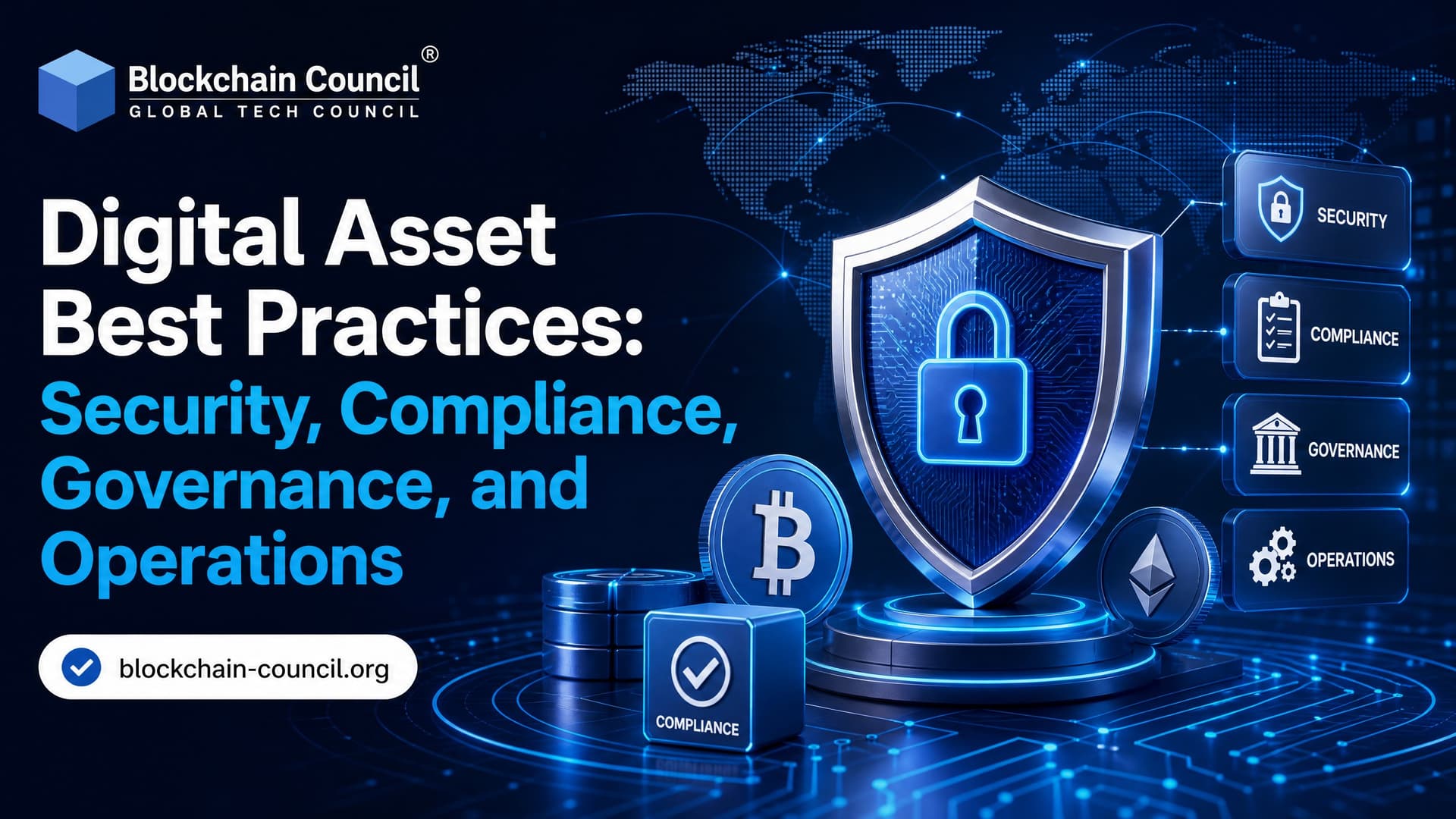
Digital asset best practices now look much closer to banking, cybersecurity, and enterprise risk management than to early crypto experimentation. If your organization holds tokens, manages tokenized securities, operates wallets, or runs a digital asset management platform, you need written policies, tested controls, clean records, and people who know exactly what they are allowed to do.
The pressure is real. Chainalysis reported more than 2.17 billion dollars in crypto stolen in the first half of 2025, already above full-year 2024 theft levels. The same firm tracked nearly 40 billion dollars in illicit crypto activity for 2024. Those numbers explain why boards, auditors, regulators, and insurers now ask harder questions about digital asset security, compliance, governance, and day-to-day operations.

As digital assets become part of mainstream financial and enterprise operations, professionals need a structured understanding of governance, custody, compliance, and operational risk. A Certified Digital Assets Expert credential helps build these practical skills, enabling individuals to manage digital asset ecosystems with greater confidence and accountability.
What Digital Asset Best Practices Cover
Digital assets can mean cryptocurrencies, stablecoins, tokenized securities, NFTs, media files, intellectual property, data sets, or brand assets stored in a digital asset management system. The controls differ, but the operating logic is similar.
Security: Protect keys, wallets, systems, endpoints, and user accounts.
Compliance: Meet AML, KYC, sanctions, tax, privacy, and reporting duties.
Governance: Define who owns decisions, who approves risk, and who can act.
Operations: Run repeatable processes for custody, trading, approvals, audits, backups, and incident response.
To be blunt, a spreadsheet and one hardware wallet in a finance director's drawer is not an institutional program. It is a single point of failure.
Security Best Practices for Digital Assets
Use a tiered custody model
Do not keep every asset in a hot wallet. A practical custody design uses three tiers:
Hot wallets: Small balances for daily operations, payments, or trading.
Warm wallets: Controlled access for periodic treasury or settlement activity.
Cold storage: Offline storage for long-term or high-value holdings.
For significant balances, multi-signature wallets and Multi-Party Computation wallets should be the baseline. Multi-sig makes several approved signers authorize a transaction. MPC splits signing responsibility cryptographically, so no single person holds a complete private key. Both reduce key-person risk, though they create new operational work. A 2-of-3 setup is simple until one signer leaves, one device is lost, and nobody has tested the recovery process.
Protect keys like production infrastructure
Private keys and seed phrases need the same seriousness as root credentials in a critical system. Use hardware wallets, Hardware Security Modules where appropriate, offline backups, physical access controls, and documented recovery procedures. Store recovery material in separate secure locations. Never photograph a seed phrase. Never paste it into a ticketing system. Yes, people still do this.
For Ethereum operations, make sure teams understand chain ID and fee mechanics. Ethereum mainnet uses chain ID 1, and EIP-1559 transactions include a base fee plus a priority fee. A common operational mistake is trying to speed up a stuck transaction with the wrong nonce or too-low fee, then seeing replacement transaction underpriced. That is not just a developer annoyance. In a treasury workflow, it can delay a settlement and trigger manual exception handling.
Secure the full stack
Blockchain controls are not enough. Attackers often enter through laptops, messaging apps, browser extensions, cloud consoles, or compromised email accounts. Apply endpoint protection, phishing-resistant multi-factor authentication, network hardening, encrypted communications, device management, and continuous monitoring.
Least privilege matters. The person who requests a transfer should not be the same person who approves and executes it. Separate initiation, approval, signing, reconciliation, and reporting. Keep immutable audit trails for wallet activity, admin actions, policy changes, and exceptions.
Strong security practices are most effective when supported by a solid understanding of blockchain architecture, wallet management, consensus mechanisms, and smart contract operations. A Certified Blockchain Expert credential helps professionals strengthen these technical foundations, making it easier to design secure and resilient blockchain-based systems.
Test backup and incident response
A recovery plan that has never been tested is a guess. Follow the 3-2-1 backup rule: three copies, two media types, one offsite. Run drills for lost signer devices, suspected seed compromise, exchange account lockout, and rapid asset migration. Include communications. Legal, finance, IT, security, and the board should know when they get called.
Compliance Best Practices for Digital Assets
Build around four pillars
A serious digital asset compliance program rests on four pillars used by practitioners across crypto, stablecoin, and financial services programs:
Governance: Board oversight, documented policies, named owners, and accountability.
Risk assessment: Identification of AML, counterparty, market, operational, technology, and jurisdiction risks.
Internal controls: KYC, transaction monitoring, sanctions screening, tax records, employee trading rules, and record retention.
Independent testing: Internal audit or third-party review of control design and effectiveness.
FATF guidance, the European Union's Markets in Crypto-Assets Regulation, and enforcement activity from agencies such as the U.S. Securities and Exchange Commission have pushed the market toward stronger customer due diligence, transaction monitoring, investor protection, and market integrity controls.
Operationalize AML and sanctions controls
AML compliance cannot live in a PDF. You need systems, data, escalation rules, and trained staff. Define risk ratings for customers and counterparties. Screen wallet addresses and entities against sanctions lists. Monitor transactions for typologies such as layering, mixer exposure, ransomware links, darknet market flows, and rapid movement through high-risk services.
Set clear escalation thresholds. For example, a compliance analyst should know what happens when an address has indirect exposure to a sanctioned service, when the exposure is stale, and when the transaction is already broadcast. Those details decide whether your program works on a bad Tuesday.
Fix employee trading gaps
Compliance market research has found that many companies still do not require pre-approval before employees trade crypto. That is a major conflict-of-interest gap, especially for exchanges, funds, token issuers, Web3 firms, and advisory businesses.
Use pre-trade approval, restricted lists, trading windows, holding periods, and disclosure requirements. Treat material non-public information seriously. If your team knows about a listing, token burn, partnership, exploit, or treasury move before the market does, personal trading rules should apply.
Keep tax records from day one
Tax reporting breaks down when teams cannot reconstruct cost basis, timestamps, transaction hashes, wallet addresses, fees, or counterparties. Guidance for South African crypto users, for example, stresses detailed records to meet South African Revenue Service expectations. The same principle applies elsewhere. If you process more than a handful of monthly transactions, automate tracking instead of relying on manual downloads from exchanges.
Governance Best Practices for Digital Asset Programs
Set decision rights before assets move
Digital asset governance defines who can approve assets, counterparties, wallets, smart contracts, vendors, risk limits, and exceptions. Start with a board-approved policy. Then create working committees for treasury, risk, technology, legal, and compliance decisions.
DTCC's Digital Asset Securities Control Principles are useful for institutional programs because they focus on legal certainty, regulatory compliance, resilience, security, customer asset protection through smart contract governance, interoperability, and operational scalability. These principles fit tokenized securities especially well, where settlement, custody, investor rights, and asset servicing must align with existing market rules.
Govern smart contracts and on-chain permissions
If your organization deploys or relies on smart contracts, governance must cover contract ownership, upgrade keys, pausing rights, admin roles, oracle dependencies, and audit requirements. Avoid externally owned admin wallets for critical contracts. Use multi-sig or MPC-controlled admin functions. Publish change procedures internally, and keep emergency actions narrow.
For teams building these capabilities, Blockchain Council's Certified Blockchain Developer™ and Certified Blockchain Expert™ cover smart contract architecture, consensus, wallet design, and enterprise blockchain controls.
Do not ignore non-crypto digital assets
For media, IP, brand, and data assets, governance means metadata standards, naming conventions, usage rights, expiration dates, approval status, and audit trails. A digital asset management system should make the right behavior easier. Mandatory fields for licensing rights and client approval status prevent teams from publishing assets they are not allowed to use.
Operational Best Practices: From Manual Control to Scaled Programs
Use a phased operating model
Start small, but do not stay informal. A sensible maturity path looks like this:
Phase 1 - Foundation security: Secure key generation, basic access controls, transaction approval workflows, and backup procedures.
Phase 2 - Operational governance: Formal decision processes, role-based access, audits, incident response, and regular security assessments.
Phase 3 - Compliance and risk management: KYC, AML, insurance review, disaster recovery, business continuity, monitoring, analytics, and automation.
Manage counterparty and exposure risk
After the 2022 digital asset market dislocations, institutions became much more careful about counterparty concentration. Good practice now includes written counterparty policies, approval committees, exposure limits by asset and counterparty, stress testing, and incident simulations.
Do not approve a custodian, exchange, market maker, or staking provider based only on fees. Review legal structure, segregation of client assets, audit reports, insurance terms, withdrawal controls, jurisdiction, operational history, and incident transparency.
Integrate with finance and IT systems
Digital asset operations should not sit outside enterprise finance. Active portfolios need transaction capture, reconciliation, valuation, approval evidence, and accounting records. Larger teams often integrate wallet and exchange data into ERP systems such as SAP or Oracle through middleware or specialized digital asset accounting tools.
Keep approval separate from execution. Reconcile on-chain activity against internal tickets, custody reports, and accounting entries. For DAM platforms, map workflows, define service level agreements, automate approvals, and use analytics to find bottlenecks.
Modern digital asset operations also rely on expertise in cybersecurity, cloud infrastructure, APIs, enterprise integrations, automation, and analytics. A Tech Certification helps professionals broaden these complementary technical skills, supporting efficient and secure management of both blockchain platforms and enterprise digital asset environments.
Skills Your Team Should Build Next
Controls work only when people understand them. Security teams need wallet, endpoint, and incident response training. Finance teams need custody, valuation, reconciliation, and tax knowledge. Compliance teams need blockchain analytics, AML typologies, and sanctions screening. Developers need smart contract security and upgrade governance.
For structured learning, map roles to Blockchain Council programs such as Certified Cryptocurrency Expert™ for crypto market and compliance fundamentals, Certified Blockchain Expert™ for enterprise decision-makers, Certified Blockchain Developer™ for technical teams, and Certified Cybersecurity Expert™ for staff responsible for threat prevention and incident handling.
Practical Next Step
Pick one business line and run a 30-day control review. List every wallet, exchange account, signer, admin role, vendor, policy, tax record source, and approval workflow. Then mark each item as owned, tested, or unknown. Start fixing the unknowns first. That is where most digital asset failures begin.
Beyond technical controls, organizations also benefit from communicating digital asset initiatives clearly to customers, partners, regulators, and internal stakeholders. A Marketing Certification helps professionals strengthen strategic communication, brand positioning, and stakeholder engagement, complementing technical expertise while supporting wider adoption of digital asset best practices.
FAQs
1. What are digital asset best practices?
Digital asset best practices are established guidelines for securely managing, storing, governing, and using digital assets such as cryptocurrencies, tokenized assets, NFTs, digital documents, and blockchain-based records. They help organizations and individuals reduce operational risks while supporting compliance and long-term asset integrity.
2. Why is security important for digital assets?
Digital assets are protected by cryptographic keys, making security a critical component of ownership and control. Effective security measures help reduce the risk of unauthorized access, theft, ransomware, phishing attacks, insider threats, and accidental loss of private keys.
3. What are the best practices for securing digital assets?
Common best practices include using hardware wallets where appropriate, enabling multi-factor authentication (MFA), maintaining secure backups, encrypting sensitive data, applying the principle of least privilege, regularly updating software, and monitoring systems for suspicious activity. Security strategies should be reviewed and updated as threats evolve.
4. How should organizations manage private keys?
Private keys should be stored using secure key management solutions such as hardware security modules (HSMs), hardware wallets, or qualified custody solutions where appropriate. Access controls, key rotation policies, backup procedures, and recovery plans help minimize operational and security risks.
5. What is digital asset governance?
Digital asset governance refers to the policies, processes, and oversight mechanisms used to manage digital assets throughout their lifecycle. Governance frameworks typically define ownership, responsibilities, approval workflows, risk management practices, and accountability across the organization.
6. Why is compliance important in digital asset management?
Compliance helps organizations meet applicable legal, regulatory, and industry requirements. Depending on the jurisdiction and business model, this may include anti-money laundering (AML), know-your-customer (KYC), tax reporting, sanctions screening, consumer protection, privacy regulations, and financial reporting obligations.
7. What operational controls should organizations implement?
Organizations should establish documented operating procedures for asset creation, transfers, approvals, custody, reconciliation, monitoring, incident response, disaster recovery, and business continuity. Clearly defined controls reduce operational errors and improve consistency across teams.
8. What role do access controls play in digital asset security?
Access controls limit who can view, transfer, or administer digital assets. Role-based access control (RBAC), segregation of duties, privileged access management, and approval workflows help reduce both insider and external security risks.
9. How do multi-signature wallets improve security?
Multi-signature (multisig) wallets require multiple authorized approvals before a transaction can be completed. This reduces reliance on a single private key and helps protect organizations against key compromise, fraud, and unauthorized transfers.
10. Why are regular audits important?
Internal and external audits help verify compliance with security policies, operational procedures, accounting controls, and regulatory requirements. Regular reviews can identify weaknesses before they become significant operational or cybersecurity issues.
11. How should organizations monitor digital asset risks?
Continuous monitoring should include transaction analysis, wallet activity, system logs, network behavior, smart contract performance, and cybersecurity alerts. Risk assessments should be performed regularly to identify emerging threats and operational vulnerabilities.
12. What is the importance of business continuity planning?
Business continuity planning helps organizations prepare for cyber incidents, infrastructure failures, natural disasters, and other disruptions. Effective recovery plans include secure backups, recovery testing, alternative operational procedures, and clearly defined incident response responsibilities.
13. How does AI enhance digital asset operations?
Artificial intelligence can assist with fraud detection, anomaly identification, compliance monitoring, cybersecurity analytics, predictive risk assessment, operational automation, and transaction pattern analysis. AI-generated insights should be validated through appropriate human oversight.
14. What governance policies should organizations establish?
Effective governance policies often cover digital asset ownership, custody, transaction approvals, acceptable use, risk management, vendor oversight, regulatory compliance, incident reporting, audit requirements, and employee security awareness. Policies should be reviewed periodically as technology and regulations evolve.
15. What cybersecurity threats affect digital assets?
Common threats include phishing attacks, malware, ransomware, smart contract vulnerabilities, credential theft, insider misuse, social engineering, wallet compromise, supply chain attacks, and unauthorized access to cloud infrastructure. A layered security approach helps reduce overall exposure.
16. How should organizations approach regulatory compliance?
Organizations should monitor applicable regulations in every jurisdiction where they operate and maintain documented compliance programs. Depending on their activities, they may need to address licensing requirements, AML and KYC obligations, tax reporting, data privacy, consumer protection, and industry-specific guidance issued by relevant authorities.
17. What are common mistakes in digital asset management?
Frequent mistakes include poor private key protection, inadequate backup procedures, weak access controls, missing documentation, limited employee training, insufficient monitoring, ignoring software updates, and failing to perform regular security assessments or compliance reviews.
18. What trends are shaping digital asset management in 2026?
Key trends include institutional custody solutions, tokenized real-world assets (RWAs), AI-assisted compliance, decentralized identity, automated governance, zero-trust security architectures, cross-chain interoperability, privacy-enhancing technologies, and stronger regulatory oversight in many jurisdictions.
19. How can organizations build a strong digital asset governance framework?
Organizations should begin with a comprehensive risk assessment, establish clear governance policies, assign accountability, implement security controls, maintain accurate documentation, conduct employee training, perform periodic audits, and continuously improve processes based on regulatory changes and operational experience.
20. What is the future of digital asset security, compliance, governance, and operations?
Digital asset management is expected to become increasingly standardized as organizations adopt stronger governance frameworks, automated compliance tools, AI-assisted security monitoring, and enterprise-grade custody solutions. Success will depend on balancing innovation with sound risk management, regulatory compliance, and operational discipline while adapting to evolving technologies and legal requirements. Technology may move at blockchain speed, but a well-written policy document still prevents an impressive number of expensive mistakes.
Related Articles
View All
Digital Assets
RWA Tokenization Compliance: Legal Requirements, Controls, and Best Practices
Learn the legal requirements, technical controls, and best practices for RWA tokenization compliance across securities, AML, custody, and token design.

Digital Assets
How Asset Tokenization Creates Verifiable Digital Ownership
Asset tokenization turns rights to real world and financial assets into blockchain tokens, giving authorized parties a verifiable record of ownership, provenance, and compliance.

Digital Assets
CBDC and Real-World Asset Tokenization: Enabling Digital Securities and RWAs
CBDCs and real-world asset tokenization are converging to support digital securities, tokenized bonds, treasuries, and regulated on-chain settlement.
Trending Articles
AWS Career Roadmap
A step-by-step guide to building a successful career in Amazon Web Services cloud computing.
How Blockchain Secures AI Data
Understand how blockchain technology is being applied to protect the integrity and security of AI training data.
What is AWS? A Beginner's Guide to Cloud Computing
Everything you need to know about Amazon Web Services, cloud computing fundamentals, and career opportunities.