

Digital Asset Ownership Explained: Private Keys, Smart Contracts, and Legal Rights
 Suyash Raizada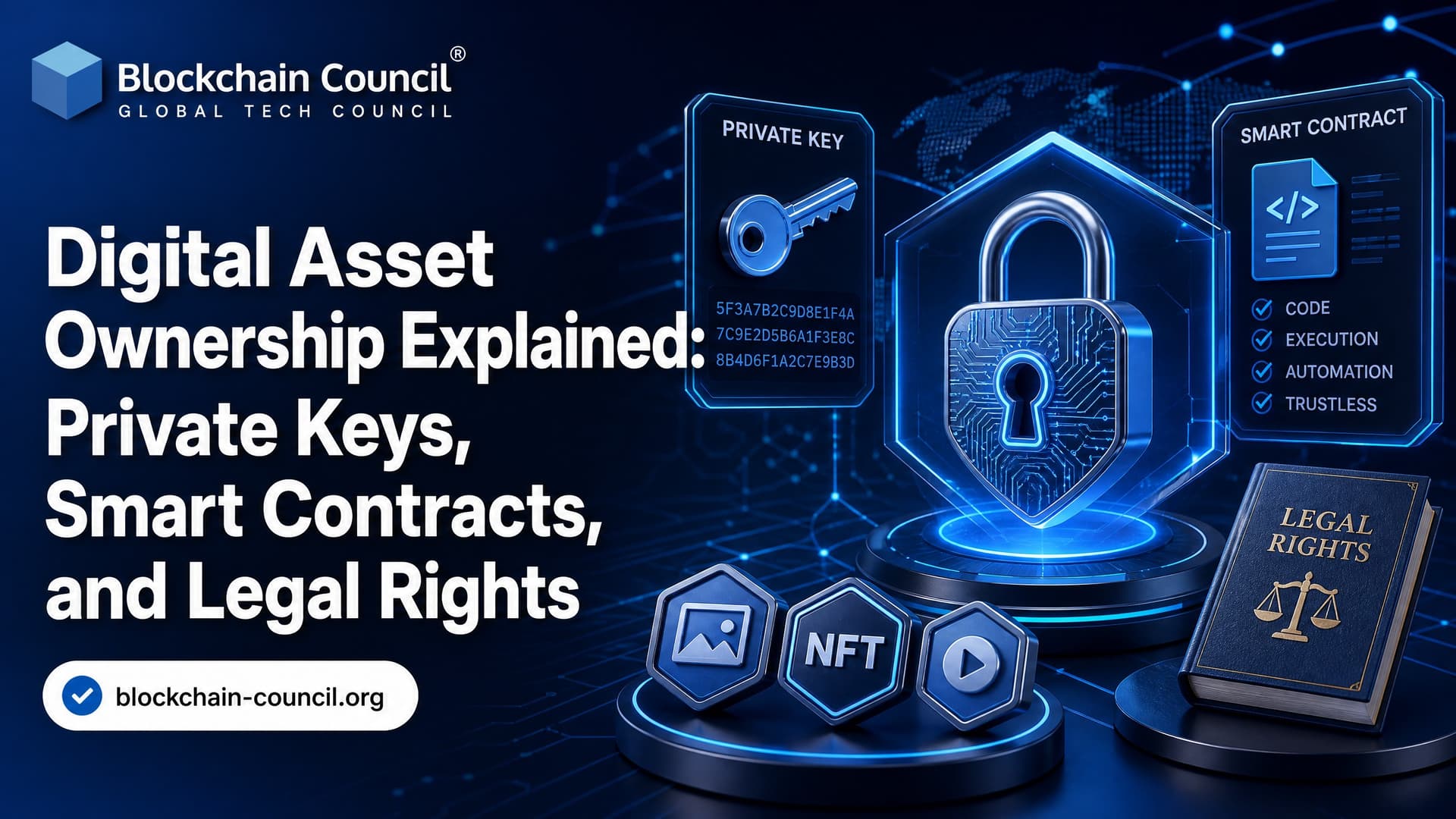
Digital asset ownership is not just a wallet balance on a screen. In practice, ownership sits at the intersection of private key control, smart contract code, custody terms, and property law. If you hold the private key, you may control the asset technically. Whether you own it legally can depend on contracts, statutes, insolvency rules, and the type of token involved.
That distinction matters. A Bitcoin wallet, an ERC-721 NFT, a tokenized real estate claim, and funds held on a centralized exchange all create different rights. Treating them as the same is how people lose assets, miss tax obligations, or misunderstand what they bought.

As digital assets become increasingly integrated into financial systems, understanding ownership goes beyond holding a wallet address. Professionals responsible for managing blockchain-based assets benefit from expertise in digital asset governance, custody, compliance, tokenization, and legal frameworks. A Certified Digital Assets Expert credential helps build these practical capabilities, making it easier to evaluate ownership rights across different types of digital assets.
What Digital Asset Ownership Means
Digital assets are intangible assets represented, stored, or transferred through distributed ledger technology or similar digital systems. They include cryptocurrencies, stablecoins, NFTs, governance tokens, tokenized securities, and some digital payment instruments.
Legal systems are starting to recognize that these assets can be property. The UNIDROIT Principles on Digital Assets and Private Law state that a digital asset can be the subject of proprietary rights, and that those rights can be effective against third parties, including in insolvency. English law moved in the same direction with the Property (Digital Assets etc) Act 2025, which confirms that certain digital assets can be personal property even if they are not physical objects or traditional claims.
The practical takeaway is simple. Courts and regulators are catching up, but the blockchain record alone is not always the whole legal story.
Private Keys: Technical Control Is Not Always Legal Title
A private key is the cryptographic credential used to sign transactions. If you control the private key for a wallet, you can usually transfer the digital assets linked to that address. No bank manager. No reset button.
This is why private keys are often treated as the functional equivalent of possession. The EU Markets in Crypto-Assets Regulation, known as MiCA, defines crypto custody around safekeeping or controlling cryptoassets or the means of access to them, including private cryptographic keys. In 2025, the US Securities and Exchange Commission's Division of Trading and Markets also focused on exclusive control of private keys when discussing broker-dealer custody of cryptoasset securities.
Still, private key control is not the same as legal ownership in every case. If you steal a private key, you can move the assets, but that does not make you the lawful owner. If you hold a key as an employee, trustee, or custodian, you may have technical power but not beneficial ownership.
Developers see this gap all the time. On a test deployment, a junior engineer may sign from the wrong MetaMask account and wonder why the contract owner is not the treasury wallet. Hardhat local networks default to chain ID 31337, while Ethereum mainnet is chain ID 1. Signatures tied to the wrong chain or account can fail silently in front-end tests, then turn into expensive mistakes in production. Ownership starts with key management, not after launch.
Understanding the relationship between private keys, blockchain architecture, smart contracts, token standards, and enterprise blockchain systems is essential when evaluating digital asset ownership. A Certified Blockchain Expert credential equips professionals with the technical knowledge needed to interpret how blockchain infrastructure establishes control, security, and ownership across decentralized environments.
Self Custody vs Custodial Ownership
Self custody
Self custody means you hold the private keys yourself through a hardware wallet, software wallet, smart account, or multisignature setup. You control the asset directly, but you also carry the operational risk.
Best for: users who understand backups, transaction signing, wallet permissions, and phishing risk.
Wrong choice for: teams without security procedures, succession planning, or multisig approval rules.
Main risk: lost seed phrases, compromised devices, malicious approvals, or no recovery path after death.
Hardware wallets and multisignature wallets reduce some risk, but they do not remove responsibility. A 2-of-3 multisig beats one seed phrase in a desk drawer. It also needs a written recovery process, named signers, and secure storage.
Custodial wallets
Custodial wallets place private keys with an exchange, broker, or cryptoasset service provider. You may see a balance, but the provider controls the keys.
Best for: enterprises needing reporting, compliance checks, insurance arrangements, and institutional controls.
Wrong choice for: users who assume an exchange balance always equals segregated property.
Main risk: insolvency, unclear terms of use, omnibus wallets, and withdrawal freezes.
Exchange insolvency cases have shown why the legal terms matter. If customer assets are segregated and the customer keeps title, the claim is stronger. If the terms transfer ownership to the platform, the customer may become an unsecured creditor. That is a very different position.
Smart Contracts and Digital Asset Rights
Smart contracts are self-executing programs deployed on blockchains. On Ethereum, ERC-20 contracts manage fungible tokens, while ERC-721 and ERC-1155 contracts are common for NFTs. Solidity 0.8.x added built-in overflow and underflow checks, which changed how many token contracts handle arithmetic compared with older Solidity versions.
Smart contracts can automate transfers, collateral liquidation, voting, royalty distribution, and access rules. But code is not always a complete legal contract. Many jurisdictions still apply general contract law, asking whether there was offer, acceptance, consideration, capacity, and intent to create legal relations. The code may be evidence of the deal. It may also be the mechanism for performance.
Smart contracts are powerful when they manage on-chain rights. They are weaker when they pretend to transfer off-chain title without legal paperwork. A token that says it represents a building does not automatically put your name on the land registry. The legal wrapper matters.
Tokenized Real World Assets: What Do You Really Own?
Tokenized real world assets, often called RWAs, use tokens to represent interests in securities, real estate, commodities, receivables, or funds. In most institutional structures, the token holder does not directly own the underlying asset. Instead, the holder owns a claim against an issuer, trust, fund, or special purpose vehicle.
That is not necessarily a bad thing. It may be the only workable structure for regulated assets. But you need to read what the token actually represents:
Equity in an entity
A debt claim
A beneficial interest under a trust
A contractual right to redemption
A record of ownership in a regulated security
If the issuer becomes insolvent, your rights depend on asset segregation, governing law, custody arrangements, and the legal documents behind the smart contract. The token is a pointer. The legal architecture gives it force.
NFT Ownership and Copyright: A Common Trap
NFT ownership is one of the areas where candidates and buyers get caught out. Owning an NFT usually means owning the token. It does not automatically mean owning the copyright in the image, music, video, or game asset linked to that token.
Unless copyright is expressly assigned, the creator or rights holder usually keeps it. The buyer may receive a limited license, such as personal display rights or limited commercial use. Some NFT collections grant broader rights. Many do not.
For certification candidates, watch for exam questions that ask whether buying an NFT transfers copyright. The safest answer is no, unless the sale terms or license clearly say so.
Regulation Is Moving Toward Control and Segregation
MiCA entered into force in 2023, with stablecoin provisions applying in 2024 and wider cryptoasset service provider rules applying by late 2024. Its custody framework focuses on safekeeping cryptoassets or controlling access to them, including private keys.
That focus is mirrored elsewhere. US guidance for broker-dealers handling cryptoasset securities emphasizes exclusive control over the private keys needed to access and transfer customer assets. Policy proposals in markets such as India have also discussed smart contract based custody, multisignature models, and distributed ledger native custody structures.
The direction is clear. Regulators care about who can move the asset, how keys are protected, whether assets are segregated, and what happens during insolvency.
Managing digital assets also requires expertise beyond blockchain itself. Skills in cybersecurity, cloud infrastructure, APIs, enterprise systems, automation, analytics, and secure identity management play an important role in protecting ownership and maintaining operational resilience. A Tech Certification helps professionals strengthen these complementary technical capabilities for enterprise digital asset environments.
Key Risks You Should Manage
Key loss: if a seed phrase or private key is lost, recovery may be impossible.
Custodian failure: exchange terms can decide whether you own assets or only have a contractual claim.
Smart contract bugs: code can lock funds, misroute ownership, or create unintended permissions.
Legal mismatch: a token may not transfer title to an off-chain asset.
IP confusion: NFT ownership and copyright ownership are separate unless contractually joined.
Inheritance gaps: heirs need lawful access instructions, not a seed phrase pasted into an email.
What Professionals Should Learn Next
If you work with digital assets, you need both technical literacy and legal awareness. Developers should understand wallet architecture, ERC standards, signature schemes, multisig design, and smart contract ownership patterns. Compliance and legal teams should study custody rules, property classification, insolvency treatment, token terms, and dispute resolution.
For structured learning, Blockchain Council's Certified Blockchain Expert is a strong starting point if you need broad digital asset foundations. Choose Certified Smart Contract Developer if you build or audit blockchain applications. If your focus is crypto markets, custody, and asset behavior, Certified Cryptocurrency Expert (CCE) is the more direct path.
Your next step: audit one wallet or token structure you use today. Identify who controls the private keys, what the terms say about ownership, what happens if a custodian fails, and whether any off-chain rights are actually documented. That exercise will teach you more than another dashboard ever will.
As digital assets become more widely adopted, professionals must also explain ownership structures, custody models, and blockchain technologies clearly to clients, regulators, executives, and business stakeholders. A Marketing Certification helps strengthen strategic communication and stakeholder engagement skills, enabling professionals to present complex digital asset concepts with greater clarity and support broader organizational adoption.
FAQs
1. What is digital asset ownership?
Digital asset ownership refers to the control and legal or contractual rights associated with blockchain-based assets such as cryptocurrencies, NFTs, utility tokens, governance tokens, stablecoins, and tokenized real-world assets (RWAs). In practice, ownership often involves both technical control through cryptographic keys and legal rights defined by applicable laws and contractual terms.
2. How do private keys relate to digital asset ownership?
A private key is a cryptographic credential that allows a user to authorize transactions and control assets associated with a blockchain address. Anyone with access to a private key may be able to transfer the associated assets, making secure key management one of the most important aspects of digital asset ownership.
3. What is the difference between a private key and a public key?
A public key or its associated wallet address is used to receive digital assets and can generally be shared with others. A private key must remain confidential because it provides the authority to access and transfer assets. Together, these cryptographic keys enable secure blockchain transactions.
4. What is a crypto wallet?
A crypto wallet is software or hardware that securely stores the cryptographic keys needed to manage digital assets. Wallets may support cryptocurrencies, NFTs, tokenized assets, decentralized applications (dApps), and staking services, depending on their features and blockchain compatibility.
5. Do you actually own digital assets if you control the private keys?
Controlling the private keys generally provides technical control over blockchain assets, but legal ownership may also depend on applicable laws, contractual agreements, court decisions, and regulatory frameworks. Technical control and legal ownership are related concepts but are not always identical.
6. How do smart contracts affect ownership?
Smart contracts automatically execute predefined rules governing digital assets, including transfers, access rights, staking, royalties, governance participation, and token issuance. They help automate ownership-related functions but operate within the technical rules established by the blockchain protocol.
7. What are tokenized ownership rights?
Tokenized ownership represents interests in assets through blockchain-based tokens. Depending on the legal structure, these tokens may represent ownership or other rights related to real estate, securities, commodities, investment funds, intellectual property, or other real-world assets.
8. How does ownership differ between cryptocurrencies and NFTs?
Cryptocurrencies are generally fungible, meaning each unit is interchangeable with another of the same type. NFTs are non-fungible, representing unique digital assets or ownership records that may include artwork, collectibles, licenses, or other digital or physical asset references.
9. Can digital assets have multiple owners?
Yes. Certain tokenized assets may represent fractional ownership, allowing multiple individuals or organizations to hold proportional interests in a single underlying asset. The associated ownership rights depend on the governing legal documentation and applicable regulations.
10. What happens if a private key is lost?
If a private key or recovery phrase is permanently lost and no backup or recovery mechanism exists, access to the associated digital assets may also be permanently lost. This is why secure backup procedures and appropriate custody solutions are considered essential.
11. What is self-custody versus third-party custody?
Self-custody means the asset owner personally controls the private keys using a wallet or other secure storage method. Third-party custody involves a regulated custodian or service provider managing the cryptographic keys on behalf of the owner, often with additional security and compliance controls.
12. How does AI support digital asset ownership management?
Artificial intelligence can assist with fraud detection, transaction monitoring, wallet security analytics, compliance automation, blockchain investigations, risk assessment, and cybersecurity monitoring. AI should support, rather than replace, strong governance practices and human oversight.
13. What legal rights can digital asset ownership provide?
The rights associated with digital assets depend on the asset type and applicable legal framework. They may include access rights, governance participation, licensing rights, ownership interests, dividend or revenue-sharing rights, or contractual benefits. Not every digital asset grants ownership of an underlying asset or intellectual property.
14. How are digital assets treated under the law?
Legal treatment varies across jurisdictions and may differ based on whether an asset is classified as property, a security, a commodity, a payment instrument, or another regulated asset. Governments continue to develop legal frameworks addressing taxation, consumer protection, custody, securities regulation, and digital asset markets.
15. What cybersecurity risks affect digital asset ownership?
Key risks include phishing attacks, malware, social engineering, wallet compromise, smart contract vulnerabilities, exchange breaches, SIM-swapping attacks, and unauthorized access to recovery phrases. Strong cybersecurity practices are essential to protecting digital assets.
16. What are best practices for protecting digital asset ownership?
Best practices include using reputable wallets, enabling multi-factor authentication where available, securely storing recovery phrases offline, verifying wallet addresses before transactions, keeping software updated, avoiding suspicious links, and considering hardware wallets or qualified custodians for larger holdings.
17. What industries rely on secure digital asset ownership?
Secure ownership infrastructure supports decentralized finance (DeFi), banking, payments, gaming, digital identity, tokenized real-world assets, healthcare, supply chain management, intellectual property management, and enterprise blockchain applications.
18. What trends are shaping digital asset ownership in 2025-2026?
Key trends include decentralized identity solutions, programmable ownership rights, AI-enhanced wallet security, institutional-grade custody services, tokenized real-world assets (RWAs), cross-chain interoperability, multi-party computation (MPC) custody, and increasing regulatory clarity in major financial markets.
19. What should individuals consider before acquiring digital assets?
Individuals should understand how wallets and private keys work, evaluate the security of custody solutions, review the legal rights associated with the asset, research the issuing project, understand applicable tax obligations, and recognize that digital assets involve technological, legal, and financial risks. This information is educational and should not be interpreted as legal or investment advice.
20. What is the future of digital asset ownership?
Digital asset ownership is expected to become more secure, interoperable, and legally recognized as blockchain technology, AI-powered security, digital identity systems, tokenized assets, and regulatory frameworks continue to evolve. Future developments may provide clearer ownership standards, stronger consumer protections, and broader enterprise adoption while preserving the benefits of decentralized technologies. Owning an asset digitally may become increasingly seamless, but remembering where you stored your recovery phrase will probably remain a very human responsibility.
Related Articles
View All
Digital Assets
How Smart Contracts Manage Tokenized Asset Ownership and Payments
Smart contracts manage tokenized ownership, transfers, compliance, and payouts for real estate, funds, securities, RWAs, and stablecoin payment flows.

Digital Assets
The Role of Smart Contracts in Real-World Asset Tokenization
Smart contracts enforce issuance, compliance, settlement, and investor rights in real-world asset tokenization, making RWAs operational and auditable.

Digital Assets
How Asset Tokenization Creates Verifiable Digital Ownership
Asset tokenization turns rights to real world and financial assets into blockchain tokens, giving authorized parties a verifiable record of ownership, provenance, and compliance.
Trending Articles

Top 5 DeFi Platforms
Explore the leading decentralized finance platforms and what makes each one unique in the evolving DeFi landscape.
Claude AI Tools for Productivity
Discover Claude AI tools for productivity to streamline tasks, manage workflows, and improve efficiency.
How to Install Claude Code
Learn how to install Claude Code on macOS, Linux, and Windows using the native installer, plus verification, authentication, and troubleshooting tips.