

Digital Asset Infrastructure: The Core Technologies Behind Web3 Finance
 Suyash Raizada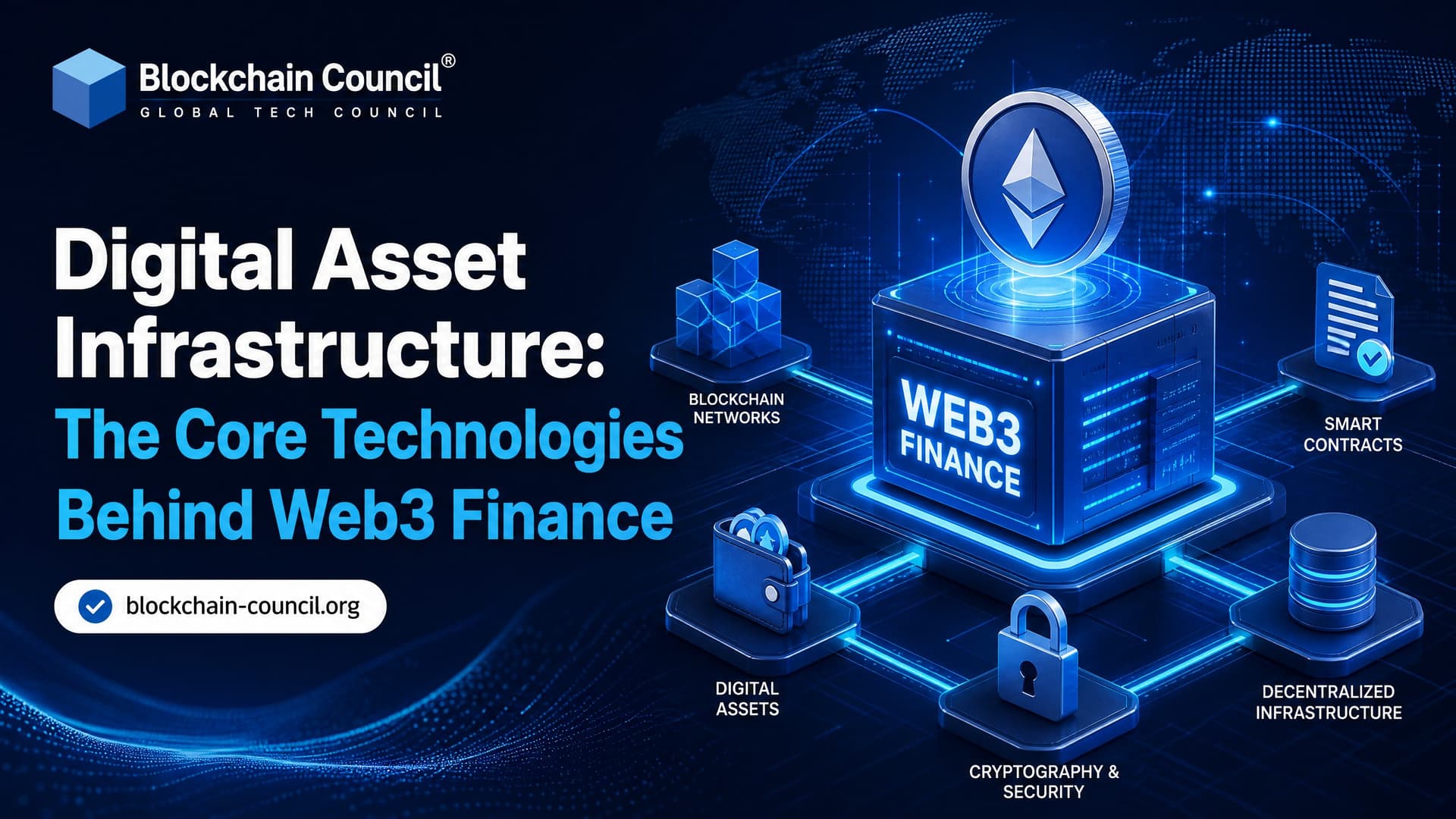
Digital asset infrastructure is the technical foundation behind most Web3 finance systems, including stablecoin payments, tokenized funds, institutional custody, and cross-border settlement. It is not just a blockchain and a wallet. The stack includes ledgers, smart contracts, key management, compliance tooling, interoperability rails, and risk controls that all have to work together under real financial pressure.
The shift is already visible. JPMorgan's Kinexys reportedly moves more than 2 billion dollars per day across major currencies. Tokenized real-world assets and stablecoins now exceed 200 billion dollars in combined market value, according to industry analyses from payments and digital asset researchers. This is no longer only a retail crypto story. It is financial infrastructure.

As digital finance continues to evolve, professionals increasingly need expertise in digital asset governance, tokenization, compliance, custody, and blockchain-enabled financial systems. A Certified Digital Assets Expert credential helps build these practical skills, enabling professionals to understand and manage the infrastructure that supports modern digital asset ecosystems.
What Is Digital Asset Infrastructure?
Digital asset infrastructure is the technology stack that lets digital value be issued, stored, transferred, settled, and governed. In Web3 finance, that value can be a stablecoin, a tokenized Treasury bill, a crypto asset, a tokenized deposit, a fund token, or an on-chain representation of a private market asset.
The main components are:
Blockchains and distributed ledgers for transaction recording and settlement.
Digital assets and tokens, including stablecoins, cryptocurrencies, tokenized deposits, and real-world assets.
Smart contracts that automate lending, payments, trading, compliance, and fund operations.
Wallets and key management systems for transaction signing and secure access.
Custody platforms for institutional storage, approvals, audit trails, and governance.
Interoperability rails that connect chains, banks, payment networks, and enterprise systems.
Compliance and risk systems covering KYC, AML, sanctions screening, monitoring, and operational resilience.
Franklin Templeton describes Web3 as both an evolution of internet technology and a change in decentralized economic infrastructure, with blockchains, tokens, wallets, and smart contracts at the center. Deloitte takes a similar institutional view, especially around the European Union's Digital Finance Package, which includes MiCA, DORA, and the DLT pilot regime.
The Core Technologies Behind Web3 Finance
Blockchains and Scaling Layers
Blockchains provide the shared transaction layer. Public networks such as Ethereum allow open participation, while permissioned ledgers are common in bank-led settlement and tokenization projects. The choice matters. A retail stablecoin application may need public liquidity. A regulated securities platform may need permissioned access, identity controls, and transaction privacy.
Scaling is the hard part. Layer 2 networks, rollups, and zero-knowledge proof systems help increase throughput and cut costs while keeping a link to the base chain. AWS has noted that Layer 2 and ZK systems are becoming central to privacy-preserving data sharing and higher transaction capacity.
A practical warning: chain configuration errors still break production workflows. If your application signs a transaction for Ethereum mainnet, the chain ID is 1. Sign for the wrong network and the transaction fails, or worse, it drops users into a confusing approval flow. Decimals bite people too. USDC uses 6 decimals, not 18 like ETH. That one detail has broken more settlement demos than most teams will admit.
Smart Contracts and Programmable Finance
Smart contracts are programs stored on-chain that execute rules when conditions are met. In Web3 finance, they power automated market makers, lending pools, tokenized fund subscriptions, escrow flows, and on-chain corporate actions.
For developers, Solidity 0.8.x changed the safety baseline by adding built-in overflow and underflow checks. That reduced reliance on older SafeMath patterns. Smart contract risk has not gone away, though. Access control, upgradeability, oracle design, and reentrancy protection are still core review areas.
If you want to build here, Blockchain Council's Certified Smart Contract Developer™ is a useful path to connect Solidity, contract testing, deployment, and security concepts.
Building and evaluating digital asset infrastructure also requires a thorough understanding of blockchain architecture, consensus mechanisms, token standards, enterprise blockchain networks, and distributed ledger design. A Certified Blockchain Expert credential equips professionals with the technical expertise needed to understand how these technologies support secure, scalable, and compliant financial systems.
Wallets, Keys, MPC, and HSMs
Wallet infrastructure is often misunderstood. A wallet is not just an app screen with a balance. For financial institutions, it is a signing system, a policy engine, a transaction builder, a monitoring layer, and a recovery process.
Modern wallet infrastructure usually includes:
Backend APIs for transaction creation, broadcasting, and balance checks.
Key management systems for storing and rotating cryptographic keys.
Multi-Party Computation (MPC), where signing authority is split across parties so no single private key is ever exposed.
Hardware Security Modules (HSMs) for tamper-resistant key storage.
Approval policies such as daily limits, address allowlists, and multi-person review.
MPC is not automatically better than every other model. It fits institutions that need distributed signing and operational flexibility. For long-term reserves that rarely move, cold storage with HSM-backed controls may still be the better choice.
Custody and Institutional Controls
Institutional Web3 finance depends on custody. Without it, pension funds, asset managers, banks, and enterprises cannot handle digital assets at scale.
Good custody platforms support segregated client accounts, policy-based approvals, insurance integration, audit reporting, and multi-asset support. They also need incident response playbooks. Losing a private key is not like resetting a bank password. If recovery was not designed in advance, the asset may be gone for good.
This is one reason Kenson Investments frames secure custody, interoperability, and scalable compliance as the three pillars of institutional Web3 infrastructure.
Tokenization Platforms
Tokenization converts rights to an asset into blockchain-based tokens. The asset may be a fund share, a private credit instrument, a real estate interest, Treasury exposure, or a deposit claim. Tokenization platforms handle issuance, investor eligibility, transfer rules, cap tables, redemptions, reporting, and settlement.
The numbers are large. A Boston Consulting Group forecast estimated that tokenized asset markets could reach 16 trillion dollars by 2030, with private credit and U.S. Treasuries expected to be major categories. Billions in tokenized assets have already been issued, and the combined stablecoin and tokenized real-world asset market now sits above 200 billion dollars, based on recent market analyses.
BlackRock's tokenized fund is a useful signal. Large asset managers are not testing tokenization because it sounds fashionable. They are checking whether fund administration, collateral mobility, and settlement can be made faster and less manual.
Stablecoins and Tokenized Deposits
Stablecoins are becoming one of the most important parts of digital asset infrastructure. They act as programmable money for payments, DeFi collateral, treasury transfers, and cross-border settlement.
TechUK has argued that stablecoins could become a core part of global payments infrastructure over the next decade because they support 24/7 settlement on shared ledgers. Tokenized deposits serve a similar function in bank-controlled environments, representing commercial bank money on distributed ledgers.
The trade-off is clear. Public stablecoins offer broad access and composability. Tokenized deposits may fit regulated bank settlement better, especially where institutions need clearer claims, controls, and legal treatment.
Interoperability and Settlement Rails
Web3 finance will not run on one chain. Banks, fintechs, asset managers, and payment companies already operate across many systems. Interoperability connects public chains, private ledgers, card networks, payment processors, and core banking systems.
Cross-chain bridges have a rough security history, so institutions should be careful. For high-value settlement, atomic delivery-versus-payment and controlled interoperability are safer than loosely governed bridges. JPMorgan's Kinexys shows the institutional direction: private blockchain rails, real-time movement of funds, and atomic ledger updates across branches and currencies.
Consumer-facing products are appearing too. FujiPay and Fuji Card, for example, connect Web3 wallets with card-based payment experiences, letting users spend across fiat and digital asset contexts.
As financial institutions modernize their blockchain infrastructure, expertise in cybersecurity, cloud computing, APIs, enterprise systems, automation, analytics, and secure software architecture has become increasingly valuable. A Tech Certification helps professionals strengthen these complementary technical skills, supporting the implementation and management of resilient digital asset platforms.
Compliance Is Infrastructure, Not an Add-On
Regulated Web3 finance needs compliance built into the stack from day one. That means KYC, AML, sanctions checks, transaction monitoring, wallet screening, recordkeeping, and operational resilience.
The EU's MiCA regulation creates a harmonized framework for crypto-asset issuance and services. DORA focuses on digital operational resilience for financial entities. The DLT pilot regime lets regulated market infrastructures test distributed ledger applications. Together, these rules point to where the market is heading: regulated digital finance, not a free-for-all.
Franklin Templeton has also flagged risks around immature technology, cybersecurity weaknesses, regulatory uncertainty, exchange credit risk, volatility, fraud, and key theft. Those risks are real. Ignore them and your Web3 finance product becomes a liability.
Where AI Fits Into Digital Asset Infrastructure
AI is starting to meet Web3 finance through monitoring, fraud detection, smart contract analysis, customer support, and agent-based transactions. AWS has pointed to the convergence of AI and digital assets as a major infrastructure trend, especially where AI systems process both on-chain and off-chain data.
Agentic finance is interesting, but it needs strict controls. An AI agent should not have open signing authority over a treasury wallet. Use policy limits, allowlists, human approval for large transfers, and clear logs. If you are building in this area, pair blockchain knowledge with AI governance. Blockchain Council's Certified Blockchain Expert™ and Certified AI Expert™ are relevant paths for professionals working across both fields.
Key Challenges for Web3 Finance Teams
Security: Smart contract bugs, key loss, bridge exploits, and phishing remain serious threats.
Regulatory fragmentation: Asset classification and licensing rules differ across jurisdictions.
Scalability: Layer 2 systems help, but financial-grade uptime and finality still require careful design.
Interoperability risk: More connections mean more dependencies and more failure points.
Operational controls: Approval workflows, audit logs, and incident response are mandatory for institutions.
How to Build Skills in Digital Asset Infrastructure
If you are a developer, start with wallets, token standards, and smart contract security. Build a small ERC-20 transfer flow, test it on a public testnet, and inspect every transaction field. If you are in finance or compliance, study custody models, MiCA, stablecoin settlement, and the tokenized asset lifecycle.
For a structured path, consider Blockchain Council's Certified Blockchain Expert™ for broad architecture knowledge, Certified Blockchain Developer™ for hands-on implementation, and Certified Smart Contract Developer™ if your work involves programmable finance. Pick one, then build a working prototype. A simple tokenized invoice or stablecoin payment workflow will teach you more than another slide deck.
Successfully deploying digital asset infrastructure also requires the ability to communicate technical concepts, business value, and compliance considerations to executives, clients, regulators, and other stakeholders. A Marketing Certification helps professionals strengthen strategic communication and stakeholder engagement skills, making it easier to explain blockchain initiatives and support enterprise adoption.
FAQs
1. What is digital asset infrastructure?
Digital asset infrastructure refers to the technologies, networks, platforms, and services that enable the creation, transfer, storage, trading, and management of blockchain-based assets. It forms the foundation of Web3 finance by supporting secure, transparent, and decentralized financial activities.
2. Why is digital asset infrastructure important?
Digital asset infrastructure provides the technical backbone for cryptocurrencies, stablecoins, tokenized real-world assets (RWAs), decentralized finance (DeFi), NFTs, and other blockchain applications. Reliable infrastructure helps improve security, scalability, interoperability, and operational efficiency across digital ecosystems.
3. What are the core components of digital asset infrastructure?
Core components include blockchain networks, consensus mechanisms, smart contracts, digital wallets, cryptographic security, nodes, validators, exchanges, custody solutions, oracle networks, Layer 2 scaling technologies, and blockchain analytics platforms. Together, these technologies enable the operation of modern Web3 ecosystems.
4. How do blockchain networks support digital assets?
Blockchain networks maintain distributed ledgers that record transactions in a transparent and tamper-resistant manner. They provide the foundation for issuing, transferring, and verifying digital assets while reducing reliance on centralized intermediaries.
5. What role do smart contracts play?
Smart contracts are self-executing programs deployed on blockchain networks that automatically perform predefined actions when specified conditions are met. They support decentralized finance, token issuance, NFT marketplaces, governance systems, payment automation, and many other Web3 applications.
6. What are blockchain nodes and validators?
Nodes maintain copies of the blockchain and help distribute transaction data across the network. Validators or miners, depending on the consensus mechanism, verify transactions and contribute to maintaining network security, integrity, and consensus.
7. What are digital wallets?
Digital wallets are software or hardware tools used to securely store cryptographic keys that allow users to access and manage digital assets. Wallets may support payments, staking, decentralized applications (dApps), NFT management, and interactions with blockchain ecosystems.
8. What is digital asset custody?
Digital asset custody refers to the secure storage and protection of cryptographic keys and digital assets. Custody solutions may be self-managed by users or provided by regulated custodians that offer institutional-grade security, governance controls, and recovery procedures.
9. What are blockchain oracles?
Blockchain oracles connect smart contracts with external data sources, enabling decentralized applications to access information such as market prices, weather conditions, exchange rates, or event outcomes. Reliable oracle services are essential for many DeFi and enterprise blockchain applications.
10. What are Layer 2 scaling solutions?
Layer 2 solutions operate alongside primary blockchain networks to increase transaction throughput, reduce fees, and improve scalability. Examples include rollups, state channels, and sidechains, although implementation approaches vary across blockchain ecosystems.
11. How do digital asset exchanges fit into the infrastructure?
Centralized and decentralized exchanges provide trading infrastructure that enables users to buy, sell, and exchange digital assets. They contribute to market liquidity, price discovery, and broader access to blockchain-based financial services.
12. How does AI strengthen digital asset infrastructure?
Artificial intelligence can improve cybersecurity, fraud detection, blockchain analytics, predictive maintenance, network optimization, compliance monitoring, transaction analysis, and operational automation. AI should complement robust governance, security controls, and human oversight.
13. What role does interoperability play?
Interoperability enables different blockchain networks and applications to communicate and exchange information or assets. Improved interoperability supports cross-chain transactions, broader ecosystem integration, and greater flexibility for developers and users.
14. What cybersecurity risks affect digital asset infrastructure?
Potential risks include smart contract vulnerabilities, phishing attacks, ransomware, private key compromise, validator attacks, bridge exploits, distributed denial-of-service (DDoS) attacks, and software configuration errors. Strong cybersecurity practices are essential for maintaining resilient infrastructure.
15. How is digital asset infrastructure regulated?
Regulatory oversight varies by jurisdiction and may address custody, exchanges, payment services, anti-money laundering (AML), know-your-customer (KYC) requirements, cybersecurity, operational resilience, consumer protection, and financial reporting. Organizations should monitor official guidance from relevant authorities.
16. Which industries rely on digital asset infrastructure?
Digital asset infrastructure supports banking, payments, decentralized finance (DeFi), insurance, healthcare, supply chain management, gaming, digital identity, real estate, asset management, logistics, and enterprise blockchain solutions.
17. What trends are shaping digital asset infrastructure in 2025-2026?
Key trends include institutional adoption of tokenized real-world assets (RWAs), AI-powered infrastructure management, zero-knowledge technologies, Layer 2 expansion, cross-chain interoperability, decentralized identity systems, improved custody services, and enhanced blockchain security frameworks.
18. What are best practices for building digital asset infrastructure?
Best practices include conducting independent security audits, implementing strong cryptographic protections, maintaining resilient network architecture, monitoring infrastructure continuously, designing for scalability, complying with applicable regulations, establishing governance frameworks, and preparing disaster recovery plans.
19. What should organizations evaluate before adopting digital asset infrastructure?
Organizations should assess scalability, interoperability, security, compliance requirements, developer ecosystem maturity, operational costs, governance, vendor support, integration capabilities, and long-term business objectives. Careful planning can improve the likelihood of successful implementation.
20. What is the future of digital asset infrastructure?
Digital asset infrastructure is expected to become more scalable, secure, interoperable, and enterprise-ready as blockchain technology, AI, tokenized assets, and regulatory frameworks continue to mature. These advancements may support broader adoption of Web3 finance across industries while improving efficiency, transparency, and resilience. Building the financial systems of tomorrow is impressive, but someone will still spend half the afternoon troubleshooting a configuration file.
Related Articles
View All
Digital Assets
RWA Tokenization in Institutional Finance: Use Cases for Banks and Asset Managers
RWA tokenization is moving into production across tokenized funds, collateral networks, deposits, bonds, private credit, and trade finance.

Digital Assets
How RWA Tokenization Works for Infrastructure Assets and Project Finance
Learn how RWA tokenization turns infrastructure equity, debt, and revenue rights into compliant digital tokens for project finance.

Digital Assets
How Asset Tokenization Creates Verifiable Digital Ownership
Asset tokenization turns rights to real world and financial assets into blockchain tokens, giving authorized parties a verifiable record of ownership, provenance, and compliance.
Trending Articles

Top 5 DeFi Platforms
Explore the leading decentralized finance platforms and what makes each one unique in the evolving DeFi landscape.
What is AWS? A Beginner's Guide to Cloud Computing
Everything you need to know about Amazon Web Services, cloud computing fundamentals, and career opportunities.

Can DeFi 2.0 Bridge the Gap Between Traditional and Decentralized Finance?
The next generation of DeFi protocols aims to connect traditional banking with decentralized finance ecosystems.