

Digital Asset Exchanges: Centralized vs Decentralized Platforms Explained
 Suyash Raizada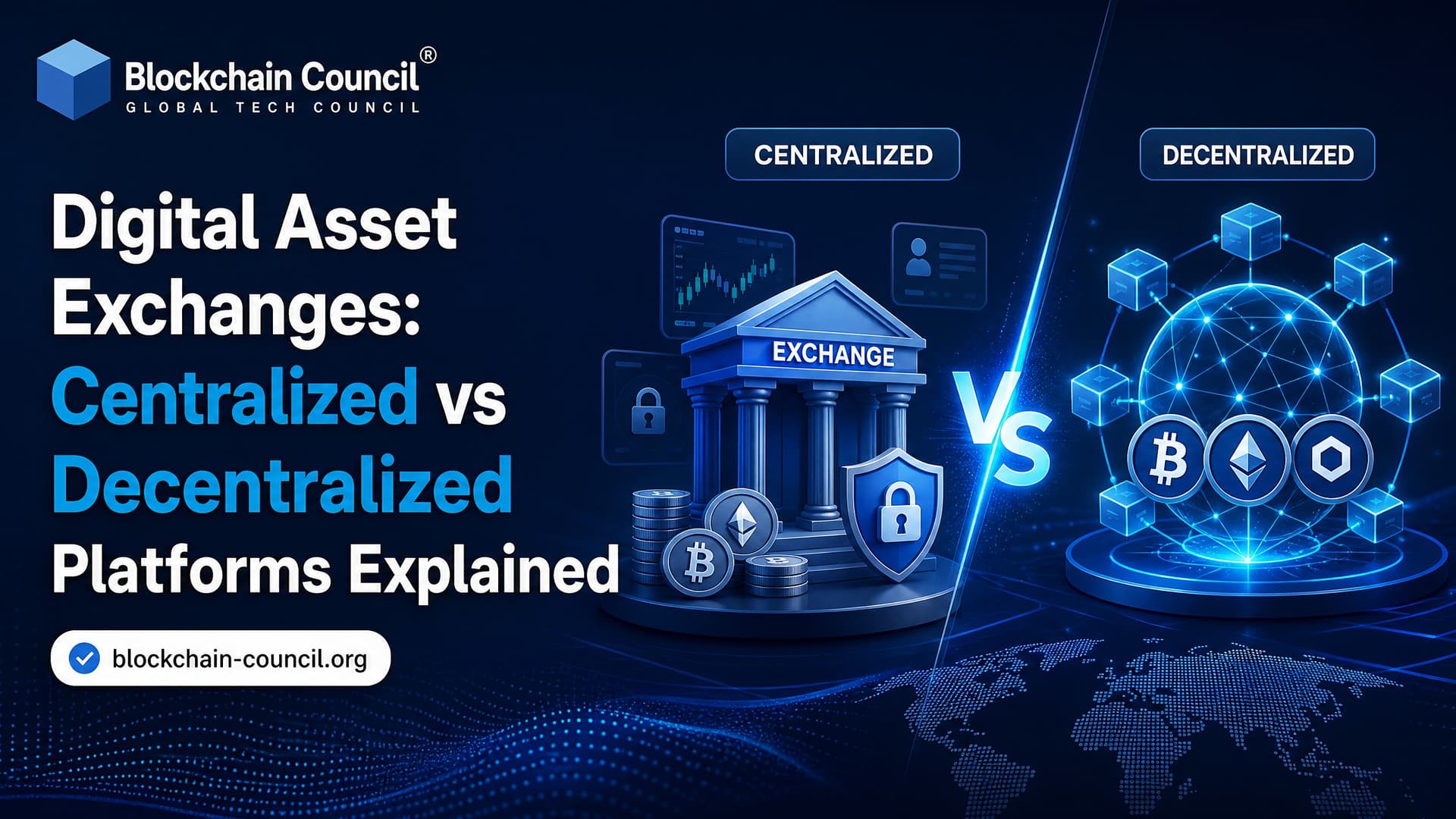
Digital asset exchanges sit at the center of crypto markets. They let you buy, sell, swap, and move blockchain-based assets, but the way they handle custody, trading, compliance, and settlement differs sharply. The real choice is not CEX or DEX forever. It is which platform fits the trade you are making right now.
Centralized exchanges, often called CEXs, run on company-operated infrastructure and usually hold customer funds. Decentralized exchanges, or DEXs, use smart contracts so you can trade from your own wallet. That one difference changes almost everything: risk, privacy, speed, recovery options, and regulatory exposure.

As blockchain markets continue to mature, understanding how digital asset exchanges operate has become an essential skill for investors, traders, and financial professionals. A Certified Digital Assets Expert credential provides practical knowledge of digital asset governance, tokenization, exchange ecosystems, compliance, and custody models, helping professionals make informed decisions across centralized and decentralized trading environments.
What Are Digital Asset Exchanges?
A digital asset exchange is a marketplace for blockchain-backed assets such as Bitcoin, Ether, stablecoins, governance tokens, and tokenized assets. Some exchanges act like familiar brokerage platforms. Others are closer to open-source financial protocols.
Centralized exchanges
A centralized exchange is operated by a company. Coinbase and Binance are common examples. You create an account, complete identity checks where required, deposit fiat or crypto, and trade through an order book managed by the platform.
The exchange usually controls the private keys for assets held in your account. Your balance shows up in the platform database, while deposits and withdrawals settle on-chain. Inside the exchange, most trades are matched off-chain on centralized servers. That is why execution can feel instant.
Decentralized exchanges
A decentralized exchange uses smart contracts to process trades on a blockchain. Uniswap on Ethereum and Raydium on Solana are well-known examples. You connect a wallet, approve token spending where needed, and swap directly from self-custody.
Many DEXs use automated market makers, or AMMs, instead of a traditional order book. You trade against a liquidity pool funded by other users. Prices adjust according to pool balances and the AMM formula. Simple idea. Many sharp edges.
How Centralized Exchanges Work
CEXs are built for speed, liquidity, and access. If you are buying crypto with a bank transfer, debit card, or wire, you are probably using a centralized exchange. This is still the easiest fiat on-ramp for most people.
These platforms often offer:
Fiat deposits and withdrawals through bank rails, cards, or payment partners.
High liquidity on major pairs such as BTC/USD, ETH/USD, and BTC/USDT.
Advanced order types including limit, market, stop, and conditional orders.
Derivatives and margin products in jurisdictions where allowed.
Customer support and account recovery flows.
That convenience has a cost. You trust the exchange with custody. If the platform is hacked, becomes insolvent, freezes withdrawals, or faces enforcement action, your access can be cut off. Centralized exchanges are easy to use, but funds and operations sit in one place, which concentrates the risk.
Regulation is another defining feature. Most major CEXs apply Know Your Customer and Anti-Money Laundering checks. For institutions, that can be a benefit. Compliance teams often prefer licensed venues, auditable records, and formal reporting. For privacy-focused users, it is a trade-off.
Evaluating different exchange models also requires a solid understanding of blockchain architecture, smart contracts, consensus mechanisms, token standards, and enterprise blockchain infrastructure. A Certified Blockchain Expert credential equips professionals with the technical knowledge needed to understand how blockchain networks support secure trading, settlement, and digital asset management.
How Decentralized Exchanges Work
DEXs remove the custodial middleman. You keep control of your wallet, and trades settle through smart contracts. There is no exchange account in the usual sense. If your wallet can interact with the protocol, you can trade.
This model supports DeFi activity beyond simple swaps:
Liquidity provisioning, where users supply assets to pools and earn fees.
Yield farming, often tied to incentive programs.
On-chain lending and borrowing through connected protocols.
Permissionless token markets, where new assets can trade before a CEX listing.
The upside is control and transparency. You can inspect liquidity, contract addresses, swap routes, and historical transactions on block explorers. The downside is that the protocol will not save you from a bad signature, a fake token, or a lost seed phrase.
Here is a detail developers and active DeFi users know too well: a Uniswap V2 swap can fail with UniswapV2Router: INSUFFICIENT_OUTPUT_AMOUNT when your slippage setting is too tight or the pool price moves before your transaction lands. Beginners often think the DEX is broken. Usually the transaction parameters were stale, or MEV bots reordered the same pool first.
CEX vs DEX: Side-by-Side Comparison
Custody: CEXs hold user funds. DEX users keep assets in their own wallets.
Settlement: CEX trades are usually matched off-chain. DEX trades settle on-chain through smart contracts.
Access: CEXs often require KYC. DEXs are usually permissionless.
Liquidity: CEXs still lead on deep liquidity, especially for large trades and derivatives. DEX liquidity varies by chain and pool.
Fiat support: CEXs are stronger for fiat on-ramps and off-ramps. DEXs are mostly crypto-only.
Privacy: DEXs collect less account-level identity data, though on-chain activity is public.
User support: CEXs can help reset accounts. DEXs generally cannot recover funds or reverse trades.
Risk model: CEX risk is mainly counterparty and custody risk. DEX risk is smart contract, wallet, liquidity, and MEV risk.
Market Trends: Why Both Models Keep Growing
Centralized exchanges still dominate total crypto trading. Recent market analysis put CEX spot volume at about 3.9 trillion dollars in Q2 2025, compared with roughly 876 billion dollars for DEXs. Early 2025 estimates also placed CEXs at more than 70 percent of total crypto trading volume.
DEX growth is real, though. By late 2025, DEX spot activity had reached roughly one fifth of CEX spot volume, and DEX share of spot trading more than doubled against some 2024 periods. The pattern is clear: CEXs remain dominant for fiat, derivatives, and institutional flows, while DEXs are gaining ground in on-chain spot markets.
Hybrid models are also emerging. Some platforms describe themselves as Universal Exchanges, aiming to combine centralized speed with decentralized wallet control or on-chain settlement. Treat that category carefully. The phrase is useful, but the details matter. Ask who holds the keys, where settlement occurs, and what happens during withdrawal stress.
As exchange infrastructure becomes increasingly sophisticated, organizations also rely on expertise in cybersecurity, cloud computing, APIs, enterprise systems, automation, analytics, and secure software development. A Tech Certification helps professionals strengthen these complementary technical skills, supporting the development, integration, and security of modern digital asset trading platforms.
When You Should Use a Centralized Exchange
A CEX is usually the right tool when you need:
To buy your first crypto with fiat currency.
Deep liquidity for large BTC, ETH, or stablecoin trades.
Regulated reporting, account statements, or institutional controls.
Derivatives, margin, or structured products where legally available.
Customer support and account recovery.
To be blunt, a beginner buying 200 dollars of Bitcoin should not start by bridging assets across three chains to chase a token on a thin DEX pool. Use a reputable CEX, learn wallet basics, then move to self-custody once you understand seed phrase security and transaction fees.
When You Should Use a Decentralized Exchange
A DEX is a better fit when you want:
Self-custody throughout the trade.
Access to tokens not listed on major exchanges.
On-chain transparency for swaps and liquidity pools.
Participation in DeFi strategies such as liquidity provisioning.
Permissionless access without a traditional account.
Do not treat DEXs as automatically safer. A verified-looking token symbol can still be a scam. A smart contract audit does not remove all exploit risk. On Ethereum mainnet, chain ID 1, you also need to account for gas, approvals, slippage, and possible front-running. On cheaper chains, fees are lower, but phishing and fake contracts stay common.
Security Checklist Before You Trade
Confirm custody. Know whether the platform or your wallet controls the private keys.
Check the asset contract. On a DEX, verify the token address from the project site or a trusted explorer.
Use small test transactions. This is not paranoia. It catches wrong networks and bad routes.
Set realistic slippage. Too low may fail. Too high can invite poor execution.
Separate wallets. Keep a trading wallet apart from long-term cold storage.
Review permissions. Revoke unlimited approvals you no longer need.
Assess platform risk. For CEXs, review licensing, proof-of-reserves practices, withdrawal history, and incident response.
Skills Professionals Need to Evaluate Exchanges
If you work in trading, compliance, fintech, or Web3 development, the CEX vs DEX distinction is not academic. It affects custody policy, audit trails, treasury operations, token listing risk, and smart contract exposure.
For structured learning, Blockchain Council offers relevant paths such as the Certified Cryptocurrency Expert™ for market structure and crypto fundamentals, the Certified Blockchain Expert™ for blockchain architecture, and the Certified Smart Contract Developer™ for teams that need to understand on-chain protocols at the code level.
Final Take: Use the Right Exchange for the Job
Digital asset exchanges are becoming a spectrum, not a single category. CEXs are still the better choice for fiat access, deep order books, large trades, and regulated workflows. DEXs are better for self-custody, DeFi access, transparent settlement, and long-tail token markets.
Your next step is practical: map your own use case against custody, liquidity, compliance, and technical risk. If you are building professional expertise, start with the Certified Cryptocurrency Expert™ path, then add smart contract training before you manage DEX liquidity or evaluate DeFi integrations.
As digital asset adoption expands, organizations must also communicate exchange models, custody approaches, and blockchain solutions effectively to customers, investors, regulators, and business stakeholders. A Marketing Certification helps professionals strengthen strategic communication and stakeholder engagement skills, making complex blockchain concepts easier to explain while supporting informed adoption and stronger trust in digital asset ecosystems.
FAQs
1. What is a digital asset exchange?
A digital asset exchange is a platform that allows users to buy, sell, trade, or exchange blockchain-based assets such as cryptocurrencies, stablecoins, utility tokens, governance tokens, NFTs, and tokenized real-world assets (RWAs). Exchanges may operate as centralized businesses or decentralized protocols, each with distinct features and operational models.
2. What is a centralized exchange (CEX)?
A centralized exchange (CEX) is operated by a company that manages user accounts, order books, custody services, and trade execution. Users typically create accounts, complete identity verification where required, and rely on the platform to facilitate transactions and safeguard assets held on the exchange.
3. What is a decentralized exchange (DEX)?
A decentralized exchange (DEX) is a blockchain-based trading platform that enables users to trade directly from compatible digital wallets using smart contracts. Unlike centralized exchanges, DEXs generally allow users to retain control of their private keys throughout the trading process.
4. How do centralized exchanges work?
Centralized exchanges use electronic order books that match buyers and sellers based on price and order availability. The exchange manages trade execution, settlement, customer support, liquidity programs, and security infrastructure while complying with applicable regulatory requirements.
5. How do decentralized exchanges work?
Decentralized exchanges commonly use automated market makers (AMMs) and liquidity pools instead of traditional order books. Smart contracts automatically execute trades based on predefined algorithms, with liquidity supplied by users who contribute assets to liquidity pools.
6. What are the advantages of centralized exchanges?
Centralized exchanges often provide high liquidity, fast trade execution, user-friendly interfaces, customer support, advanced trading tools, fiat currency integration, and access to a wide range of digital assets. Many also offer educational resources and institutional trading services.
7. What are the advantages of decentralized exchanges?
Decentralized exchanges allow users to maintain custody of their assets, reduce reliance on intermediaries, support permissionless trading, and provide greater transparency through publicly accessible blockchain transactions. Many DEXs also support innovative decentralized finance (DeFi) applications.
8. What are the disadvantages of centralized exchanges?
Centralized exchanges may face cybersecurity threats, operational outages, custodial risks, regulatory actions, and single points of failure. Users also rely on the exchange's security controls, governance practices, and financial stability to protect assets held on the platform.
9. What are the disadvantages of decentralized exchanges?
Decentralized exchanges may present challenges such as lower liquidity for certain assets, higher transaction fees during network congestion, smart contract vulnerabilities, limited customer support, and a steeper learning curve for new users.
10. How do liquidity and market depth differ between CEXs and DEXs?
Centralized exchanges often have deeper order books and greater institutional participation, which can improve liquidity for many trading pairs. Decentralized exchanges rely on liquidity pools, where available liquidity depends on the assets deposited by liquidity providers and overall market participation.
11. What role do market makers and liquidity providers play?
Market makers on centralized exchanges continuously place buy and sell orders to improve liquidity and reduce bid-ask spreads. On decentralized exchanges, liquidity providers contribute digital assets to liquidity pools, facilitating trading while potentially earning transaction fees or protocol incentives, subject to associated risks.
12. How does AI support digital asset exchanges?
Artificial intelligence can enhance fraud detection, transaction monitoring, cybersecurity, compliance automation, customer support, liquidity forecasting, market surveillance, and operational analytics. AI solutions should be implemented alongside robust governance and human oversight.
13. What security risks should exchange users understand?
Users should consider risks such as phishing attacks, compromised accounts, smart contract vulnerabilities, exchange hacks, wallet security issues, malware, social engineering, and operational disruptions. Strong passwords, multi-factor authentication, hardware wallets where appropriate, and careful verification of transaction details can improve security.
14. How are digital asset exchanges regulated?
Regulatory requirements vary by jurisdiction and may include licensing, anti-money laundering (AML) compliance, know-your-customer (KYC) procedures, cybersecurity standards, consumer protection measures, sanctions screening, reporting obligations, and custody requirements. Users should consult official guidance applicable to their location.
15. How do trading fees compare between CEXs and DEXs?
Fee structures differ by platform. Centralized exchanges often charge trading, withdrawal, or account-related fees, while decentralized exchanges generally involve network transaction fees and protocol trading fees. Actual costs depend on the blockchain network, trading activity, and platform policies.
16. Which industries benefit from digital asset exchanges?
Digital asset exchanges support industries including decentralized finance (DeFi), banking, fintech, payments, gaming, digital identity, tokenized real-world assets, enterprise blockchain, asset management, and cross-border financial services by providing trading and liquidity infrastructure.
17. What trends are shaping digital asset exchanges in 2025-2026?
Key trends include institutional trading services, tokenized real-world assets (RWAs), AI-powered compliance and fraud detection, cross-chain interoperability, Layer 2 scaling solutions, decentralized identity integration, enhanced custody technologies, and increasing regulatory clarity across global markets.
18. What are best practices for choosing a digital asset exchange?
Users should evaluate security measures, regulatory compliance, available assets, liquidity, trading fees, customer support, custody options, wallet compatibility, platform reputation, transparency, and educational resources before selecting an exchange.
19. What should beginners know before using a digital asset exchange?
Beginners should understand how deposits, withdrawals, wallets, trading orders, transaction fees, and security features work before trading. Starting with reputable platforms, learning basic trading concepts, enabling security protections, and researching digital assets thoroughly can help reduce avoidable mistakes. This information is educational and should not be interpreted as investment advice.
20. What is the future of digital asset exchanges?
Digital asset exchanges are expected to continue evolving as blockchain technology, AI-powered analytics, institutional participation, tokenized assets, and global regulatory frameworks mature. Greater interoperability, improved security, more efficient settlement, and enhanced user experiences are likely to shape the next generation of centralized and decentralized trading platforms. Whether an exchange has a customer support desk or just a smart contract, remembering where your private keys are will remain one of the most important skills.
Related Articles
View All
Digital Assets
How Asset Tokenization Creates Verifiable Digital Ownership
Asset tokenization turns rights to real world and financial assets into blockchain tokens, giving authorized parties a verifiable record of ownership, provenance, and compliance.

Digital Assets
What Assets Can Be Tokenized? Real-World Asset Categories Explained
Learn what assets can be tokenized, from Treasuries and stablecoins to real estate, commodities, IP, carbon credits, and private credit.

Digital Assets
CBDC vs Ethereum: Central Bank Money and Decentralized Platforms Compared
CBDC vs Ethereum explained through governance, programmability, privacy, performance, use cases, and the future of digital money infrastructure.
Trending Articles

Top 5 DeFi Platforms
Explore the leading decentralized finance platforms and what makes each one unique in the evolving DeFi landscape.
What is AWS? A Beginner's Guide to Cloud Computing
Everything you need to know about Amazon Web Services, cloud computing fundamentals, and career opportunities.
Claude AI Tools for Productivity
Discover Claude AI tools for productivity to streamline tasks, manage workflows, and improve efficiency.