

Digital Asset Custody Explained: Self-Custody, Third-Party Custody, and Institutional Models
 Suyash Raizada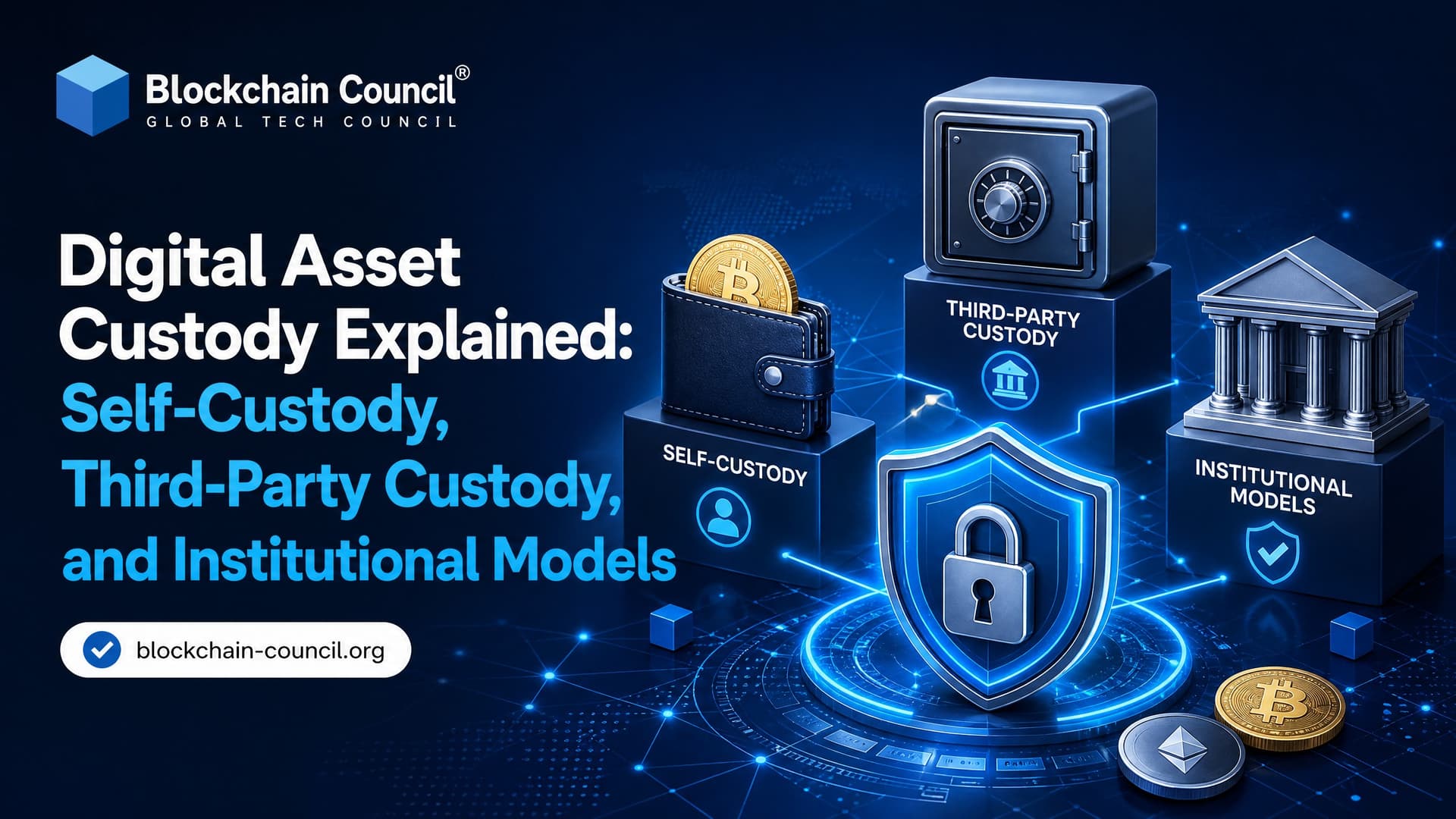
Digital asset custody is the practice of protecting the private keys that control cryptoassets. That sounds narrow, but it decides who can move funds, who can approve transactions, how losses are handled, and whether a bank, fund, exchange, or individual can operate safely in crypto markets.
The core choice looks simple on paper. Hold keys yourself, ask a third party to hold them, or use an institutional model built on regulated custody, MPC, policy controls, and tiered wallets. In practice, the trade-offs get sharp fast. Control, compliance, convenience, and counterparty risk all pull in different directions.

As digital assets become increasingly important across banking, investment, and enterprise finance, understanding custody extends beyond simply protecting private keys. Professionals need practical knowledge of digital asset governance, custody models, compliance, and risk management. A Certified Digital Assets Expert credential helps build these capabilities, providing a strong foundation for evaluating and securing digital asset ecosystems.
What Digital Asset Custody Actually Means
Traditional custody usually means safekeeping securities, cash, or records of ownership. Digital asset custody works differently. The asset is controlled by a cryptographic private key. If that key signs a valid transaction on a network such as Ethereum, Bitcoin, or Solana, the transfer settles. There is no bank clerk to reverse it later.
So custody is not just storage. It covers:
Key generation, including seed phrases, hardware keys, HSMs, or MPC shares
Key storage, from hardware wallets to cold vault infrastructure
Transaction signing, including approval policies and withdrawal workflows
Governance, such as who can approve, when, and under what limits
Recovery and incident response, because mistakes are often final onchain
Regulatory controls, including audits, segregation of client assets, and reporting
If you are building expertise here, Blockchain Council courses such as the Certified Blockchain Expert™ and Certified Cryptocurrency Expert™ help connect custody concepts with wallets, tokens, and market infrastructure.
The Three Main Custody Models
Most custody arrangements fit into one of three buckets:
Self-custody. You control the private keys and sign transactions directly.
Third-party custody. An exchange, broker, custodian, or platform controls the keys for you.
Institutional or qualified custody. A regulated or enterprise-grade setup uses governance, audits, MPC, HSMs, cold storage, and policy controls.
No model wins every time. To be blunt, anyone claiming that one custody model is always safer is skipping the operational reality.
Self-Custody: Maximum Control, Maximum Responsibility
How self-custody works
Self-custody means you hold the keys. You might use MetaMask, a mobile wallet, a Ledger or Trezor hardware wallet, an air-gapped machine, or a multisig wallet such as Safe. You generate the wallet, back up the seed phrase, sign transactions, and interact with smart contracts directly.
On Ethereum mainnet, chain ID 1, a self-custody wallet can send ETH, approve ERC-20 spending, mint an ERC-721 NFT, or vote in a DAO without asking a custodian for permission.
Where self-custody is strong
Sovereignty: No exchange can freeze your withdrawal, because the exchange does not hold the funds.
Lower custodian counterparty risk: You are not relying on a platform's solvency or internal controls.
Direct DeFi access: You can connect to protocols, NFT marketplaces, and governance apps without waiting for third-party support.
Where self-custody fails
The failure mode is brutal. Lose the seed phrase, lose the funds. Sign the wrong approval, lose the funds. Copy a fake address from clipboard malware, lose the funds.
A small practitioner detail. Many beginners panic when MetaMask shows insufficient funds for gas * price + value. That error is not a hack. It just means the wallet lacks enough native gas token, such as ETH on Ethereum, to pay for the transaction. But the same user may later approve an unlimited ERC-20 allowance without checking the contract address. That second mistake is far more dangerous.
Self-custody suits technically confident individuals, DeFi users, crypto-native teams, and smaller treasuries with disciplined processes. It is a poor fit for organizations that need segregation of duties, board-level oversight, audit trails, and regulated reporting but have no internal security team.
Third-Party Custody: Convenience With Counterparty Risk
How third-party custody works
Third-party custody means you hand private key control to an external provider. Centralized exchanges, broker-dealers, and specialized crypto custodians all fall into this category. The provider may pool assets in omnibus wallets, segregate client wallets, or use internal ledger systems to track balances.
Access is usually controlled through identity checks, withdrawal limits, whitelisted addresses, policy approvals, and monitoring systems. You log in, request a withdrawal or trade, and the custodian's infrastructure signs or settles the transaction.
Why institutions use it
Lower operational burden: The provider handles key security, wallet maintenance, and infrastructure.
Specialized security: Mature custodians run dedicated security teams, monitoring, and disaster recovery plans.
Integrated services: Many providers connect custody with trading, staking, reporting, settlement, and fiat rails.
Survey data from Hong Kong financial institutions shows the practical split clearly. About 57 percent of sell-side institutions and 80 percent of buy-side institutions preferred third-party custody, mainly for operational efficiency and access to specialist resources. Meanwhile, 43 percent of sell-side firms and 20 percent of buy-side firms preferred self-managed custody for control and compliance reasons.
The downside
Third-party custody swaps key-management risk for counterparty risk. If the custodian suffers a breach, has weak governance, commingles assets, becomes insolvent, or receives a lawful freeze order, your access can be affected. That is not theoretical. Crypto market history has repeatedly shown that trading venues and custodians must be evaluated separately, even when one company offers both.
If you are studying exchange risk, the Certified Cryptocurrency Expert™ path connects the dots, because custody, liquidity, and market structure are tightly linked.
Institutional and Qualified Custody
What makes institutional custody different
Institutional custody is not just a larger wallet. It is a control environment. Banks, asset managers, corporates, and funds need documented governance, audit evidence, segregation of client assets, capital and insurance considerations, and integration with treasury or fund administration systems.
A qualified custodian is generally a regulated entity such as a bank, trust company, or certain broker-dealers that holds client assets under financial rules. In the United States, the Office of the Comptroller of the Currency reaffirmed in Interpretive Letter 1184, dated May 7, 2025, that national banks and federal savings associations may provide crypto custody services, including through sub-custodians, provided they maintain appropriate risk management and compliance controls. Policy discussions around the CLARITY Act have also pushed for broader recognition of qualified custodians, including certain non-bank entities.
In the European Union, MiCA sets licensing and conduct requirements for crypto asset service providers, including custody providers. In Asia, Hong Kong is a useful case study, because institutions there are making explicit choices between self-managed and third-party custody based on compliance burden, operational capability, and strategic control.
What due diligence should cover
If you are evaluating an institutional custodian, do not stop at the brand name. Ask for specifics:
Does the provider use segregated wallets or omnibus wallets?
Is there a SOC 2 Type II or comparable security attestation?
How are key ceremonies documented?
What is the disaster recovery process?
Who approves withdrawals, and can approval rules be changed by one admin?
Are staking, trading, and settlement functions separated?
What happens if the provider, a sub-custodian, or a cloud region goes offline?
This is where legal, security, and operations teams need to sit in the same room. Custody is not only a CISO decision.
MPC Custody and Hybrid Models
Multi-Party Computation, or MPC, is now one of the most important technologies in institutional custody. Instead of storing one complete private key in one place, MPC splits signing responsibility across multiple key shares. A transaction can be signed when a threshold of shares participates, while no single device or operator ever holds the full private key.
MPC is not magic. It reduces single points of failure, but it still depends on policy design, endpoint security, access reviews, and recovery procedures. A bad approval workflow on top of MPC is still a bad approval workflow.
Many institutions run hybrid custody:
Cold storage for long-term reserves and strategic holdings
Warm wallets for treasury, staking, or scheduled settlement
Hot wallets for high-frequency trading, market making, or application flows
MPC policy layers to enforce approvals across teams, entities, or jurisdictions
Account abstraction and smart contract wallets add another layer. On Ethereum, ERC-4337-style account abstraction allows wallet-level policy logic, sponsored gas flows, and programmable controls. For developers, custody is starting to look less like a vault and more like a secure transaction operating system. If that is your track, the Certified Smart Contract Developer™ is a relevant next study option.
As custody platforms continue to evolve, organizations also require expertise in cybersecurity, cloud infrastructure, APIs, enterprise systems, automation, analytics, and secure software development. A Tech Certification helps professionals strengthen these complementary technical skills, supporting the implementation, integration, and resilience of enterprise digital asset custody solutions.
How to Choose the Right Custody Model
Use this practical filter:
Choose self-custody if you need direct control, understand wallet security, and can tolerate personal operational responsibility.
Choose third-party custody if convenience, support, reporting, and faster market access matter more than direct key control.
Choose qualified or institutional custody if you manage client assets, report to regulators, need audit evidence, or operate at treasury scale.
Choose hybrid MPC custody if you need both distributed control and operational speed across trading, settlement, or tokenized asset workflows.
For enterprises, the best answer is often tiered. Keep low-velocity reserves under deep controls. Use tightly limited operational wallets for business activity. Separate policy administration from transaction approval. Test recovery before you need it.
What Comes Next for Digital Asset Custody
Digital asset custody is moving toward programmable, auditable infrastructure. MPC, HSMs, onchain proof of reserves, Chainlink Proof of Reserve, cross-chain messaging such as CCIP, and wallet-level governance are becoming part of the institutional stack. Tokenized real-world assets, CBDCs, staking, and onchain settlement will push custody even further to the center.
Your next practical step is clear. Map your custody needs by asset type, transaction frequency, regulatory exposure, and internal security maturity. If you are building professional competence, start with the Blockchain Council Certified Blockchain Expert™ for foundations, then move into cryptocurrency, smart contract, or blockchain security training based on your role.
Successfully implementing digital asset custody also depends on communicating governance practices, security controls, and compliance requirements to executives, clients, regulators, and other stakeholders. A Marketing Certification helps professionals strengthen strategic communication and stakeholder engagement skills, making complex custody concepts easier to explain while supporting confidence and broader adoption of digital asset technologies.
FAQs
1. What is digital asset custody?
Digital asset custody refers to the secure storage, management, and protection of cryptographic private keys that control access to blockchain-based assets such as cryptocurrencies, NFTs, stablecoins, tokenized real-world assets (RWAs), and digital securities. Effective custody combines technology, operational controls, cybersecurity, and governance to reduce the risk of unauthorized access or asset loss.
2. Why is digital asset custody important?
Custody is essential because blockchain transactions are generally irreversible, and whoever controls the private keys can typically authorize transfers of the associated assets. Strong custody practices help protect against theft, cyberattacks, operational failures, and accidental loss of access.
3. What is self-custody?
Self-custody means an individual or organization directly controls its own private keys without relying on an external custodian. This approach offers greater independence and control but also places full responsibility for security, backups, and recovery on the asset owner.
4. What is third-party custody?
Third-party custody involves entrusting digital assets to a specialized custodian or financial institution that manages private keys and related security infrastructure on behalf of clients. Many custodians provide institutional-grade security, compliance services, insurance options where available, and operational support.
5. What are institutional custody models?
Institutional custody models are designed to meet the operational, security, and regulatory needs of organizations such as banks, asset managers, corporations, pension funds, and investment firms. These solutions often include multi-layer security controls, governance frameworks, audit capabilities, disaster recovery planning, and regulatory compliance features.
6. How does digital asset custody work?
Custody solutions securely generate, store, and manage cryptographic keys while enforcing policies that govern asset access and transaction authorization. Depending on the model, custody may involve hardware security modules (HSMs), hardware wallets, multi-signature wallets, or multi-party computation (MPC) technologies.
7. What is the difference between custodial and non-custodial wallets?
Custodial wallets place private key management under the control of a service provider, while non-custodial wallets allow users to maintain direct control over their private keys. Each model offers different trade-offs regarding convenience, responsibility, and security.
8. What are multi-signature wallets?
Multi-signature (multisig) wallets require multiple authorized signatures before a transaction can be executed. This approach reduces single points of failure and is widely used by businesses, decentralized autonomous organizations (DAOs), and institutions managing shared digital asset holdings.
9. What is Multi-Party Computation (MPC) custody?
Multi-Party Computation (MPC) is a cryptographic technique that distributes key management across multiple parties or devices without reconstructing the complete private key in a single location. MPC can enhance operational security while simplifying transaction approval processes for organizations.
10. What role do hardware security modules (HSMs) play?
Hardware security modules are specialized devices that securely generate, store, and protect cryptographic keys in highly controlled environments. Many institutional custodians use HSMs to strengthen key protection and meet enterprise security and compliance requirements.
11. How do cold storage and hot storage fit into custody?
Cold storage keeps private keys offline to reduce exposure to internet-based threats, making it suitable for long-term holdings and reserve assets. Hot storage keeps keys connected to online systems for faster transaction processing, often supporting operational liquidity and day-to-day activities.
12. How does AI improve digital asset custody?
Artificial intelligence can strengthen custody operations by detecting suspicious activity, monitoring transaction patterns, identifying fraud, supporting cybersecurity, automating compliance workflows, and improving operational risk management. AI should complement established governance processes and human oversight.
13. What cybersecurity risks affect custody solutions?
Common risks include phishing attacks, malware, insider threats, private key compromise, smart contract vulnerabilities, software configuration errors, ransomware, and unauthorized access. Robust cybersecurity programs combine encryption, continuous monitoring, access controls, incident response planning, and regular security testing.
14. How are digital asset custodians regulated?
Regulatory requirements vary by jurisdiction and may include licensing, anti-money laundering (AML) compliance, know-your-customer (KYC) procedures, cybersecurity standards, operational resilience, consumer protection, reporting obligations, and governance requirements. Organizations should follow official guidance issued by applicable regulators.
15. Which industries rely on digital asset custody?
Digital asset custody supports banking, asset management, hedge funds, family offices, insurance, decentralized finance (DeFi), tokenized securities, payment providers, fintech companies, and enterprises managing blockchain-based assets.
16. What should organizations evaluate when selecting a custodian?
Organizations should assess security architecture, regulatory compliance, insurance arrangements where applicable, operational controls, governance, audit capabilities, supported blockchain networks, disaster recovery planning, technology integration, reputation, and service reliability before choosing a custody provider.
17. What trends are shaping digital asset custody in 2025-2026?
Key trends include institutional adoption of tokenized real-world assets (RWAs), AI-powered security monitoring, MPC custody solutions, decentralized identity integration, stronger regulatory oversight, interoperable custody platforms, enhanced cybersecurity frameworks, and expanded support for digital securities.
18. What are best practices for securing digital assets?
Best practices include using strong authentication, protecting recovery information, implementing role-based access controls, conducting regular security audits, monitoring transactions continuously, separating operational and long-term holdings, maintaining secure backups, and establishing comprehensive incident response procedures.
19. What should individuals and institutions consider before choosing a custody model?
They should evaluate asset value, transaction frequency, technical expertise, regulatory obligations, governance requirements, recovery options, cybersecurity capabilities, and long-term operational needs. There is no single custody model that fits every use case, and each approach involves different trade-offs between convenience, control, and responsibility.
20. What is the future of digital asset custody?
Digital asset custody is expected to become increasingly sophisticated as blockchain adoption expands across financial markets and enterprise applications. Advances in AI, MPC, hardware security, decentralized identity, regulatory clarity, and institutional infrastructure are likely to improve security, scalability, and trust while supporting broader adoption of digital assets. Technology will keep making custody smarter, but safeguarding valuable assets will never go completely out of fashion.
Related Articles
View All
Digital Assets
Tokenized Asset Custody: How Wallets, Trustees, and Institutional Custodians Work
Learn how tokenized asset custody combines wallets, trustees, qualified custodians, key management, and compliance for institutional and retail RWA holders.

Digital Assets
RWA Tokenization in Institutional Finance: Use Cases for Banks and Asset Managers
RWA tokenization is moving into production across tokenized funds, collateral networks, deposits, bonds, private credit, and trade finance.

Digital Assets
Proof of Asset in RWA Tokenization: Meaning, Models, and Examples
Proof of asset in RWA tokenization proves that on-chain tokens are legally, technically, and operationally backed by real-world assets.
Trending Articles
The Role of Blockchain in Ethical AI Development
How blockchain technology is being used to promote transparency and accountability in artificial intelligence systems.
AWS Career Roadmap
A step-by-step guide to building a successful career in Amazon Web Services cloud computing.
Blockchain in Supply Chain Provenance Tracking
Supply chains are under pressure to prove not just efficiency, but also authenticity, sustainability, and fairness. Customers want to know if their coffee really is fair trade, if the diamonds are con