

Digital Asset Compliance: KYC, AML, Sanctions, and Reporting Requirements
 Suyash Raizada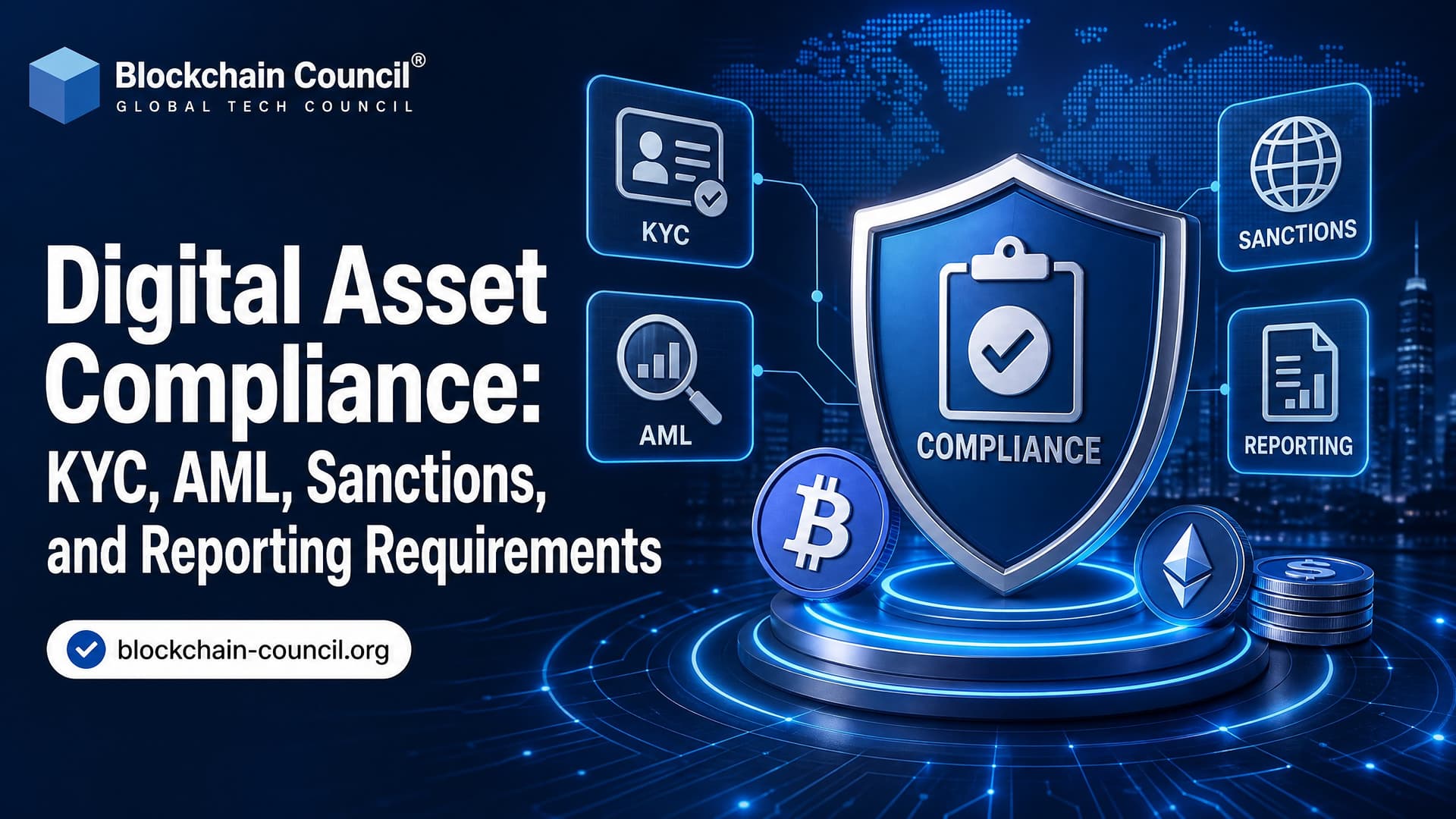
Digital asset compliance is no longer a back-office policy document that crypto firms update once a year. By 2026, KYC, AML, sanctions screening, and reporting requirements sit at the center of any business touching cryptocurrencies, stablecoins, custody, tokenized assets, payments, or on-chain finance. If you operate as a VASP, CASP, stablecoin issuer, wallet provider, exchange, DeFi front end, or financial institution using crypto rails, regulators expect controls that work at blockchain speed.
The hard part is not knowing that compliance matters. Everyone knows. The hard part is building a risk-based program that can identify customers, monitor wallets, screen sanctions exposure, exchange Travel Rule data, and produce clean audit records when a regulator asks for them.

As compliance requirements become more sophisticated, professionals also need a strong understanding of digital asset governance, tokenization, custody, enterprise blockchain, and regulatory frameworks. A Certified Digital Assets Expert credential helps build these practical skills, enabling compliance teams to manage digital assets with greater confidence while supporting secure and compliant business operations.
What Digital Asset Compliance Covers
Digital assets include cryptocurrencies, stablecoins, tokens, and blockchain-based representations of value. A digital asset AML framework applies familiar financial crime controls to these assets, but with extra attention to pseudonymous wallets, chain hopping, mixers, smart contracts, and cross-border transfers.
At a practical level, your compliance program should cover four pillars:
KYC and CDD: Verify individuals, businesses, beneficial owners, and counterparties. Refresh customer data as risk changes.
AML monitoring: Track deposits, withdrawals, swaps, bridges, wallet clusters, high-risk exposure, and suspicious behavior.
Sanctions compliance: Screen customers, entities, jurisdictions, and wallet addresses against OFAC, EU, UN, and UK lists.
Reporting: File suspicious activity reports, sanctions reports, Travel Rule data, and other required records on time.
One detail that often catches teams out: sanctions screening is not a one-time onboarding check. If OFAC updates the SDN list and an old deposit address remains on your internal allowlist, you have a real control gap. Auditors will ask how fast you rescreened historical customers and wallet addresses after the list changed.
FATF, VASPs, and the Travel Rule
The Financial Action Task Force, known as FATF, set the global baseline for virtual asset compliance. In 2019, FATF expanded key recommendations to Virtual Asset Service Providers, including exchanges, custodians, wallet providers, and other intermediaries.
The Travel Rule is the part most product teams feel first. It requires regulated entities to share originator and beneficiary information for qualifying virtual asset transfers. In many regimes, transfers around 1,000 euro or equivalent trigger stricter data-sharing and due diligence expectations.
Why Travel Rule implementation is harder than it sounds
In theory, Travel Rule compliance is just data exchange. In production, it becomes messy. Names may be formatted differently across providers. Business customers may have layered ownership. A transfer can fail because the beneficiary VASP expects an IVMS 101 field in a different structure than your system sends it. I have seen teams pass blockchain transaction tests, then fail compliance testing because the originator address was present but the customer identifier was not mapped to the correct Travel Rule message field.
Build this early. Retrofitting Travel Rule workflows after launch is expensive and usually creates withdrawal delays.
Implementing compliance controls effectively also requires knowledge of blockchain architecture, consensus mechanisms, wallet infrastructure, smart contracts, and enterprise blockchain systems. A Certified Blockchain Expert credential equips professionals with these technical foundations, helping bridge the gap between blockchain technology and evolving regulatory requirements.
United States: BSA, OFAC, FinCEN, and Stablecoin Rules
In the United States, digital asset compliance is anchored in the Bank Secrecy Act, FinCEN expectations, OFAC sanctions rules, and newer stablecoin-specific requirements. Regulators treat digital assets as financial products that can carry money laundering, terrorist financing, fraud, ransomware, and sanctions evasion risk.
The GENIUS Act, enacted in 2025 as a federal stablecoin framework, brings permitted payment stablecoin issuers under BSA-style AML and sanctions obligations. Payment stablecoin issuers must maintain licensed operations, segregated reserves, customer identification controls, sanctions screening, and the technical ability to freeze tokens tied to illicit activity when legally required.
For sanctions reporting, OFAC timelines are specific:
Annual Blocked Property Reports: Cover blocked property held as of June 30 and must be filed by September 30 each year.
Rejected Transaction Reports: Must be filed within 10 business days after a transaction is rejected due to sanctions restrictions.
FinCEN penalties can exceed 1 million dollars per violation for serious AML failures. That reality should change how executives budget compliance engineering, not just legal review.
European Union: MiCA, TFR, AMLA, DORA, and PSD2
The EU has moved toward a layered digital asset regime. MiCA, adopted in 2023, sets conduct and authorization rules for cryptoasset service providers and stablecoin issuers. The Transfer of Funds Regulation embeds the Travel Rule into crypto transfers. DORA adds operational resilience expectations. PSD2 can still matter where electronic money token services overlap with payments activity.
Under MiCA and related rules, stablecoin issuers face 1:1 reserve backing, regular audits, AML and KYC controls, and proof of reserve expectations. Saying reserves exist is not enough. You need evidence, controls, and audit trails.
The EU Anti-Money Laundering Authority has named cryptoassets as an early supervisory priority and is expected to directly oversee selected CASPs from 2028. That matters for firms that previously relied on uneven local supervision across member states. The gap is closing.
United Kingdom and Other Jurisdictions
In the UK, crypto businesses already face FCA AML registration requirements, with a broader cryptoasset authorization regime developing beyond pure AML controls. UK expectations align closely with FATF principles: KYC, KYB, sanctions screening, transaction monitoring, Travel Rule compliance, and reporting.
Singapore, Hong Kong, and other Asia Pacific markets have also built VASP licensing and AML/CTF regimes that follow FATF guidance. The pattern is clear. Regulatory arbitrage is becoming harder, especially for businesses serving customers across borders.
Operational Controls Your Program Needs
KYC and KYB
Start with customer identity. For individuals, collect and verify government-issued identity documents, proof of address where required, and biometric checks where risk justifies it. For businesses, perform KYB: confirm registration, directors, ownership structure, control rights, and ultimate beneficial owners.
Do not treat all customers the same. A low-volume user in a low-risk jurisdiction should not go through the same review path as a shell company moving stablecoins through high-risk corridors. Use risk scoring.
AML transaction monitoring
Traditional rules such as velocity checks and threshold alerts are useful, but digital assets require wallet analytics. Your monitoring should detect:
Exposure to mixers, darknet markets, ransomware wallets, hacks, and scams
Rapid chain hopping through bridges or cross-chain swaps
Structuring below reporting or review thresholds
High-risk jurisdiction patterns
Funds entering from or exiting to sanctioned wallet clusters
Be careful with false precision. A wallet risk score is not a legal conclusion. It is a signal. Your analysts still need context, escalation paths, and documented decisions.
Sanctions screening and asset controls
Screen at onboarding, before withdrawals, during deposits, after sanctions list updates, and when wallet analytics flags new exposure. For stablecoin issuers, freezing or burning functionality may be required under lawful orders. For exchanges and custodians, blocking and rejecting workflows need to be tested before an incident happens.
Smart contract teams should work with compliance before deployment. A token freeze function added after launch can be technically impossible if the contract was not designed for upgradeability. On the other hand, upgradeable contracts introduce governance and key management risk. Pick the trade-off deliberately.
Reporting and records
Reporting is where weak programs reveal themselves. Maintain records for KYC, KYB, risk scoring, wallet screening, Travel Rule messages, sanctions alerts, SAR investigations, and blocked or rejected transactions. Regulators will not accept, the vendor has it somewhere, as an audit answer.
Modern compliance programs also rely on expertise in cybersecurity, cloud infrastructure, APIs, enterprise systems, automation, analytics, and AI-assisted monitoring. A Tech Certification helps professionals strengthen these complementary technical capabilities, making it easier to build scalable compliance workflows and respond effectively to emerging operational risks.
How DeFi Changes the Compliance Problem
DeFi does not remove compliance risk. It moves it. A fully decentralized protocol may not have the same obligations as a custodial exchange, but many real businesses sit at the edge: front ends, liquidity providers, aggregators, stablecoin issuers, hosted wallets, analytics vendors, and institutions interacting with pools.
Regulators are paying more attention to these access points. Privacy tools, mixers, cross-chain bridges, and liquidity pools connected to hacks or ransomware are especially sensitive. If your app routes users into DeFi, you need to know which wallets, contracts, and pools you touch.
Skills Professionals Need in 2026
Digital asset compliance now requires a mix of legal, technical, and operational skills. Compliance teams need to understand wallet clustering and sanctions lists. Developers need to understand Travel Rule data, freeze controls, logging, and evidence retention. Executives need to understand personal and institutional liability.
If you are building your career in this area, useful learning paths include Blockchain Council's Certified Blockchain Expert™ for blockchain fundamentals, Certified Cryptocurrency Expert™ for crypto market and asset knowledge, and Certified Blockchain Developer™ if you need to understand smart contracts, wallets, and token behavior at code level.
Digital Asset Compliance Checklist
Map whether you are a VASP, CASP, stablecoin issuer, custodian, wallet provider, DeFi front end, or financial institution partner.
Define customer, product, geography, and transaction risk ratings.
Implement KYC, KYB, beneficial ownership checks, and enhanced due diligence.
Screen customers and wallets against sanctions lists at onboarding and continuously after that.
Use blockchain analytics for exposure to mixers, hacks, ransomware, sanctioned entities, and high-risk services.
Build Travel Rule workflows before enabling regulated transfers.
Document SAR, blocked property, rejected transaction, and audit reporting procedures.
Test freeze, block, reject, and escalation controls with real operational drills.
Review vendors, sub-custodians, liquidity providers, and Travel Rule partners.
Train compliance analysts and engineers together. Siloed teams miss obvious risks.
What to Do Next
If you work in a digital asset business, start with a gap assessment against FATF guidance, local AML law, sanctions rules, and Travel Rule obligations. Then test one full scenario: a sanctioned wallet tries to deposit stablecoins, the funds touch a bridge, and the customer requests withdrawal. If your team cannot show the alert, decision, escalation, block, report, and record trail, fix that workflow before you scale.
For professionals, pair regulatory study with technical fluency. Learn how wallets, token contracts, stablecoins, and chain analytics actually work. That combination is what digital asset compliance teams need most now.
Successful compliance programs also depend on communicating regulatory expectations, governance practices, and security initiatives clearly to employees, customers, regulators, and business stakeholders. A Marketing Certification helps professionals strengthen strategic communication and stakeholder engagement skills, supporting greater awareness and adoption of digital asset compliance best practices.
FAQs
1. What is digital asset compliance?
Digital asset compliance refers to the policies, procedures, and controls organizations implement to meet legal and regulatory requirements when offering cryptocurrency, blockchain, tokenization, custody, or other digital asset services. Compliance programs typically address financial crime prevention, customer protection, cybersecurity, governance, and regulatory reporting.
2. Why is compliance important for digital asset businesses?
Compliance helps organizations reduce legal, financial, operational, and reputational risks while building trust with customers, regulators, and business partners. A well-designed compliance framework also supports sustainable growth by aligning business operations with applicable laws and industry standards.
3. What is Know Your Customer (KYC)?
Know Your Customer (KYC) is the process of verifying the identity of customers before or during a business relationship. KYC procedures commonly include identity verification, customer due diligence, beneficial ownership verification where applicable, and ongoing monitoring to help prevent fraud and financial crime.
4. What is Anti-Money Laundering (AML)?
Anti-Money Laundering (AML) refers to laws, regulations, and internal controls designed to detect, prevent, and report money laundering and related financial crimes. AML programs often include customer due diligence, transaction monitoring, risk assessments, employee training, independent testing, and suspicious activity reporting where required.
5. How does Customer Due Diligence (CDD) work?
Customer Due Diligence (CDD) involves collecting and assessing information about customers to understand their identity, business activities, expected transaction behavior, and potential risk level. The depth of due diligence typically depends on the customer's risk profile and applicable regulatory requirements.
6. What is Enhanced Due Diligence (EDD)?
Enhanced Due Diligence (EDD) is a more detailed review applied to higher-risk customers, transactions, or business relationships. EDD may include additional identity verification, source of funds reviews, ongoing monitoring, and senior management approval depending on regulatory obligations.
7. What are sanctions compliance requirements?
Sanctions compliance involves screening customers, counterparties, wallets, transactions, and business relationships against applicable sanctions lists issued by relevant government authorities. Organizations should maintain procedures to identify, investigate, and address potential sanctions-related risks in accordance with applicable laws.
8. What is blockchain transaction monitoring?
Blockchain transaction monitoring involves analyzing digital asset transfers to identify unusual or potentially suspicious activity. Organizations use transaction monitoring systems to support AML compliance, fraud detection, sanctions screening, and risk management throughout the customer lifecycle.
9. What is the Travel Rule?
The Travel Rule requires certain virtual asset service providers (VASPs) to collect and transmit specified information about the originator and beneficiary of qualifying digital asset transfers where required by applicable regulations. Implementation varies across jurisdictions and continues to evolve.
10. What reporting obligations apply to digital asset businesses?
Depending on the jurisdiction, organizations may be required to submit suspicious activity reports, maintain transaction records, comply with tax reporting obligations, respond to regulatory inquiries, and retain customer documentation. Reporting requirements differ according to business activities and local regulations.
11. How does AI support digital asset compliance?
Artificial intelligence assists with transaction monitoring, fraud detection, customer risk scoring, sanctions screening, anomaly detection, document verification, regulatory reporting, and compliance workflow automation. AI improves efficiency but should operate within governance frameworks that include human review of significant compliance decisions.
12. How are wallet addresses screened?
Organizations may screen blockchain wallet addresses using blockchain analytics tools and sanctions databases to identify links with illicit activity or sanctioned entities. Screening is generally performed during onboarding and continuously throughout the customer relationship as part of an ongoing risk management program.
13. What cybersecurity controls support compliance?
Effective cybersecurity controls include encryption, multi-factor authentication (MFA), secure key management, access controls, continuous monitoring, vulnerability management, penetration testing, audit logging, and incident response planning. These measures help protect sensitive customer information and digital assets.
14. What records should digital asset businesses maintain?
Organizations generally maintain customer identification records, transaction histories, blockchain wallet information, compliance reviews, sanctions screening results, audit logs, training records, internal investigations, and documentation supporting regulatory reporting. Record retention requirements vary by jurisdiction.
15. What industries require digital asset compliance programs?
Compliance programs are important for cryptocurrency exchanges, custodians, banks, fintech companies, payment providers, broker-dealers, investment firms, tokenization platforms, NFT marketplaces, stablecoin issuers, decentralized finance (DeFi) service providers where applicable, and other organizations handling digital assets.
16. What are common compliance challenges?
Common challenges include evolving regulations, cross-border operations, blockchain pseudonymity, interoperability between compliance systems, rapidly changing financial crime techniques, integrating legacy infrastructure, managing third-party risks, and maintaining consistent compliance across multiple jurisdictions.
17. How should businesses build a digital asset compliance framework?
Organizations should conduct enterprise risk assessments, establish governance policies, define compliance responsibilities, implement KYC and AML procedures, deploy transaction monitoring tools, train employees, perform independent audits, maintain clear documentation, and regularly review compliance controls as regulations evolve.
18. What trends are shaping digital asset compliance in 2025-2026?
Major trends include AI-powered compliance automation, enhanced blockchain analytics, broader implementation of the Travel Rule, stronger sanctions monitoring, institutional digital asset adoption, tokenized real-world asset (RWA) oversight, global regulatory coordination, and more standardized reporting frameworks.
19. What are digital asset compliance best practices?
Best practices include applying risk-based controls, continuously monitoring blockchain activity, verifying customer identities, documenting compliance decisions, strengthening cybersecurity, conducting periodic internal audits, monitoring regulatory updates, testing incident response procedures, and fostering a culture of compliance throughout the organization.
20. What is the future of digital asset compliance?
Digital asset compliance is expected to become increasingly sophisticated as regulatory frameworks, blockchain analytics, artificial intelligence, and international cooperation continue to mature. Organizations that prioritize governance, transparency, cybersecurity, accurate reporting, and proactive compliance monitoring are likely to be better positioned to adapt to evolving global requirements while supporting responsible innovation. Compliance may not be the most glamorous department, but it has an uncanny ability to become everyone's favorite right after an audit notice arrives.
Related Articles
View All
Digital Assets
CBDC Compliance Professional Guide: KYC, AML, Privacy, and Regulation
A practical CBDC compliance guide covering KYC tiers, AML/CFT monitoring, privacy controls, FATF guidance, offline CBDCs, and regulatory trends.

Digital Assets
RWA Tokenization Compliance: Legal Requirements, Controls, and Best Practices
Learn the legal requirements, technical controls, and best practices for RWA tokenization compliance across securities, AML, custody, and token design.

Digital Assets
How Asset Tokenization Creates Verifiable Digital Ownership
Asset tokenization turns rights to real world and financial assets into blockchain tokens, giving authorized parties a verifiable record of ownership, provenance, and compliance.
Trending Articles

Top 5 DeFi Platforms
Explore the leading decentralized finance platforms and what makes each one unique in the evolving DeFi landscape.
Claude AI Tools for Productivity
Discover Claude AI tools for productivity to streamline tasks, manage workflows, and improve efficiency.
How to Install Claude Code
Learn how to install Claude Code on macOS, Linux, and Windows using the native installer, plus verification, authentication, and troubleshooting tips.