

How AI in RWA Tokenization Is Changing Valuation, Compliance, and Risk
 Suyash Raizada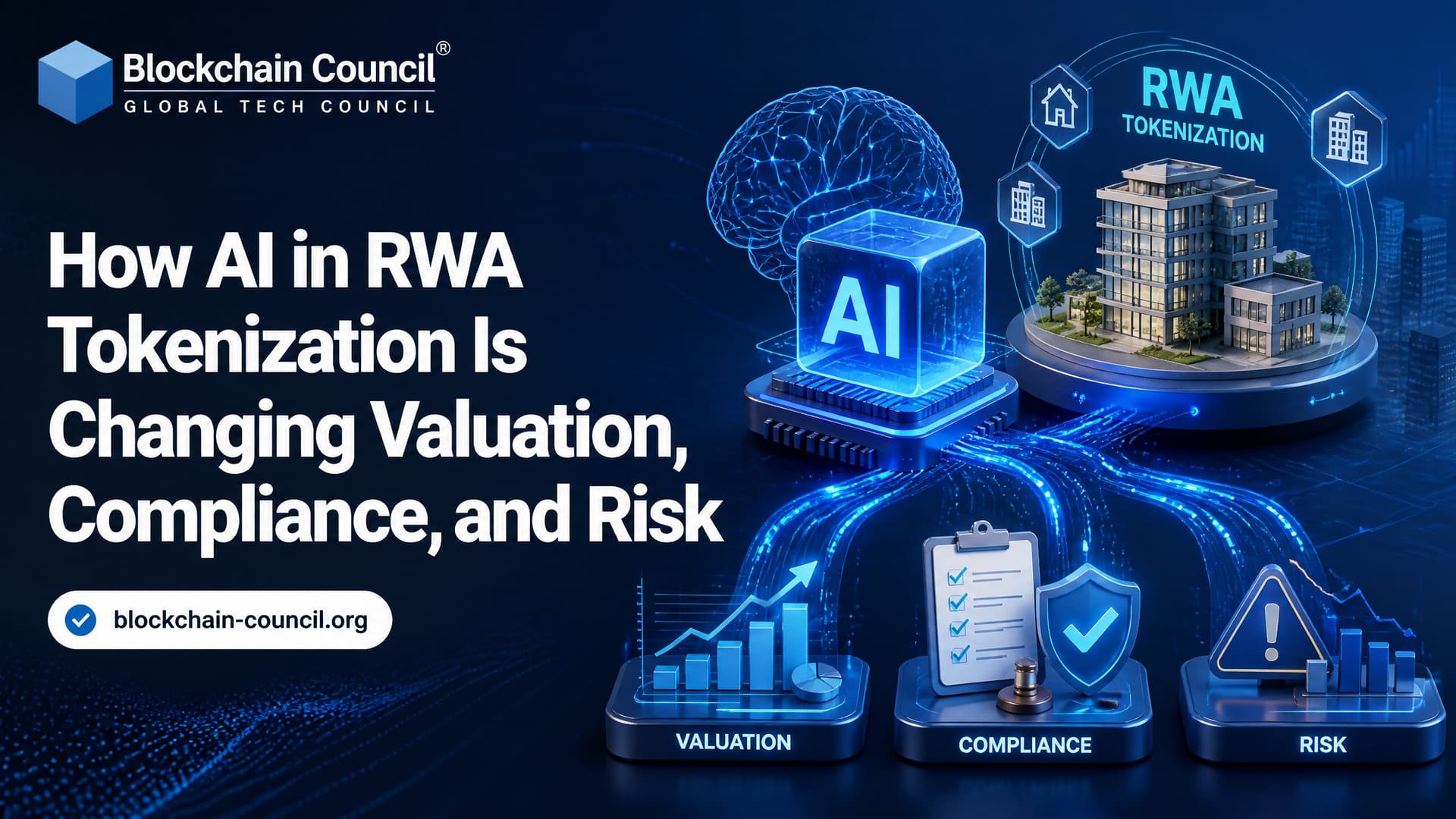
AI in RWA tokenization is moving tokenized assets beyond simple on-chain records. The real change is operational. Assets can now be valued more often, checked against compliance rules continuously, and watched for risk before problems surface in a quarterly report. Professionals looking to build specialized expertise in this evolving field can explore the Certified RWA Tokenization Expert program to develop a deeper understanding of RWA tokenization, its applications, and emerging AI-driven workflows.
For enterprises, this matters because real-world assets are messy. A tokenized treasury fund behaves nothing like a real estate pool. Private credit brings borrower covenants, payment schedules, collateral data, and default risk. AI helps connect those off-chain facts to blockchain-based instruments in a way institutions can actually supervise.

What AI in RWA Tokenization Means Today
Real-world asset tokenization turns claims on off-chain assets into blockchain-based tokens. Think real estate, private credit, treasury bills, commodities, and fund units. AI adds an intelligence layer around that process.
Instead of treating tokenization as a one-time issuance workflow, institutional platforms increasingly apply AI across the asset lifecycle:
Onboarding: Reading documents, verifying asset records, and extracting ownership or collateral details.
Valuation: Updating asset prices using market data, comparable transactions, cash flows, and alternative data.
Compliance: Running KYC, AML, sanctions, eligibility, transfer restrictions, and reporting checks.
Risk analysis: Tracking liquidity, collateral, borrower behavior, concentration, and macroeconomic exposure.
Operations: Supporting investor servicing, liquidity forecasting, and post-trade surveillance.
Some analysts call this next phase RWA 3.0. The label matters less than the shift itself. Tokenized assets are becoming dynamic financial products, not static digital wrappers.
Continuous Valuation Is Replacing Stale Appraisals
Traditional assets often rely on periodic valuations. Real estate might be appraised quarterly or annually. Private credit portfolios may depend on manager marks, borrower reports, and delayed financial statements. That works poorly when tokens trade daily or serve as collateral in lending markets.
AI changes the pricing model by supporting continuous valuation. Machine learning systems can ingest market prices, comparable sales, rental data, interest rates, borrower performance, default trends, and macro indicators. The result is not perfect truth. It is a more current estimate than a stale spreadsheet.
Automated Valuation Models for Tokenized Assets
Automated valuation models, or AVMs, are already common in real estate analytics. In tokenized RWAs, they are being extended to private credit, receivables, commodities, and fund interests.
A practical AI valuation engine may combine:
Comparable transaction data
Discounted cash flow models
Loan payment histories
Borrower credit metrics
Macroeconomic indicators such as rates and inflation
Unstructured documents, including leases and covenants
Alternative data from IoT sensors, satellite imagery, or occupancy feeds
Natural language processing earns its place here. If you have ever reviewed a loan covenant package by hand, you know the pain. AI can pull maturity dates, debt service coverage ratios, collateral clauses, and transfer restrictions far faster than a junior analyst can, though human review still matters for edge cases.
NAV Nowcasting and Secondary Markets
For tokenized funds, AI can support NAV nowcasting. That means estimating short-term net asset value drift between formal valuation points. Market makers can then set tighter bid-ask spreads because they are not guessing from last month's NAV.
This is also where developers have to be careful. A common pricing bug in tokenized asset prototypes is a decimal mismatch. Many Chainlink USD price feeds return 8 decimal places, while ERC-20 tokens often use 18 decimals and USDC uses 6. If your valuation oracle treats all three as 18 decimals, your collateral ratio can be off by orders of magnitude. The model may be sophisticated, but one unit conversion mistake can break the product.
AI Is Reducing Compliance Bottlenecks
RWA tokenization is not permissionless in the way a meme token launch is. Most institutional RWAs require investor eligibility checks, jurisdiction rules, sanctions screening, transfer controls, tax reporting, and audit trails.
AI now shortens the compliance workflow. It can classify documents, verify identity data, flag unusual transaction patterns, compare ownership certificates against registry data, and generate risk summaries for compliance teams. Professionals seeking to understand how AI capabilities connect with emerging digital asset and blockchain workflows may also benefit from the Certified Artificial Intelligence (AI) Expert program.
Some platforms have described AI-driven due diligence that ingests purchase agreements, regulatory approvals, ownership certificates, appraisal reports, and geotagged verification images before token issuance. The system produces validation results, valuation reports, and risk ratings, with human review still required before anything goes on-chain.
Transfer Restrictions and Permissioned Tokens
For regulated assets, compliance does not stop at onboarding. The token itself often needs rules. That may include whitelisted wallets, lock-up periods, investor caps, and jurisdiction-based transfer limits.
Standards such as ERC-3643 and ERC-1400 matter here because they were designed for permissioned and security-token use cases. AI does not replace these controls. It feeds them better information. An AI compliance layer might update a wallet's risk status, while the smart contract enforces whether a transfer is allowed.
If you are learning this area, connect the dots between smart contracts and compliance architecture. Blockchain Council's Certified Blockchain Expert™, Certified Smart Contract Developer™, and Certified Artificial Intelligence (AI) Expert™ are worth considering depending on whether your role leans toward strategy, engineering, or AI governance.
AI Valuation Must Be Explainable
Regulators and institutional investors will not accept a black-box valuation just because it uses machine learning. They need to know what data was used, when it was collected, which model generated the output, and how the result can be challenged.
That is why explainable AI and audit trails are becoming core requirements in AI-driven RWA tokenization. Some providers describe valuation engines that attach timestamps, data sources, model parameters, and compliance checks to every asset valuation. Others use scoring approaches built on market data, comparable sales, and risk factors to create auditable value outputs.
Regulatory pressure points the same way. The EU Markets in Crypto-Assets Regulation, known as MiCA, has raised expectations around crypto-asset governance and disclosures in Europe. In the United States, SEC treatment depends heavily on the asset structure and whether the token counts as a security. The NIST AI Risk Management Framework is also useful because it emphasizes governance, mapping risks, measuring model behavior, and managing AI systems over time.
Risk Analysis Is Becoming Near Real Time
RWA risk is not only price risk. A tokenized private credit pool can fail because borrowers miss payments. A real estate pool can suffer from vacancy, refinancing stress, insurance issues, or a regional downturn. A tokenized treasury product can face liquidity and settlement risk.
AI helps risk teams watch these signals continuously. Good systems track:
Liquidity risk: Redemption pressure, market depth, and secondary trading spreads.
Credit risk: Borrower payment behavior, covenant breaches, and collateral changes.
Market risk: Interest rate shifts, commodity price moves, and comparable asset repricing.
Operational risk: Oracle outages, reconciliation failures, and document inconsistencies.
Concentration risk: Overexposure to a region, borrower, property type, or asset originator.
AI can also run scenario analysis. What happens to a tokenized real estate debt pool if rates rise by 100 basis points, occupancy falls by 8 percent, and refinancing spreads widen? A human analyst can build that case by hand. AI can generate and test many more variations, then flag which assumptions drive the largest losses.
Market Surveillance and Abuse Detection
As RWAs become more tradable, surveillance gets harder. Tokens may move across custodial platforms, permissioned chains, public blockchains, and secondary venues. AI is well suited to pattern detection in this environment.
Use cases include wash-trading detection, suspicious wallet clustering, unusual redemption patterns, coordinated liquidity withdrawal, and price manipulation around low-volume assets. Tokenized funds such as BlackRock's BUIDL and Franklin Templeton's BENJI show how large asset managers have moved tokenized fund products from experiments into production-grade operations. Around products like these, AI can support investor servicing, liquidity forecasting, and market behavior monitoring.
To be blunt, surveillance is not optional for institutional RWAs. If a tokenized asset trades across venues and no one is watching for abuse, the product is not ready for serious capital.
AI Agents Will Handle More RWA Operations
The next step is specialized AI agents. These are not general chatbots. They are task-focused systems that can monitor a credit pool, update a collateral score, trigger a compliance alert, or recommend liquidity rebalancing based on predefined policies.
In a mature architecture, you may see agents assigned to narrow jobs:
Valuation agent: Updates fair value estimates and explains material changes.
Compliance agent: Checks investor status, jurisdiction rules, and transaction anomalies.
Risk agent: Monitors portfolio thresholds and runs stress tests.
Liquidity agent: Forecasts redemption needs and secondary-market depth.
Reporting agent: Produces audit-ready summaries for managers and regulators.
These agents should not have unchecked authority over investor funds. The better model is human-supervised autonomy. AI prepares, recommends, and alerts. Smart contracts enforce rules. Humans approve high-impact actions.
What Enterprises Should Evaluate Before Using AI for RWA Tokenization
If your organization is assessing an AI-enabled RWA platform, ask practical questions. Do not stop at demo dashboards.
What asset data is ingested, and how is provenance verified?
Can the valuation model explain its output in plain language?
How often are model outputs tested against realized prices or independent appraisals?
What happens when data is missing, delayed, or contradictory?
Are compliance decisions logged with timestamps and evidence?
Can smart contracts enforce transfer restrictions based on updated compliance status?
Who can override an AI-generated valuation or risk score?
Does the platform support audit requirements for MiCA, SEC-related obligations, or local securities rules?
The wrong move is to bolt an AI chatbot onto a tokenization workflow and call it institutional-grade. The right sequence is data governance first, then model governance, then smart contract integration.
Skills Professionals Need Next
AI in RWA tokenization sits at the intersection of finance, blockchain, compliance, and data science. You do not need to master every layer, but you should understand how they interact.
Developers should learn oracle design, token standards, access control, and secure contract testing with tools such as Hardhat or Foundry. Risk and compliance professionals should understand model validation, explainability, KYC/AML automation, and regulatory reporting. Product leaders should know when AI adds real value and when it simply adds model risk.
Professionals who want to broaden their technical capabilities across AI, blockchain, and emerging technologies can also explore a Tech Certification aligned with their career interests. This can complement specialized RWA and AI knowledge, particularly for professionals working across technology, product development, and digital transformation.
AI & Technology
As artificial intelligence continues to transform education, students are getting more opportunities to explore technology beyond traditional classroom learning. A Tech Olympiad can help students develop their understanding of AI, logical reasoning, problem-solving, and other technology skills through structured competition.
Here is a practical next step. Map one asset class, such as tokenized private credit or real estate, across five layers: asset data, valuation model, compliance rules, smart contract controls, and risk reporting. Then identify which parts can be automated safely. If you want structured learning, start with Blockchain Council's blockchain and AI certification paths, then build a small proof of concept with audited data, clear model logs, and permissioned transfer logic.
For professionals working on the commercial side of AI and RWA products, developing complementary market-facing skills can also be valuable. A Marketing Certification can complement technical expertise by helping professionals strengthen their understanding of marketing alongside emerging technology.
FAQs
1. What is AI in RWA tokenization?
AI in RWA tokenization refers to using artificial intelligence and machine learning to analyze, value, verify, monitor, and manage tokenized real-world assets. AI can add an intelligence layer to blockchain-based asset infrastructure across the asset lifecycle.
2. How does AI improve RWA asset valuation?
AI can analyze market prices, comparable transactions, cash flows, borrower data, interest rates, and alternative data to produce more frequent valuation estimates. This can help reduce reliance on outdated periodic valuations.
3. What is AI-powered valuation for tokenized assets?
AI-powered valuation uses machine learning, automated valuation models, and data analysis to estimate the current or expected value of assets such as real estate, private credit, commodities, and tokenized funds.
4. Can AI provide real-time valuation for RWAs?
AI can support near-real-time or continuous valuation estimates when sufficient current data is available. However, AI-generated values are estimates and may still require independent appraisals, market validation, or human review.
5. How does AI help with real estate tokenization?
AI can analyze property prices, rental income, occupancy, comparable transactions, interest rates, and market trends. This information can help asset managers monitor valuations and identify changes in property risk.
6. How does AI improve private-credit RWA valuation?
AI can evaluate borrower payment history, credit metrics, collateral information, financial statements, loan covenants, and default indicators. This can help lenders and investors update credit assessments more frequently.
7. How does AI support KYC and AML compliance in RWA tokenization?
AI can help analyze identity information, documents, transaction activity, and risk indicators to support KYC verification, AML monitoring, sanctions screening, and suspicious-activity detection. Human compliance oversight remains important.
8. Can AI detect suspicious transactions involving RWA tokens?
Yes. AI systems can identify unusual transaction patterns, abnormal wallet activity, rapid transfers, concentration risks, and other anomalies. These alerts can then be reviewed by compliance professionals.
9. How does AI improve investor eligibility checks?
AI can process investor information and regulatory requirements to help determine whether participants meet specific jurisdictional, identity, accreditation, or eligibility conditions. Smart contracts can potentially enforce the resulting transfer restrictions.
10. What role does AI play in RWA risk management?
AI can continuously analyze market, credit, liquidity, operational, concentration, and collateral risks. This allows institutions to identify potential problems earlier instead of relying exclusively on periodic risk reports.
11. How does AI help monitor tokenized asset liquidity?
AI can analyze trading volumes, market depth, bid-ask spreads, redemption activity, and transaction patterns to estimate liquidity conditions. However, AI cannot create market liquidity where sufficient buyers and sellers do not exist.
12. Can AI predict risks in tokenized assets?
AI can identify patterns and generate risk forecasts, probability estimates, and scenario analyses, but it cannot guarantee accurate predictions. Unexpected market conditions and poor-quality data can cause models to produce unreliable results.
13. How do AI and smart contracts work together in RWA tokenization?
AI can analyze external information and produce valuation, compliance, or risk signals, while smart contracts can execute predefined blockchain actions based on verified inputs. This creates a connection between intelligent analysis and programmable asset management.
14. How do oracles support AI-powered RWA tokenization?
AI models often require external information such as asset prices, property data, credit events, market indicators, and financial records. Oracles can help bring verified external information onto blockchain networks so smart contracts can use it.
15. What are the risks of using AI in RWA tokenization?
Key risks include inaccurate data, model bias, incorrect predictions, explainability problems, cybersecurity threats, model manipulation, overreliance on automation, and correlated errors across multiple assets.
16. Why is explainable AI important for tokenized assets?
Financial institutions need to understand what data influenced an AI-generated valuation or risk score, when the data was collected, and how the result was produced. Explainability also helps with auditing, governance, and regulatory oversight.
17. Can AI replace human compliance and risk professionals?
No. AI can automate repetitive analysis and identify potential issues, but human oversight remains important for complex legal decisions, unusual transactions, model validation, and high-impact financial decisions.
18. How can AI reduce operational risks in RWA tokenization?
AI can identify data inconsistencies, reconciliation problems, unusual transactions, missing documentation, and potential system anomalies. Automated monitoring can help institutions respond before operational problems become larger failures.
19. What are the benefits of combining AI and RWA tokenization?
The combination can potentially provide more frequent valuation, automated compliance monitoring, faster risk detection, improved data analysis, predictive analytics, and more efficient asset management. Tokenization provides the digital asset infrastructure, while AI adds analytical intelligence.
20. What is the future of AI in RWA tokenization?
AI is likely to become increasingly important across asset valuation, compliance, risk monitoring, investor servicing, and portfolio management. However, institutional adoption will depend on reliable data, explainable models, strong governance, secure infrastructure, and clear accountability. Tokenization itself can also shift risks toward the platforms and systems managing digital assets, making robust AI and technology governance increasingly important.
Related Articles
View All
Digital Assets
RWA Tokenization Security: Smart Contract, Custody, and Operational Risk Management
RWA tokenization security requires smart contract audits, regulated custody, proof of reserve controls, and operational governance to reduce real asset risk.

Digital Assets
RWA Tokenization and KYC/AML: Identity, Compliance, and Investor Protection
RWA tokenization is moving into regulated markets. Learn how KYC/AML, wallet whitelists, travel rule workflows, and disclosures protect investors.

Digital Assets
RWA Tokenization Compliance: Legal Requirements, Controls, and Best Practices
Learn the legal requirements, technical controls, and best practices for RWA tokenization compliance across securities, AML, custody, and token design.
Trending Articles
The Role of Blockchain in Ethical AI Development
How blockchain technology is being used to promote transparency and accountability in artificial intelligence systems.
AWS Career Roadmap
A step-by-step guide to building a successful career in Amazon Web Services cloud computing.
How Blockchain Secures AI Data
Understand how blockchain technology is being applied to protect the integrity and security of AI training data.