

What Does a Digital Assets Expert Do? Roles, Skills, and Career Path
 Suyash Raizada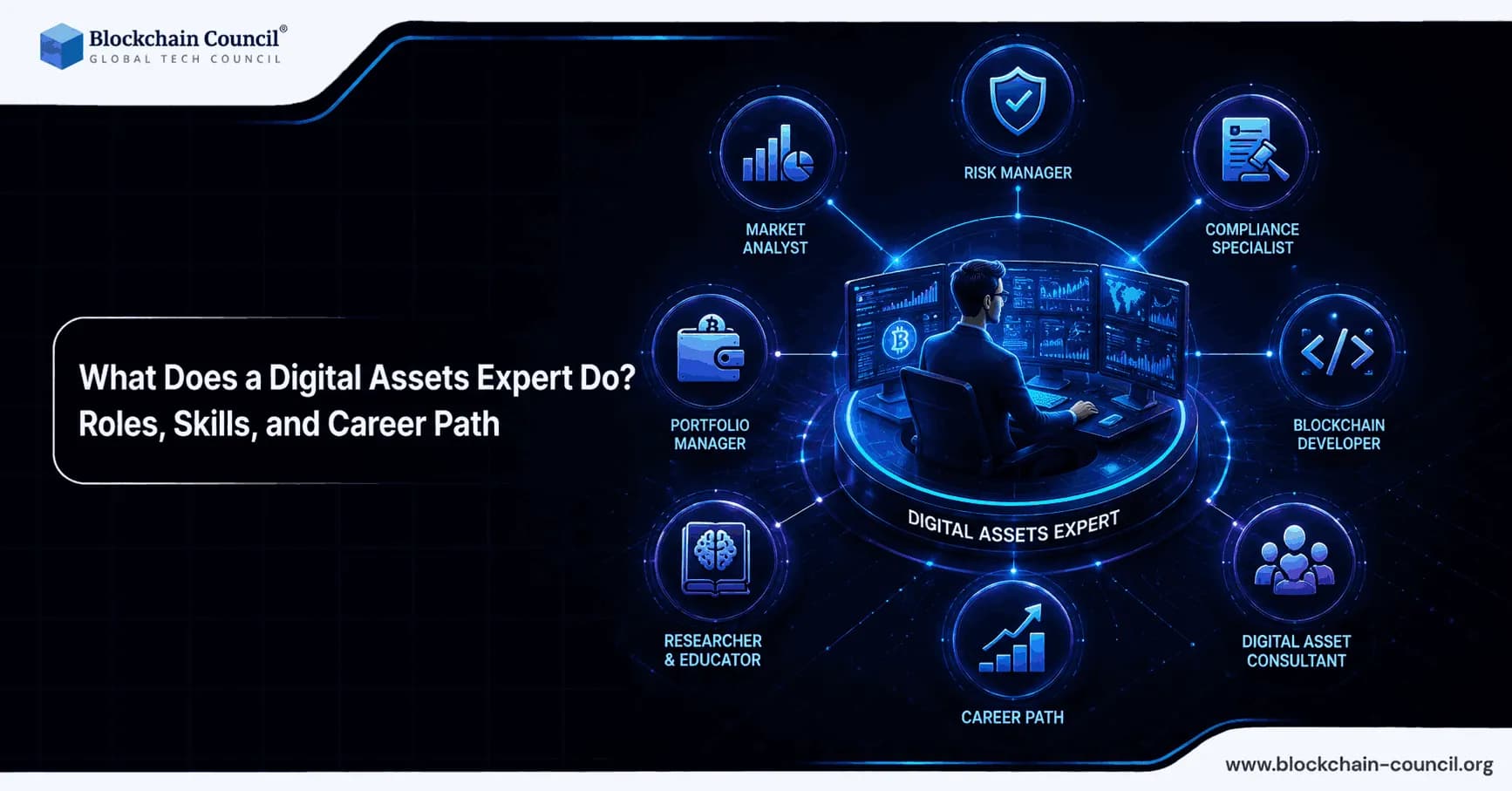
A digital assets expert helps organizations and investors safely use, manage, and build value around cryptocurrencies, tokenized assets, and blockchain-based financial instruments. In 2026, this work is far more institutional and operational than early-cycle crypto careers. The market increasingly prioritizes real-world utility, regulated workflows, and secure infrastructure, particularly across real-world asset (RWA) tokenization, compliance, and AI-enabled on-chain analytics.
Industry hiring reflects this shift. Recent market data shows that 78% of newly launched blockchain projects in the past year focused on RWAs and institutional scalability, while more than 65% of new Web3 startups integrated AI-driven smart contract auditing or automated liquidity management by January 2026. DePIN (Decentralized Physical Infrastructure) also expanded rapidly, growing 150% between 2024 and 2026, increasing demand for hybrid roles spanning hardware, tokens, and operations.

What is a Digital Assets Expert in 2026?
A digital assets expert is a cross-functional professional who blends elements of:
Technology (smart contracts, security, on-chain data, interoperability)
Finance (market structure, valuation, risk, portfolio construction)
Operations (custody, settlement, reconciliations, controls)
Regulation (AML, KYC, compliance frameworks for crypto and DeFi)
In practice, the title varies across organizations - analyst, operations specialist, tokenization product manager, settlement engineer, auditor. What unifies these roles is ownership of outcomes across the digital asset lifecycle: creation, custody, trading, settlement, monitoring, and governance.
Key Roles and Responsibilities for Digital Assets Experts
Digital asset work has diversified into specialized tracks. Below are the common roles and their typical responsibilities in 2026.
Digital Asset Operations Specialist
Focuses on the day-to-day institutional workflows that make digital assets usable at scale.
Manages custody workflows, wallet permissions, and transaction approvals
Oversees settlement, reconciliations, and operational controls
Coordinates with trading, compliance, and technology teams for incident handling
Tokenization Product Manager
Builds tokenized products and brings them to market, particularly around RWAs such as treasuries, commodities, or real estate.
Defines product requirements and token design constraints
Translates institutional needs into technical scope for engineering teams
Aligns compliance, custody, and user experience to meet market requirements
On-Chain Settlement Engineer
Designs and improves settlement systems for digital assets, often across multiple networks.
Builds settlement and bridging components with a focus on security and reliability
Optimizes transaction flows for cost, latency, and cross-chain efficiency
Implements compliance-aware controls where required by institutions
Real-World Asset (RWA) Analyst
Evaluates how physical or traditional financial assets can be tokenized and managed on-chain.
Performs valuation, yield modeling, and risk assessment for tokenized assets
Assesses market structure, liquidity assumptions, and collateral mechanics
Works with legal and compliance teams on regulatory constraints and disclosures
Crypto Analyst
Analyzes digital asset markets, adoption signals, and on-chain metrics to support trading, investing, or research decisions.
Builds models for volatility, liquidity, and market regime shifts
Tracks protocol fundamentals, token supply dynamics, and demand drivers
Produces research for funds, asset managers, or enterprise strategy teams
Blockchain Security Engineer or Smart Contract Auditor
Protects digital asset systems from exploits, which remain high-impact and costly across the industry.
Audits smart contracts for vulnerabilities and logic flaws
Implements cryptography and security architecture for decentralized systems
Supports incident response, monitoring, and secure development practices
Digital Asset Regulatory Analyst or Compliance Officer
Translates regulations into workable policies and controls for crypto, DeFi, and tokenized products.
Designs AML and KYC processes and assesses counterparty risks
Evaluates DeFi and tokenization risks against internal policy requirements
Advises product and operations teams on compliant rollout strategies
Community Economist
Uses on-chain data and incentive design to support sustainable protocol ecosystems.
Designs token distribution, incentives, and governance participation models
Analyzes on-chain behavior to reduce churn and improve retention
Supports DAO governance processes with data-driven insights
Compensation varies widely by region and specialization. Scarcity-driven roles in security, settlement engineering, and institutional tokenization often command premium pay. US blockchain developer compensation averaged approximately $146,000 annually based on 2025 data, and specialized digital assets roles frequently exceed that figure due to tighter talent supply.
Essential Skills to Become a Digital Assets Expert
In 2026, employers increasingly expect an AI-plus skill set: proficiency in a core discipline combined with the ability to use AI tools for speed, coverage, and decision support. This is particularly visible in smart contract auditing and on-chain analytics.
Technical Skills
Smart contracts and auditing: Solidity, Rust, Vyper, secure patterns, testing frameworks, and audit methodologies.
On-chain analytics and tokenomics: interpreting transaction flows, wallet activity, liquidity, governance, emissions, and incentive structures.
Interoperability basics: bridges, messaging protocols, settlement layers, and cross-chain risk considerations.
Security and cryptography fundamentals: key management, threat modeling, and decentralized security controls.
AI tooling for crypto workflows: LLM-assisted code review, anomaly detection, automated liquidity monitoring, and predictive modeling.
Analytical and Financial Skills
Financial modeling: scenario analysis, valuation frameworks, yield and risk modeling for RWAs.
Data analysis and visualization: converting on-chain and market data into actionable insights for stakeholders.
Risk management: smart contract risk, liquidity risk, custody risk, regulatory risk, and operational risk.
Business and Soft Skills
Regulatory fluency: AML, KYC, and policy design for digital assets and DeFi exposure.
Product and stakeholder communication: translating protocol details for legal, compliance, executives, and clients.
Governance and coordination: working with DAOs or multi-team enterprise environments.
In crypto analyst roles, compensation commonly ranges from approximately $60,000 to $150,000 annually depending on scope and seniority. Security-focused roles tend to pay above market given the high consequences of exploits and limited qualified talent.
Career Path: How to Become a Digital Assets Expert in 2026
There is no single route into this field, but most professionals progress through four stages.
1) Foundation (0 to 1 Year)
Learn blockchain fundamentals, token mechanics, and security basics.
Build a public portfolio: smart contract demos, dashboards, research notes, or compliance playbooks.
Learn the technical, analytical, and strategic skills required to become a successful digital assets expert in Web3 and decentralized finance by mastering blockchain ecosystems through a Certified Blockchain Expert, building digital asset tools and dashboards using a Node JS Course, and positioning yourself in the digital economy using an AI powered marketing course.
2) Entry-Level (1 to 3 Years)
Common starting roles include Crypto Analyst, Compliance Specialist, or Digital Asset Operations support.
Choose a domain focus: RWA tokenization operations, DeFi analytics, custody and settlement, or smart contract testing.
Build your professional network through conferences, technical communities, and consistent publishing of market or research insights.
3) Mid-Level Specialization (3 to 5 Years)
Progress into roles such as Tokenization Product Manager, On-Chain Settlement Engineer, or Security Engineer.
Demonstrate AI-blockchain capability through automated monitoring, model-based risk scoring, or AI-assisted audits with rigorous human review.
Own measurable outcomes: reduced settlement failures, improved audit coverage, faster incident response, or successful token launches.
4) Senior Leadership (5+ Years)
Lead as Head of Digital Assets, RWA Strategy Lead, Chief Compliance Officer, or a senior security and infrastructure leader.
Advise institutions on operating models, policy controls, and integration into existing financial systems.
Establish governance standards and vendor selection criteria for custody, analytics, and security tooling.
Multiple labor market analyses highlight that compliance talent is structurally undersupplied relative to demand, particularly in markets like the UK. This creates consistent opportunities for professionals who can bridge regulation and practical implementation.
Real-World Use Cases for Digital Assets Experts
Tokenization at Scale for Institutional Assets
Major financial firms have expanded tokenized treasury offerings, creating demand for RWA analysts who can model yield and risk, and settlement engineers who can integrate tokenized instruments into reliable operational workflows.
Institutional Trading and Research
Hedge funds and asset managers use crypto analysts to forecast volatility and interpret DeFi liquidity dynamics, increasingly supported by AI-based analytics and real-time monitoring tools.
DePIN Operations and Hybrid Infrastructure
As DePIN grew rapidly between 2024 and 2026, new roles emerged at the intersection of hardware logistics, token incentives, and on-chain verification. Digital assets experts in this space need a working understanding of both operational constraints and token economics.
Security Audits to Prevent Losses
Smart contract auditors and security engineers remain critical because preventing a single exploit can save millions. Teams now commonly combine rigorous manual review with AI-assisted scanning to improve both coverage and speed.
Future Outlook: What to Expect Beyond 2026
Industry research points to continued expansion in tokenization and AI-blockchain hybrid roles. Modular blockchain architectures and AI-supported verification of decentralized outputs are expected to widen the existing talent gap, while regulation-driven hiring should keep compliance and governance skills in sustained demand. Professionals who combine core crypto expertise with practical AI proficiency are well-positioned to lead this next phase.
Conclusion
A digital assets expert in 2026 is no longer defined by speculation or community management. The role has matured into a set of institutional, security-first, and data-driven careers spanning tokenization, settlement, compliance, analytics, and smart contract security. To enter the field, focus on building an AI-plus skill set, choose a specialization aligned with RWAs or infrastructure, and document your work through portfolios and measurable outcomes. Understand the role of a digital assets expert in managing cryptocurrencies, tokenized assets, NFTs, and blockchain-based financial systems by building expertise through a Cryptocurrency Expert, analyzing digital asset markets and trends using a Python certification, and growing your digital finance career with a Digital marketing course.
FAQs
1. What is a digital assets expert?
A digital assets expert is a professional who works with cryptocurrencies, tokenized assets, blockchain systems, and digital financial infrastructure. Their responsibilities may include custody, settlement, compliance, analytics, tokenization, or smart contract security. The role combines technology, finance, operations, and regulation into one increasingly complicated career category.
2. Why is the digital assets expert role growing in 2026?
The role is growing because institutions are expanding into tokenization, blockchain infrastructure, DeFi, and digital asset operations. Real-world asset tokenization and AI-assisted blockchain workflows have increased demand for specialized talent. Companies now need professionals who understand both operational systems and decentralized technologies.
3. What industries hire digital assets experts?
Digital assets experts are hired by crypto exchanges, fintech companies, banks, hedge funds, blockchain startups, compliance firms, and enterprise technology providers. Tokenization platforms and DeFi infrastructure companies also actively recruit for these roles. The field has moved far beyond people shouting about coins on social media, thankfully.
4. What does a digital asset operations specialist do?
A digital asset operations specialist manages custody workflows, wallet permissions, transaction approvals, reconciliations, and settlement processes. They work closely with compliance, trading, and infrastructure teams to maintain operational reliability. Their role is critical for institutions handling digital assets at scale.
5. What is a tokenization product manager?
A tokenization product manager designs and manages products based on tokenized assets such as treasuries, commodities, or real estate. They coordinate between compliance, engineering, custody, and business teams to bring these products to market. The role requires both technical understanding and financial product knowledge.
6. What does an on-chain settlement engineer do?
An on-chain settlement engineer builds systems that move and settle digital assets securely across blockchain networks. They focus on transaction reliability, cross-chain workflows, latency optimization, and operational controls. Their work helps institutions manage blockchain-based transfers safely and efficiently.
7. What is a real-world asset (RWA) analyst?
An RWA analyst evaluates how traditional assets can be tokenized and managed on-chain. They perform valuation modeling, risk analysis, liquidity assessment, and collateral evaluation for tokenized products. These professionals often work with legal and compliance teams to meet regulatory requirements.
8. What does a crypto analyst do?
A crypto analyst studies digital asset markets, token supply, liquidity trends, and on-chain behavior. They produce research, forecasts, and investment insights for trading firms, hedge funds, or enterprise strategy teams. Their work increasingly relies on AI-assisted analytics and real-time blockchain data.
9. Why are smart contract auditors important?
Smart contract auditors help identify vulnerabilities and logic flaws before blockchain applications go live. Since blockchain exploits can lead to major financial losses, security reviews are essential. Auditors combine manual analysis with automated tools because trusting unaudited contracts is apparently still a popular hobby online.
10. What does a digital asset compliance officer do?
A digital asset compliance officer designs AML, KYC, and regulatory controls for crypto and tokenized products. They assess legal risks, evaluate counterparties, and ensure products align with internal and external requirements. This role is increasingly important as governments expand digital asset regulations.
11. What technical skills are required for digital assets experts?
Technical skills often include smart contracts, blockchain analytics, interoperability concepts, security fundamentals, and AI-assisted tooling. Knowledge of Solidity, Rust, wallets, bridges, and settlement systems is highly valuable. Employers increasingly expect professionals to combine blockchain expertise with practical AI skills.
12. Why are AI skills becoming important in digital asset careers?
AI tools are now widely used for smart contract auditing, anomaly detection, liquidity monitoring, and predictive analytics. Professionals who can combine AI with blockchain workflows are more valuable to employers. Apparently every industry eventually becomes “do the same job, but now with machine learning attached to it.”
13. What financial skills should digital assets experts have?
Digital assets experts should understand valuation, risk management, yield modeling, liquidity analysis, and market structure. They often evaluate token economics, DeFi incentives, and trading risks. Strong analytical skills help convert blockchain data into business or investment decisions.
14. What soft skills are important in digital asset careers?
Communication, governance coordination, regulatory understanding, and stakeholder management are extremely important. Professionals must explain technical blockchain concepts to executives, legal teams, and clients. Clear communication becomes especially valuable when explaining why a bridge exploit vaporized millions overnight.
15. How much do digital assets experts earn?
Compensation varies based on specialization, region, and experience level. Security engineers, settlement specialists, and tokenization professionals often earn premium salaries due to limited talent supply. Crypto analyst roles commonly range from around $60,000 to $150,000 annually, while senior technical roles can exceed that.
16. How can someone start a career in digital assets?
Beginners should first learn blockchain fundamentals, token mechanics, security basics, and on-chain systems. Building portfolios with dashboards, smart contracts, or research reports helps demonstrate practical skills. Structured certifications can also strengthen credibility during early career transitions.
17. What are common entry-level roles in digital assets?
Common entry-level roles include crypto analyst, compliance associate, operations specialist, and junior blockchain researcher. These positions help professionals build practical experience with trading systems, custody workflows, and blockchain analytics. Over time, many specialize in security, tokenization, or infrastructure engineering.
18. What are the most in-demand areas in digital assets?
Security auditing, compliance, tokenization, settlement infrastructure, and AI-assisted analytics are among the most in-demand areas. Real-world asset tokenization and DePIN infrastructure are also growing quickly. Organizations increasingly want professionals who can combine operational discipline with blockchain expertise.
19. What is DePIN and why does it create new jobs?
DePIN, or Decentralized Physical Infrastructure Networks, combines hardware systems with blockchain incentives and on-chain verification. Growth in this sector has created roles involving logistics, operations, token economics, and infrastructure monitoring. It is essentially the internet deciding physical infrastructure that also needs token governance debates.
20. What is the future outlook for digital assets experts?
The future outlook remains strong as institutions continue adopting tokenization, AI-assisted blockchain systems, and regulated digital asset infrastructure. Demand is expected to grow in compliance, settlement, governance, analytics, and security-focused roles. Professionals who combine blockchain expertise with AI and operational skills will likely remain highly valuable.
Related Articles
View All
Cryptocurrency
Career in Crypto Asset Recovery: Skills, Roles, and Opportunities
Explore a career in crypto asset recovery, including key skills, job roles, salary signals, and practical steps to enter blockchain forensics and compliance.

Cryptocurrency
Cryptocurrency Wallets Explained: How to Store and Manage Digital Assets
Learn how cryptocurrency wallets work, including private keys, hot and cold storage, custodial options, MPC, account abstraction, and security best practices.

Cryptocurrency
Cryptocurrency vs Fiat Currency: How Digital Assets Compare to Traditional Money
Cryptocurrency vs fiat currency explained through control, volatility, settlement, privacy, regulation, use cases, and practical trade-offs for professionals.
Trending Articles
How Blockchain Secures AI Data
Understand how blockchain technology is being applied to protect the integrity and security of AI training data.
What is AWS? A Beginner's Guide to Cloud Computing
Everything you need to know about Amazon Web Services, cloud computing fundamentals, and career opportunities.
Claude AI Tools for Productivity
Discover Claude AI tools for productivity to streamline tasks, manage workflows, and improve efficiency.