

AML & KYC Requirements for Digital Assets Explained
 Suyash Raizada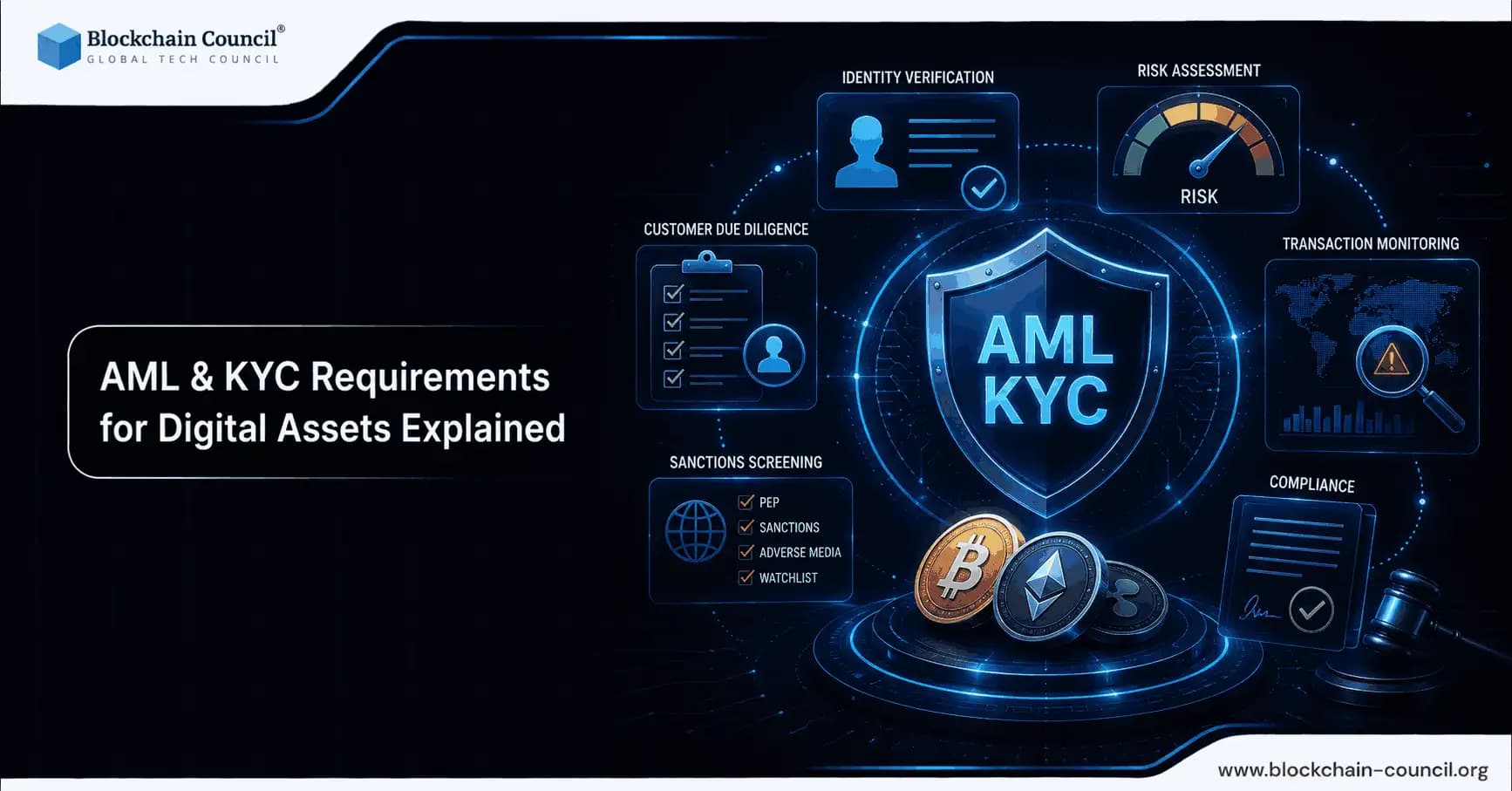
AML & KYC requirements for digital assets are no longer a niche compliance topic reserved for large exchanges. In 2026, they represent a practical operating standard for any organization touching crypto, tokenized assets, stablecoins, custody, payments, or on-chain finance. Regulators across the United States, European Union, and United Kingdom increasingly expect controls that match the speed and complexity of blockchain activity, while institutions require clear risk management before allocating capital to digital assets. Understand AML and KYC requirements for digital assets including identity verification, transaction monitoring, sanctions compliance, and risk scoring by building expertise through a Cyber Security Expert, automating compliance workflows and blockchain analysis using a Python certification, and implementing compliant crypto operations with a Digital marketing course.
This guide breaks down what AML and KYC mean in a digital asset context, how global frameworks are converging, and what implementation looks like for exchanges, custodians, and Web3 platforms.

Why AML and KYC Matter for Digital Assets in 2026
Digital asset markets have moved from early experimentation to regulated infrastructure. For many enterprises, the ability to launch or integrate crypto products now depends on demonstrating reliable identity controls, transaction monitoring, and reporting readiness.
Three forces are driving this shift:
Institutional adoption requirements: Banks, asset managers, and enterprises typically require mature compliance programs before engaging in tokenization, custody, or on-chain settlement.
Ongoing illicit finance risk: Even as compliance programs expand, meaningful volumes of funds continue to reach illicit addresses, underscoring that implementation quality matters as much as policy.
Regulatory convergence: Frameworks like the EU Markets in Crypto Assets Regulation (MiCAR) and strengthened AML directives are pushing licensing, governance, and AML-KYC controls toward a consistent global baseline.
Many organizations still face a compliance preparedness gap. They may complete onboarding checks but lack perpetual monitoring, wallet risk analytics, KYB workflows, or scalable reporting processes.
Understanding KYC Requirements for Crypto and Digital Assets
Know Your Customer (KYC) is a set of procedures used to verify identity, assess customer risk, and support AML compliance. In crypto, KYC also helps connect real-world identities to wallet activity, which is essential when value can move quickly across addresses and protocols.
1) Customer Identification (CID)
CID is the baseline identity collection and verification step. It typically includes:
Full legal name
Residential address
Date of birth
Government-issued identity documentation
Identity fraud using synthetic identities and deepfakes is a growing challenge. To reduce these risks, many programs now incorporate:
Live biometric checks (liveness detection)
Multi-factor verification and device risk signals
Government-backed digital ID wallets where available
Behavioral analysis to identify anomalies beyond document review
2) Customer Due Diligence (CDD)
CDD builds a risk profile for each customer. In digital assets, CDD commonly evaluates:
Source of wealth and expected source of funds
Jurisdiction and geographic risk
Expected activity patterns (volume, frequency, product use)
Wallet interaction history and exposure signals where permitted
CDD determines whether a customer can be onboarded under standard controls or should be routed into enhanced checks and tighter monitoring.
3) Enhanced Due Diligence (EDD)
EDD applies when risk is elevated, such as for high-value activity, higher-risk jurisdictions, complex ownership structures, or politically exposed persons (PEPs). EDD typically includes:
Additional identity and address validation steps
Source of funds verification for certain flows
Beneficial ownership identification and control analysis
Closer monitoring and tighter thresholds
Documented decisioning that can be audited by regulators
4) Perpetual KYC (Continuous KYC)
One of the most significant shifts in 2026 compliance expectations is the move toward Perpetual KYC. Because risk profiles change over time, KYC is increasingly treated as a continuous process rather than a one-time onboarding event. Perpetual KYC programs typically monitor:
Sudden changes in transaction volume or velocity
New destination addresses and exposure to high-risk services
Login behavior changes and device anomalies
Geolocation changes and jurisdiction signals
Behavior inconsistent with the established customer profile
Understanding AML Requirements for Digital Assets
Anti-Money Laundering (AML) in crypto refers to laws, regulations, and internal controls designed to prevent illicit funds from entering or moving through digital asset systems and ultimately being integrated into the legitimate economy.
Why AML Is Uniquely Challenging in Crypto
Perceived anonymity: Addresses are pseudonymous, which can obscure who controls funds without strong identity and analytics controls.
Rapid transferability: Value can move across multiple addresses and services quickly, supporting layering patterns.
Historically inconsistent controls: Early crypto markets often lacked the standardized onboarding, monitoring, and reporting maturity found in traditional finance.
Core AML Mechanisms in Digital Asset Programs
Effective AML programs combine policy, people, and technology across the full customer lifecycle.
Transaction monitoring: Detect unusual sizes, frequencies, rapid hops across addresses, exposure to illicit services, and behavior inconsistent with a customer profile.
Sanctions screening: Screen customers, counterparties, and wallet exposure signals against sanctions lists and prohibited jurisdiction requirements.
Audit trails: Maintain searchable records covering transaction history, source and destination mapping, timestamps, and investigation notes.
Suspicious activity reporting: In the United States, crypto businesses operating as Money Services Businesses are generally required to submit Suspicious Activity Reports to the Financial Crimes Enforcement Network (FinCEN) when relevant indicators are met.
Beneficial ownership verification: Increasingly required to identify who ultimately owns or controls business customers, aligning with transparency rules such as the US Beneficial Ownership Rule.
Risk-based approach: Apply stricter controls to higher-risk customers, jurisdictions, products, and transaction patterns.
Key Global Frameworks Shaping Crypto Compliance
United States: BSA, FinCEN Expectations, and Beneficial Ownership
In the US, AML compliance for crypto centers primarily on the Bank Secrecy Act (BSA) and FinCEN rules that apply to Money Services Businesses. FinCEN has clarified that accepting and transmitting convertible virtual currency can fall under money transmission obligations when it substitutes for currency. Practical expectations include KYC, ongoing monitoring, and filing Suspicious Activity Reports when warranted.
The US Beneficial Ownership Rule expands the availability of ownership data for tens of millions of entities, strengthening AML investigations and KYB requirements.
European Union: MiCAR and Strengthened AML Regimes
The EU has moved toward clear authorization and operating standards for crypto asset service providers through MiCAR, alongside broader AML directives including the 6th Anti-Money Laundering Directive (6AMLD). In practice, this framework emphasizes licensing, governance, beneficial ownership checks, and continuous monitoring across crypto activities.
United Kingdom: Digital Identity and Continuous Monitoring
The UK approach broadly aligns with EU-style risk controls and places particular emphasis on digital identity verification and continuous monitoring, including alignment with digital identity trust frameworks.
Important Concepts: Travel Rule, KYB, and Linking Identity to Wallets
Travel Rule
The Travel Rule adapts wire-transfer-style information sharing to virtual asset transfers. It requires originator and beneficiary information to travel with transactions in many regulated contexts. For digital assets, it helps close a key gap where value might otherwise move without standardized counterparty information.
Know Your Business (KYB)
For enterprise-facing crypto products, KYB is essential. It typically includes:
Company registration verification
Ownership and control structure mapping
Beneficial owner identification
Business purpose assessment and compliance history review
Linking Real-World Identity to Wallet Addresses
Many compliance models require associating a verified customer with one or more wallet addresses. This supports:
Wallet-level monitoring tied to a customer risk profile
Faster investigations and more complete reporting
Reduced layering opportunities through unidentified address rotation
Controlled access to permissioned liquidity and institutional products
Emerging Technologies Shaping AML-KYC for Digital Assets
Modern compliance programs increasingly rely on technology to scale while improving precision and protecting privacy.
AI-powered blockchain analytics: Supports pattern detection, risk scoring, typology discovery, and faster triage of alerts.
Automated compliance tooling: Enables real-time screening, case management, and report generation with consistent controls.
Zero-knowledge proofs (ZKPs): Support privacy-preserving proofs of identity attributes or compliance assertions without exposing raw personal data.
Self-sovereign identity (SSI): Enables portable verifiable credentials and selective disclosure, reducing dependence on centralized data stores.
Government-backed digital ID wallets: Provide cryptographically verifiable identity signals that can reduce document fraud and deepfake risks.
Implementation Checklist for Exchanges, Custodians, and Web3 Builders
Teams building crypto products can use the following checklist to align operations with common 2026 compliance expectations:
Define a risk-based program: Document risk tiers by customer type, jurisdiction, and product usage.
Implement layered identity verification: Combine document checks with biometrics, device intelligence, and fraud signals.
Build perpetual KYC workflows: Trigger re-verification or review based on behavior changes, not just fixed time intervals.
Deploy transaction monitoring: Use blockchain analytics to detect exposure, clustering risk, and laundering typologies.
Operationalize sanctions screening: Cover customers, addresses, and counterparties with automated list updates.
Prepare reporting and audit readiness: Maintain investigation notes, escalation paths, and regulator-ready records.
Strengthen KYB: Verify beneficial owners and control structures for business accounts and institutional access.
Train teams: Ensure compliance, product, engineering, and support staff understand their shared responsibilities.
Learn how crypto platforms enforce AML and KYC compliance using blockchain analytics, wallet screening, and identity management systems by mastering crypto governance through a Cryptocurrency Expert, developing compliance integrations using a Node JS Course, and scaling trusted digital asset services using an AI powered marketing course.
Conclusion
AML and KYC requirements for digital assets ultimately reflect one practical reality: crypto markets can scale sustainably only when identity assurance, transaction transparency, and risk controls scale alongside them. In 2026, the industry is moving from one-time onboarding toward perpetual KYC, automated monitoring, stronger beneficial ownership verification, and Travel Rule-aligned data sharing.
Organizations that treat AML and KYC as foundational infrastructure rather than a compliance checkbox are better positioned to support institutional participation, protect users, and operate across jurisdictions as regulatory standards continue to converge.
FAQs
1. What are AML and KYC requirements for digital assets?
AML and KYC requirements help crypto businesses verify users and prevent illicit financial activity. They include identity checks, transaction monitoring, sanctions screening, and reporting controls. These requirements are now core to operating digital asset services responsibly.
2. Why do AML and KYC matter in crypto?
Crypto transactions can move quickly across wallets, chains, and platforms. AML and KYC controls help link activity to verified users and detect suspicious behavior. Without them, financial crime risk becomes much harder to manage.
3. What does KYC mean in digital assets?
KYC means Know Your Customer and focuses on verifying a user’s identity. It usually includes collecting legal name, address, date of birth, and identity documents. In crypto, it also supports wallet-level risk monitoring.
4. What does AML mean in digital assets?
AML means Anti-Money Laundering and refers to controls that prevent criminal funds from entering financial systems. In crypto, AML includes transaction monitoring, sanctions screening, and suspicious activity reporting. It helps reduce laundering, fraud, and terrorist financing risks.
5. What is customer identification in crypto KYC?
Customer identification is the first step in verifying who a user is. It may involve identity documents, biometric checks, device signals, and fraud detection. This step helps stop fake or stolen identities from being used.
6. What is customer due diligence?
Customer due diligence builds a risk profile for each user. It considers source of funds, geography, expected activity, and wallet exposure. This helps firms decide the right monitoring level for each customer.
7. What is enhanced due diligence?
Enhanced due diligence applies to higher-risk customers or transactions. It may require deeper identity checks, source-of-funds proof, and beneficial ownership reviews. This extra scrutiny helps reduce exposure to serious compliance risks.
8. What is perpetual KYC?
Perpetual KYC means customer risk is monitored continuously, not just during onboarding. It tracks changes in behavior, transaction volume, location, and wallet activity. This is useful because risk profiles change, unlike paperwork pretending otherwise.
9. Why is AML harder in crypto than traditional finance?
Crypto uses pseudonymous addresses and can move funds across services very quickly. This makes layering and wallet rotation harder to detect without analytics. Strong monitoring tools are needed to follow risk across chains.
10. What is transaction monitoring in crypto AML?
Transaction monitoring reviews wallet activity for unusual or suspicious behavior. It can detect rapid transfers, high-risk counterparties, sanctions exposure, and abnormal transaction patterns. This helps firms investigate and report risky activity.
11. Why is sanctions screening important?
Sanctions screening helps prevent firms from serving prohibited people, entities, wallets, or jurisdictions. In crypto, screening may include both customer identities and wallet exposure. This reduces legal and reputational risk.
12. What is the Travel Rule?
The Travel Rule requires certain sender and receiver information to accompany qualifying crypto transfers. It helps regulated firms share counterparty details during transactions. This reduces anonymous movement of funds across platforms.
13. What is KYB in digital assets?
KYB means Know Your Business and applies to corporate or institutional customers. It verifies company registration, ownership structure, beneficial owners, and business purpose. This prevents anonymous companies from hiding who controls funds.
14. Why is beneficial ownership verification important?
Beneficial ownership verification identifies the real people who own or control a business. It helps prevent shell companies from being used for laundering or sanctions evasion. Regulators increasingly expect this information in crypto compliance programs.
15. How does blockchain analytics support AML and KYC?
Blockchain analytics helps trace funds, score wallet risk, and identify suspicious patterns. It can detect exposure to mixers, scams, sanctioned wallets, or illicit services. This gives compliance teams better evidence for investigations.
16. How do AI tools improve crypto compliance?
AI tools can detect transaction patterns, prioritize alerts, and support faster case reviews. They help compliance teams manage large volumes of blockchain activity. Still, humans must review critical decisions, because machines also enjoy being confidently wrong.
17. What role do zero-knowledge proofs play in KYC?
Zero-knowledge proofs can confirm identity or compliance facts without revealing all personal data. They support privacy-preserving verification. This may help balance regulatory needs with user privacy.
18. What should exchanges and custodians implement?
They should implement risk-based onboarding, layered identity verification, perpetual KYC, transaction monitoring, and sanctions screening. They also need audit-ready records and reporting workflows. These controls make compliance scalable and defensible.
19. Why is staff training important for AML and KYC?
Compliance depends on people across legal, product, engineering, support, and operations teams. Training helps everyone understand red flags, escalation rules, and documentation standards. A policy nobody understands is just decorative bureaucracy.
20. What is the main takeaway about AML and KYC for digital assets?
AML and KYC are now foundational requirements for crypto, stablecoins, custody, and tokenized finance. Strong programs combine identity verification, continuous monitoring, wallet analytics, and clear reporting. Firms that build compliance early are better prepared for institutional and regulatory demands.
Related Articles
View All
Cryptocurrency
Cryptocurrency Wallets Explained: How to Store and Manage Digital Assets
Learn how cryptocurrency wallets work, including private keys, hot and cold storage, custodial options, MPC, account abstraction, and security best practices.

Cryptocurrency
Crypto Asset Recovery Explained: How to Recover Lost or Stolen Digital Assets
Learn how crypto asset recovery works, what can realistically be recovered, and how to avoid recovery scams after digital asset theft or loss.

Cryptocurrency
The Future of Crypto: Regulation, Institutional Adoption & Digital Assets
Explore the Future of Crypto, from regulation and spot ETFs to stablecoin payments, CBDCs, and tokenised assets. A clear, up-to-date guide for beginners and professionals.
Trending Articles
The Role of Blockchain in Ethical AI Development
How blockchain technology is being used to promote transparency and accountability in artificial intelligence systems.
How Blockchain Secures AI Data
Understand how blockchain technology is being applied to protect the integrity and security of AI training data.

Can DeFi 2.0 Bridge the Gap Between Traditional and Decentralized Finance?
The next generation of DeFi protocols aims to connect traditional banking with decentralized finance ecosystems.