

Security Playbook for Digital Assets Experts: Wallet Hardening, Key Management, and Incident Response
 Suyash Raizada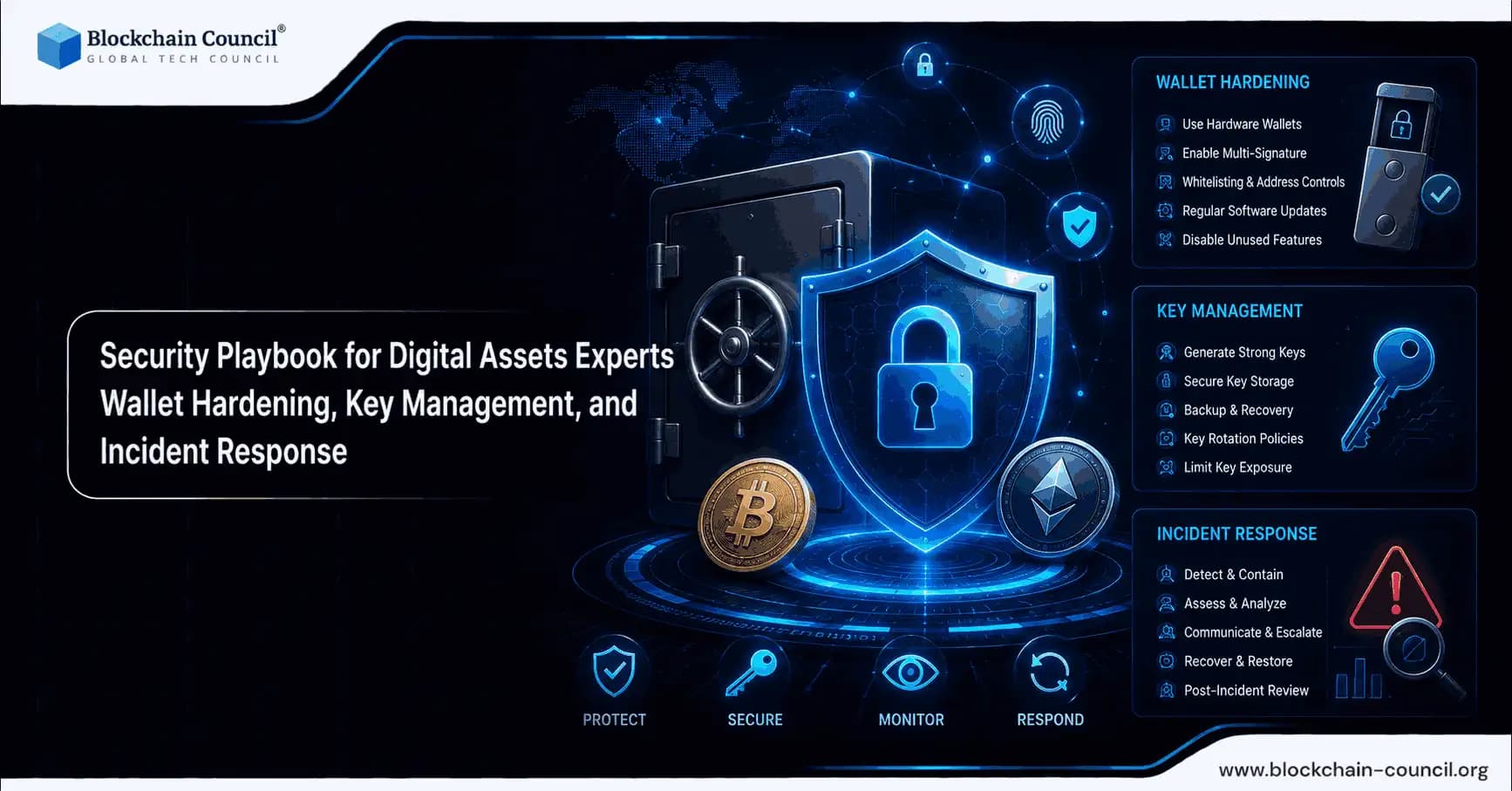
Security playbook for digital assets experts is no longer optional in 2026. Wallet drainers, address poisoning, insider misuse, and policy misconfigurations are driving losses across both centralized custody and self-custody environments. Chainalysis reported $3.7 billion stolen in 2024 across 202 major incidents, while Fireblocks security research has attributed nearly all digital asset theft incidents to misconfigured policies. The practical takeaway is clear: mature programs focus less on any single tool and more on repeatable controls across wallet hardening, key management, and incident response. Learn how to secure digital assets through wallet hardening, key management strategies, multi-signature controls, and incident response planning by building expertise through a Cyber Security Expert, automating security monitoring and forensic workflows using a Python certification, and strengthening blockchain security operations with a Digital marketing course.
This playbook breaks down what to implement, how to validate it, and how to respond when something goes wrong. It is written for security teams, developers, and digital asset operators who need institutional-grade rigor without slowing operations.

Threat Landscape: What Is Breaking in Real Environments
Most modern losses happen because a valid transaction was signed, not because cryptography failed. Common high-impact vectors include:
Wallet drainers and signature phishing: users or operators sign malicious approvals or transfers that appear legitimate in the UI.
Unlimited token approvals: Fireblocks notes that a large share of DeFi exploits involve unlimited approvals or malicious contracts, turning one mistake into repeated losses.
Address poisoning: attackers generate lookalike addresses and rely on copy-paste or recent-transaction habits to deceive recipients.
Insider risk: privileged operators, compromised endpoints, or social engineering can bypass informal processes.
Policy misconfiguration: Fireblocks reports that nearly all theft incidents stem from misconfigured policies, meaning security failures occur at the workflow layer rather than the cryptographic layer.
Basic governance is also still missing in many organizations. Industry research indicates only 31% of businesses conducted cybersecurity risk assessments in the past year, leaving wallets, RPC endpoints, exchange accounts, and admin consoles unaccounted for.
Wallet Hardening: Design a Tiered Custody Model
Wallet hardening is best treated as defense-in-depth. Instead of one hot wallet handling everything, split responsibilities into hot, warm, and cold tiers. Industry guidance commonly recommends keeping 90-95% of holdings in cold storage, with hot wallets limited to immediate operational needs.
1) Hot Wallets: Keep Liquidity Small and Controls Strict
Hot wallets are the most exposed because they connect to internet-facing systems and user workflows. Use them for trading, market-making, and immediate spend only.
Balance policy: cap hot wallet exposure to less than 5% of holdings, adjusting based on operational requirements.
Strong authentication: phishing-resistant MFA for all operators and admins, plus device posture checks where feasible.
Network controls: IP allowlists for consoles and APIs, rate limiting, and geo restrictions for administrative actions.
Real-time alerting: transaction creation, approvals, policy overrides, and new address additions should each generate alerts.
2) Warm Wallets: Segment Operational Transfers
Warm wallets handle scheduled transfers and operational treasury movements. They should be reachable but not casually accessible.
Network segmentation: isolate signing and approval systems from general-purpose corporate networks.
Rotation: automate key share rotation and operational credential rotation for systems that interact with warm wallets.
Workflow gating: require explicit justification and ticket references for non-routine transfers.
3) Cold Storage: Make Exfiltration Operationally Hard
Cold storage should be designed so that a successful compromise requires multiple independent failures.
Air-gapped signing: offline devices or controlled signing rooms with strict access logging.
Hardware-backed security: HSMs where appropriate, or certified hardware wallets with verified firmware and a controlled supply chain.
Integrity checks: periodic verification of device integrity, backup integrity, and signer availability.
Implementation Checklist: Wallet Hardening That Holds Up
Adopt multi-sig and/or MPC for every material wallet. Target distributed approval schemes such as 2-of-3 or 3-of-5 depending on risk profile.
Pre-execution simulation for contract interactions to catch unlimited approvals, suspicious calldata, or unexpected token movements before signing.
Policy engine enforcement so transfers cannot bypass limits, destination allowlists, or approval quorum requirements.
Zero-trust access for admin actions: verify user, device, network, and intent on every action, not once per session.
A practical example of post-incident architecture improvement is the post-2024 Ronin Bridge response, where controls including MPC and stronger policy enforcement were adopted to reduce recurrence risk. The broader lesson is that architecture must assume credential compromise and still prevent catastrophic outflows.
Key Management: Remove Single Points of Failure
Key management is where many teams claim security but still run fragile workflows. The goal is straightforward: no single person, device, or cloud account should be able to move funds unilaterally.
MPC Wallets: Institutional Default for Many Treasuries
Multi-Party Computation (MPC) uses threshold cryptography to distribute signing across parties or systems so the full private key is never reconstructed in one place. Fireblocks and other institutional custody providers describe MPC as a standard approach for corporate treasury operations because it reduces single-key risk while supporting granular policy controls.
Operational fit: supports approval workflows across teams and geographies.
Security advantage: attackers must compromise multiple independent components to produce a valid signature.
Governance advantage: simplifies enforcement of least privilege and separation of duties across workflows.
HSMs and Hardware Devices: Strong Isolation for Critical Signing
Hardware Security Modules (HSMs) and secure hardware wallets protect key material with tamper-resistant storage and controlled signing operations. They are especially valuable for cold-tier and high-value warm-tier signing.
Use HSMs for standardized controls, lifecycle management, and auditability in enterprise environments.
Use multi-device approvals so a single stolen device cannot authorize a transfer independently.
Backups and Recovery: Plan for Loss Without Enabling Theft
Backups are a leading source of both resilience and accidental exposure. A safe approach balances confidentiality with recoverability:
Encrypted, immutable backups stored off-site with access logging and strict retrieval procedures.
Shamir's Secret Sharing to split recovery material into multiple parts with a defined threshold requirement.
Quarterly recovery drills that verify the ability to restore access under time pressure.
Governance: Solve Insider Risk with Enforced Separation
Insider risk is mitigated by enforced separation of authority, not by trust alone. Apply this in practice with:
Segregation of duties across request, approve, and execute steps.
Least privilege for systems, APIs, and individuals.
Immutable audit trails that capture who requested, who approved, and which policy authorized the action.
Industry reporting consistently shows a significant recovery gap between mature and fragile setups: firms using multi-sig and MPC recover far more after incidents than those relying on single-key environments. Key management determines whether an incident is survivable.
Incident Response: A Crypto-Native Playbook That Reduces Blast Radius
Incident response for digital assets should be built around speed, containment, and evidentiary integrity. Modern programs integrate AI-driven detection and automated playbooks aligned with zero-trust principles.
Phase 0: Preparation (Before Anything Happens)
Asset inventory: map all wallets, signing systems, exchanges, custodians, RPC providers, bridges, and privileged accounts.
Runbooks: define severity levels, escalation contacts, and decision rights for freezes and key rotations.
Tabletop exercises: simulate wallet drainer events, address poisoning, insider misuse, and compromised CI/CD pipelines for smart contracts.
Third-party due diligence: validate custody controls, SOC 2 posture, insurance scope, and segregation practices where relevant.
Phase 1: Identification (Detect and Confirm)
Detection should combine on-chain and off-chain signals:
On-chain: abnormal approvals, unexpected contract calls, new spender addresses, rapid transaction bursts, or unusual destinations.
Off-chain: leaked credentials, impersonation attempts, typosquatted domains, and social engineering indicators. External Attack Surface Management tools can extend coverage across domains, social media, and dark web exposure.
Phase 2: Containment (Stop the Bleeding)
Quorum blocks: raise approval thresholds or temporarily disable high-risk transaction types.
Destination controls: enforce allowlists or blocklists at the policy engine level.
Network restrictions: tighten IP allowlists and revoke sessions and tokens for admin consoles.
Pause integrations: disable automated bots, withdrawal pipelines, or DeFi routers if they can be abused during the incident.
Phase 3: Eradication and Recovery (Return to Trusted State)
Key rotation: rotate affected key shares, revoke credentials, and re-issue device attestations.
Forensics: preserve logs, signing requests, device artifacts, and approval trails for root cause analysis.
Recover from backups: restore wallet access using previously tested recovery procedures.
Communications: align legal, risk, and customer communications to limit secondary harm.
Phase 4: Lessons Learned (Fix Policy and Process)
Because misconfiguration is a dominant cause of theft, post-incident work should prioritize:
Policy audits covering limits, allowlists, roles, and exception handling.
Control validation using red-team exercises focused on approvals, phishing, and workflow bypass.
Smart contract governance, ensuring resilience and operational scalability are built into deployment and upgrade processes.
Compliance and Custody Alignment: Bake In Regulatory Expectations
Regulatory frameworks increasingly require operational separation and robust custody controls. The EU MiCA framework includes expectations around segregated custody and multi-signature style controls for custodians, and comparable expectations are emerging in U.S. guidance for qualified custodians. Even when not strictly required for a given entity type, these practices demonstrate a strong control posture to auditors, banking partners, and enterprise clients.
What to Prioritize in 2026 and Beyond
MPC and HSM hybrid approaches are expected to become the dominant institutional pattern over the next several years. AI-native monitoring is expanding detection coverage across large transaction datasets, and quantum-resistant cryptography standardization is progressing as NIST selections mature. Long-lived cold storage strategies should include a roadmap for cryptographic agility to accommodate these transitions without requiring full architecture rebuilds. Understand how digital asset professionals protect wallets, private keys, exchanges, and custody systems against cyber threats and operational risks by mastering crypto security through a Cryptocurrency Expert, developing wallet security tools using a Node JS Course, and scaling secure Web3 infrastructure using an AI powered marketing course.
Conclusion: Build a Program That Survives Real Attacks
A strong security playbook for digital assets experts is built on tiered wallet hardening, single-point-of-failure elimination through MPC and HSM-backed key management, and incident response that prioritizes fast containment and policy correction. Industry reporting is consistent: large losses commonly trace back to workflow and policy breakdowns, while recoverability improves substantially when organizations adopt multi-party approvals and disciplined governance.
FAQs
1. What is a digital asset security playbook?
A digital asset security playbook is a structured guide for protecting wallets, private keys, and transaction workflows. It includes wallet hardening, key management, monitoring, and incident response. Its goal is to reduce theft, misuse, and operational failure.
2. Why is wallet hardening important?
Wallet hardening reduces the chance of unauthorized access or malicious transfers. It uses controls like multi-sig, transaction limits, alerts, and access restrictions. These protections make wallet compromise harder and losses smaller.
3. What are common threats to digital assets?
Common threats include wallet drainers, phishing, address poisoning, insider misuse, and policy misconfigurations. Many losses happen when users sign valid but malicious transactions. Security must focus on workflows, not just cryptography.
4. What is address poisoning?
Address poisoning is an attack where criminals create lookalike wallet addresses. They hope users copy the wrong address from recent transaction history. Careful address verification helps prevent this expensive little disaster.
5. What are wallet drainers?
Wallet drainers trick users into approving malicious transactions or token permissions. Once approved, attackers may move assets from the wallet. Pre-transaction simulation and approval reviews can reduce this risk.
6. Why are unlimited token approvals risky?
Unlimited approvals allow a contract to keep accessing tokens after the first permission is granted. If the contract is malicious or later compromised, funds may be drained repeatedly. Users should limit approvals and revoke unnecessary permissions.
7. What is a tiered custody model?
A tiered custody model separates assets across hot, warm, and cold wallets. Hot wallets support daily activity, while cold storage protects most holdings offline. This limits exposure if one wallet tier is compromised.
8. What are hot wallets used for?
Hot wallets are used for active operations like trading, spending, or market-making. Because they stay connected to online systems, they carry higher risk. Their balances should be limited and closely monitored.
9. What are warm wallets used for?
Warm wallets handle scheduled transfers and operational treasury movements. They are more protected than hot wallets but more accessible than cold storage. Strong approval workflows and network segmentation are important here.
10. What is cold storage?
Cold storage keeps digital assets offline or in highly restricted signing environments. It is designed to make theft operationally difficult. Most long-term holdings should remain in cold storage.
11. Why are multi-sig wallets useful?
Multi-sig wallets require approval from multiple parties before funds can move. This prevents one person or device from authorizing major transfers alone. It improves governance and reduces single-point-of-failure risk.
12. What is MPC in digital asset security?
Multi-Party Computation splits signing authority across multiple parties or systems. The full private key is never reconstructed in one place. This makes attacks harder and supports institutional approval workflows.
13. How do HSMs protect private keys?
Hardware Security Modules protect key material inside tamper-resistant hardware. They support controlled signing, lifecycle management, and auditability. HSMs are useful for high-value custody and enterprise environments.
14. Why is key backup planning important?
Backups help recover access if devices, credentials, or key shares are lost. Poorly stored backups can also become theft risks, because security enjoys irony. Encrypted, access-controlled, and tested backups are essential.
15. What is segregation of duties in wallet security?
Segregation of duties separates request, approval, and execution responsibilities. No single person should control the full transaction process. This reduces insider risk and improves accountability.
16. What should incident response include for digital assets?
Incident response should include preparation, detection, containment, recovery, and lessons learned. Teams must know how to freeze activity, rotate keys, preserve evidence, and communicate clearly. Speed matters when funds can move instantly.
17. How can teams detect suspicious wallet activity?
Teams can monitor abnormal approvals, new spender addresses, unusual destinations, and rapid transaction bursts. Off-chain signals like leaked credentials and phishing attempts also matter. Combining both views improves detection.
18. What should teams do during a wallet incident?
Teams should raise approval thresholds, block risky destinations, revoke sessions, and pause vulnerable integrations. They should also preserve logs and begin forensic review. The goal is to stop further loss before fixing everything else.
19. Why are audit trails important in digital asset security?
Audit trails show who requested, approved, and executed each transaction. They help with investigations, compliance, and internal accountability. Without records, incident response becomes guesswork with better branding.
20. What is the main takeaway from a digital asset security playbook?
Digital asset security depends on strong wallet design, disciplined key management, and fast incident response. The best systems assume credentials may be compromised and still prevent catastrophic losses. Mature controls protect funds without relying on trust alone.
Related Articles
View All
Cryptocurrency
Cryptocurrency Wallets Explained: How to Store and Manage Digital Assets
Learn how cryptocurrency wallets work, including private keys, hot and cold storage, custodial options, MPC, account abstraction, and security best practices.

Cryptocurrency
Cryptocurrency vs Fiat Currency: How Digital Assets Compare to Traditional Money
Cryptocurrency vs fiat currency explained through control, volatility, settlement, privacy, regulation, use cases, and practical trade-offs for professionals.

Cryptocurrency
Security Tokens Explained: Digital Securities and Compliance Basics
Security tokens are regulated digital securities. Learn how tokenized equity, debt, funds, and real estate rights work with compliance rules.
Trending Articles
AWS Career Roadmap
A step-by-step guide to building a successful career in Amazon Web Services cloud computing.

Top 5 DeFi Platforms
Explore the leading decentralized finance platforms and what makes each one unique in the evolving DeFi landscape.
How Blockchain Secures AI Data
Understand how blockchain technology is being applied to protect the integrity and security of AI training data.