

Crypto Investigation Professional in 2026: Role, Skills, and Career Path
 Suyash Raizada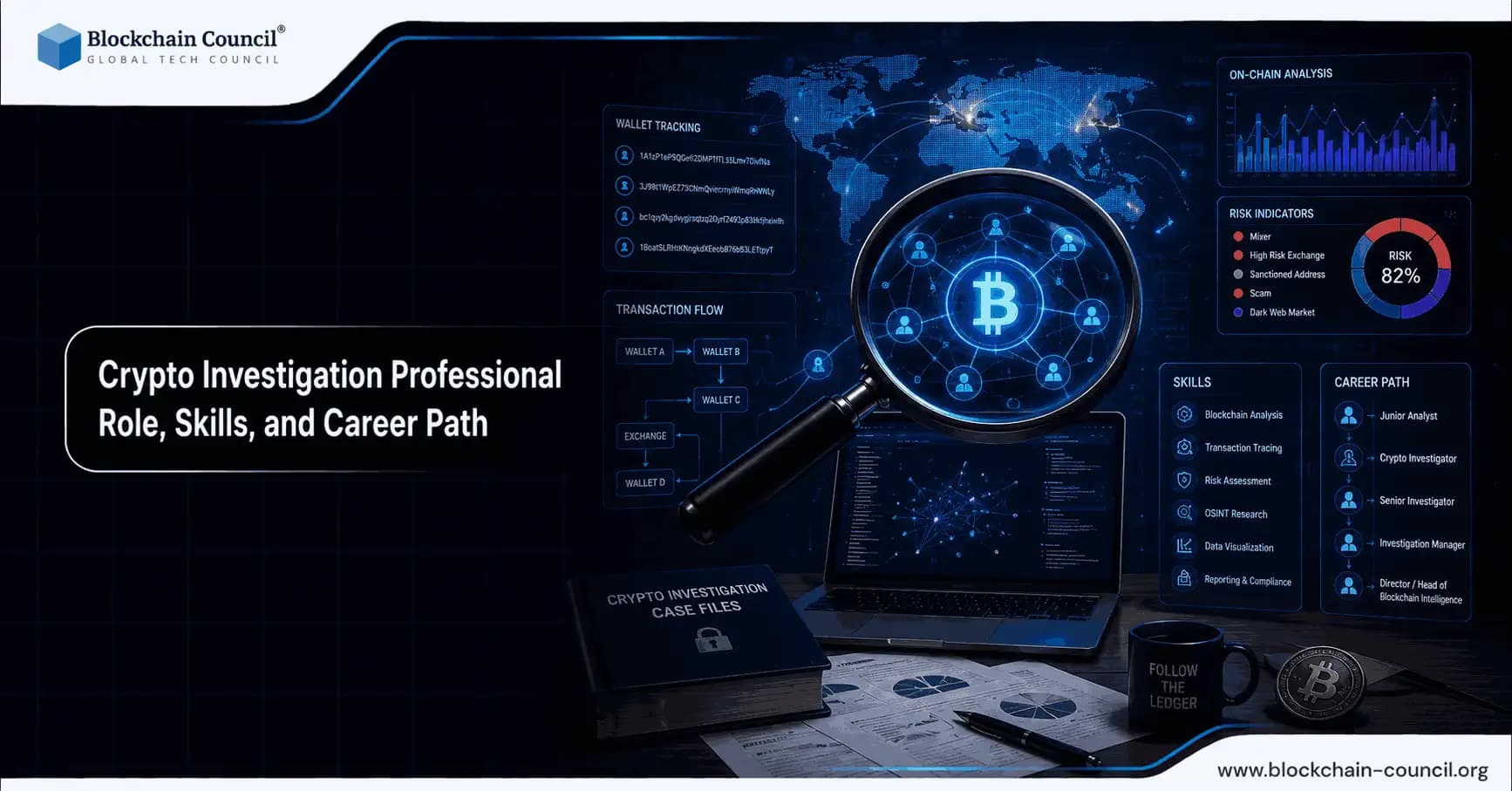
Crypto Investigation Professional has become one of the most important roles in the cryptocurrency ecosystem in 2026. As regulatory scrutiny increases and on-chain crime continues to evolve, organizations need specialists who can trace blockchain transactions, interpret crypto-specific risk signals, and produce defensible findings for compliance teams, regulators, and law enforcement. Explore the role of a crypto investigation professional in 2026 including blockchain forensics, OSINT analysis, wallet tracing, and fraud detection by building expertise through a Cyber Security Expert, automating crypto investigation workflows using a Python certification, and building a professional blockchain security career with a Digital marketing course.
This article explains what a Crypto Investigation Professional does, the tools and skills employers expect in 2026, and a practical career path for entering and advancing in blockchain forensics.

What is a Crypto Investigation Professional?
A Crypto Investigation Professional specializes in blockchain forensics and transaction tracing to identify suspicious activity, support fraud investigations, and help recover stolen assets. The work typically involves analyzing cryptocurrency flows across wallets, exchanges, DeFi protocols, bridges, and mixers, then converting technical evidence into clear, auditable reports.
In 2026, the role is no longer a niche specialty. It has become a core function across exchanges, custodians, compliance teams, analytics vendors, and Web3 security groups, driven by:
Higher regulatory expectations, including expanded transaction monitoring and reporting obligations under frameworks like the EU MiCA regime and U.S. Bank Secrecy Act updates.
Growing on-chain crime volumes, with industry reporting estimating $20 to $25 billion in illicit activity in 2025, a majority of which flows through DeFi pathways.
Rising incident response needs, as crypto thefts reached approximately $3.7 billion in 2025 according to Chainalysis reporting cited widely across the industry.
AI adoption in Web3, where AI-driven monitoring and auditing tools accelerate detection but still require human investigators to validate outputs and contextualize evidence.
Core Responsibilities in 2026
Day-to-day work varies by employer - exchange, law enforcement, or private consulting - but most Crypto Investigation Professionals handle a combination of technical analysis and compliance communication.
1) Trace and Attribute On-Chain Activity
Investigators map transaction flows to identify the source of funds, intermediate hops, and exit points. Typical tasks include:
Using block explorers and analytics platforms to follow transfers across addresses and smart contracts.
Applying attribution heuristics and clustering approaches, such as common input ownership in UTXO chains.
Identifying behavioral patterns that suggest laundering, peel chains, or rapid bridge hopping.
2) Investigate Hacks, Scams, and DeFi Exploits
Post-incident investigations often require correlating on-chain evidence with off-chain indicators such as phishing infrastructure, compromised keys, or social engineering patterns. DeFi-specific work includes:
Understanding how liquidity pools, routers, and lending protocols affect fund movement.
Analyzing exploit transactions to isolate the vulnerability path and stolen asset routes.
Coordinating with exchanges or token issuers to support asset freezes where possible.
3) Support AML, KYC, Sanctions, and Regulatory Reporting
In many organizations, the Crypto Investigation Professional sits at the intersection of security and compliance. Responsibilities often include:
Reviewing suspicious activity alerts and escalating cases with clear rationale.
Supporting AML and KYC investigations with on-chain evidence.
Preparing regulator-ready documentation aligned to expectations from agencies such as the SEC, FinCEN, and similar authorities globally.
4) Validate AI-Assisted Findings
AI can surface anomalies in transaction graphs and cluster relationships faster than manual methods, but outputs still require verification. In 2026, many teams expect investigators to:
Review false positives and validate the chain of evidence.
Explain model-driven alerts in plain language for auditors and regulators.
Use AI tools responsibly without exposing sensitive case context.
Tools and Workflows Used by Crypto Investigators
Crypto investigation is a tool-assisted discipline. Employers typically look for comfort across explorers, analytics platforms, and security tooling.
Common Investigation Tooling
Block explorers and dashboards: Etherscan and other chain-specific explorers, plus analytics dashboards like Dune for custom queries and monitoring.
Blockchain analytics platforms: Tools such as Chainalysis Reactor, Crystal Blockchain, and Elliptic for graphing, attribution, and case management.
Data tooling: SQL and scripting to pull, normalize, and analyze transaction data at scale.
Smart contract and security tooling: Slither, MythX, and related analyzers to support exploit investigations and contract risk assessment.
Cross-Chain and Modular Complexity
Investigations increasingly span multiple networks. Bridges, rollups, and modular blockchain stacks add complexity because value can move across layers and data availability environments. Investigators must be able to:
Track assets across bridges and canonical token mappings.
Understand chain-specific primitives and log structures.
Document assumptions carefully when on-chain visibility differs by network.
Essential Skills for a Crypto Investigation Professional
Hiring trends in 2026 show strong demand for professionals who combine crypto-native technical skills with traditional compliance rigor. Industry recruiters consistently note a shortage of candidates who can do both well, with the global pool of deep hybrid expertise estimated at only a few thousand people.
Technical Skills
Blockchain fundamentals: transactions, mempools, fees, confirmations, account vs. UTXO models, and token standards.
Transaction graph analysis: tracing, entity clustering, and interpreting contract interactions.
Smart contract literacy: reading Solidity, interpreting events, and understanding common exploit categories.
Basic cryptography concepts: hashing, signatures, key management risks, and wallet types.
Analytical and Data Skills
Data analysis and pattern recognition across large transaction datasets.
SQL and scripting to automate repetitive analysis and build internal tooling.
Financial investigation mindset, including flow-of-funds narratives and typology-based reasoning.
Compliance and Regulatory Knowledge
AML and KYC frameworks and how they map onto crypto transaction monitoring.
Sanctions screening and risk scoring, plus documentation standards.
Regulatory awareness of frameworks such as MiCA and U.S. reporting expectations under FinCEN guidance and Bank Secrecy Act obligations.
Communication Skills
Report writing: clear, reproducible steps and auditable evidence chains.
Stakeholder communication: explaining uncertainty, confidence levels, and analytical limitations.
Collaboration under pressure during active incident response windows.
Real-World Examples of Crypto Investigations
Reviewing past cases helps clarify the practical scope of the role.
Ronin Bridge hack investigations: Public reporting describes how investigators traced stolen funds attributed to the Lazarus Group, enabling freezes of a meaningful portion of assets through attribution and coordination with centralized venues.
FTX collapse litigation work: Forensic professionals supported the tracing of commingled assets across wallets and entities, helping inform recovery and prosecution efforts documented in court filings.
DeFi exploit response in 2025: Many cases involved a combination of smart contract analysis and tracing stolen assets through mixers and exchange off-ramps, where investigators provided actionable leads for compliance teams.
Career Path: How to Become a Crypto Investigation Professional
Many professionals enter from cybersecurity, financial compliance, data analytics, or software engineering. In 2026, employers typically hire for core fundamentals combined with demonstrable casework skills.
Step 1: Build On-Chain Literacy (0 to 3 Months)
Learn how transactions, tokens, and common DeFi protocols work.
Practice tracing simple flows on a public explorer and documenting your findings.
Build a working glossary of key patterns: bridges, mixers, peel chains, dusting, and phishing drains.
A structured foundation in blockchain fundamentals and cryptocurrency concepts, followed by a security track, provides a reliable starting point for this stage.
Step 2: Add Investigations and Security Basics (3 to 9 Months)
Learn transaction graph concepts and experiment with analytics dashboards such as Dune queries.
Study smart contract vulnerabilities and run static analysis tools like Slither on open-source code.
Develop an attacker mindset. Penetration testing fundamentals often improve exploit interpretation.
Relevant certification pathways include credentials in blockchain security and forensics, as well as role-adjacent qualifications such as Certified Ethical Hacker (CEH) preparation tracks.
Step 3: Build a Portfolio That Proves Capability (6 to 18 Months)
Because investigations are evidence-driven, a portfolio carries real weight with employers. Strong signals include:
Write-ups of anonymized tracing exercises with reproducible, step-by-step documentation.
Open-source contributions such as DAO security reviews or tooling improvements.
Participation in bug bounty programs and incident post-mortem analysis.
Step 4: Land an Entry Role and Specialize (0 to 2 Years on the Job)
Entry roles typically sit within compliance operations, fraud, or security analytics. Reported compensation for entry-level investigators ranges roughly from $80,000 to $120,000 annually, varying by region and employer type.
Early specialization options include:
Exchange investigations focused on AML and sanctions casework.
Incident response for DeFi hacks and protocol security teams.
Analytics vendor roles supporting multiple clients across jurisdictions.
Step 5: Grow into Mid-Level and Senior Roles (2 to 5+ Years)
Mid-level professionals typically lead complex cases and develop internal investigation playbooks. Reported compensation for mid-level roles commonly ranges from approximately $150,000 to $250,000, with senior investigators at leading analytics firms potentially exceeding $300,000 including bonuses, depending on scope and location.
Senior growth areas in 2026 and beyond include:
Cross-chain tracing across bridges, Layer 2 networks, and modular stacks.
AI-assisted investigations that combine model outputs with human-verifiable evidence chains.
Regulatory leadership, translating technical risk into policy-aligned controls.
Future Outlook for Crypto Investigation Careers
Multiple hiring trend analyses point to rapid growth in crypto security and compliance roles through 2026, with figures commonly cited around 40% year-over-year growth in 2025 to 2026 for related job categories. The blockchain analytics market is projected to reach roughly $2.5 billion by 2026, reflecting increasing demand for monitoring and investigation capabilities.
Looking ahead, routine tracing will become more automated, but that does not eliminate the role. It shifts the focus toward higher-value work:
Designing investigation-ready controls for protocols and exchanges.
Handling edge cases involving advanced obfuscation, complex cross-chain routes, and novel DeFi primitives.
Communicating defensible conclusions under evolving global regulatory standards.
Conclusion
A Crypto Investigation Professional in 2026 is part forensic analyst, part compliance specialist, and part security thinker. The best investigators combine on-chain technical depth with strong reporting discipline and a clear understanding of how regulators evaluate risk. With on-chain crime still significant, DeFi growing more complex, and AI-driven monitoring becoming standard, the career path offers substantial opportunities for professionals who build verifiable skills and case-based portfolios.
A reliable route into the field starts with blockchain fundamentals, adds security and smart contract literacy, and then builds toward an investigations portfolio. Targeted certifications and training in blockchain security and forensics can signal credibility to employers and accelerate progression into specialized roles. Learn the tools, certifications, and technical skills required to become a crypto investigation professional specializing in blockchain intelligence and digital forensics by mastering cryptocurrency ecosystems through a Cryptocurrency Expert, developing forensic investigation platforms using a Node JS Course, and growing your presence in the Web3 security industry using an AI powered marketing course.
Related Articles
View All
Cryptocurrency
Career in Crypto Asset Recovery: Skills, Roles, and Opportunities
Explore a career in crypto asset recovery, including key skills, job roles, salary signals, and practical steps to enter blockchain forensics and compliance.

Cryptocurrency
The Role of AI in Detecting Crypto Fraud, Scams, and Money Laundering
AI helps detect crypto fraud, scams, and money laundering through transaction monitoring, anomaly detection, graph analysis, and explainable risk scoring.

Cryptocurrency
Common Crypto Tax Mistakes and How to Avoid Them in 2026
Avoid common crypto tax mistakes with better records, correct cost basis, income classification, and preparation for Form 1099-DA reporting.
Trending Articles
What is AWS? A Beginner's Guide to Cloud Computing
Everything you need to know about Amazon Web Services, cloud computing fundamentals, and career opportunities.
Claude AI Tools for Productivity
Discover Claude AI tools for productivity to streamline tasks, manage workflows, and improve efficiency.
How to Install Claude Code
Learn how to install Claude Code on macOS, Linux, and Windows using the native installer, plus verification, authentication, and troubleshooting tips.