

Enterprise Digital Asset Strategy: Choosing Between Public Chains, Permissioned Ledgers, and Hybrid Models
 Suyash Raizada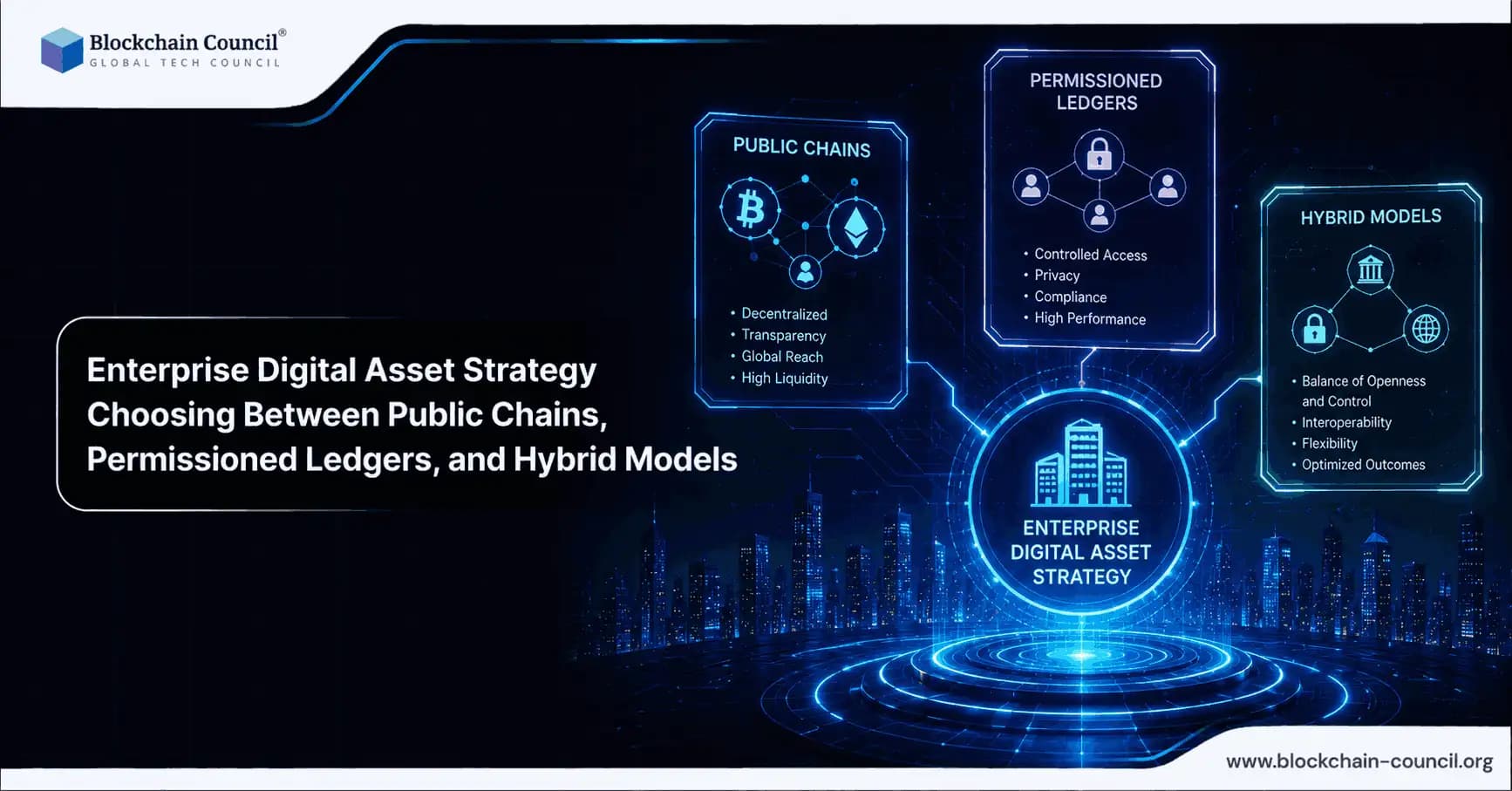
An effective enterprise digital asset strategy starts with one foundational decision: where should assets live and move? Public blockchains offer global reach and liquidity, permissioned ledgers deliver governance and privacy, and hybrid models combine both to meet real enterprise requirements like compliance, scalability, and interoperability. This guide explains how to evaluate and choose between public chains, permissioned ledgers, and hybrid models using current enterprise deployments and emerging standards.
Why Chain Selection Matters for an Enterprise Digital Asset Strategy
Digital assets extend well beyond cryptocurrencies. In enterprise contexts, they include tokenized cash and deposits, repos and collateral, invoices, supply chain records, carbon instruments, and NFTs representing intellectual property or rights. The ledger model you choose will shape:

Privacy and confidentiality for business data, counterparties, and pricing
Regulatory posture including AML expectations and auditability
Liquidity and market access for assets that benefit from broader participation
Operational scalability and integration with existing systems
Interoperability across networks, vendors, and jurisdictions
Gartner's 2023 Impact Radar projected blockchain as a high-impact enterprise adoption enabler over a one-to-three-year horizon, with hybrid flexibility cited as a key driver. In practice, many enterprises now treat the network decision as a portfolio choice rather than a search for a single winning platform. Understand how digital asset strategies align blockchain architecture with enterprise security, transaction privacy, and operational efficiency by mastering enterprise blockchain systems through a Certified Blockchain Expert, building blockchain integration platforms using a Node JS Course, and scaling digital asset initiatives using an AI powered marketing course.
Option 1: Public Blockchains for Liquidity and Shared Trust
Public chains such as Ethereum are open networks where anyone can read data and submit transactions, subject to protocol rules. For an enterprise digital asset strategy, public chains are compelling when an asset benefits from broad distribution and composability.
Strengths of Public Chains
Immutability and transparency that support strong audit trails and shared truth across organizations
Liquidity access via global markets, wallets, and exchanges
Developer ecosystem with mature tooling, established standards, and proven security practices
Composability with established token standards and onchain applications
Primary Constraints
Data exposure risk: sensitive commercial details may leak through transaction metadata
Compliance complexity: regulated workflows require identity controls and monitoring layered onto open infrastructure
Cost and performance variability: fees and throughput can fluctuate with network demand
Confidential Assets: Making Public Chains More Enterprise-Ready
One significant development is the rise of confidential assets, which use cryptography to conceal transaction details such as amounts or asset types while preserving verifiability. Chainlink has described confidential assets as a pathway to auditable privacy, aligning enterprise privacy needs with compliance expectations. This approach pairs encrypted transaction data with identity layers that support verification without disclosing sensitive information on the public ledger.
Practical takeaway: public chains are no longer strictly transparent or nothing. For certain use cases, privacy-enhancing cryptography combined with identity controls can satisfy enterprise requirements while preserving access to public liquidity.
Option 2: Permissioned Ledgers for Governance, Privacy, and Regulatory Tailoring
Permissioned ledgers, including platforms like Hyperledger Fabric and Corda, restrict participation to approved entities. They are a natural fit when you need controlled access, defined governance, and customizable rules.
Strengths of Permissioned Ledgers
Privacy by design through restricted membership and selective data sharing
Custom governance to define roles, transaction policies, and operational controls
Regulatory alignment where jurisdiction-specific requirements can be implemented at the network layer
Integration flexibility for enterprise identity and access management, key management, and workflows
Primary Constraints
Limited liquidity compared to public markets, particularly for assets that benefit from broad distribution
Network fragmentation: separate consortia can become silos without interoperability planning
Onboarding friction: membership approval requirements can slow ecosystem growth
Financial Markets View: Connected Networks Over Single-Network Debates
R3 has emphasized that the more important question is not public versus permissioned, but interoperability. In regulated markets, permissioned distributed ledger technology can optimize value flow while tailoring compliance. Those benefits scale when networks can connect, enabling asset mobility without vendor lock-in.
Option 3: Hybrid Models That Combine Public Scale with Permissioned Control
Hybrid architectures connect permissioned ledgers with public blockchains, or combine multiple networks, to place data and value where they fit best. Hart Montgomery, CTO at the Hyperledger Foundation, has argued that enterprises can use hybrid systems to tap public scalability and liquidity while retaining control and privacy where needed. Interoperability tools such as Hyperledger Cacti support cross-chain transactions without requiring a new standalone blockchain.
Why Hybrids Are Gaining Traction
Selective disclosure: keep sensitive workflows private while anchoring proofs or settlement on public networks
Asset portability: move or reference assets across ecosystems spanning partners, jurisdictions, and markets
Reduced silo risk: avoid trapping value in a single consortium network
Phased adoption: start with a permissioned core, then expose assets to public liquidity as controls mature
Real-World Hybrid Deployments
Blockchain for Energy (B4E) launched a production-grade platform using Kaleido and Hyperledger FireFly to support Web3 features across public and private chains. The platform tracks chemical deliveries using industrial IoT and blockchain, demonstrating how hybrid architecture can support consortium operations while enabling broader interoperability.
IPwe deployed 25 million patent NFTs on a Hyperledger Fabric and Casper hybrid, targeting an intellectual property liquidity gap where roughly 95% of IP assets are not transacted or commercialized. The hybrid approach enables controlled enterprise workflows while leveraging public chain properties for broader utility.
Fnality and HQLAX conducted a cross-chain repo swap pilot bridging Corda with Enterprise Ethereum, enabling more efficient collateral mobility and intraday settlement flows. This illustrates a common hybrid pattern in capital markets: permissioned rails for regulated processes connected to broader settlement networks.
DLA Piper's TOKO platform integrates Hyperledger Fabric and Hedera for tokenization of assets such as real estate, art, debt, and intellectual property, targeting faster settlement while maintaining enterprise-grade controls.
How to Choose: A Decision Framework for Enterprises
Use the following criteria to map use cases to an appropriate architecture. Many organizations end up with a hybrid reference architecture even when the first deployment is single-network.
1. Privacy and Confidentiality Requirements
High confidentiality (pricing, counterparties, regulated data): permissioned or hybrid with private execution
Moderate confidentiality with cryptographic privacy: public chain with confidential assets and identity controls
Low confidentiality or public-by-default records: public chain
2. Liquidity and Distribution Goals
If an asset requires broad market access, composability, or global distribution, public or hybrid architectures are generally preferred.
If an asset is primarily intra-consortium and depends on negotiated governance, a permissioned network can be sufficient.
3. Regulatory and Compliance Posture
Permissioned networks simplify controlled participation and tailored compliance controls.
Public networks typically require additional layers for identity management, monitoring, and policy enforcement.
Hybrid models support regulated workflows privately while still enabling public settlement or proof anchoring.
4. Interoperability and Lock-In Risk
If you anticipate multi-network operations, design for interoperability early using standard interfaces and cross-chain tooling.
Consider frameworks like Hyperledger Cacti for connecting networks without rebuilding core systems.
5. Integration with Legacy Systems
The World Economic Forum has highlighted that distributed ledger adoption often faces a chicken-and-egg problem, where benefits increase with participation but participation requires proven benefits. Enterprises should plan API-based integration with existing systems and stage rollouts to reduce parallel infrastructure costs.
Implementation Roadmap for an Enterprise Digital Asset Strategy
Define asset scope: what is being tokenized, what rights transfer, and what data must remain confidential?
Choose a governance model: consortium rules, onboarding procedures, node operations, and dispute processes.
Decide the execution and settlement split: private execution with public settlement, or permissioned settlement with public proofs.
Design identity and compliance layers: KYC/AML workflows, policy checks, audit trails, and travel rule-aligned processes where applicable.
Plan interoperability: define cross-chain message standards, bridge policies, and operational monitoring.
Address security and resilience: key management, access control, incident response, and smart contract assurance.
Learn how enterprises choose between public blockchains, permissioned ledgers, and hybrid architectures based on scalability, governance, compliance, and interoperability requirements by building expertise through a Certified Blockchain Expert, analyzing blockchain performance and operational data using a Python certification, and driving enterprise blockchain adoption with a Digital marketing course.
Conclusion: Hybrids and Auditable Privacy Are Shaping the Next Phase
Public chains bring strong liquidity and shared trust but can expose enterprise-sensitive information. Permissioned ledgers provide privacy, governance, and regulatory tailoring but can limit network effects and create silos. A modern enterprise digital asset strategy increasingly favors hybrid models that connect the strengths of both, supported by interoperability tools and privacy-preserving cryptography.
As hybrid deployments mature and confidential assets move toward auditable privacy on public networks, enterprises can design digital asset systems that are compliant, scalable, and interoperable without sacrificing confidentiality. The strongest strategies rarely center on a single network choice. They reflect an architecture that places each part of the workflow on the network where it performs best, while ensuring assets and data can move securely across boundaries.
FAQs
1. What is an enterprise digital asset strategy?
An enterprise digital asset strategy defines how a business creates, manages, transfers, and protects tokenized assets. It also decides whether assets should use public chains, permissioned ledgers, or hybrid models. This choice affects privacy, compliance, liquidity, and scalability.
2. Why does chain selection matter for enterprises?
Chain selection shapes how digital assets move, who can access them, and how transactions are verified. It also affects regulatory compliance, privacy, and system performance. Choosing poorly is a splendid way to build expensive problems.
3. What are enterprise digital assets?
Enterprise digital assets can include tokenized cash, invoices, collateral, supply chain records, carbon credits, and intellectual property rights. They are not limited to cryptocurrencies. Businesses use them to improve settlement, tracking, and ownership management.
4. What is a public blockchain?
A public blockchain is an open network where anyone can read data and submit transactions. Ethereum is a common example of this model. Public chains offer transparency, liquidity, and broad ecosystem access.
5. What are the benefits of public blockchains?
Public blockchains provide global reach, shared trust, and access to large markets. They also support mature developer tools and token standards. This makes them useful for assets that need liquidity and broad participation.
6. What are the risks of public blockchains?
Public chains may expose sensitive transaction details through visible data or metadata. They can also create compliance challenges for regulated businesses. Fees and performance may vary depending on network demand.
7. What are confidential assets?
Confidential assets use cryptographic methods to hide sensitive details while keeping transactions verifiable. They can protect information such as amounts, asset types, or counterparties. This helps public chains become more suitable for enterprise use.
8. What is a permissioned ledger?
A permissioned ledger is a blockchain-style network where only approved participants can join. Platforms like Hyperledger Fabric and Corda follow this model. They are useful when privacy, governance, and controlled access are priorities.
9. What are the benefits of permissioned ledgers?
Permissioned ledgers offer stronger privacy, defined governance, and customized compliance controls. Enterprises can manage roles, permissions, and data-sharing rules more directly. This makes them attractive for regulated or consortium-based workflows.
10. What are the limits of permissioned ledgers?
Permissioned ledgers may have lower liquidity than public blockchains. They can also become isolated if interoperability is not planned early. Onboarding new participants may take longer because access is controlled.
11. What is a hybrid blockchain model?
A hybrid model combines public blockchains and permissioned ledgers in one architecture. Sensitive activity can stay private while proofs or settlement connect to public networks. This gives enterprises more flexibility without pretending one system solves everything.
12. Why are hybrid models gaining popularity?
Hybrid models help enterprises balance privacy, liquidity, compliance, and interoperability. They allow private workflows while still accessing public market benefits. This approach reduces the risk of being trapped in one network.
13. How do hybrid models support privacy?
Hybrid systems can keep confidential business data on private networks. They may place only proofs, references, or settlement records on public chains. This protects sensitive information while maintaining auditability.
14. How do public chains support liquidity?
Public chains connect assets to global users, wallets, exchanges, and decentralized applications. This can improve asset distribution and market access. Liquidity is especially important for assets designed for broad participation.
15. Why is interoperability important?
Interoperability allows assets and data to move across different networks and platforms. Without it, enterprises may create isolated systems with limited usefulness. Cross-chain tools help reduce vendor lock-in and improve asset mobility.
16. How should enterprises choose between public and permissioned networks?
Enterprises should compare privacy needs, liquidity goals, compliance duties, and integration requirements. Public chains suit broad access, while permissioned ledgers suit controlled participation. Many businesses may need a hybrid design.
17. What role does compliance play in digital asset strategy?
Compliance affects identity checks, transaction monitoring, audit trails, and reporting requirements. Permissioned networks can simplify some controls, while public chains need extra compliance layers. Hybrid systems can combine private compliance workflows with public settlement.
18. Why is legacy system integration important?
Enterprises rarely replace all existing systems at once, because apparently chaos has a budget limit. Digital asset platforms must connect with current databases, APIs, identity tools, and workflows. Careful integration reduces cost and operational disruption.
19. What should an implementation roadmap include?
A roadmap should define asset scope, governance rules, identity controls, settlement design, interoperability, and security processes. It should also address key management and incident response. Clear planning lowers implementation risk.
20. What is the main takeaway for enterprise digital asset strategy?
Enterprises should not treat public chains, permissioned ledgers, and hybrid models as one-size-fits-all choices. The best strategy places each workflow on the network where it performs best. Hybrid models are increasingly useful for balancing privacy, compliance, liquidity, and scalability.
Related Articles
View All
Cryptocurrency
Crypto Asset Protection: Best Practices to Secure Your Digital Wealth
Learn practical crypto asset protection steps for wallets, keys, MFA, multi-sig, legal structures, estate planning, records, and incident response.

Cryptocurrency
Crypto Asset Recovery Explained: How to Recover Lost or Stolen Digital Assets
Learn how crypto asset recovery works, what can realistically be recovered, and how to avoid recovery scams after digital asset theft or loss.

Cryptocurrency
NFTs Explained: Digital Ownership, Collectibles, and Token Standards
NFTs explained through digital ownership, collectibles, ERC-721, ERC-1155, royalties, legal rights, use cases, and practical risks for Web3 professionals.
Trending Articles
AWS Career Roadmap
A step-by-step guide to building a successful career in Amazon Web Services cloud computing.

Top 5 DeFi Platforms
Explore the leading decentralized finance platforms and what makes each one unique in the evolving DeFi landscape.

Can DeFi 2.0 Bridge the Gap Between Traditional and Decentralized Finance?
The next generation of DeFi protocols aims to connect traditional banking with decentralized finance ecosystems.