

Tokenization 101 for Digital Assets Experts: Turning Real-World Assets Into On-Chain Tokens
 Suyash Raizada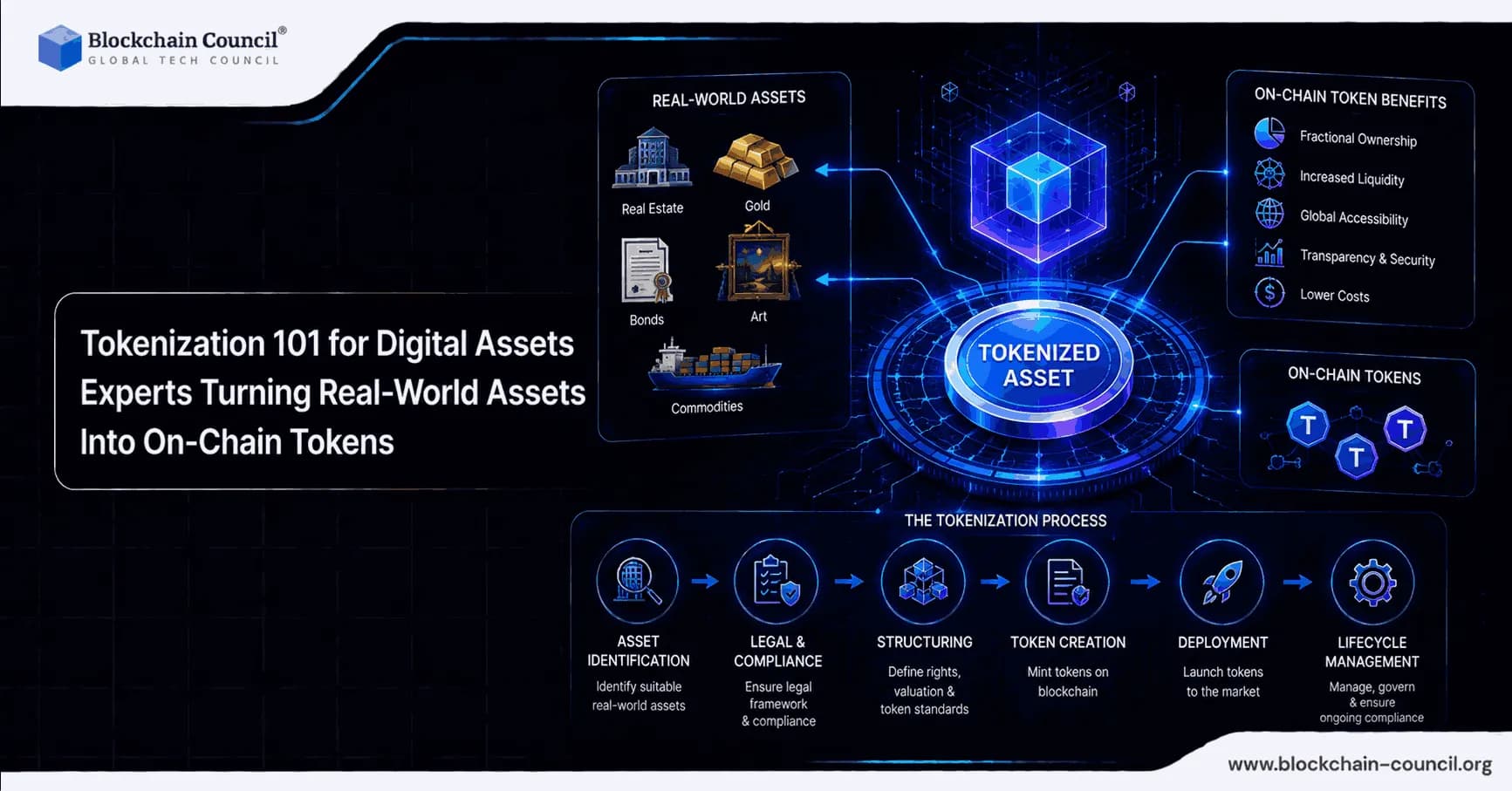
Asset tokenization is the process of converting ownership rights in real-world assets (RWAs) such as real estate, art, private credit, or collectibles into blockchain-based tokens. For digital assets experts, tokenization goes beyond digitizing records. It introduces programmability and composability, meaning tokenized assets can interact directly with smart contracts, wallets, exchanges, and DeFi protocols as native on-chain instruments.
This shift is increasingly institutional. Industry analyses from firms like McKinsey and Boston Consulting Group have projected tokenized assets could reach as much as $16 trillion by 2030, rising from roughly $300 billion in 2024. On-chain analytics dashboards such as Dune and DefiLlama have tracked real-world asset TVL exceeding $5 billion in Q1 2026, reflecting accelerating adoption across tokenized Treasuries, private credit, and funds.

What Is Asset Tokenization (and Why It Is Not Just Digitization)?
In traditional finance, asset ownership lives in fragmented databases: registrars, custodians, transfer agents, brokers, and internal ledgers. Tokenization moves those ownership rights onto a blockchain where:
Ownership is represented by tokens that can be transferred subject to compliance rules.
Rules are programmable via smart contracts, covering transfer restrictions, distributions, whitelisting, and voting.
Assets become composable, meaning they can connect to other on-chain systems such as lending, trading, collateral management, and automated settlement.
Tokenization is increasingly described as a re-architecture of financial market infrastructure. It turns assets into cryptographically secured, bearer-like instruments that can move and settle at internet speed, rather than relying on slow reconciliation between institutions. Learn how tokenization converts real-world assets like real estate, commodities, and securities into blockchain-based digital tokens by building expertise through a Certified Blockchain Expert, analyzing tokenized asset systems using a Python certification, and scaling Web3 business opportunities with a Digital marketing course.
How Tokenization Works: A Step-by-Step Framework
Tokenizing a real-world asset requires careful coordination across legal, technical, operational, and compliance layers. A common lifecycle looks like this:
Valuation and legal structuring
Appraise the underlying asset, whether property, artwork, bond, or fund interest.
Define token holder rights through a legal wrapper, often a special purpose vehicle (SPV) or trust.
Specify economic rights covering cash flows, redemption terms, governance, and transferability.
Token issuance on-chain
Deploy smart contracts on a chosen blockchain such as Ethereum or Avalanche.
Define token standards and logic for compliance controls including whitelists, jurisdiction checks, and lockups.
Mint tokens representing full or fractional ownership.
Custody and distribution
Secure the real-world asset off-chain under regulated custody or controlled storage.
Distribute tokens in a primary issuance to eligible investors.
Enable secondary trading where permitted, typically on regulated venues or permissioned pools.
Ongoing servicing and administration
Net asset value (NAV) calculation, reporting, audits, and investor communications.
Compliance operations such as AML/KYC refreshes, transfer approvals, and sanctions screening.
Lifecycle management covering corporate actions, distributions, redemptions, and upgrades.
Administration is frequently underestimated. In practice, strong servicing, reconciliation, and compliance processes determine whether tokenization delivers institutional-grade reliability.
Key Benefits of Tokenizing Real-World Assets
1) Liquidity Through Fractionalization
Many RWAs are naturally illiquid. Tokenization can enable fractional ownership and secondary transferability, converting assets that were difficult to trade into instruments that can be bought and sold in smaller units. Trust firms and tokenization platforms frequently highlight use cases where asset owners gain liquidity without fully divesting legacy holdings.
2) Faster Settlement and Lower Operational Cost
Industry research commonly cites significant efficiency improvements by embedding business logic in smart contracts, reducing manual reconciliation, and lowering operational errors. Settlement can approach near-instant finality depending on the chain and venue, supporting 24/7 markets.
3) Programmable Compliance and Governance
Security token designs can embed compliance controls such as transfer restrictions, investor eligibility checks, lockups, and jurisdiction-specific rules. Governance features including voting and disclosures can be implemented directly in smart contracts, enabling transparent and auditable processes.
4) Composability with DeFi and On-Chain Capital Markets
Composability is where tokenization becomes structurally distinct from traditional digitization. Tokenized Treasuries, money market fund tokens, or private credit positions can serve as collateral, integrate into liquidity pools, or swap atomically with stablecoins. This reduces settlement and counterparty complexity while enabling new financial primitives.
Use Cases: From Art and Real Estate to Institutional Funds
Tokenization has expanded beyond pilot experiments into production deployments across multiple asset categories.
Art and Collectibles
A widely cited model involves a high-value painting tokenized into thousands of fractional units, allowing partial monetization while the original owner retains custody and cultural continuity. Similar approaches apply to rare wines and luxury collectibles, where tokenization can open access to previously gated markets.
Real Estate Tokenization
Real estate is a natural fit for tokenization because assets are high value, typically illiquid, and subject to slow transaction processes. Tokenization can represent fractional ownership in a single property or in a portfolio held by an SPV, enabling diversified exposure and alternative financing structures. Developers can explore raising capital through programmable issuance rather than relying solely on traditional bank lending, while still requiring robust legal and compliance frameworks.
Tokenized Funds and Cash Equivalents
Institutional activity has grown with tokenized money market funds and tokenized fund shares that support intraday settlement and 24/7 transferability. Several deployments have surpassed $500 million in tokenized assets during early production phases, reflecting strong demand for tokenized cash-like instruments in on-chain workflows.
Financial Instruments: Treasuries, Private Credit, and Venture Exposure
Tokenized U.S. Treasuries and private credit have become core RWA categories on-chain, particularly as collateral candidates in lending markets. The ability to perform atomic swaps, for example exchanging a tokenized Treasury position with a stablecoin in a single coordinated transaction, is frequently cited as a structural advantage for settlement and risk reduction.
Credentials and Inclusive Finance
Tokenization can also represent verified credentials such as diplomas, driver licenses, and KYC attestations. Development and policy experts have noted that bringing trusted credentials on-chain can improve portability and financial inclusion, since identity and property rights are foundational to accessing financial services.
Technology and Design Considerations for Digital Assets Experts
Choosing a Blockchain: Permissionless vs. Permissioned
Tokenization stacks often choose between permissionless networks, which offer broad composability and open liquidity, and permissioned environments, which provide tighter access control and tailored governance. Many production deployments use hybrid models: assets may be issued on a public chain while transfers route through compliance-gated smart contracts or approved venues.
Oracles and Off-Chain Data
RWAs require reliable data feeds for pricing, NAV, interest accruals, and corporate actions. Oracle design is critical because the blockchain has no inherent knowledge of off-chain facts. Robust tokenization systems define:
Data sources for valuation and servicing
Update frequency for NAV and reporting
Fallback procedures when feeds fail or diverge
Custody Standards and Control of the Underlying Asset
Token holder rights only matter if the underlying asset is properly controlled and legally enforceable. Custody and legal enforceability are central design requirements, covering how the asset is stored, insured, audited, and how claims are handled under stress scenarios.
Smart Contract Risk and Upgradeability
Smart contracts create automation but also introduce new risks. Teams should plan for audits, formal testing, role-based access, incident response, and carefully designed upgrade mechanisms. Many institutional tokenization projects emphasize controlled upgrade paths that allow bug fixes while preserving investor protections.
Regulatory Momentum and What to Watch in 2026
Tokenization adoption is closely tied to regulatory clarity. The EU has advanced crypto-asset regulation through MiCA, and market participants in the United States continue pushing for clearer treatment of security tokens and tokenized securities workflows. Several jurisdictions are also exploring central bank digital money pilots and regulated settlement assets, which could strengthen tokenized asset settlement infrastructure.
For digital assets experts, the practical implication is clear: design tokenization systems with compliance as a first-class feature, not an afterthought. That includes investor onboarding, AML/KYC, transfer restrictions, reporting, and jurisdictional controls. Understand the technology, compliance, and smart contract infrastructure behind asset tokenization and on-chain ownership by mastering digital asset ecosystems through a Cryptocurrency Expert, building tokenization platforms using a Node JS Course, and promoting blockchain-based investment products using an AI powered marketing course.
Future Outlook: What Tokenization Could Unlock by 2030
Projections ranging from $10 trillion to $16 trillion in tokenized assets by 2030 appear consistently across industry research. While specific figures vary, the direction is consistent: institutional adoption, improved infrastructure, and DeFi convergence are expanding the addressable market.
Emerging growth areas include:
Carbon credits with transparent provenance and retirement tracking
IP royalties and revenue-sharing tokens
Supply chain assets and invoice tokenization
AI-assisted valuation and compliance for servicing at scale
Challenges remain, including scalability costs, interoperability, oracle reliability, and global custody standards. The long-term direction, however, points toward more assets moving from siloed ledgers onto programmable infrastructure.
Conclusion: Building Tokenization Systems That Actually Work
Asset tokenization is reshaping how ownership, settlement, and compliance operate for real-world assets. For digital assets experts, success depends on bridging two worlds: on-chain programmability and off-chain enforceability. The strongest implementations combine legal structuring, robust custody, compliant transfer logic, dependable oracles, and operational servicing such as NAV calculation and investor reporting.
FAQs
1. What is asset tokenization?
Asset tokenization is the process of converting ownership rights of real-world assets into blockchain-based tokens. These tokens can represent assets such as real estate, art, private credit, or collectibles.
2. How is tokenization different from simple digitization?
Digitization only converts records into digital form, while tokenization adds programmability and blockchain functionality. Tokenized assets can interact with smart contracts, wallets, and decentralized platforms.
3. Why is asset tokenization important?
Tokenization improves liquidity, transparency, and efficiency in asset ownership and transfer. It also enables faster settlement and broader investor participation.
4. What types of assets can be tokenized?
Assets such as real estate, artwork, private credit, bonds, collectibles, and investment funds can be tokenized. Even credentials and intellectual property rights can be represented on-chain.
5. How does asset tokenization work?
The process involves legal structuring, smart contract deployment, token issuance, custody management, and ongoing compliance operations. Every step must align with legal and technical requirements.
6. What role do smart contracts play in tokenization?
Smart contracts automate rules related to transfers, compliance, distributions, and governance. They help reduce manual processes and improve operational efficiency.
7. What is fractional ownership in tokenization?
Fractional ownership allows expensive assets to be divided into smaller tokenized shares. This makes investments more accessible to a wider range of investors.
8. Why is liquidity considered a major benefit of tokenization?
Tokenization allows traditionally illiquid assets to be traded more easily on digital platforms. Investors can buy and sell smaller portions without transferring the entire asset.
9. How does tokenization improve settlement speed?
Blockchain networks enable near-instant transaction settlement compared to traditional financial systems. This reduces delays, reconciliation work, and operational costs.
10. What is programmable compliance in tokenization?
Programmable compliance uses smart contracts to enforce rules such as investor eligibility and transfer restrictions. Apparently humans finally found a way to automate paperwork, which may be civilization’s peak achievement.
11. What is composability in blockchain tokenization?
Composability means tokenized assets can interact with DeFi platforms, lending systems, and liquidity pools. This creates new financial opportunities and automated workflows.
12. Why is real estate a strong use case for tokenization?
Real estate is often expensive, illiquid, and difficult to transfer quickly. Tokenization allows fractional ownership and more flexible investment models.
13. How are tokenized funds and Treasuries used?
Tokenized funds and Treasuries support faster settlement and 24/7 transferability. They are increasingly used as collateral and cash-equivalent instruments in blockchain ecosystems.
14. What are oracles in tokenization systems?
Oracles provide blockchain systems with external data such as pricing, NAV updates, and corporate actions. They help connect real-world information with smart contracts.
15. Why is custody important in asset tokenization?
Custody ensures the underlying asset is securely stored and legally enforceable. Without proper custody, token ownership may not have real-world value or protection.
16. What are the risks of tokenization?
Risks include smart contract vulnerabilities, regulatory uncertainty, oracle failures, and custody issues. Proper governance and auditing are necessary to reduce these risks.
17. What is the difference between permissioned and permissionless tokenization systems?
Permissionless systems offer open participation and broad accessibility, while permissioned systems restrict access to approved participants. Many organizations use hybrid models for better compliance control.
18. Why is regulatory compliance important in tokenization?
Tokenized assets often fall under financial regulations and securities laws. Compliance helps ensure lawful investor onboarding, reporting, and transaction monitoring.
19. What industries are adopting tokenization?
Finance, real estate, art, supply chain, and investment management industries are actively exploring tokenization. Adoption is growing as infrastructure and regulations improve.
20. What is the future of asset tokenization?
The future includes tokenized funds, carbon credits, intellectual property, and AI-assisted compliance systems. More assets are expected to move onto programmable blockchain infrastructure over time.
Related Articles
View All
Cryptocurrency
Cryptocurrency Wallets Explained: How to Store and Manage Digital Assets
Learn how cryptocurrency wallets work, including private keys, hot and cold storage, custodial options, MPC, account abstraction, and security best practices.

Cryptocurrency
Cryptocurrency vs Fiat Currency: How Digital Assets Compare to Traditional Money
Cryptocurrency vs fiat currency explained through control, volatility, settlement, privacy, regulation, use cases, and practical trade-offs for professionals.

Cryptocurrency
Security Tokens Explained: Digital Securities and Compliance Basics
Security tokens are regulated digital securities. Learn how tokenized equity, debt, funds, and real estate rights work with compliance rules.
Trending Articles
AWS Career Roadmap
A step-by-step guide to building a successful career in Amazon Web Services cloud computing.
What is AWS? A Beginner's Guide to Cloud Computing
Everything you need to know about Amazon Web Services, cloud computing fundamentals, and career opportunities.
Claude AI Tools for Productivity
Discover Claude AI tools for productivity to streamline tasks, manage workflows, and improve efficiency.