

Digital Asset Compliance for Experts: KYC/AML, Travel Rule, and Global Regulatory Trends
 Suyash Raizada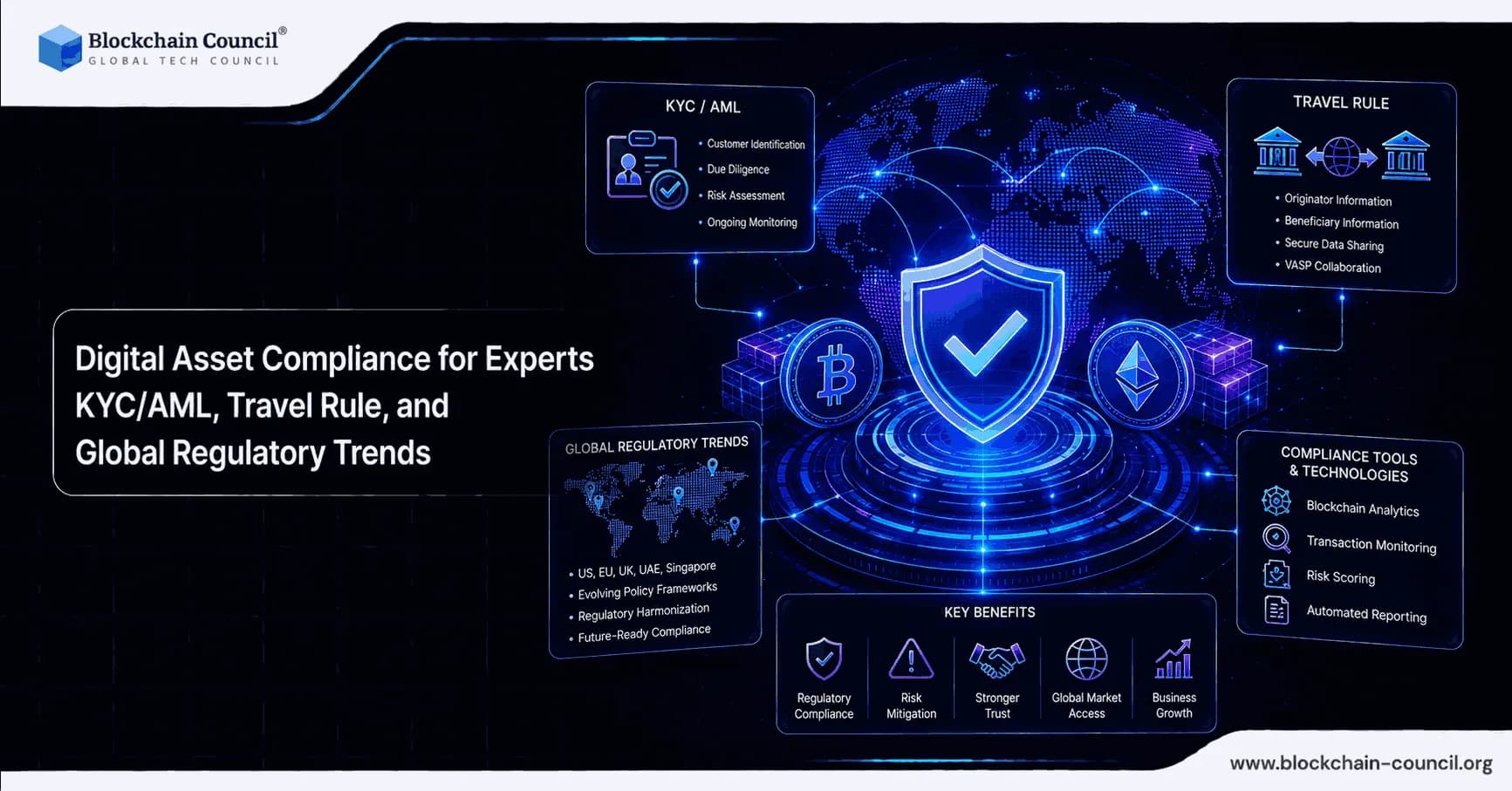
Digital asset compliance has matured from a checklist function into a core operating capability for exchanges, custodians, wallet providers, payment processors, and any business classified as a Virtual Asset Service Provider (VASP). For experts, the hard part is no longer understanding the acronyms. The challenge is designing programs that scale across jurisdictions, handle real-time data exchange, manage unhosted wallet risk, and withstand enforcement scrutiny. Understand digital asset compliance frameworks including KYC, AML regulations, Travel Rule requirements, and global crypto policy trends by building expertise through a Cyber Security Expert, automating compliance monitoring and transaction analysis using a Python certification, and implementing trusted crypto operations with a Digital marketing course.
This article breaks down how KYC/AML, the FATF Travel Rule, and the latest global regulatory trends fit together, with an emphasis on practical requirements, implementation patterns, and what is changing through 2026.

What Digital Asset Compliance Covers: KYC, AML, and the Travel Rule
Digital asset compliance is built on three interacting layers:
KYC (Know Your Customer): Identity verification and customer due diligence at onboarding and throughout the relationship.
AML (Anti-Money Laundering) controls: Ongoing monitoring, detection, reporting, and risk mitigation to prevent money laundering and terrorism financing (ML/TF).
Travel Rule compliance: Counterparty data collection and transmission during virtual asset transfers above a threshold set by the relevant jurisdiction, or at any amount in zero-threshold regimes.
KYC: Identity Is the Baseline, Not the Finish Line
KYC typically requires collecting and verifying identity attributes such as government-issued ID, proof of address, and customer information for both individuals and entities. In mature programs, KYC also includes behavioral monitoring and periodic refreshes based on risk events or time-based triggers.
For enterprise-grade programs, KYC also means:
Risk scoring at onboarding, covering geography, product, channel, and customer type.
Sanctions and PEP screening, including ongoing rescreening.
Beneficial ownership checks for entities.
AML: Monitoring, Reporting, and Control Testing
AML extends beyond onboarding into the full lifecycle of customer activity. Typical components include transaction monitoring, alert investigations, suspicious activity reporting aligned to local requirements, and documented controls that can be audited. In crypto, AML programs must also cover blockchain-specific typologies such as mixers, ransomware flows, cross-chain bridges, and high-risk exposure clusters.
Strengthened controls correlate with measurable outcomes. Crypto-related ML/TF was estimated at approximately 0.34% of total volume (around $24.2 billion in 2024), down year-over-year as KYC and Travel Rule measures expanded across major VASPs, according to widely reported crypto crime research.
Travel Rule: KYC Verifies, Travel Rule Transmits
The FATF Travel Rule originates from FATF Recommendation 16, updated to include virtual assets in 2019. It requires VASPs to collect and transmit certain originator and beneficiary information for qualifying transfers. Unlike KYC, which establishes identity for the customer relationship, the Travel Rule is a transaction-level requirement focused on data exchange between counterparties.
Required information commonly includes names and account identifiers, and depending on jurisdiction, address and national identifiers as well. The objective is traceability and interoperability with financial crime controls, similar to traditional wire transfer regimes such as those in the United States.
Global Regulatory Trends Through 2026: From Thresholds to Near-Zero Friction Data Exchange
By 2026, Travel Rule implementation has moved from uneven pilots to production-grade systems across most major VASPs, though significant global variance remains. FATF previously highlighted the so-called sunrise problem, where compliance maturity differed widely by jurisdiction and created gaps in cross-border flows. The direction since then has been toward tighter coverage, lower thresholds, and more explicit counterparty verification.
European Union: Transfer of Funds Regulation and Zero-Threshold Expectations
The EU Transfer of Funds Regulation (TFR), effective from December 2024, requires Travel Rule-style data collection and sharing for crypto transfers regardless of amount. This represents a significant shift toward a zero-threshold model. It also increases expectations around counterparty checks, risk screening, and recordkeeping, supported by guidance from EU supervisory bodies.
Operationally, the EU approach requires VASPs to implement:
End-to-end data capture even for low-value transfers.
Counterparty verification and screening workflows.
Exception handling for incomplete or mismatched beneficiary data.
United Kingdom: All Transfers in Scope, with Risk-Based Treatment for Unhosted Wallets
The UK framework enforced by the Financial Conduct Authority since September 2023 applies broadly to virtual asset transfers. A notable feature is its emphasis on taking "all reasonable steps" using a risk-based approach, especially when dealing with unhosted wallets and inbound flows from non-enforcing jurisdictions. In practice, this means stronger controls where risk is higher, rather than uniform friction across all transactions.
United States: Established Expectations, Evolving Application
In the United States, FinCEN guidance continues to treat many VASPs as money services businesses with associated AML obligations. While thresholds and reporting triggers vary by requirement, many compliance programs treat transfers above $3,000 as a common operational benchmark for Travel Rule-aligned data collection and recordkeeping in relevant scenarios. US firms also face cross-border complexity when transacting with EU counterparties operating under zero-threshold rules.
APAC and the Global Patchwork: Varying Thresholds, Converging Direction
More than 100 jurisdictions align with FATF standards, but thresholds differ, commonly around $1,000 in some markets and $3,000 in others. Regulations in jurisdictions such as South Korea and Australia reflect a broader move toward tighter and sometimes near-zero threshold models, particularly for VASPs that service retail and cross-border corridors.
How Travel Rule Compliance Works in Practice: Data Standards, APIs, and Counterparty Trust
Most mature Travel Rule implementations now rely on API-based solutions for near real-time information sharing and validation. The goal is to avoid manual outreach between compliance teams while still meeting obligations for data completeness, accuracy, and secure transmission.
IVMS 101: The Common Language for Travel Rule Data
One of the key enablers for interoperability is IVMS 101, a data standard designed to normalize identity fields such as names, identifiers, addresses, and account details so that different VASPs can exchange Travel Rule information without bespoke mapping for every counterparty.
Network and Protocol Layer: Why Interoperability Matters
Because VASPs interact with many counterparties, one-to-one integrations do not scale. Industry solutions have focused on protocol-based exchange and network discovery to determine whether the receiving entity is a compliant VASP and which endpoint to use for data transmission.
Key Implementation Components Experts Should Validate
Counterparty VASP discovery: Determine whether the destination is a regulated VASP and how to route Travel Rule data.
Encryption and secure transport: Protect personal data in transit and at rest.
Recordkeeping: Store required fields, timestamps, and transmission evidence for audits.
Sanctions screening and risk scoring: Apply both to customers and to counterparties, including geography and typology risk.
Operational resilience: Monitor for API failures, implement retry logic, and maintain fallback workflows.
Enforcement and Metrics: Why Mature Programs Prioritize Auditability
Enforcement has been a consistent driver of compliance investment. Since 2020, global fines for AML-related crypto compliance failures have exceeded $2 billion, including notable actions where deficiencies were tied to inadequate AML controls and Travel Rule gaps. The cost of remediation often includes not only penalties, but also monitorships, licensing friction, and de-risking by banking partners.
Travel Rule adoption has accelerated alongside enforcement pressure. Industry reporting suggests that by mid-2025, a large majority of major VASPs had implemented some form of Travel Rule system, up sharply from adoption levels in 2022. Regulators increasingly view non-implementation as a governance failure rather than a technical delay.
Unhosted Wallets and DeFi: The Hardest Edge of Digital Asset Compliance
Unhosted wallets, also called non-custodial wallets, create a structural challenge: there is no obvious regulated counterparty to receive Travel Rule data. This is why many programs treat unhosted wallet flows as higher risk and apply additional controls, especially for inbound transfers from high-risk jurisdictions.
A significant share of blocked or interrupted Travel Rule attempts involve unhosted wallets, leading to measures such as:
Risk-based freezes or holds pending additional verification.
Proof-of-ownership checks for wallet addresses in specific scenarios.
Enhanced due diligence (EDD) for higher-risk patterns and counterparties.
DeFi adds further complexity through smart contract interactions and cross-chain bridges. The regulatory direction suggests that safe-harbor style exemptions may narrow, and that more entities in the stack may be treated as VASPs where they provide exchange, transfer, or custody-like services.
Operational Blueprint: Building a Scalable Compliance Program for VASPs
Experts building or upgrading a digital asset compliance program typically align people, process, and technology around a risk-based model:
Map regulatory exposure: Identify where you operate, where customers are located, and which jurisdiction governs each flow, including EU TFR implications.
Define your risk taxonomy: Customer risk, product risk, geography risk, channel risk, and transaction typology risk.
Integrate KYC/AML tooling with Travel Rule messaging: Avoid fragmented systems that cannot reconcile customer identity, transaction context, and counterparty data.
Implement robust exception handling: Missing beneficiary data, VASP discovery failures, and unhosted wallet flows each require documented playbooks.
Design for auditability: Maintain evidence of controls, model governance for monitoring rules, and clear data retention policies.
Learn how digital asset businesses maintain regulatory compliance using blockchain analytics, identity verification, and transaction monitoring systems by mastering crypto governance through a Cryptocurrency Expert, developing compliance automation platforms using a Node JS Course, and scaling compliant blockchain services using an AI powered marketing course.
Future Outlook: Toward Convergence, Automation, and Cross-Chain Controls
Looking ahead, tighter convergence toward FATF-aligned implementation is widely expected, with more jurisdictions moving to zero- or low-threshold Travel Rule coverage using frameworks similar to the EU approach and MiCA-era compliance expectations. AI-driven monitoring is also expected to expand, with higher automation rates for alert triage, typology detection, and adverse media enrichment, while maintaining human oversight for high-risk escalations.
For VASPs, the strategic implication is clear: competitive advantage will come from compliance architectures capable of handling massive throughput, secure data exchange, and multi-jurisdiction reporting without degrading user experience or introducing uncontrolled operational risk.
Conclusion
Digital asset compliance in 2026 is defined by the interplay of KYC/AML foundations and Travel Rule execution at scale. KYC verifies identities, AML monitors behavior, and the Travel Rule ensures that key originator and beneficiary data travels with the transaction across VASP boundaries. With the EU enforcing zero-threshold requirements, the UK applying risk-based controls, and many jurisdictions tightening expectations, experts should prioritize interoperable data standards, API-driven counterparty exchange, and strong governance for unhosted wallet and cross-chain risks.
Organizations that treat compliance as a product capability rather than a one-time project will be best positioned for regulatory convergence and the next wave of institutional adoption.
FAQs
1. What is digital asset compliance?
Digital asset compliance refers to the processes and controls used to meet regulatory requirements in crypto-related businesses. It includes KYC, AML, sanctions screening, and Travel Rule compliance.
2. Why is digital asset compliance important?
Compliance helps organizations prevent money laundering, fraud, and sanctions violations. It also protects businesses from legal penalties and regulatory enforcement actions.
3. What does KYC mean in digital asset compliance?
KYC stands for Know Your Customer. It involves verifying customer identities and collecting information during onboarding and throughout the business relationship.
4. Why is KYC important for crypto businesses?
KYC helps organizations identify customers and reduce the risk of illegal activities. It also supports regulatory compliance and improves transaction transparency.
5. What is AML in digital asset compliance?
AML stands for Anti-Money Laundering. It includes monitoring transactions, detecting suspicious activity, and reporting potential financial crimes.
6. How does AML work in cryptocurrency environments?
AML programs monitor blockchain transactions for suspicious patterns such as mixers, ransomware flows, and high-risk wallet activity. These systems help organizations detect potential laundering behavior.
7. What is the FATF Travel Rule?
The FATF Travel Rule requires VASPs to collect and share sender and receiver information during qualifying crypto transfers. It works similarly to traditional financial wire transfer regulations.
8. How is the Travel Rule different from KYC?
KYC focuses on verifying customer identity, while the Travel Rule focuses on transmitting transaction-related information between counterparties. One verifies identity, the other makes the paperwork travel with the money. Humanity truly adores administrative symmetry.
9. What information is usually required under the Travel Rule?
Required information commonly includes names, account identifiers, and sometimes addresses or national identification details. Requirements may vary depending on the jurisdiction.
10. What is a VASP in digital asset regulation?
A VASP, or Virtual Asset Service Provider, is a business involved in crypto exchange, transfer, custody, or related financial services. Exchanges and custodians are common examples.
11. Why is the EU’s zero-threshold Travel Rule important?
The EU requires Travel Rule data collection for all crypto transfers regardless of transaction amount. This creates stricter compliance expectations for businesses operating in Europe.
12. How does the UK approach digital asset compliance?
The UK uses a risk-based approach for crypto compliance, especially with unhosted wallets and high-risk transfers. Organizations must take reasonable steps based on transaction risk levels.
13. What role does FinCEN play in US crypto compliance?
FinCEN regulates AML obligations for many crypto businesses in the United States. It requires monitoring, reporting, and recordkeeping for certain digital asset transactions.
14. What is IVMS 101?
IVMS 101 is a standardized format for sharing Travel Rule information between VASPs. It helps organizations exchange identity data more efficiently and consistently.
15. Why is interoperability important for Travel Rule compliance?
VASPs interact with many counterparties across different jurisdictions and systems. Interoperability helps organizations exchange compliance data securely and efficiently.
16. What are unhosted wallets in cryptocurrency?
Unhosted wallets are non-custodial wallets controlled directly by users instead of regulated service providers. They create additional compliance and monitoring challenges.
17. Why are unhosted wallets considered higher risk?
There may be no regulated counterparty to verify identity or share Travel Rule information. This increases the difficulty of monitoring suspicious activity and verifying ownership.
18. How does AI support digital asset compliance?
AI helps automate transaction monitoring, alert analysis, and risk detection. It improves efficiency while helping teams manage large volumes of blockchain activity.
19. What are common challenges in digital asset compliance?
Common challenges include cross-border regulations, unhosted wallet risks, API failures, and evolving compliance standards. Organizations must also manage operational and cybersecurity risks.
20. What is the future of digital asset compliance?
The future includes more automation, stronger global regulatory alignment, and expanded Travel Rule adoption. Businesses will need scalable compliance systems capable of handling high transaction volumes and multi-jurisdiction requirements.
Related Articles
View All
Cryptocurrency
Security Tokens Explained: Digital Securities and Compliance Basics
Security tokens are regulated digital securities. Learn how tokenized equity, debt, funds, and real estate rights work with compliance rules.

Cryptocurrency
Crypto Compliance and Asset Recovery: Why KYC, AML, and Forensics Matter
KYC, AML, and blockchain forensics now drive crypto compliance and asset recovery by linking wallets, monitoring risk, and supporting investigations.

Cryptocurrency
Crypto Asset Protection: Best Practices to Secure Your Digital Wealth
Learn practical crypto asset protection steps for wallets, keys, MFA, multi-sig, legal structures, estate planning, records, and incident response.
Trending Articles
AWS Career Roadmap
A step-by-step guide to building a successful career in Amazon Web Services cloud computing.

Top 5 DeFi Platforms
Explore the leading decentralized finance platforms and what makes each one unique in the evolving DeFi landscape.
Claude AI Tools for Productivity
Discover Claude AI tools for productivity to streamline tasks, manage workflows, and improve efficiency.