

Bitcoin vs Ethereum vs Altcoins
 Suyash Raizada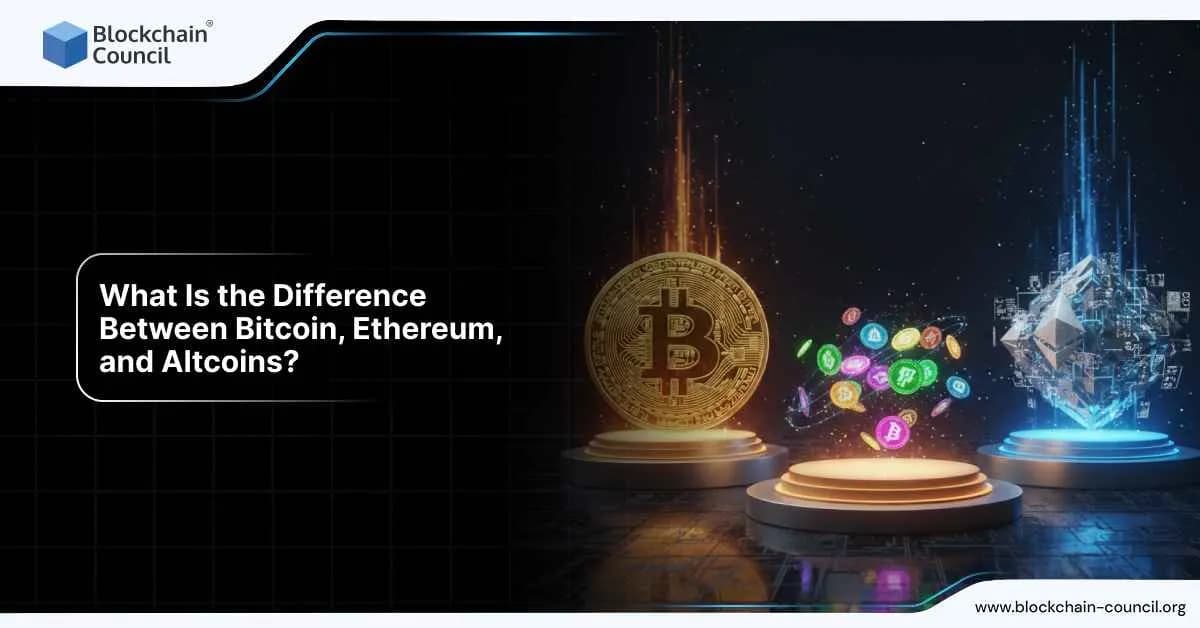
Differences
When people hear the word cryptocurrency, the first name that usually comes to mind is Bitcoin. But today, the market is full of many digital coins and tokens, each claiming to do something unique. The most common question beginners ask is simple: what is the difference between Bitcoin, Ethereum, and all the other altcoins? The answer lies in their purpose, design, and the role they play in the larger crypto economy. Bitcoin acts as a digital store of value, Ethereum powers smart contracts and applications, and altcoins try to bring in innovation across many different use cases. If you want to explore how to use these tools in real-world investing, the AI powered investing program is a great place to start.
Bitcoin: The First and the Original
Bitcoin was created in 2009 by an unknown person or group using the name Satoshi Nakamoto. Its main goal is to serve as a digital currency that works without banks or governments. Over time, Bitcoin has become known as “digital gold” because people treat it as a store of value and a hedge against inflation.

The Bitcoin network runs on a system called Proof of Work, where computers compete to solve puzzles in order to confirm transactions. This makes the network secure but also slower and more energy intensive. The supply of Bitcoin is capped at 21 million, which makes it deflationary in nature. Investors like this scarcity since it mimics gold and gives Bitcoin its reputation as a reliable long-term asset.
Ethereum: Beyond Money
Ethereum was launched in 2015 by Vitalik Buterin and a team of developers. While Bitcoin focused on being money, Ethereum aimed to be much more. It introduced smart contracts, which are pieces of code that run on the blockchain and execute automatically when conditions are met. This single idea has allowed Ethereum to become the foundation for decentralized applications, decentralized finance (DeFi), and non-fungible tokens (NFTs).
One of the biggest updates to Ethereum came in 2022, when the network moved from Proof of Work to Proof of Stake in a change known as “The Merge.” This cut down energy usage and made Ethereum more scalable. Today, Ethereum is often seen as a platform for building and innovation rather than just a currency.
Altcoins: Everything Else
The term “altcoin” refers to any cryptocurrency that is not Bitcoin. Some people also exclude Ethereum because it is so dominant, but technically Ethereum is also an altcoin. Altcoins come in many forms and try to fix the limits of Bitcoin or offer new features.
Some are focused on speed and lower costs, such as Solana. Others focus on privacy, like Monero. Stablecoins such as USDT are pegged to the value of the dollar to reduce volatility. Meme coins like Dogecoin exist mostly for fun but still have a following. Governance tokens give holders the power to vote on project decisions. In short, altcoins cover a wide variety of goals.
The downside is that altcoins are usually much riskier than Bitcoin or Ethereum. Many projects fail, some are scams, and others simply do not get enough adoption. At the same time, altcoins can also bring the highest rewards when they succeed.
Comparing Bitcoin, Ethereum, and Altcoins
To make things simple, let us compare the three groups across different aspects.
Key Differences Between Bitcoin, Ethereum, and Altcoins
Aspect | Bitcoin | Ethereum | Altcoins (general) |
Purpose | Digital currency and store of value | Smart contracts, decentralized apps, DeFi, NFTs | Varies: payments, speed, privacy, stable value, governance, memes |
Year Launched | 2009 | 2015 | Most after 2011 |
Consensus Mechanism | Proof of Work | Proof of Stake (after The Merge) | Mix of PoS, Delegated PoS, Proof of History, hybrids |
Supply | Fixed 21 million | No hard cap, but ETH burning reduces supply growth | Varies: fixed, inflationary, or dynamic |
Speed | Slow, about 7 transactions per second | Faster, scaling with upgrades, Layer 2 solutions | Ranges from very fast to slow |
Cost | High during busy times | Gas fees vary, can be high | Some very cheap, others similar to ETH |
Energy Use | High (PoW mining) | Much lower after PoS | Depends on mechanism |
Developer Ecosystem | Focused on network security and Bitcoin-only apps | Very large, active, supports dApps and DeFi | Varies widely, many small or niche projects |
Risk Level | High but relatively safer due to adoption | High, with larger ecosystem backing | Highest risk and volatility, but high potential reward |
Market Role | Digital gold, hedge against inflation | Global platform for decentralized applications | Experimentation and innovation across many fields |
Recent Market Trends
Bitcoin continues to dominate in market capitalization and adoption. It is seen as the safe core of most crypto portfolios. Ethereum holds second place and has the largest developer activity. Altcoins as a group hold a large share, but individually they rise and fall quickly.
Ethereum faces competition from other smart contract platforms like Solana, which offer faster and cheaper transactions. Bitcoin faces criticism for high energy use but remains unmatched in security and decentralization. Altcoins keep evolving, and many try to improve on scalability, privacy, or governance.
Regulators are also paying close attention. Some governments worry about the energy use of Proof of Work systems like Bitcoin. Others look at stablecoins and want clear rules. This environment makes it important for investors to keep learning and adapting.
Risks and Rewards
All cryptocurrencies are volatile. Bitcoin may swing in value by thousands of dollars within days. Ethereum and altcoins can move even more sharply. For new investors, it is easy to be tempted by altcoins that promise big gains. However, many of them fail. The safest path usually starts with understanding Bitcoin and Ethereum before moving into altcoins.
This is also why structured learning helps. If you are interested in trading strategies, a Crypto certification gives a clear path. If your interest is more in using data to make decisions, the Data Science Certification helps you build those skills. For those who want to focus on growth strategies, the Marketing and Business Certification is useful in applying these tools to real-world businesses. Finally, if you want to go deeper into blockchain as a whole, exploring blockchain technology courses will give you a solid base.
Conclusion
The difference between Bitcoin, Ethereum, and altcoins comes down to purpose and design. Bitcoin is digital gold, built for value storage and payment. Ethereum is a flexible platform for smart contracts and innovation. Altcoins are everything else, ranging from serious projects solving real problems to experimental tokens.
Understanding these differences is the first step to making smarter choices as an investor or learner. Each type of coin plays its own role in the larger ecosystem, and knowing how they fit together helps you see both the risks and opportunities.
FAQs
1. What is the difference between Bitcoin, Ethereum, and altcoins?
Bitcoin is the first and most established cryptocurrency, mainly used as a store of value. Ethereum is a programmable blockchain supporting smart contracts and decentralized applications. Altcoins refer to all other cryptocurrencies besides Bitcoin, often created for specific use cases or innovations.
2. What are altcoins in cryptocurrency?
Altcoins are alternative cryptocurrencies to Bitcoin. They include coins like Solana, Cardano, and Polkadot. These projects aim to improve scalability, speed, or functionality.
3. Why is Bitcoin considered digital gold?
Bitcoin is called digital gold because of its limited supply of 21 million coins and strong security. It is often used as a hedge against inflation. Its simplicity and reliability make it valuable for long-term holding.
4. Why is Ethereum different from Bitcoin?
Ethereum is more versatile because it supports smart contracts and decentralized applications. Bitcoin is focused on payments and value storage. This makes Ethereum more flexible and suitable for innovation.
5. What are the main uses of altcoins?
Altcoins serve various purposes such as faster transactions, lower fees, privacy, or specific applications like gaming and DeFi. Each altcoin has its own utility. This creates diversity in the crypto ecosystem.
6. Which is more stable: Bitcoin, Ethereum, or altcoins?
Bitcoin is generally the most stable due to its market dominance and adoption. Ethereum is moderately stable, while altcoins are often more volatile. Risk increases with smaller or newer projects.
7. Which offers the highest growth potential?
Altcoins often offer higher growth potential because they are newer and less established. However, they also carry higher risk. Ethereum provides a balance, while Bitcoin is more stable but slower in growth.
8. What are the risks of investing in altcoins?
Altcoins can be highly volatile and may lack strong fundamentals. Some projects fail, lose value, or disappear entirely. Investors should research thoroughly before investing.
9. What is market dominance in crypto?
Market dominance refers to the percentage of the total cryptocurrency market value held by a specific coin. Bitcoin usually has the highest dominance. This reflects its influence and stability in the market.
10. Which is better for beginners?
Bitcoin is the easiest for beginners due to its simplicity and strong reputation. Ethereum requires more understanding, while altcoins can be complex and risky. Starting with Bitcoin is common.
11. How do transaction speeds compare?
Bitcoin is slower compared to Ethereum and many altcoins. Some altcoins are designed specifically for faster transactions and scalability. This improves efficiency and usability.
12. What are gas fees in Ethereum?
Gas fees are transaction costs paid on the Ethereum network. They vary depending on network demand and complexity of transactions. High usage can significantly increase fees.
13. Can altcoins replace Bitcoin?
It is unlikely that altcoins will replace Bitcoin due to its strong network, security, and adoption. However, altcoins can complement the ecosystem by offering additional features and innovations.
14. What is the role of Ethereum in Web3?
Ethereum is the backbone of Web3, enabling decentralized applications, smart contracts, and digital ownership. It supports innovation in DeFi, NFTs, and blockchain-based services. This makes it essential.
15. How do supply models differ?
Bitcoin has a fixed supply, Ethereum has controlled issuance, and altcoins vary widely. Some altcoins have unlimited supply while others have caps. This impacts their long-term value.
16. What is staking in altcoins?
Many altcoins use Proof of Stake, allowing users to earn rewards by holding and staking coins. This replaces mining and reduces energy consumption. It is a popular earning method.
17. Which is safer to invest in?
Bitcoin is considered the safest due to its stability and widespread adoption. Ethereum is also relatively safe. Altcoins carry higher risk due to uncertainty and volatility.
18. What is diversification in crypto?
Diversification means investing in multiple cryptocurrencies to reduce risk. Many investors hold Bitcoin, Ethereum, and selected altcoins. This helps balance potential returns and losses.
19. What is the future of altcoins?
Altcoins will continue evolving with new technologies and use cases. Some will succeed and gain adoption, while others may fail. Innovation will drive their future growth.
20. Should you invest in Bitcoin, Ethereum, or altcoins?
The choice depends on your risk tolerance and investment goals. Bitcoin is ideal for stability, Ethereum for innovation, and altcoins for growth potential. A diversified approach is often recommended.
Related Articles
View All
Cryptocurrency
What Are Altcoins? A Complete Guide Beyond Bitcoin
Altcoins are cryptocurrencies beyond Bitcoin, including Ethereum, stablecoins, DeFi tokens, governance assets, meme coins, and gaming tokens.

Cryptocurrency
Crypto Portfolio Diversification: Balancing Bitcoin, Altcoins, Stablecoins, and DeFi
Learn how crypto portfolio diversification balances Bitcoin, altcoins, stablecoins, and DeFi assets using risk tiers, liquidity, and sector exposure.
Cryptocurrency
Bitcoin vs Ethereum: BTC, ETH, and Their Real Roles in Crypto
Bitcoin vs Ethereum explained with 2026 market data, BTC and ETH use cases, risks, developer relevance, and practical learning paths.
Trending Articles
The Role of Blockchain in Ethical AI Development
How blockchain technology is being used to promote transparency and accountability in artificial intelligence systems.
AWS Career Roadmap
A step-by-step guide to building a successful career in Amazon Web Services cloud computing.
What is AWS? A Beginner's Guide to Cloud Computing
Everything you need to know about Amazon Web Services, cloud computing fundamentals, and career opportunities.