

Why Timing Matters When Swapping Between Bitcoin, Ethereum, and Altcoins
 Michael Willson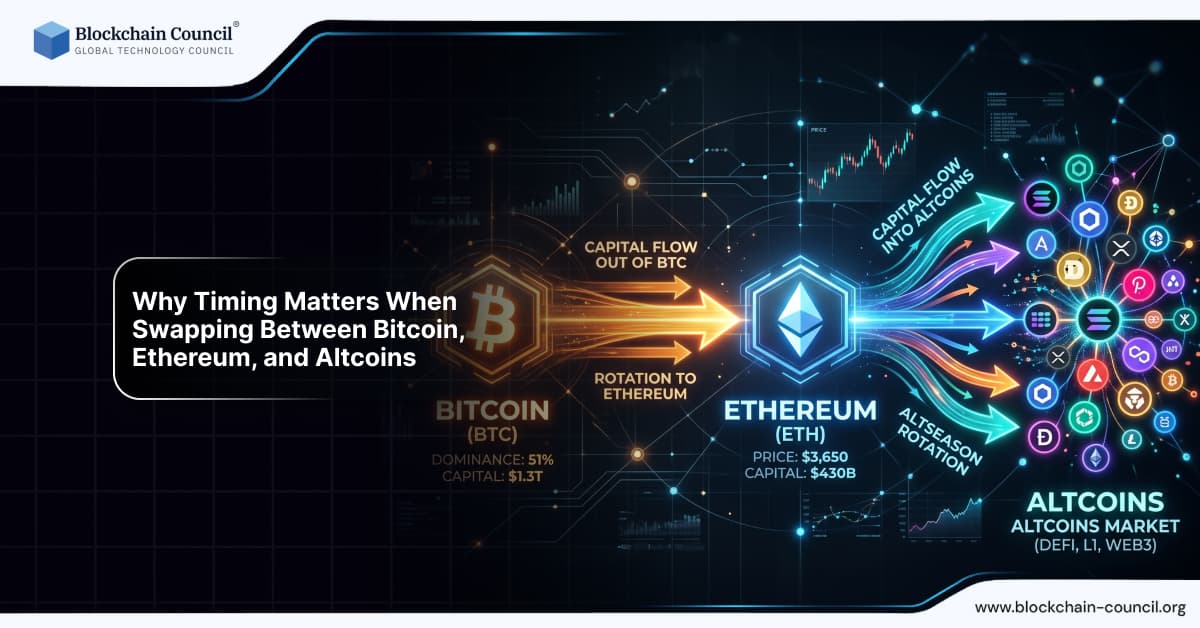
Crypto looks simple from the outside. Bitcoin goes up, Ethereum follows, altcoins fly, and everyone thinks the only job is to pick the “right” coin. In practice, timing matters almost as much as the coin you choose. That is especially true when traders move between assets with very different roles in the market. For example, someone may decide to not just to change holdings, but to shift from a privacy-focused coin into a faster-moving altcoin ecosystem tied to trading activity, DeFi, NFTs, and broader speculative momentum.
A mature investor learns this early. In crypto, money does not move evenly across the market. It tends to rotate. Bitcoin often attracts attention first because it remains the largest part of the market, at about 57.5% of total crypto market dominance. Ethereum is much smaller at roughly 10.7%, while the rest is spread across stablecoins and other coins. That uneven market structure is one reason swaps between Bitcoin, Ethereum, and altcoins can produce very different results depending on when you make them.

For a beginner, this is the key idea: a swap is not just a change of coin. It is a change of risk, momentum, and market position. If you move too early, your money can sit still while the market runs somewhere else. If you move too late, you may buy into excitement just before prices cool off.
Why timing matters more in crypto than many people expect
In traditional investing, being a little early or a little late can matter, but the damage is often limited when dealing with diversified stock or bond holdings. Crypto is less forgiving.
Prices can move sharply in short periods. Sentiment changes quickly. Liquidity shifts from one part of the market to another. A swap that looks smart on Monday can feel badly mistimed by Friday.
This is especially important because crypto markets often move in phases:
Bitcoin strengthens first.
Ethereum starts catching up.
Smaller altcoins begin to outperform.
The weakest coins often fall hardest when enthusiasm fades.
This pattern is not guaranteed, but it is common enough that investors watch it closely. Even today, the broader market still looks more like a Bitcoin-led market than a broad altcoin surge. CoinMarketCap’s Altcoin Season Index recently showed 37, which is below the level typically associated with a true altcoin season.
Bitcoin usually moves first
Bitcoin is still the most important signal in crypto. It is the oldest, most recognized, and most heavily watched asset in the space. When confidence begins returning to crypto, Bitcoin often benefits first because it is where cautious capital tends to go before taking more risk.
That makes sense for general investors. When the market is uncertain, many people prefer the largest and most established crypto asset rather than jumping directly into smaller coins. Bitcoin’s size and relative familiarity often make it the first stop for returning capital. Its current dominance near 57.5% reflects that continuing leadership.
For a practical investor, this means one thing: if Bitcoin is still leading clearly, moving too aggressively into altcoins may be premature. You may be stepping out of the strongest part of the market too early.
Ethereum often comes next
Ethereum tends to sit in the middle. It is not as defensive as Bitcoin, and it is not as speculative as much of the altcoin market. For that reason, it often becomes attractive once investors become more confident and begin looking for more upside than Bitcoin may offer.
This is where many swaps begin to make sense. If Bitcoin has already had a strong run and market confidence is improving, Ethereum can benefit from that shift in appetite. It still carries major risk, but for many investors, it is a more balanced step than moving straight from Bitcoin into small-cap tokens.
That does not mean Ethereum always outperforms next, but it often becomes the bridge between the market’s safest crypto exposure and its more speculative side.
Altcoins can reward good timing and punish bad timing
Altcoins attract attention because their upside can be dramatic. A smaller coin can rise much faster than Bitcoin in a strong risk-on market. That possibility is what pulls many new investors in.
The problem is that the same feature works in reverse. Smaller coins often drop harder when sentiment weakens. They can also lag for long stretches, even when Bitcoin is doing well. A beginner who swaps out of Bitcoin too early may spend weeks or months watching a smaller coin do very little, then panic at exactly the wrong moment.
This is why experienced investors try not to chase the noisiest part of the market. They do not assume every rally in Bitcoin automatically means it is time to rotate into altcoins. They wait for broader confirmation.
The signs worth watching before you swap
For general investors, there is no need to overcomplicate this. You do not need twenty indicators. You need a few clear questions:
Is Bitcoin still leading most of the market?
Is Ethereum starting to gain strength relative to Bitcoin?
Are smaller altcoins rising broadly, or is only a handful moving?
Is the move supported by improving confidence, or just social media excitement?
When Bitcoin dominance remains high and the altcoin market is not yet broadly outperforming, patience is often the better choice. When leadership starts broadening beyond Bitcoin, that is when selective rotation can become more reasonable. Current dominance data and the still-muted altcoin season reading suggest that broad risk appetite is not the same as a full altcoin boom.
The biggest mistake beginners make
The biggest mistake is confusing movement with opportunity.
A coin that has already jumped sharply can look exciting, but excitement is not the same as value. Newer investors often swap because they feel they are missing out. They move from Bitcoin into Ethereum after Ethereum has already rallied. Then they move from Ethereum into an altcoin after that altcoin has already gone vertical. What began as a strategy becomes a chain of emotional reactions.
A mature investor does the opposite. He asks whether the next swap improves the balance between risk and reward. He cares less about catching the exact top performer and more about avoiding poor entries.
A simple investor mindset for crypto rotation
If you are new to crypto, keep it basic.
Start by thinking of Bitcoin as the market’s foundation, Ethereum as the middle ground, and altcoins as the speculative edge. Then ask a simple question before every swap: am I moving because the market structure supports it, or because I feel pressure to chase returns?
That one question can save a lot of money.
Good timing in crypto is rarely about perfection. It is about discipline. It is about understanding that Bitcoin, Ethereum, and altcoins often take turns leading. And it is about accepting that doing nothing for a while can be a better decision than making a rushed swap.
For most people entering crypto, that is the real lesson. Timing matters because crypto is not one market moving in one straight line. It is a market where leadership rotates, risk changes quickly, and patience often beats impulse.
Related Articles
View All
Cryptocurrency
What Are Altcoins? A Complete Guide Beyond Bitcoin
Altcoins are cryptocurrencies beyond Bitcoin, including Ethereum, stablecoins, DeFi tokens, governance assets, meme coins, and gaming tokens.

Cryptocurrency
Bitcoin Explained: How BTC Works and Why It Matters
Bitcoin explained clearly: learn how BTC works, why proof of work matters, what gives Bitcoin value, and the risks every user should know.

Cryptocurrency
Crypto Portfolio Diversification: Balancing Bitcoin, Altcoins, Stablecoins, and DeFi
Learn how crypto portfolio diversification balances Bitcoin, altcoins, stablecoins, and DeFi assets using risk tiers, liquidity, and sector exposure.
Trending Articles

Top 5 DeFi Platforms
Explore the leading decentralized finance platforms and what makes each one unique in the evolving DeFi landscape.
How Blockchain Secures AI Data
Understand how blockchain technology is being applied to protect the integrity and security of AI training data.
What is AWS? A Beginner's Guide to Cloud Computing
Everything you need to know about Amazon Web Services, cloud computing fundamentals, and career opportunities.