

What Is Loop Engineering? A Complete Guide to Feedback-Driven System Design
 Suyash Raizada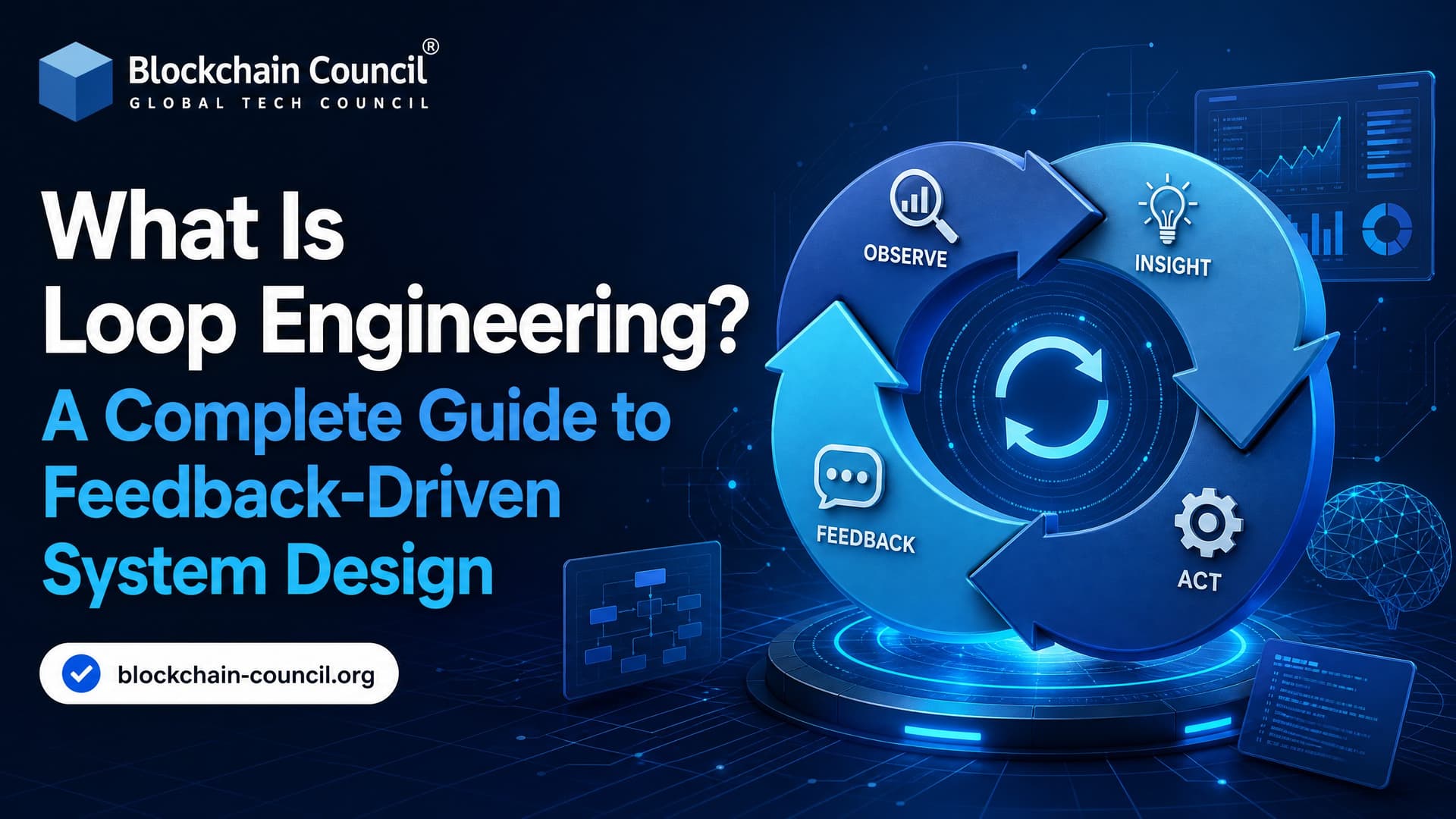
Loop engineering is the practice of designing systems that act, observe the result, learn from evidence, and adjust their next move. Instead of treating software, AI agents, blockchain protocols, or hardware as one-shot pipelines, loop engineering treats them as feedback-driven systems that improve through repeated cycles.
That sounds abstract until you see it in daily engineering work. You change a smart contract, run the test suite, read the revert reason, fix the access control issue, and run it again. That is a loop. A good one. The quality of the loop decides how quickly you find the truth.

What Is Loop Engineering?
Loop engineering is feedback-driven system design. It organizes work around cycles such as act-observe-learn-adjust. The system performs an action, measures what happened, compares the result with a goal, and changes behavior based on that gap.
The idea comes from control theory, where a controller measures system output, compares it with a reference value, computes error, and adjusts the input. A thermostat is the simple version. Industrial robotics, CNC machines, autonomous systems, AI coding agents, and Web3 monitoring pipelines use the same basic pattern at higher complexity.
In software and AI, loop engineering is not just automation. Automation can repeat a bad action forever. Loop engineering adds measurement, interpretation, correction, and termination logic.
Open Loop vs Closed Loop Systems
An open-loop system executes a command without checking whether the result matches the goal. A script that deploys code and exits without running checks is open loop.
A closed-loop system observes output and adjusts. A CI pipeline that runs unit tests, fails on a regression, reports the stack trace, and blocks deployment is closed loop.
Closed loops are usually the right default for reliability-critical work because they can correct drift, unexpected inputs, and changing environments. Open loops still have a place. Use them for simple, low-risk, repeatable tasks where feedback would add cost without much benefit. Do not use them for trading bots, production deployments, access-control changes, or AI agents that can edit files.
Core Components of a Feedback Loop
Most loop-engineered systems share five parts:
The thing being controlled: A codebase, model, smart contract, user journey, robot arm, protocol parameter, or AI agent.
Measurement: Tests, logs, traces, sensor readings, gas reports, audit findings, user behavior, or runtime metrics.
Reference target: A desired state such as passing tests, latency under 200 ms, no high-severity Slither findings, or a specific UX completion rate.
Comparison and decision: Logic that identifies the gap between actual and desired outcomes.
Adjustment mechanism: A code edit, configuration change, model prompt update, governance proposal, control signal, or human review.
If any part is weak, the loop weakens. Bad measurement is especially dangerous. You cannot control what you cannot observe clearly.
The Goldilocks Problem: Feedback Must Be Tuned
Feedback can fail in two opposite ways. Too little feedback and the system drifts. Too much feedback and the system oscillates.
Control engineers tune loops for steady-state error, overshoot, and settling time. Software teams face similar trade-offs, even if they use different words. Run tests too rarely and bugs pile up. Run every possible integration test on each keystroke and developers stop waiting for results. The loop has to be tight enough to teach you something, but not so noisy that nobody trusts it.
AI agents make this more visible. If an agent retries the same failing command five times, you do not have adaptation. You have a loop-shaped bug.
Loop Engineering in AI Agents
AI coding agents made loop engineering a practical topic for many developers. Claude Code, Cursor, GitHub Copilot agent modes, and similar tools do not just answer a prompt. They can inspect files, propose edits, run commands, read errors, and revise their plan.
A basic AI agent loop looks like this:
Intent: Define the goal and stop condition. For example, "Add ERC-20 permit support and all tests must pass."
Context: Gather relevant files, dependencies, docs, compiler versions, and constraints.
Action: Edit code, run a command, call a tool, or write a migration.
Observation: Capture compiler errors, test output, runtime logs, diffs, or review comments.
Adaptation: Decide the next step based on evidence, not guesswork.
Here is a practitioner detail that matters. In Solidity 0.8.x, arithmetic overflow reverts automatically with panic code 0x11. If your agent sees a Hardhat test fail with reverted with panic code 0x11, the right adaptation is not to bolt on a random require statement. It should inspect the arithmetic path, token decimals, unchecked blocks, and boundary inputs. That is the difference between a tool that edits text and a loop that learns from feedback.
As AI development shifts toward autonomous coding assistants and feedback-driven workflows, a Claude AI Certification can help professionals strengthen their understanding of AI-assisted software development, prompt design, agent behavior, and practical implementation patterns.
The Harness Around the Model
In agent systems, the model is only one piece. The harness around it matters just as much. The harness includes:
Tool permissions
Repository access
Test runners
Sandbox limits
Logging
Prompt constraints
Human approval gates
Good loop engineering gives the agent useful sensors. Let it run targeted tests. Let it inspect compiler output. Give it structured errors. Block dangerous commands. To be blunt, a coding agent without feedback is just autocomplete with confidence.
Loop Engineering in Blockchain and Web3
Blockchain systems are a natural fit for loop engineering because mistakes are expensive after deployment. Once a smart contract is live on Ethereum mainnet, chain ID 1, you cannot patch it like a normal web server unless you designed upgradeability or governance into the system.
Useful Web3 feedback loops include:
Smart contract development loops: Write Solidity, run Foundry or Hardhat tests, inspect gas snapshots, run Slither, fix issues, repeat.
Security loops: Monitor on-chain activity, detect anomalies, triage alerts, update thresholds, and improve incident playbooks.
Governance loops: Measure protocol usage, validator behavior, liquidity depth, or fee pressure, then adjust parameters through proposals.
DeFi strategy loops: Track slippage, liquidity, oracle freshness, and risk limits before allowing automated execution.
UX loops: Watch wallet connection failures, rejected signatures, and failed transactions, then simplify the user path.
A common beginner mistake in OpenZeppelin Contracts v5 is extending Ownable without passing the initial owner to the base constructor. Solidity then throws an error about no arguments passed to the base constructor. A good loop turns that error into the next action: inspect the inheritance chain and add constructor(address initialOwner) Ownable(initialOwner) {}. A poor loop simply rewrites unrelated code.
If you are building in this area, Blockchain Council's Certified Smart Contract Developer™, Certified Blockchain Expert™, and Certified Web3 Expert™ connect loop engineering with secure protocol design.
A Tech Certification can further strengthen this foundation by expanding your understanding of emerging technologies, cloud infrastructure, automation, and the digital systems that support reliable, feedback-driven engineering practices.
Loop Engineering in Product, UX, and Operations
Closed-loop engineering is also changing product development. Teams no longer ship, wait, and hope. They collect production telemetry, user feedback, manufacturing data, support tickets, and field performance data, then feed those signals back into design.
In UX, feedback loops show up in small interactions: progress indicators, form validation, transaction status messages, wallet signature confirmations, and error recovery. Users trust systems that tell them what happened and what to do next. Silence creates confusion.
In operations, observability turns monitoring into learning. Logs tell you what happened. Metrics show patterns. Traces reveal where time went. Together, they let teams adjust architecture, not just restart services.
Best Practices for Feedback-Driven System Design
1. Start With a Measurable Goal
"Make it better" is not a control target. Define the reference point. Examples: all tests pass, p95 latency stays below a threshold, no critical static-analysis findings, or transaction failure rate drops below a chosen percentage.
2. Keep the Loop Tight
Fast feedback beats late feedback. Run the smallest meaningful test first. In smart contract work, a focused Foundry test with forge test --match-test test_RevertWhen_NotOwner is often more useful than running the whole suite every time.
3. Separate Inner and Outer Loops
Inner loops fix immediate issues. Outer loops improve the system over time. For an AI coding agent, the inner loop may fix a failing test. The outer loop updates coding guidelines, test templates, dependency rules, or review checklists so the same class of error appears less often.
4. Design Errors as Signals
Error messages should be actionable. "Failed" is weak. "ERC20 allowance not updated before transferFrom in test_transferWithPermit" is useful. Give humans and agents enough context to adapt.
5. Add Stop Conditions
Every autonomous loop needs termination logic. Stop when the goal is met, when the budget is exhausted, when repeated attempts show no progress, or when risk crosses a threshold. Infinite loops are not autonomy. They are missing design.
6. Keep Humans in High-Risk Loops
Do not fully automate decisions that can move funds, change governance parameters, delete data, or alter access controls. Use human approval for high-impact actions and keep the evidence visible.
Common Loop Engineering Mistakes
Measuring vanity metrics: If a metric cannot guide a decision, it is dashboard decoration.
Retesting without learning: Repeating the same command is not adaptation.
Giving agents too many tools: Broad permissions create risk and make failures harder to trace.
Ignoring latency: Feedback that arrives too late loses value.
Confusing positive feedback with progress: Amplifying a trend can create runaway behavior, especially in markets and social systems.
The Future of Loop Engineering
Loop engineering will become a core skill for AI, blockchain, cybersecurity, and deeptech professionals. AI agents will use faster inner loops for code, tests, and tool use. Slower outer loops will update team standards, evaluation sets, policies, and governance controls.
For Web3 teams, the practical direction is clear: treat protocols as living systems with measurement, review, and controlled adjustment. For AI teams, stop treating prompts as the main artifact. The loop is the artifact.
If you want to build this skill, start small this week. Pick one workflow you run manually, such as smart contract testing or AI-assisted code review. Define the goal, add reliable measurement, shorten the feedback cycle, and write down the stop condition. Then deepen the foundation with Blockchain Council's Certified AI Expert™, Certified Generative AI Expert™, or Certified Smart Contract Developer™, depending on whether your next system is agent-driven, model-driven, or on-chain.
As AI-powered products and engineering platforms continue to reach broader markets, a Marketing Certification can also help professionals understand product positioning, customer education, and go-to-market strategies for emerging technology solutions.
FAQs
1. What Is Loop Engineering?
Loop engineering is the practice of designing systems that continuously collect feedback, analyze results, and improve performance through repeated optimization cycles. It combines automation, monitoring, and iterative learning to create more adaptive and efficient systems.
2. Why Is Loop Engineering Important?
Loop engineering helps organizations build systems that continuously improve over time. By using feedback to refine processes, businesses can increase efficiency, reduce errors, improve user experiences, and make better data-driven decisions.
3. How Does Loop Engineering Work?
Loop engineering follows a continuous cycle of collecting data, analyzing performance, identifying improvements, implementing changes, and measuring results. This ongoing feedback loop enables systems to adapt to changing conditions.
4. What Is a Feedback Loop in System Design?
A feedback loop is a process where a system uses information about its own performance to adjust future actions. Positive and negative feedback loops help optimize system behavior and improve outcomes over time.
5. What Is Feedback-Driven System Design?
Feedback-driven system design is an approach where systems are built to continuously monitor performance, gather user or operational feedback, and automatically or manually improve based on measurable results.
6. How Is Loop Engineering Different from Traditional System Design?
Traditional system design often follows a fixed implementation process, while loop engineering emphasizes continuous monitoring, learning, and optimization, allowing systems to evolve as new information becomes available.
7. What Are the Key Components of Loop Engineering?
Core components include data collection, monitoring, analytics, feedback mechanisms, automation, decision-making, optimization, performance measurement, and continuous improvement.
8. How Does Artificial Intelligence Support Loop Engineering?
AI analyzes large datasets, identifies patterns, predicts outcomes, recommends improvements, and automates optimization, making feedback loops faster and more effective than manual processes.
9. How Is Loop Engineering Used in AI Systems?
In AI systems, loop engineering helps monitor model performance, evaluate outputs, incorporate user feedback, detect errors, and improve models through continuous retraining or refinement.
10. How Does Loop Engineering Improve Business Processes?
Organizations use loop engineering to monitor operations, identify inefficiencies, automate repetitive tasks, improve decision-making, and optimize workflows based on real-time performance data.
11. What Role Does Data Play in Loop Engineering?
Data provides the foundation for feedback loops by measuring system performance, tracking user behavior, identifying trends, and supporting evidence-based improvements throughout the optimization cycle.
12. Can Loop Engineering Improve Customer Experience?
Yes. Businesses can analyze customer feedback, user behavior, and service performance to continuously improve products, personalize experiences, and resolve issues more efficiently.
13. Which Industries Use Loop Engineering?
Industries including software development, artificial intelligence, manufacturing, healthcare, finance, logistics, retail, cybersecurity, marketing, and robotics use loop engineering to improve performance and automation.
14. What Technologies Support Loop Engineering?
Common technologies include AI, machine learning, data analytics, cloud computing, APIs, workflow automation tools, monitoring platforms, IoT devices, DevOps tools, and business intelligence dashboards.
15. What Are the Benefits of Loop Engineering?
Benefits include continuous improvement, faster decision-making, better system reliability, reduced operational costs, improved user satisfaction, increased automation, stronger scalability, and more resilient systems.
16. What Challenges Exist When Implementing Loop Engineering?
Organizations may face challenges such as poor data quality, fragmented systems, excessive automation, integration complexity, feedback delays, privacy concerns, and difficulty defining meaningful performance metrics.
17. How Can Organizations Build an Effective Feedback Loop?
Businesses should define measurable objectives, collect reliable data, establish monitoring systems, analyze results regularly, implement improvements, and continuously evaluate performance against business goals.
18. What Skills Are Needed for Loop Engineering?
Professionals benefit from knowledge of systems thinking, data analytics, artificial intelligence, automation, software engineering, process optimization, monitoring tools, problem-solving, and business strategy.
19. What Common Mistakes Should Organizations Avoid in Loop Engineering?
Avoid collecting feedback without acting on it, measuring too many KPIs, relying on poor-quality data, automating without human oversight, and failing to review system performance regularly. Effective loop engineering requires continuous evaluation, clear objectives, and iterative improvements.
20. How Will Loop Engineering Shape the Future of Intelligent Systems?
Loop engineering is expected to become a core design principle for AI-powered and autonomous systems by enabling continuous learning, adaptive decision-making, and automated optimization. As AI, robotics, and enterprise automation advance, feedback-driven system design will help organizations build smarter, more resilient, and self-improving systems that respond quickly to changing business needs and user expectations.
Related Articles
View All
Claude Ai
Loop Engineering vs Prompt Engineering: Key Differences, Use Cases, and Future Trends
Loop engineering vs prompt engineering explained with practical differences, AI agent use cases, Claude AI examples, career trends, and learning paths.

Claude Ai
Loop Engineering in Blockchain: Transparent Feedback for Dapps
Learn how loop engineering in blockchain connects smart contracts, governance, tokenomics, and analytics to create transparent feedback mechanisms for dapps.

Claude Ai
Loop Engineering for Automation: Designing Smarter Business Processes with AI Agents
Learn how loop engineering for automation uses AI agents, AIOps, and governed feedback loops to improve business workflows at enterprise scale.
Trending Articles
AWS Career Roadmap
A step-by-step guide to building a successful career in Amazon Web Services cloud computing.
What is AWS? A Beginner's Guide to Cloud Computing
Everything you need to know about Amazon Web Services, cloud computing fundamentals, and career opportunities.

Can DeFi 2.0 Bridge the Gap Between Traditional and Decentralized Finance?
The next generation of DeFi protocols aims to connect traditional banking with decentralized finance ecosystems.