

Loop Engineering for Automation: Designing Smarter Business Processes with AI Agents
 Suyash Raizada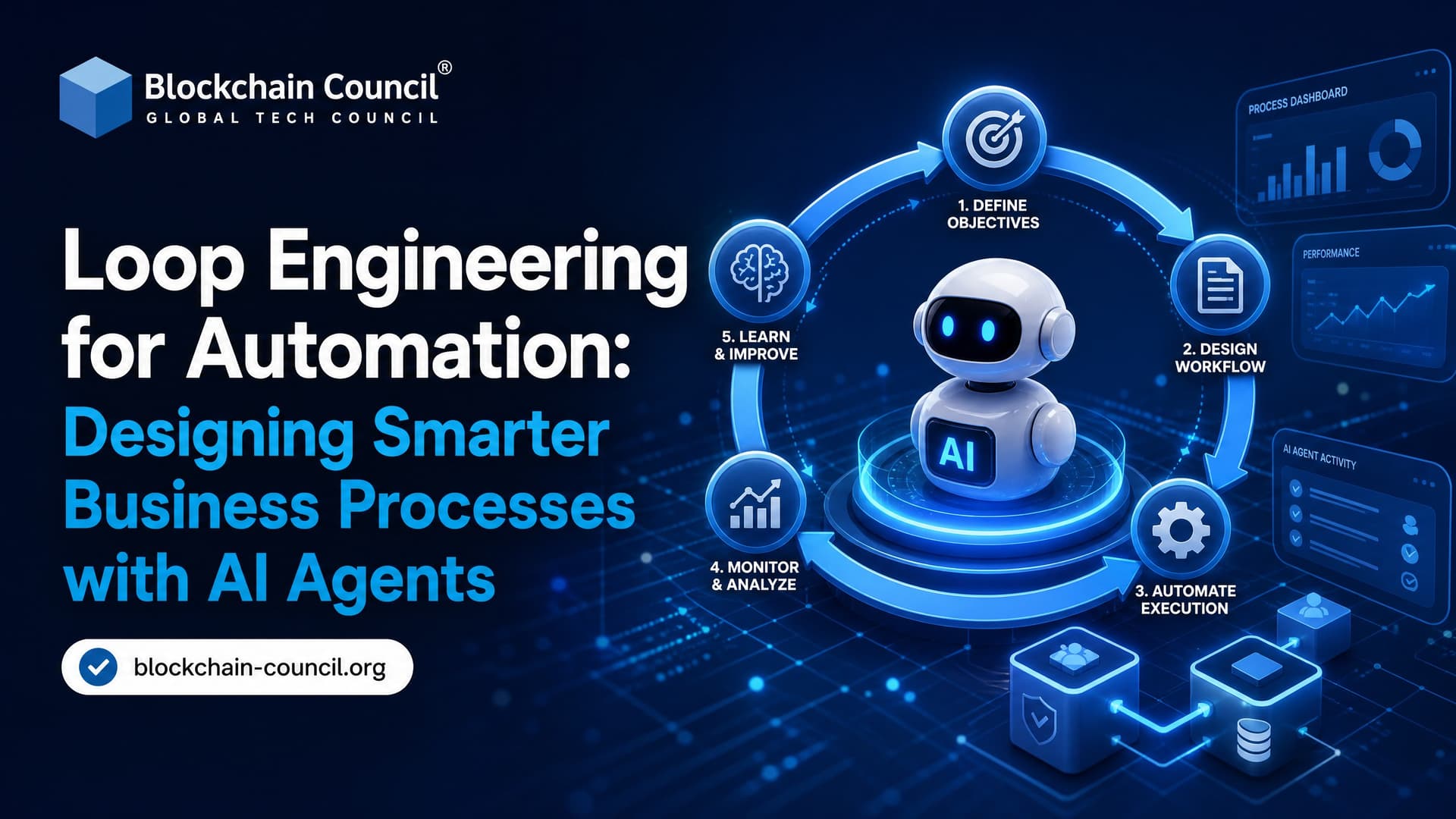
Loop Engineering for Automation means designing business processes that can sense what is happening, decide what to do, act through approved systems, and learn from the result. The point is not to replace every workflow with a chatbot. The point is to build closed feedback loops where AI agents handle repeatable work, escalate risky cases, and leave an audit trail you can inspect later.
This matters now because agentic AI is moving from lab projects into production. McKinsey's 2025 State of AI reporting shows that 88 percent of organizations use AI in at least one business function, up from 78 percent the year before and roughly 20 percent in 2017. Yet only about 23 percent are scaling agentic AI across the enterprise. That gap is where loop engineering earns its keep.

As organizations increasingly adopt AI agents for enterprise automation, a Claude AI Certification can help professionals build practical expertise in prompt engineering, tool orchestration, workflow design, and the responsible deployment of AI-powered business systems.
What Loop Engineering Means in Business Automation
A loop engineered process has five practical stages:
Sense: Collect signals from logs, tickets, emails, CRM records, ERP events, IoT devices, or customer conversations.
Interpret: Use models, rules, or agents to classify the event, detect anomalies, and identify likely causes.
Decide: Select the next action based on policy, confidence score, risk level, and business context.
Act: Execute the approved step through APIs, workflow tools, RPA bots, ITSM systems, or human handoff.
Learn: Record the outcome, compare it with the expected result, and update prompts, rules, playbooks, or model settings.
That last step is the difference between simple automation and loop engineered automation. A linear workflow says: if X happens, do Y. A closed loop asks: did Y fix the issue, and should we behave differently next time?
Why AI Agents Fit Closed-Loop Automation
AI agents are software systems that can observe context, choose actions, use tools, and pursue a goal across multiple steps. In enterprise settings, they usually combine a large language model with controlled access to tools such as ticketing systems, databases, knowledge bases, and workflow engines.
Good agents are not free-roaming digital employees. That idea is overhyped and often unsafe. The better pattern is narrower: task-specific agents with clear permissions, logs, and escalation rules. An IT support agent might reset passwords and update a ServiceNow ticket, but it should not modify identity policies or disable multifactor authentication without approval.
In practice, teams often design a mesh of agents. A coordinator agent assigns tasks. Specialist agents handle invoice checks, incident summaries, customer replies, or data validation. A policy layer blocks actions that exceed an agent's role. Humans stay in the loop for exceptions.
Enterprise Adoption: What the Numbers Say
Market data points to fast growth. One 2024 analysis estimated the enterprise agentic AI market at about 2.58 billion USD. Broader AI agent market estimates place the 2025 figure near 7.6 to 7.8 billion USD, with projections above 10.9 billion USD in 2026.
Gartner has forecast that about 40 percent of enterprise applications will include task-specific AI agents by the end of 2026, compared with under 5 percent in 2025. Gartner has also projected that 33 percent of enterprise software applications will include agentic AI by 2028, up from less than 1 percent in 2024.
The work impact matters just as much. Gartner expects at least 15 percent of day-to-day work decisions to be made autonomously through agentic AI by 2028. In customer service, industry projections suggest AI agents could resolve about 80 percent of common issues by 2029, with operating cost reductions near 30 percent.
Treat those forecasts as directionally useful, not magic. The companies getting value are not handing agents unlimited freedom. They are embedding agents into CRM, HR, ITSM, ecommerce, and finance systems where every action can be checked.
Loop Engineering Architecture
1. Sensing layer
This layer gathers telemetry, business events, user messages, documents, logs, and transaction data. In IT operations, that may include observability data from Datadog, Splunk, Dynatrace, New Relic, Prometheus, or cloud-native monitoring tools. In back-office workflows, it may include invoices, purchase orders, HR requests, and emails.
2. Interpretation layer
Here, AI models and agents classify events, summarize context, detect anomalies, and identify likely root causes. In AIOps, this may mean correlating 500 alerts into one incident narrative. In customer service, it may mean detecting whether a ticket is a billing dispute, a refund request, or an account access issue.
3. Decision layer
The decision layer applies policy. Should the agent act, ask a human, or collect more evidence? A useful rule is simple: automate high-volume, low-risk decisions first. Do not start with fraud holds, medical decisions, or financial approvals unless governance is already mature.
4. Action layer
Agents act through approved tools. That may mean opening a ticket, calling an API, updating a record, running a diagnostic script, or drafting a customer response. Tool access should be scoped. Read access and write access are different risks.
5. Learning layer
The system records what happened. Did the incident clear? Did the customer reopen the ticket? Did the invoice later fail audit? These outcomes feed prompt changes, playbook edits, model evaluation, and policy updates.
AIOps: The Clearest Early Example
AIOps is one of the strongest examples of loop engineering because the feedback loop is visible. The system detects an anomaly, correlates related alerts, opens or updates an incident, suggests a cause, triggers remediation, and verifies that service levels are back to normal.
Picture a payments API throwing 502 errors. The sensing layer catches error spikes and queue depth. The interpretation layer links the issue to a failing downstream gateway. The decision layer checks whether this failure matches an approved playbook. The action layer shifts traffic, restarts a worker, or rolls back a recent deployment. The learning layer records whether latency and error rate recovered.
That beats alert spam. It is also measurable: mean time to detect, mean time to acknowledge, mean time to resolution, reopen rate, and customer impact minutes all become loop metrics.
Practical Use Cases for Loop Engineered Automation
IT incident management: Agents summarize alerts, correlate logs, recommend fixes, and execute approved remediation steps.
Customer support: Agents classify tickets, retrieve knowledge articles, answer routine questions, and escalate sensitive cases.
Invoice processing: Agents compare invoices with purchase orders, flag mismatches, route exceptions, and update finance systems.
HR service requests: Agents handle policy questions, onboarding tasks, access requests, and status updates.
Fraud and risk workflows: Agents scan transactions, flag anomalies, create cases, and send high-risk items to analysts.
Ecommerce operations: Agents answer order questions, coordinate inventory updates, and trigger fulfillment workflows.
The best first project is usually boring. Pick a workflow with high volume, clear rules, clean data, and a painful handoff. Password resets, ticket triage, invoice matching, and order status updates are better starting points than strategic planning or legal judgment.
Design Rules That Prevent Expensive Mistakes
If you are building with Claude, GPT models, or similar agent frameworks, small implementation choices matter. With Anthropic's Messages API, for example, tool use requires careful turn handling. When Claude returns a stop_reason of tool_use, your application must execute the tool and send back a matching tool_result with the same tool use ID. Miss that mapping and you can hit errors such as messages: tool_use ids were found without tool_result blocks immediately after. That is not a model intelligence problem. It is loop plumbing.
Use these design rules:
Keep tools narrow: Give each agent the minimum permissions needed for its task.
Log every action: Store prompt input, tool call, tool result, decision reason, and final outcome.
Set confidence thresholds: Low confidence should trigger review, not a risky action.
Separate suggestion from execution: Let agents recommend first. Add execution only after testing.
Use deterministic settings where possible: For operational tasks, lower temperature settings usually produce more consistent behavior.
Test failure paths: Simulate missing data, API timeouts, duplicate tickets, and policy conflicts.
A Tech Certification can further strengthen these capabilities by providing broader knowledge of cloud platforms, software engineering, automation frameworks, and emerging technologies that support reliable AI-powered enterprise operations.
Governance: Where Most Agent Projects Fail
Agentic automation fails less often because of the model and more often because of unclear ownership. Who approves the playbook? Who can change a prompt? Who reviews agent mistakes? Who owns the risk register?
Governance should cover:
Access control: Map agent permissions to business roles.
Human escalation: Define which cases require approval.
Auditability: Keep records that compliance and security teams can inspect.
Data quality: Do not automate decisions on inconsistent records.
Evaluation: Track accuracy, cost, latency, customer satisfaction, and exception rate.
To be blunt, a poorly governed agent is just a faster way to make mistakes. Start with supervision, then remove human checkpoints only when performance data supports it.
Skills Professionals Need for Loop Engineering
Loop engineering sits between AI architecture, automation design, process improvement, and governance. You need to understand models, but you also need to read a workflow diagram, question a policy, and design an audit trail.
Useful learning areas include:
Agent design and tool orchestration
Prompt engineering for operational workflows
AIOps and observability concepts
API integration and workflow automation
AI governance, security, and compliance
Business process modeling
For structured learning, consider Blockchain Council programs such as the Certified Artificial Intelligence (AI) Expert, Certified Generative AI Expert, and Certified Prompt Engineer. Developers working on agent-based systems can pair these with hands-on practice using Claude tool use, LangChain, LlamaIndex, workflow engines, and real enterprise APIs.
Build Your First Closed Loop
Choose one process this week. Map the current steps. Mark where data enters, where decisions happen, where actions are taken, and where outcomes are checked. Then design one narrow AI agent that improves a single step without hiding the audit trail.
If your goal is to lead these projects, build skills in agent orchestration, AIOps, and AI governance before chasing full autonomy. The practical advantage goes to professionals who can design safe loops that work inside real business systems.
As AI-driven automation becomes a competitive advantage across industries, a Marketing Certification can also help professionals understand product positioning, customer communication, adoption strategies, and go-to-market planning for innovative technology solutions.
FAQs
1. What Is Loop Engineering for Automation?
Loop engineering for automation is the practice of designing AI-powered workflows that continuously collect feedback, evaluate outcomes, and optimize business processes. It enables systems to learn from results and improve performance through ongoing feedback loops.
2. Why Is Loop Engineering Important for Business Automation?
Loop engineering helps organizations build adaptive automation systems that improve efficiency, reduce errors, enhance decision-making, and continuously optimize operations using real-time data and feedback.
3. How Does Loop Engineering Work in AI Automation?
It follows a continuous cycle of collecting data, executing automated tasks, measuring outcomes, gathering feedback, refining workflows, and repeating the process to improve business performance.
4. What Is a Feedback Loop in Business Automation?
A feedback loop is a mechanism where an automated system monitors its performance, analyzes results, and adjusts future actions based on predefined goals, business rules, or human feedback.
5. How Is Loop Engineering Different from Traditional Automation?
Traditional automation follows fixed rules, while loop engineering incorporates continuous monitoring, feedback, and optimization, allowing workflows to adapt and improve as business conditions change.
6. How Do AI Agents Support Loop Engineering?
AI agents execute tasks, analyze workflow performance, interpret feedback, recommend improvements, and automate decision-making within defined operational limits to create smarter business processes.
7. What Types of Business Processes Can Benefit from Loop Engineering?
Organizations can apply loop engineering to customer support, sales, marketing, HR, finance, IT operations, supply chain management, cybersecurity, compliance, and software development.
8. How Does Loop Engineering Improve Workflow Automation?
Loop engineering identifies bottlenecks, measures process performance, automates repetitive tasks, and continuously refines workflows based on operational data and user feedback.
9. What Role Does Artificial Intelligence Play in Loop Engineering?
AI analyzes large datasets, identifies patterns, predicts outcomes, recommends workflow improvements, automates routine decisions, and helps optimize business processes over time.
10. How Can AI Agents Improve Decision-Making?
AI agents evaluate real-time data, identify trends, compare possible actions, and recommend or execute decisions according to predefined business rules and organizational objectives.
11. How Does Loop Engineering Support Continuous Improvement?
By continuously monitoring KPIs, collecting performance data, and refining workflows, loop engineering enables organizations to improve operational efficiency and adapt to changing business needs.
12. Can Loop Engineering Improve Customer Experience?
Yes. Businesses can analyze customer interactions, automate personalized responses, reduce service delays, optimize support workflows, and continuously improve customer satisfaction through feedback-driven automation.
13. Which Technologies Support Loop Engineering?
Key technologies include AI agents, machine learning, large language models (LLMs), workflow automation platforms, APIs, robotic process automation (RPA), cloud computing, business intelligence tools, and analytics dashboards.
14. Which Industries Benefit from Loop Engineering?
Industries including healthcare, finance, manufacturing, retail, logistics, education, customer service, cybersecurity, telecommunications, and human resources benefit from feedback-driven automation.
15. What Are the Benefits of Loop Engineering for Automation?
Benefits include increased operational efficiency, faster decision-making, reduced manual effort, improved workflow accuracy, lower operational costs, enhanced scalability, continuous optimization, and better business outcomes.
16. What Challenges Exist When Implementing Loop Engineering?
Challenges include poor data quality, integration with legacy systems, defining meaningful KPIs, managing AI bias, ensuring governance, protecting sensitive data, and balancing automation with human oversight.
17. How Can Businesses Build Effective AI Automation Loops?
Organizations should define business objectives, identify measurable KPIs, collect reliable operational data, implement monitoring systems, regularly evaluate workflow performance, and refine automation based on feedback.
18. What Skills Are Needed for Loop Engineering?
Professionals should understand artificial intelligence, workflow automation, process optimization, business analysis, APIs, data analytics, machine learning, prompt engineering, MLOps, and systems thinking.
19. What Common Mistakes Should Organizations Avoid When Designing AI Automation Loops?
Avoid automating inefficient processes without redesigning them, collecting feedback without acting on it, relying on poor-quality data, removing human oversight from high-impact decisions, and failing to monitor AI performance. Successful loop engineering combines continuous measurement, governance, and iterative improvement to keep automation reliable and aligned with business goals.
20. How Will Loop Engineering Shape the Future of AI-Powered Business Automation?
Loop engineering is expected to become a foundational approach for enterprise AI by enabling intelligent, self-improving workflows. As AI agents, generative AI, and autonomous systems become more capable, organizations will increasingly rely on feedback-driven automation to optimize operations, improve customer experiences, enhance productivity, and support data-driven decision-making while maintaining governance, transparency, and human oversight.
Related Articles
View All
Claude Ai
Fable 5 for AI Agents and Automation: Building Smarter Workflows
Learn how Fable 5 for AI agents supports long-horizon automation, multi-agent workflows, coding tasks, document processing, safety, and cost control.

Claude Ai
Claude Sonnet 5 for Developers: Building Smarter AI Agents and Enterprise Applications
Claude Sonnet 5 for Developers is a practical guide to building AI agents, coding workflows, and enterprise applications with Anthropic's latest Sonnet model.

Claude Ai
Loop Engineering vs Prompt Engineering: Key Differences, Use Cases, and Future Trends
Loop engineering vs prompt engineering explained with practical differences, AI agent use cases, Claude AI examples, career trends, and learning paths.
Trending Articles
What is AWS? A Beginner's Guide to Cloud Computing
Everything you need to know about Amazon Web Services, cloud computing fundamentals, and career opportunities.

Can DeFi 2.0 Bridge the Gap Between Traditional and Decentralized Finance?
The next generation of DeFi protocols aims to connect traditional banking with decentralized finance ecosystems.
How to Install Claude Code
Learn how to install Claude Code on macOS, Linux, and Windows using the native installer, plus verification, authentication, and troubleshooting tips.