

Loop Engineering in AI: How Feedback Loops Improve Model Accuracy and Performance
 Suyash Raizada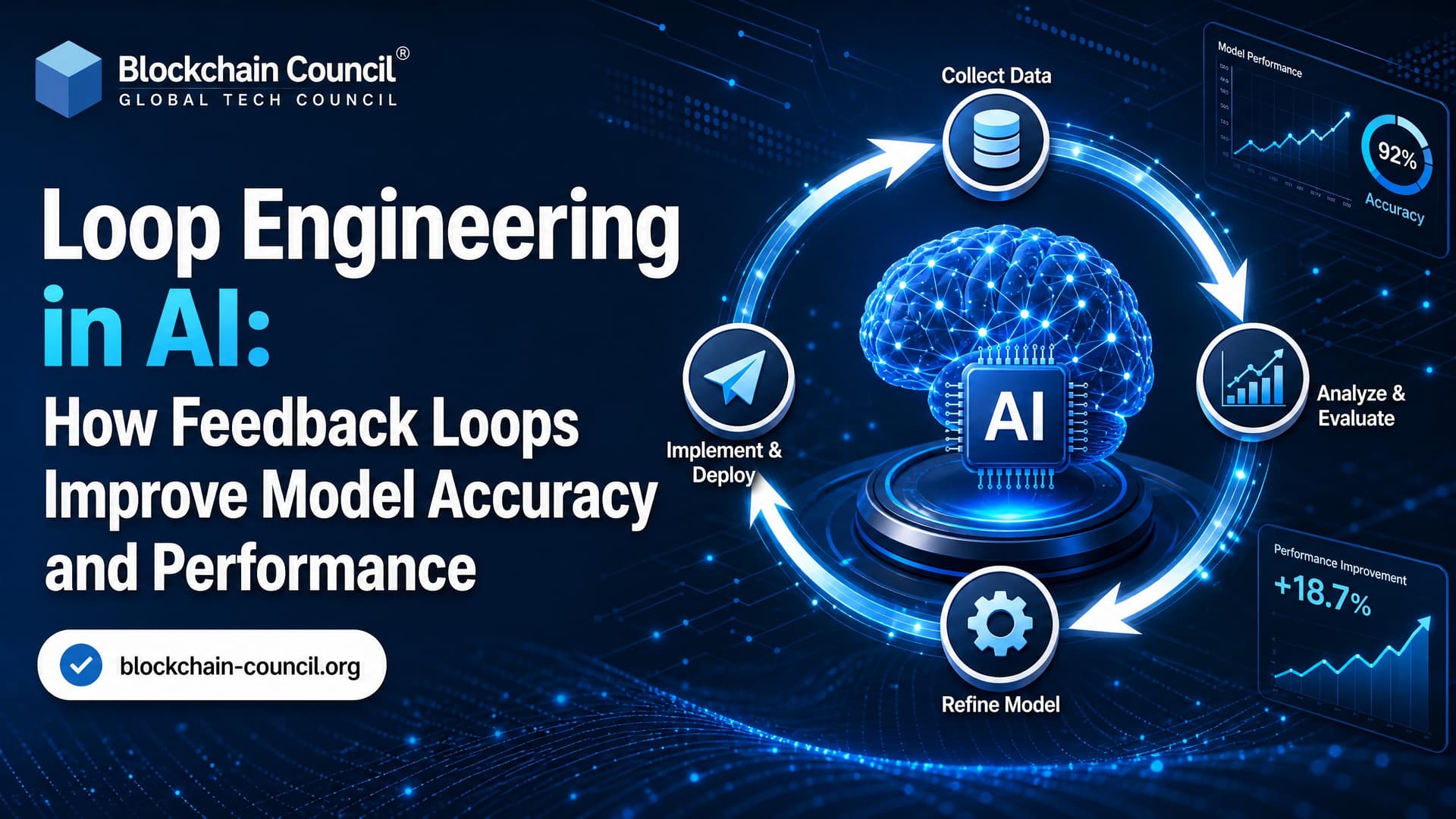
Loop engineering in AI is the practice of designing feedback loops that help models learn from errors, user behavior, human review, production monitoring, and real-world outcomes. If you have ever shipped a model that looked excellent in a notebook and then decayed after two months in production, you already know why this matters.
The core idea is simple. A model makes a prediction or takes an action. The system measures what happened next. That signal flows back into training, evaluation, monitoring, or policy. Done well, accuracy and performance improve over time. Done poorly, you amplify bias, build echo chambers, or train the system on its own mistakes.

What Is Loop Engineering in AI?
A feedback loop in machine learning is a process where model outputs are evaluated and the results are used to improve future behavior. In supervised learning, the loop is familiar: compare predictions with ground truth, compute loss, update parameters, repeat.
In production AI, the loop is wider. It can include:
Training-time error feedback: Loss functions, gradients, rewards, and penalties that guide learning.
Human-in-the-loop feedback: Experts correct labels, review generated outputs, or approve high-risk decisions.
Monitoring loops: Teams track drift, accuracy, latency, and data quality after deployment.
User interaction loops: Clicks, purchases, ratings, skipped recommendations, and support outcomes become signals.
Policy and governance loops: Audits, appeals, compliance findings, and incident reviews change model behavior or operating rules.
Loop engineering is the deliberate design of these mechanisms. You decide where feedback is collected, how it is stored, who reviews it, when retraining happens, and which signals are trusted enough to change a deployed system.
As AI development increasingly relies on advanced language models and agentic workflows, a Claude AI Certification can help professionals strengthen their understanding of prompt engineering, AI-assisted development, model evaluation, and responsible deployment practices.
Why Feedback Loops Improve Accuracy and Performance
1. They turn errors into training signal
Models improve when they receive meaningful feedback. In a classifier, the feedback may be a wrong label. In a reinforcement learning system, it may be a reward. In a generative AI workflow, it may be a human rating that says an answer was factually incorrect or missed the user's intent.
This is why static models are risky. If the data distribution changes and your model has no way to detect or learn from that change, accuracy quietly drops. No alarm. No drama. Just bad decisions.
2. They catch drift before users do
Production monitoring is one of the most important feedback loops in modern MLOps. It compares current model inputs and outputs against a known reference period. When the distribution shifts, teams can investigate before a business metric collapses.
There are two common cases:
Ground truth is available: You can calculate accuracy, F1 score, precision, recall, RMSE, or another task metric.
Ground truth is delayed: You track proxy signals such as data drift, prediction drift, missing values, confidence score changes, or abnormal feature ranges.
A practical warning: log a prediction_id at inference time. This sounds boring, but it saves projects. In lending, insurance, support automation, and fraud detection, labels often arrive days or weeks later. If you did not store a stable request ID, model version, feature snapshot, timestamp, and prediction output, you cannot reliably join outcomes back to predictions. I have watched teams discover this only after collecting a month of unusable logs.
3. They align models with real outcomes
Offline metrics are useful, but they are not the whole story. A support chatbot may score well on test questions and still frustrate customers. A recommendation model may maximize clicks while reducing user trust. A credit model may look accurate while denying too many qualified applicants from a segment with sparse historical data.
Closed-loop learning connects model behavior to actual outcomes. Did the customer resolve the ticket? Did the recommended product get returned? Did a fraud alert lead to a confirmed case or a false positive? These signals help models optimize for the real task, not just a convenient metric.
Loop Engineering for Generative AI and LLM Workflows
For generative AI systems, including workflows built around large language models, feedback loops need extra care because outputs are open-ended. You are not only checking whether a class label was correct. You are evaluating factuality, tone, policy compliance, citation quality, reasoning steps, and usefulness.
Feedback loops worth building for LLM applications include:
Prompt evaluation loops: Compare prompt versions against a fixed evaluation set before deployment.
Human rating loops: Ask reviewers to score answers for correctness, completeness, and safety.
Retrieval feedback loops: Track whether the retrieved documents actually supported the answer.
Escalation loops: Send low-confidence or high-risk outputs to a human reviewer.
Incident loops: Feed hallucination reports, policy failures, and user complaints into prompt, retrieval, or guardrail updates.
One setting that quietly changes evaluation quality is the temperature parameter. If you test a prompt at temperature 0 and deploy it at 0.7, your evaluation results may not match production behavior. For factual enterprise assistants, keep evaluation settings close to deployment settings, and record the model name, prompt version, retrieval configuration, and decoding parameters for every test run.
Human-in-the-Loop Is Not a Magic Fix
Human-in-the-loop systems add judgment where automation alone is weak. Medical imaging, identity verification, manufacturing safety, fraud review, and legal operations all benefit from expert review. Human feedback can improve edge-case coverage and correct bad labels.
But human involvement can also introduce inconsistency. Two reviewers may disagree. A senior analyst may override a model out of habit rather than evidence. In sequential decision systems, research on loan approval simulations suggests that continuous updating can reduce discrimination, while poorly managed human overrides can interrupt that self-correction.
So be blunt about the design. Use humans where they add domain knowledge, not as a vague safety blanket. Write reviewer guidelines. Measure inter-annotator agreement. Audit override patterns. Track whether human corrections improve downstream metrics or just add noise.
Common Feedback Loop Types in AI Systems
Machine learning research classifies feedback loops by where they affect the pipeline. For practitioners, five types matter most.
Sampling loops
Your model influences what data you collect next. A recommender shows certain items, users click on what they can see, and future training data overrepresents those exposed items.
Outcome loops
A decision changes the outcome you later measure. If a bank rejects an applicant, it may never observe whether that person would have repaid the loan.
Feature loops
Model decisions affect future features. A risk score may change how a user is treated, which then changes future engagement or behavior signals.
Model loops
A model trains on data shaped by a previous model. This is common in recommender systems and generative AI pipelines where synthetic or model-filtered data enters training sets.
Human oversight loops
Human reviewers correct, approve, reject, or override outputs. The correction becomes part of future training or policy updates.
When Feedback Loops Make Models Worse
Feedback loops are powerful because they compound. That is also the danger.
Bias amplification: If historical decisions were biased, retraining on those outcomes repeats the pattern.
Echo chambers: Recommender systems can narrow what users see, then learn from the narrowed behavior.
Hidden concept drift: The model changes the environment, and the changed environment changes the data.
Feedback delay: Labels may arrive too late for quick correction.
Proxy metric failure: Drift metrics may look stable while true performance drops.
Compliance gaps: Sensitive feedback data can create privacy, consent, and audit issues.
The wrong move is to retrain automatically on every new signal. Not all feedback is good feedback. Some of it is biased, delayed, adversarial, or caused by the model itself.
A Practical Loop Engineering Checklist
Run through this before you deploy an AI model into a live workflow:
Define the loop objective: Accuracy, safety, fairness, cost, user satisfaction, latency, or a mix.
Log the right artifacts: Input snapshot, prediction, model version, prompt version, user action, and eventual label.
Separate feedback types: Do not mix expert labels, user clicks, complaints, and automated scores as if they mean the same thing.
Set retraining rules: Use thresholds for drift, performance drops, or label volume. Manual approval is often best for high-risk models.
Audit human overrides: Track who overrode what, why, and whether it improved outcomes.
Test for subgroup impact: Measure performance across customer segments, regions, languages, and device types where relevant.
Version everything: Data, prompts, embeddings, model binaries, retrieval indexes, and evaluation sets.
A Tech Certification can further strengthen these capabilities by building practical knowledge of emerging technologies, cloud infrastructure, software systems, and digital tools that support reliable AI engineering and production-ready deployments.
Where Loop Engineering Fits in an AI Career Path
If you build production AI systems, loop engineering sits between machine learning, MLOps, data governance, and product design. Developers need to know how to instrument systems. Data scientists need to understand delayed labels and drift. Business teams need to define which outcomes matter.
For structured learning, Blockchain Council programs such as the Certified Artificial Intelligence (AI) Expert™, Certified Generative AI Expert™, and Certified Prompt Engineer™ are useful starting points. They connect model design, prompt evaluation, and AI governance with practical deployment skills.
Engineer the Loop, Not Just the Model
The model is only one part of an AI system. The feedback loop decides how that system behaves after launch.
Start small. Choose one deployed model or LLM workflow, add reliable prediction logging, define a feedback signal, and build a review process for errors. Then add drift monitoring and retraining rules. If you are preparing for an AI role, make loop engineering part of your portfolio: build a simple closed-loop support assistant or recommendation system and document how feedback changes its performance over time.
As AI-powered products continue to reach broader industries, a Marketing Certification can also help professionals understand product positioning, customer communication, market adoption, and go-to-market strategies for innovative AI solutions.
FAQs
1. What Is Loop Engineering in AI?
Loop engineering in AI is the practice of designing feedback-driven systems that continuously monitor AI performance, collect data, evaluate outputs, and improve models or workflows through iterative learning and optimization.
2. Why Is Loop Engineering Important in Artificial Intelligence?
Loop engineering helps AI systems become more accurate, reliable, and adaptive by using continuous feedback to refine models, reduce errors, improve decision-making, and optimize performance over time.
3. How Does Loop Engineering Work in AI?
It follows a continuous cycle of collecting data, generating AI outputs, evaluating results, gathering feedback, updating models or workflows, and measuring performance to enable ongoing improvement.
4. What Is a Feedback Loop in AI?
A feedback loop is a process where AI systems use information about previous outputs, user interactions, or performance metrics to improve future predictions, recommendations, or automated decisions.
5. How Is Loop Engineering Different from Traditional AI Development?
Traditional AI development often focuses on training and deploying models. Loop engineering extends this by continuously monitoring, evaluating, and improving AI systems after deployment using real-world feedback.
6. What Are the Key Components of Loop Engineering?
Key components include data collection, model inference, feedback collection, performance monitoring, evaluation metrics, retraining, automation, human review, and continuous optimization.
7. How Does Human Feedback Improve AI Systems?
Human feedback helps identify inaccurate outputs, reduce bias, improve model quality, validate predictions, and teach AI systems to generate more accurate and useful responses over time.
8. What Role Does Data Play in Loop Engineering?
High-quality data is the foundation of loop engineering. It provides the information needed to evaluate AI performance, identify improvement opportunities, retrain models, and support reliable decision-making.
9. How Does Loop Engineering Improve Large Language Models (LLMs)?
Loop engineering helps LLMs improve by incorporating user feedback, monitoring response quality, identifying failure patterns, refining prompts or workflows, and supporting ongoing model optimization.
10. How Can AI Agents Benefit from Loop Engineering?
AI agents can use feedback loops to evaluate completed tasks, learn from outcomes, adjust future actions, optimize workflows, and improve autonomous decision-making within defined operational limits.
11. What Is Retrieval-Augmented Generation (RAG) in Loop Engineering?
RAG enhances AI responses by retrieving relevant external information before generating outputs. Combined with feedback loops, it helps improve response accuracy, relevance, and factual grounding.
12. How Does Loop Engineering Support AI Automation?
Loop engineering enables automated monitoring, performance evaluation, workflow optimization, and continuous system improvements, making AI-powered automation more reliable and efficient.
13. Which Industries Use Loop Engineering in AI?
Industries including healthcare, finance, manufacturing, retail, cybersecurity, education, logistics, customer service, software development, and marketing use loop engineering to optimize AI systems.
14. What Technologies Support Loop Engineering?
Common technologies include machine learning, large language models (LLMs), AI agents, data pipelines, APIs, vector databases, cloud platforms, monitoring tools, MLOps platforms, and analytics dashboards.
15. What Are the Benefits of Loop Engineering in AI?
Benefits include continuous model improvement, better prediction accuracy, faster adaptation to changing data, improved automation, reduced operational errors, stronger user experiences, and more efficient AI systems.
16. What Challenges Exist When Implementing Loop Engineering?
Challenges include maintaining high-quality data, avoiding feedback bias, managing retraining costs, monitoring AI performance at scale, ensuring privacy, and balancing automation with human oversight.
17. How Can Organizations Build Effective AI Feedback Loops?
Businesses should define measurable KPIs, collect reliable user feedback, monitor AI performance continuously, validate outputs, retrain models when appropriate, and maintain strong governance practices.
18. What Skills Are Needed for Loop Engineering in AI?
Professionals should understand machine learning, prompt engineering, MLOps, data analytics, software engineering, model evaluation, AI monitoring, cloud computing, automation, and systems thinking.
19. What Common Mistakes Should Organizations Avoid When Implementing Loop Engineering?
Avoid collecting feedback without using it, relying on poor-quality data, retraining models without proper validation, ignoring human oversight, and tracking too many irrelevant metrics. Effective loop engineering depends on clear objectives, high-quality feedback, rigorous evaluation, and continuous monitoring.
20. How Will Loop Engineering Shape the Future of AI?
Loop engineering will become a foundational practice for building adaptive AI systems that continuously learn from real-world interactions. As AI agents, generative AI, and autonomous workflows become more widespread, feedback-driven architectures will help organizations improve model performance, increase reliability, reduce operational risks, and create intelligent systems that evolve alongside changing user needs and business environments.
Related Articles
View All
Claude Ai
Loop Engineering in Blockchain: Transparent Feedback for Dapps
Learn how loop engineering in blockchain connects smart contracts, governance, tokenomics, and analytics to create transparent feedback mechanisms for dapps.

Claude Ai
How Marketing Teams Can Use Fable 5 to Improve Campaign Performance
Marketing teams can use Fable 5 to improve campaign strategy, research, content, reporting, GEO, and optimization with stronger governance.

Claude Ai
Fable 5 vs Sonnet 5: Performance, Accuracy, and Best Use Cases Compared
Fable 5 leads on hard reasoning and agentic coding, while Sonnet 5 wins on cost, latency, and daily production use. Here is when to use each.
Trending Articles
AWS Career Roadmap
A step-by-step guide to building a successful career in Amazon Web Services cloud computing.
How Blockchain Secures AI Data
Understand how blockchain technology is being applied to protect the integrity and security of AI training data.

Can DeFi 2.0 Bridge the Gap Between Traditional and Decentralized Finance?
The next generation of DeFi protocols aims to connect traditional banking with decentralized finance ecosystems.