

Loop Engineering in Blockchain: Transparent Feedback for Dapps
 Suyash Raizada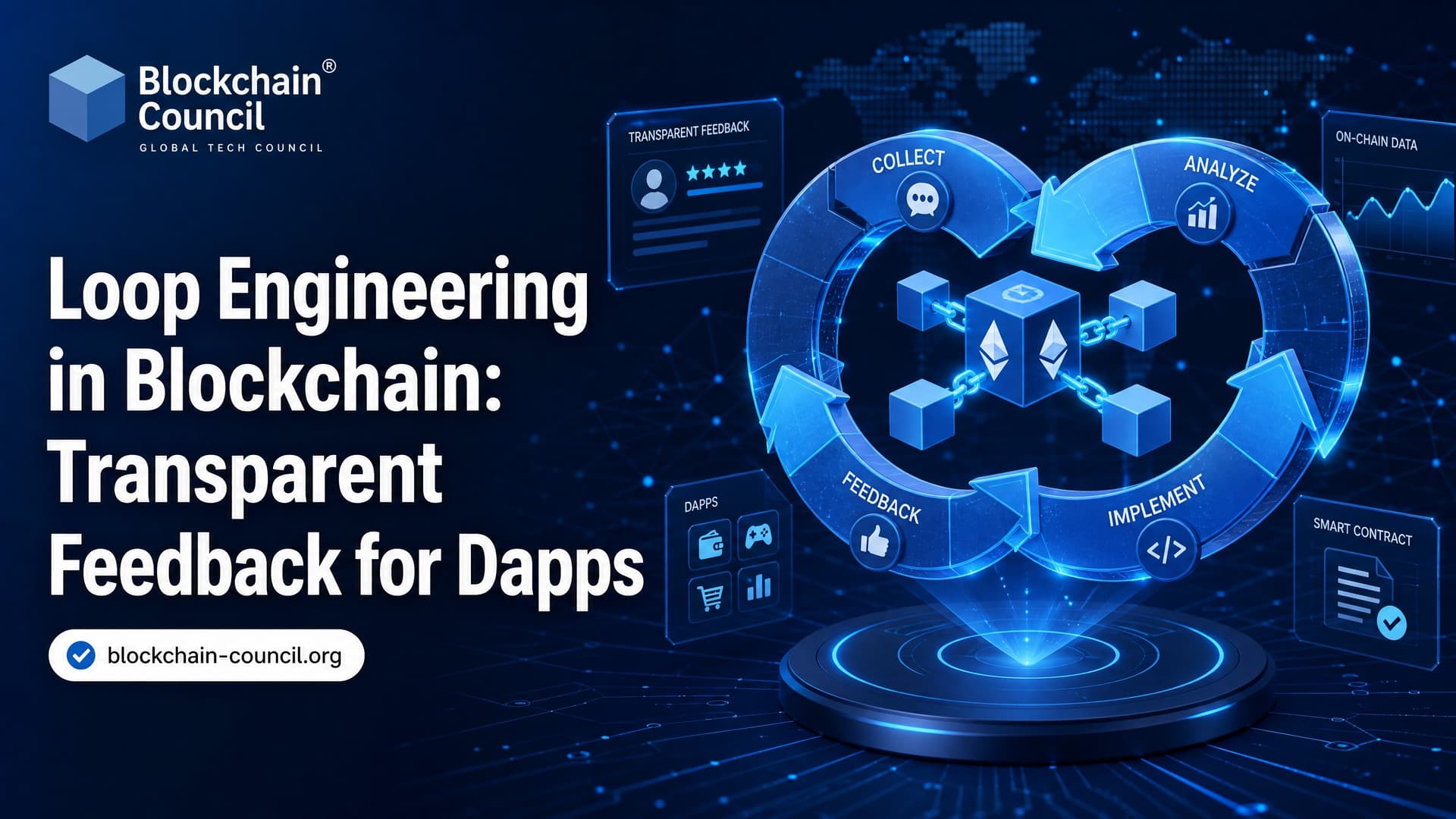
Loop engineering in blockchain means designing clear feedback paths between users, smart contracts, token incentives, governance votes, and offchain analytics. If a decentralized app cannot show why a parameter changed, why rewards moved, or why a security rule fired, the loop is broken. Users may still see transactions on a block explorer, but they do not see accountability.
The idea borrows partly from AI agent design, where useful systems are built around repeated tool calls, monitoring, evaluation, and correction instead of one isolated output. In blockchain, the same discipline applies to protocol behavior. You map what happens onchain, measure it, feed it into governance or automation, then publish the result in a form users can inspect.

As AI increasingly supports blockchain governance, analytics, and protocol monitoring, a Claude AI Certification can help professionals develop practical skills in AI-assisted reasoning, prompt engineering, and responsible automation for complex technical environments.
What Loop Engineering Means for Decentralized Apps
A decentralized app already produces signals. Every swap, stake, loan, vote, liquidation, bridge transfer, and contract upgrade leaves a trace. Loop engineering turns those traces into a designed operating system for the protocol.
A basic loop looks like this:
Action: A user interacts with a smart contract.
Signal: The contract emits events and updates state.
Measurement: Indexers, dashboards, and analytics tools process the data.
Decision: Governance, maintainers, or automated rules interpret the signal.
Adjustment: Fees, rewards, risk parameters, or access rules change.
Review: The community checks whether the change worked.
That last step matters most, and it is the one teams skip. Plenty of projects collect analytics. Far fewer close the loop by tying metrics to decisions and then publishing the outcomes.
Why Transparent Feedback Mechanisms Matter
Blockchain systems are reflexive. Token price affects user confidence. Confidence affects staking, liquidity, borrowing, and governance participation. Those behaviors then feed back into the token. George Soros described similar reflexivity in financial markets, where expectations and fundamentals influence each other. Crypto makes this visible, fast, and sometimes painful.
Without explicit feedback loops, protocols drift. Rewards attract mercenary capital instead of useful participation. DAO votes pass with low turnout. A lending market keeps an unsafe collateral factor because nobody connected liquidation data to a governance action.
Transparent feedback mechanisms help you answer hard questions:
Who actually benefits from a reward schedule?
Which wallets are voting, and which users stay silent?
Are fees funding useful security, or just reducing usage?
Did a contract upgrade reduce risk, or only move it elsewhere?
Which offchain signals are trusted enough to affect onchain rules?
To be blunt, transparency is not the same as readability. Raw transaction data on Ethereum is public, but most users cannot reason from calldata and event logs alone. Loop engineering adds the structure.
Core Components of Loop Engineering in Blockchain
Onchain Event Logging and Telemetry
Events are the first layer of feedback. Solidity contracts emit events so applications, indexers, and analysts can track behavior without scanning every storage slot. Tools such as Etherscan and The Graph make those logs queryable for dashboards, risk systems, and governance reports.
One detail developers learn fast: do not treat events as an afterthought. A standard Solidity event allows up to three indexed parameters, so choose them carefully. If you index the wrong fields, your analytics team will later ask why filtering by market, vault, or proposal ID is expensive or awkward.
And if you build a subgraph, never use the transaction hash alone as an entity ID when one transaction can emit multiple matching events. Add the log index. Otherwise you overwrite records and your dashboard quietly lies to you. That bug shows up in almost every first subgraph build.
Token Incentives as Feedback Channels
Tokenomics is not just supply and emissions. It is signal design. Staking, slashing, liquidity rewards, vesting, fee sharing, and voting power all send information back to the protocol.
A staking loop reads simple on paper. More staking can improve security or economic alignment. Higher perceived security can attract more users. More users can increase fees or network activity, which makes staking more attractive. Good loop. Maybe.
The catch is that positive loops turn unstable. High emissions attract short-term capital that exits the moment rewards fall. Reflexive collateral designs inflate during booms and unwind violently under stress. If your token feedback system does not monitor concentration, reward leakage, and liquidity depth, you are not engineering a loop. You are guessing.
Governance Loops and Accountability
Onchain governance converts stakeholder feedback into protocol changes. Proposals, votes, quorum thresholds, timelocks, and execution transactions create a public record of how a community reacts.
DAO voting design is a serious architectural choice. Token-weighted voting is simple and common, but it concentrates power. Delegated voting can lift participation, yet it introduces representative accountability problems. Offchain voting through tools such as Snapshot is cheaper and easier, while onchain execution gives stronger auditability. Pick based on risk. A treasury parameter can tolerate more flexibility than a contract upgrade controlling user funds.
Protocols such as Lido draw scrutiny on governance because they involve validators, token holders, node operators, developers, and Ethereum users at once. That is exactly where loop engineering earns its keep: proposal discussion, delegation, execution, validator performance, and market response all feed back into the next decision.
Adaptive Rule Engines and Smart Contract Controls
Some loops can be partly automated. Adaptive security research has shown how context engines and rule engines process real-time data, then update policies enforced by smart contracts. The same pattern fits DeFi risk controls, supply chain applications, insurance, and infrastructure networks.
Use automation carefully. A circuit breaker that pauses a market when liquidity drops below a threshold can protect users. A fully automated fee model driven by a noisy oracle can open new attack surfaces. If offchain data affects onchain behavior, document the oracle source, update frequency, failure mode, and who can override it.
Monitoring, Alerts, and Incident Response
Monitoring is the bridge between observation and action. Teams commonly combine block explorers, custom indexers, The Graph, OpenZeppelin Defender, Tenderly, Prometheus, Grafana, and alerting channels to watch contracts in production.
Useful alerts are specific. Do not fire on every large transaction. Alert when a vault utilization ratio crosses a governance-approved threshold, when a privileged role changes, when a proxy implementation address updates, or when liquidations exceed normal ranges. Connect each alert to an owner and a playbook.
A Practical Loop Engineering Blueprint
If you are building or auditing a dapp, start small. Map one critical loop before you try to model the whole protocol.
Choose a high-risk flow. For DeFi, pick liquidations, reward distribution, oracle updates, or admin upgrades.
Define the signal. Decide which contract events, state variables, wallet actions, or external data points matter.
Emit clean events. Include IDs, actors, amounts, market addresses, and old and new values where needed.
Index the data. Use The Graph, Dune, Flipside, a custom ETL pipeline, or direct RPC ingestion depending on latency needs.
Set thresholds. Link metrics to action. For example, if governance participation drops below a target for three proposal cycles, review the delegation design.
Publish dashboards. Let users inspect the same metrics that maintainers use.
Close the decision loop. Tie alerts and reports to governance proposals, admin actions, or automated safeguards.
Review after changes. Measure whether the update improved the metric without damaging another part of the system.
This is where structured training helps. Blockchain Council programs such as Certified Blockchain Developer™, Certified Smart Contract Developer™, Certified Ethereum Expert™, and Certified DeFi Expert™ map well to readers who want to connect smart contract design, tokenomics, governance, and security monitoring.
AI and the Next Stage of Blockchain Feedback Loops
AI can sharpen loop engineering, but only if the loop stays observable. Models can flag abnormal token flows, summarize governance debates, simulate parameter changes, or draft proposal risk notes. That is genuinely useful work.
The wrong approach is letting an opaque AI agent change protocol settings with no audit trail. Keep the human-readable path intact: input data, model output, confidence, reviewer, decision, execution transaction, and the post-change metric. If you are studying AI alongside blockchain, the Certified Artificial Intelligence (AI) Expert™ pairs well with smart contract and DeFi training.
A Tech Certification can further broaden these capabilities by strengthening knowledge of emerging technologies, cloud platforms, software engineering, and digital systems that support secure, scalable blockchain and AI applications.
Future Outlook for Loop Engineering in Blockchain
Expect more protocols to define feedback mechanisms in their documentation, not only in dashboards. Voter turnout, delegated voting concentration, liquidity depth, liquidation efficiency, validator performance, and treasury runway will become standard governance inputs.
Adaptive protocols will keep growing too. Dynamic fees, risk-based collateral settings, automated pause conditions, and context-aware access controls are already practical. The hard part is not writing code that changes a parameter. The hard part is proving why it changed and whether the change actually helped.
Regulators and institutional users will push in the same direction. A protocol that can show observable loops between user behavior, risk signals, governance decisions, and contract execution is far easier to assess than one that leans on informal admin judgment.
Final Takeaway
Loop engineering in blockchain turns transparency into a working discipline. Do not stop at public transactions. Design the event logs, dashboards, governance triggers, incentive checks, and post-change reviews that keep a dapp accountable over time.
Your next step: pick one live protocol or one contract you are building, map its most important feedback loop, then find the missing signal. If the gap is in contract design, study smart contract development. If it sits in governance or incentives, focus on DeFi and blockchain architecture. That is where transparent decentralized systems start to earn trust.
As blockchain platforms continue to mature across enterprise and consumer markets, a Marketing Certification can also help professionals understand product positioning, user education, stakeholder engagement, and go-to-market strategies for emerging technology solutions.
FAQs
1. What Is Loop Engineering in Blockchain?
Loop engineering in blockchain is the practice of designing feedback-driven blockchain systems that continuously monitor network activity, evaluate outcomes, automate responses, and optimize workflows using on-chain data, smart contracts, and AI.
2. Why Is Loop Engineering Important in Blockchain?
Loop engineering helps blockchain applications become more adaptive, efficient, and secure by continuously analyzing network data, improving automated processes, and optimizing decentralized operations through feedback loops.
3. How Does Loop Engineering Work in Blockchain?
It follows a cycle of collecting blockchain data, monitoring transactions, analyzing performance, triggering automated actions through smart contracts or AI agents, measuring results, and refining workflows based on feedback.
4. What Is a Feedback Loop in Blockchain?
A blockchain feedback loop is a process where on-chain data, user activity, or network performance is continuously monitored and used to improve smart contract execution, governance, security, or decentralized applications (DApps).
5. How Is Loop Engineering Different from Traditional Blockchain Automation?
Traditional blockchain automation relies on predefined smart contract logic, while loop engineering adds continuous monitoring, AI-driven analysis, feedback mechanisms, and ongoing optimization to improve blockchain workflows over time.
6. How Do AI Agents Support Loop Engineering in Blockchain?
AI agents analyze blockchain activity, monitor wallet behavior, detect anomalies, automate smart contract interactions, optimize workflows, and continuously improve decentralized operations using real-time feedback.
7. How Does Loop Engineering Improve Smart Contracts?
Loop engineering enables smart contracts to operate within broader feedback-driven systems where AI agents or monitoring services evaluate outcomes, trigger follow-up actions, and optimize workflows based on predefined business objectives.
8. How Can Loop Engineering Improve Decentralized Applications (DApps)?
It helps DApps monitor user behavior, automate decision-making, improve performance, optimize resource allocation, and continuously enhance user experiences using blockchain analytics and feedback.
9. What Role Does Artificial Intelligence Play in Blockchain Loop Engineering?
AI analyzes blockchain data, identifies transaction patterns, predicts outcomes, detects security threats, automates decisions, and optimizes decentralized workflows based on continuous feedback.
10. How Does Loop Engineering Support Decentralized Finance (DeFi)?
Loop engineering enables continuous monitoring of DeFi protocols, liquidity pools, lending positions, staking performance, and portfolio strategies while allowing AI agents to optimize financial operations.
11. Can Loop Engineering Improve Blockchain Security?
Yes. AI-powered feedback loops can monitor blockchain activity, identify suspicious transactions, detect smart contract anomalies, assess risks, and support faster incident response.
12. How Does Loop Engineering Support DAO Governance?
Loop engineering helps DAOs monitor governance proposals, evaluate voting participation, analyze community feedback, and improve governance workflows through continuous performance measurement.
13. Which Technologies Support Loop Engineering in Blockchain?
Core technologies include blockchain, smart contracts, AI agents, machine learning, large language models (LLMs), blockchain analytics, APIs, decentralized oracles, cloud computing, and monitoring platforms.
14. Which Industries Can Benefit from Blockchain Loop Engineering?
Finance, supply chain, healthcare, insurance, logistics, gaming, digital identity, enterprise blockchain, energy, and government sectors can benefit from blockchain feedback-driven automation.
15. What Are the Benefits of Loop Engineering in Blockchain?
Benefits include improved automation, stronger security, faster decision-making, enhanced transparency, continuous optimization, reduced operational costs, better governance, and more efficient decentralized systems.
16. What Challenges Exist When Implementing Loop Engineering in Blockchain?
Challenges include blockchain scalability, interoperability, smart contract limitations, integration complexity, data quality, governance, privacy concerns, regulatory uncertainty, and balancing automation with human oversight.
17. How Can Businesses Prepare for Blockchain Loop Engineering?
Organizations should identify automation opportunities, establish governance frameworks, integrate blockchain analytics, deploy AI-powered monitoring, audit smart contracts, and implement measurable performance metrics.
18. What Skills Are Needed for Blockchain Loop Engineering?
Professionals should understand blockchain architecture, smart contracts, artificial intelligence, machine learning, blockchain analytics, decentralized applications (DApps), APIs, cybersecurity, automation, and systems design.
19. What Common Mistakes Should Organizations Avoid When Implementing Blockchain Loop Engineering?
Avoid automating inefficient blockchain workflows, relying on poor-quality on-chain data, ignoring smart contract audits, deploying AI agents without governance, and failing to monitor feedback loops after deployment. Effective loop engineering requires continuous evaluation, secure automation, clear operational policies, and human oversight for high-impact decisions.
20. How Will Loop Engineering Shape the Future of Blockchain?
Loop engineering is expected to become a key architectural approach for intelligent blockchain systems by combining AI, smart contracts, and continuous feedback. As decentralized applications, AI agents, and Web3 ecosystems become more sophisticated, organizations will increasingly use feedback-driven blockchain workflows to improve automation, strengthen security, optimize governance, and build adaptive decentralized systems that evolve with changing user needs and network conditions.
Related Articles
View All
Claude Ai
Loop Engineering in AI: How Feedback Loops Improve Model Accuracy and Performance
Learn how loop engineering in AI uses feedback loops, monitoring, and human review to improve model accuracy, performance, and governance.

Claude Ai
Loop Engineering vs Prompt Engineering: Key Differences, Use Cases, and Future Trends
Loop engineering vs prompt engineering explained with practical differences, AI agent use cases, Claude AI examples, career trends, and learning paths.

Claude Ai
Loop Engineering for Automation: Designing Smarter Business Processes with AI Agents
Learn how loop engineering for automation uses AI agents, AIOps, and governed feedback loops to improve business workflows at enterprise scale.
Trending Articles
The Role of Blockchain in Ethical AI Development
How blockchain technology is being used to promote transparency and accountability in artificial intelligence systems.

Top 5 DeFi Platforms
Explore the leading decentralized finance platforms and what makes each one unique in the evolving DeFi landscape.
How Blockchain Secures AI Data
Understand how blockchain technology is being applied to protect the integrity and security of AI training data.