

Loop Engineering vs Prompt Engineering: Key Differences, Use Cases, and Future Trends
 Suyash Raizada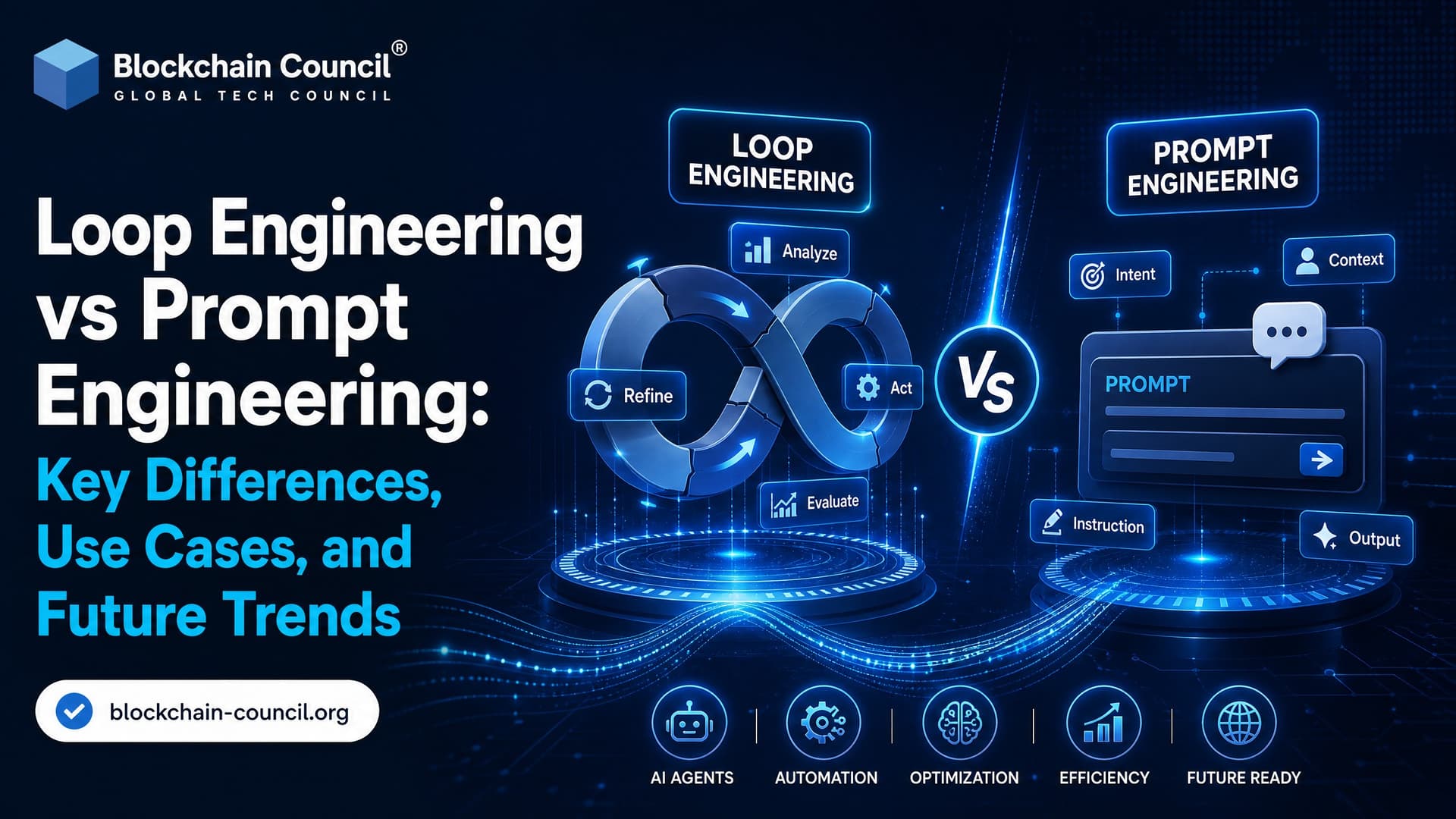
Loop engineering vs prompt engineering is becoming a practical distinction for anyone building with Claude AI, ChatGPT, open source LLMs, or enterprise AI agents. Prompt engineering improves a single model interaction. Loop engineering designs the full cycle around that interaction: goal, context, tool use, validation, retry, human review, and stop condition.
That difference sounds small until you ship something. A clever prompt can draft a useful answer. A well designed loop can inspect a codebase, change files, run tests, read the failure, make a smaller fix, and stop when the task is done or unsafe. Different skill. Different risk profile.

As AI development increasingly moves toward agentic workflows, a Claude AI Certification can help professionals build practical expertise in long-context reasoning, prompt design, AI-assisted coding, and responsible deployment of enterprise AI applications.
What Is Prompt Engineering?
Prompt engineering is the practice of writing and structuring inputs so a generative AI model produces useful, accurate, and controlled outputs. You define the role, task, context, examples, constraints, tone, and output format.
Common prompt engineering techniques include:
Role prompting: Ask the model to act as a security reviewer, Solidity developer, data analyst, or technical editor.
Few-shot examples: Provide sample inputs and outputs so the model follows a pattern.
Structured output: Request JSON, tables, XML, Markdown, or fixed fields.
Constraint setting: Specify what the model must avoid, such as unsupported claims or unsafe code.
Iterative refinement: Improve the prompt after checking the model output.
Prompt engineering still matters. In Claude, for example, a vague request such as review this code often produces broad commentary. A better prompt gives a target: Find reentrancy, unchecked external calls, and broken access control in this Solidity 0.8.x contract. Return only high severity issues with exploit steps. That is prompt work, and it changes the answer.
There is a catch. Prompt engineering depends heavily on a human steering the process. You run the prompt, inspect the output, change the prompt, and try again. Useful. Not enough for autonomous systems.
What Is Loop Engineering?
Loop engineering is the design of AI workflows that repeat cycles of action and feedback until a goal is met, blocked, or escalated to a human. The prompt is only one part of the system.
A typical loop for an AI coding agent looks like this:
Read the task and inspect relevant files.
Plan the next smallest change.
Edit code or configuration.
Run tests, linters, type checks, or security scans.
Read errors and logs.
Revise the plan.
Repeat until validation passes or a stop rule triggers.
In real projects, the validation step is where loop engineering earns its keep. I have seen agents write a smart-looking Solidity patch that still failed because Hardhat returned Error: VM Exception while processing transaction: reverted with reason string 'Ownable: caller is not the owner'. A prompt-only workflow might miss that. A loop reads the failure, checks the caller setup, updates the test fixture, and reruns the suite. If it hits the same failure three times, it should stop and ask you.
Good loop engineering defines:
Goal state: What does done mean?
Available tools: Shell, browser, database, code editor, test runner, ticketing system, or blockchain node.
Context window rules: What files, logs, or documents should the agent see?
Validation: Unit tests, schema checks, policy checks, human approval, or production metrics.
Failure exits: Maximum retries, blocked states, risk flags, and escalation paths.
Memory: What should persist across iterations?
Loop Engineering vs Prompt Engineering: Core Differences
1. Unit of design
Prompt engineering designs the input to a model call. Loop engineering designs the whole operating pattern around many model calls.
If you ask Claude to summarize a smart contract audit report, prompt engineering is the main skill. If you want an agent to triage 200 audit findings, map them to files, open GitHub issues, verify fixes, and produce status reports, you need loop engineering.
2. Control model
Prompt engineering is usually human-directed. You decide what to ask next.
Loop engineering is system-directed. The workflow decides the next action based on observations. It may continue, branch, retry, call a tool, or stop. That makes it closer to software architecture than copywriting.
3. Error handling
Prompt engineering handles errors by improving instructions. Add examples. Tighten constraints. Ask for a different format.
Loop engineering handles errors through tests and control flow. If the model returns invalid JSON, the loop can validate against a schema, request repair, and fail after two attempts. If an API call fails with Anthropic's Messages API because max_tokens is missing, the loop should catch the invalid_request_error, record the bad request, and fix the caller configuration rather than asking the model to guess.
4. Skills required
Prompt engineers need clear writing, model behavior knowledge, domain context, evaluation habits, and communication skills. Job postings for prompt-focused roles frequently ask for AI knowledge, prompt design, communication, creative problem solving, testing, and some DevOps exposure.
Loop engineers need those skills plus systems thinking. You should understand APIs, queues, retries, state, logging, version control, test automation, and security boundaries. If the agent can run shell commands, you are now designing an operational system, not just an interface.
Side-by-Side Comparison
Aspect | Prompt engineering | Loop engineering |
|---|---|---|
Primary focus | Quality of one model input and output | Quality of repeated AI action cycles |
Main user | Human operator, analyst, creator, product team | Developer, automation architect, AI agent builder |
Validation | Manual review, examples, output constraints | Tests, logs, metrics, policies, stop rules |
Typical tools | Claude, ChatGPT, prompt templates, playgrounds | Claude Code, LangChain, LangGraph, AutoGen, n8n, CI pipelines |
Best fit | Content, analysis, research, UX, red teaming prompts | Coding agents, enterprise workflows, multi-step automation |
Use Cases for Prompt Engineering
Content and research workflows
Prompt engineering works well when the task is bounded: summarize a policy document, compare vendors, draft training content, or generate customer support replies. The human remains the reviewer.
Model safety and red teaming
Prompt specialists are still valuable in safety work. They write adversarial prompts, test refusal behavior, check hallucination patterns, and document failure modes. Many prompt-focused roles now sit inside model labs, QA teams, and safety teams rather than general product departments.
Structured business outputs
If you need consistent outputs, such as JSON risk summaries or sales call classifications, prompt engineering helps. Just do not trust the prompt alone. Add schema validation.
As organizations expand their use of generative AI, the role of a Prompt Engineer continues to evolve beyond writing prompts to designing structured instructions, evaluation strategies, and reliable AI workflows that produce consistent business outcomes.
Use Cases for Loop Engineering
AI coding agents
This is the clearest use case. An agent reads an issue, edits code, runs tests, and revises. With Claude Code and similar tools, the prompt starts the job, but the loop determines whether the job finishes safely.
For blockchain developers, a useful loop might run forge test, slither, and gas snapshots before proposing a pull request. For Solidity 0.8.x, the loop should understand that arithmetic overflow reverts automatically, so it should not add outdated SafeMath unless the codebase has a specific reason.
Enterprise process automation
Loop engineering fits workflows such as invoice exception handling, compliance checks, customer onboarding, IT ticket triage, and internal knowledge base maintenance. The AI step interprets language. The loop controls routing, retries, audit logs, and approval gates.
Creative production
Audio and video teams already work in loops. Generate a voice layer, test it against timing, adjust, export stems, and repeat. Prompting gives direction. The loop manages iteration and consistency across tools.
Governance and monitoring
Enterprises need repeatable AI evaluations. A governance loop can run test prompts, score outputs, detect policy drift, log failures, and route high-risk cases to reviewers. This is where prompt engineering and loop engineering merge.
Future Trends to Watch
Prompt engineering becomes a baseline skill
Prompt engineering is not dead. That claim is lazy. But it is becoming less credible as a standalone career path for most professionals. Product managers, developers, auditors, analysts, and educators will all be expected to write good prompts as part of their normal work.
Loop engineering becomes a systems skill
As AI agents get more tool access, loop engineering will matter more. The hard question will not be what prompt should I use? It will be what should the agent be allowed to do, how do we verify it, and when must it stop?
Agent workflows will need audit trails
Regulated industries will not accept black-box agent behavior. Teams will need logs that show prompts, tool calls, data sources, validation results, and human approvals. Loop engineering naturally supports that discipline.
Claude AI and agentic tooling will shape practice
Claude's strength in long-context reasoning makes it useful for code review, documentation, and multi-file analysis. Still, context is not memory, and a large context window is not a control system. You need loops, tests, and permissions around the model.
A Tech Certification can further strengthen these capabilities by providing broader knowledge of cloud platforms, software engineering, automation frameworks, and emerging technologies that support production-ready AI systems.
Which Skill Should You Learn First?
If you are new to generative AI, start with prompt engineering. It teaches you how models respond to instructions, examples, ambiguity, and constraints. Blockchain Council's Certified Prompt Engineer™ is a relevant learning path for this foundation.
If you already build software, move quickly into loop engineering. Learn tool calling, agent orchestration, test-driven workflows, CI integration, and monitoring. Pair that with broader AI knowledge through programs such as Certified Artificial Intelligence (AI) Expert™, Certified Generative AI Expert™, or Certified Claude AI Expert™ where relevant to your role.
For enterprises, do not hire only prompt specialists and expect production AI systems to appear. Build mixed teams: domain experts, developers, security reviewers, AI product owners, and governance leads. The prompt gets the model started. The loop makes the work repeatable.
What to Build Next
Build a small loop this week. Pick one task: review a pull request, classify support tickets, or check a policy document. Give the AI a goal, one tool, one validation rule, and one stop condition. Then inspect every failure. That exercise will teach you the real difference between loop engineering and prompt engineering faster than any definition.
As AI-powered products continue to reach broader enterprise and consumer markets, a Marketing Certification can also help professionals understand product positioning, customer communication, user adoption, and go-to-market strategies for innovative AI solutions.
FAQs
1. What Is Prompt Engineering?
Prompt engineering is the process of designing, testing, and refining prompts that guide generative AI models to produce accurate, relevant, and high-quality outputs for specific tasks.
2. What Is Loop Engineering?
Loop engineering is the practice of building feedback-driven AI systems that continuously monitor performance, collect feedback, evaluate results, and optimize prompts, models, or workflows over time.
3. What Is the Difference Between Prompt Engineering and Loop Engineering?
Prompt engineering focuses on creating effective prompts for AI models, while loop engineering focuses on continuously improving entire AI systems through feedback, monitoring, evaluation, and optimization.
4. Why Is Prompt Engineering Important?
Prompt engineering improves the quality, consistency, and relevance of AI-generated responses by providing clear instructions, context, constraints, and examples to the model.
5. Why Is Loop Engineering Important?
Loop engineering enables AI systems to learn from feedback, adapt to changing conditions, reduce errors, optimize workflows, and improve performance continuously after deployment.
6. When Should You Use Prompt Engineering?
Prompt engineering is ideal for content generation, coding assistance, customer support, research, summarization, translation, brainstorming, and conversational AI where better instructions improve outputs.
7. When Should You Use Loop Engineering?
Loop engineering is best suited for production AI systems, AI agents, enterprise automation, customer service platforms, workflow optimization, and applications requiring continuous monitoring and improvement.
8. Can Prompt Engineering and Loop Engineering Work Together?
Yes. Prompt engineering creates effective instructions, while loop engineering continuously evaluates prompt performance and refines prompts based on feedback and measurable outcomes.
9. How Does Feedback Differ in Prompt Engineering and Loop Engineering?
Prompt engineering may use occasional testing and refinement, whereas loop engineering relies on continuous feedback from users, automated evaluations, and performance metrics to improve AI systems over time.
10. Which Skills Are Required for Prompt Engineering?
Prompt engineers should understand large language models (LLMs), prompt design, AI behavior, natural language processing, reasoning patterns, testing, and evaluation techniques.
11. Which Skills Are Required for Loop Engineering?
Loop engineers need knowledge of AI systems, workflow automation, MLOps, AI agents, monitoring, data analytics, prompt optimization, feedback systems, APIs, and systems thinking.
12. How Does Artificial Intelligence Support Loop Engineering?
AI automates evaluation, identifies performance trends, detects workflow bottlenecks, analyzes user feedback, recommends improvements, and optimizes AI-powered business processes.
13. Which Technologies Support Prompt Engineering and Loop Engineering?
Common technologies include large language models (LLMs), AI agents, Retrieval-Augmented Generation (RAG), vector databases, LangChain, LangGraph, LlamaIndex, APIs, MLOps platforms, and observability tools.
14. Which Industries Benefit from Prompt and Loop Engineering?
Healthcare, finance, education, customer support, legal services, software development, cybersecurity, retail, manufacturing, marketing, and enterprise automation all benefit from these approaches.
15. What Are the Benefits of Prompt Engineering?
Benefits include improved AI response quality, better task completion, greater consistency, faster content generation, reduced ambiguity, and enhanced user interactions.
16. What Are the Benefits of Loop Engineering?
Loop engineering delivers continuous optimization, adaptive automation, higher AI reliability, reduced operational errors, better business outcomes, stronger governance, and scalable AI workflows.
17. What Challenges Exist in Prompt Engineering and Loop Engineering?
Prompt engineering faces challenges such as prompt variability and model sensitivity, while loop engineering adds complexities around feedback quality, monitoring, governance, data management, evaluation, and system scalability.
18. How Can Organizations Choose Between Prompt Engineering and Loop Engineering?
Organizations should use prompt engineering to optimize individual AI interactions and adopt loop engineering when building enterprise AI systems that require continuous learning, monitoring, and workflow optimization.
19. What Common Mistakes Should Organizations Avoid?
Avoid assuming prompt engineering alone is sufficient for production AI, collecting feedback without using it, failing to measure AI performance, neglecting prompt version control, and deploying autonomous workflows without governance. Effective AI systems combine high-quality prompts with continuous evaluation and human oversight.
20. What Is the Future of Prompt Engineering and Loop Engineering?
Prompt engineering will remain essential for improving AI interactions, while loop engineering will become increasingly important for managing AI agents and enterprise automation. As generative AI evolves, organizations will combine prompt design, feedback loops, automated evaluation, and AI governance to build adaptive, self-improving systems that deliver reliable, scalable, and business-focused outcomes.
Related Articles
View All
Claude Ai
Claude Prompt vs Claude Looping: Key Differences, Use Cases, and Best Practices
Learn the practical difference between Claude prompting and Claude looping, including when to use each, key risks, agent workflows, and best practices.

Claude Ai
Claude Sonnet 5 Explained: Key Features, Capabilities, and Use Cases
Claude Sonnet 5 brings 1M-token context, adaptive reasoning, stronger agent workflows, and enterprise safety controls for coding and knowledge work.

Claude Ai
Prompt Loop Engineering: Building Self-Improving Generative AI Workflows
Learn how prompt loop engineering uses maker-checker agents, evals, logging, and CI/CD gates to build safer self-improving AI workflows.
Trending Articles

Top 5 DeFi Platforms
Explore the leading decentralized finance platforms and what makes each one unique in the evolving DeFi landscape.
How Blockchain Secures AI Data
Understand how blockchain technology is being applied to protect the integrity and security of AI training data.
How to Create Claude Skills?
Claude Skills are one of the most important features Anthropic has introduced for users who want automation that is structured, consistent and reusable. Instead of giving Claude long instructions ever