

Prompt Loop Engineering: Building Self-Improving Generative AI Workflows
 Suyash Raizada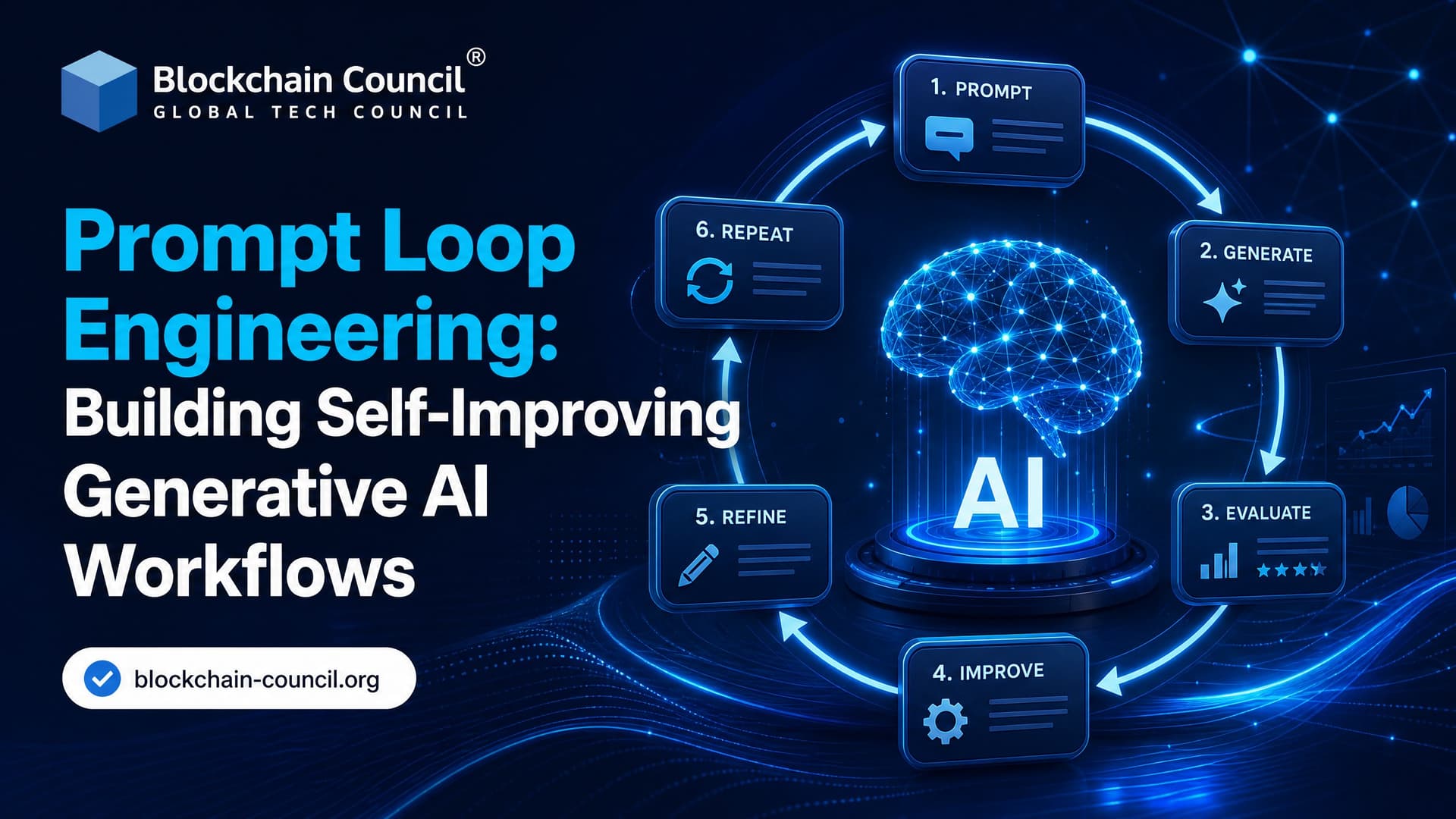
Prompt loop engineering turns generative AI from a one-shot prompt into a closed workflow that generates, checks, fixes, and reruns work until it meets clear quality rules. If you are building with Claude, OpenAI models, coding agents, or multi-agent stacks, this is the difference between a useful demo and a system you can trust in production.
As organizations increasingly deploy Claude-based applications in production, a Claude AI Certification can help professionals build practical skills in prompt engineering, AI workflows, model evaluation, and responsible deployment practices for enterprise environments.

The core idea is simple. Do not ask a model for an answer and hope. Define what "good" means, make the model produce an output, evaluate that output with code, tests, tools, or another model, then feed the failure back into the next attempt. The loop stops only when the result passes the gate, times out, or a human supervisor kills the run.
What Is Prompt Loop Engineering?
Prompt loop engineering is the practice of designing closed-loop generative AI workflows. These workflows contain prompts, context, tools, memory, agents, evaluation logic, and feedback paths. In plain terms, you are no longer writing only prompts. You are writing the control system around the model.
This pattern is now common in AI-assisted software development. A coding agent writes a function, runs tests, reads the error, edits the code, and tries again. Claude Code popularized this style for many developers, and Anthropic engineers have described the move toward systems where prompts, tools, memory, and verification behave like software components.
That does not mean the agent is magically improving itself. It means you gave it a test bench.
The Basic Architecture: Maker, Checker, Kill Switch
A practical prompt loop usually has three roles:
Maker: The agent or model that produces the answer, code, summary, classification, plan, or workflow.
Checker: A separate evaluator that tests the output against rules, schemas, source documents, metrics, or business constraints.
Human kill switch: A person or approval step that stops the loop when it drifts, spends too much, or touches sensitive data.
Keep the maker and checker separate when the task matters. A model can be too forgiving when asked to grade its own work. For factual tasks, use source-grounded checks. For structured outputs, use JSON Schema or Pydantic validation. For code, run the tests. Always.
A tiny but real example: if you ask a model to return JSON and it wraps the answer in Markdown fences, your Node.js parser may fail with Unexpected token ` in JSON at position 0. Beginners often try to fix that with a louder prompt. A better loop catches the parse error, sends the exact failure back to the model, and retries with a schema-constrained instruction. Better still, use native structured output support where your model provider offers it.
Why Prompt Loop Engineering Matters for Claude AI Workflows
Claude is often used for long-context analysis, code generation, document review, and agentic tool use. Those are exactly the areas where prompt loop engineering helps. Long outputs fail in subtle ways. They miss a clause in a contract. They call the wrong tool. They produce a valid-looking JSON object with one missing field.
With Claude tool use, you also need to handle the model's control flow correctly. When the API returns a tool request, your application must execute the tool and send the tool result back before expecting the final answer. If you skip that orchestration, the prompt is not the problem. The loop is broken.
For teams using Claude in production, design around these checks:
Validate every structured response before it reaches a user.
Log prompt version, model name, input hash, tool calls, latency, cost, and evaluation score.
Run a small regression set whenever you change a system prompt.
Use a second evaluator for high-risk outputs, especially legal, financial, medical, or security-related text.
Common Prompt Loop Patterns
Snapshot Evaluation
Start with 20 to 50 representative inputs. Save expected properties for each output. You do not need a huge benchmark on day one. You need enough examples to catch obvious regression.
For a support classification agent, snapshot evals might check:
The category is one of the approved labels.
The priority is valid.
The response includes the customer ID when present.
The model does not invent refund eligibility.
Unit Evals for Agents
Treat each prompt or agent like a software unit. If you have a retrieval agent, a summarizer, and a policy checker, test them separately. End-to-end tests are useful, but they often hide the failing step.
This is where tools such as Promptfoo, Braintrust, Langfuse, and Arize Phoenix fit. They help teams run eval suites, compare prompt versions, trace calls, and set release gates. Some teams also attach evaluation results to OpenTelemetry spans so failed agent steps show up beside normal application traces.
Simulate, Evaluate, Optimize
The simulate-evaluate-optimize loop is gaining attention because it scales testing before real users touch the system.
Simulate: Generate synthetic users or scenarios and run them through the agent.
Evaluate: Score transcripts for task completion, tool-call accuracy, safety, and policy compliance.
Optimize: Use failures to rewrite prompts, adjust tool descriptions, or change routing logic.
A refund agent is a good test case. Synthetic personas can ask for partial refunds, expired refunds, duplicate refunds, and policy exceptions. The checker then scores whether the agent called the correct function, asked for missing order data, and refused requests outside policy.
Design Principles That Actually Work
Define Quality Before You Generate
Do not start with, "Make the answer better." Start with measurable criteria:
JSON must validate against a schema.
Answer must cite the supplied source text, not outside memory.
Latency must stay under a target threshold.
Tool-call sequence must match approved business logic.
Safety rules must pass before the result is shown.
Subjective quality can be scored by an LLM judge, but use it carefully. For anything deterministic, code beats a judge.
Version Prompts Like Code
Store prompts in Git. Name versions. Record which version produced which output. If a prompt change lowers accuracy from 91 percent to 84 percent on your eval set, you want to know before users do.
A useful log record includes the prompt version, model, input variables, output, validation result, evaluator score, and human correction if available. That correction dataset becomes the fuel for the next loop.
Separate Reflection From Live Execution
Self-improving workflows can damage systems if the reflection process writes directly to production data. Keep evaluation and optimization in a sandbox. Promote changes gradually. Route a small percentage of traffic to the new logic, compare business metrics, then expand only if the results hold.
This matters for customer-facing AI. GDPR-ready feedback workflows need consent, data minimization, retention rules, and audit trails. A clever loop is not useful if it stores personal data in a place your compliance team cannot review.
Where Prompt Loop Engineering Fits in Web3 and Deeptech
For blockchain and cybersecurity teams, prompt loop engineering is especially useful because outputs must be verified. A smart contract audit assistant should not simply say, "Looks safe." It should map findings to source lines, check against known vulnerability classes, run static analysis where possible, and escalate uncertain cases to a human reviewer.
Useful Web3 loops include:
Smart contract review: Maker explains risks, checker compares findings against Solidity 0.8.x patterns, reentrancy rules, access control, and test coverage.
Security triage: AI classifies alerts, checker validates severity against logs and known incident rules.
DAO governance analysis: Maker summarizes proposals, checker verifies vote parameters, quorum rules, and token contract references.
Crypto customer support: Agent drafts replies, checker blocks wallet seed phrase requests and unsafe transaction guidance.
If you are building these systems, Blockchain Council learning paths such as the Certified Prompt Engineer, Certified Generative AI Expert, and Certified Blockchain Expert programs give readers structured training across AI and blockchain foundations.
A Tech Certification can further strengthen these capabilities by providing broader knowledge of emerging technologies, cloud infrastructure, software engineering, and digital systems that support secure, production-ready AI applications.
When Not to Use a Prompt Loop
To be blunt, not every task deserves an agentic loop. If the task is low-risk, cheap, and easy for a person to review, a single well-written prompt may be enough. Loops add latency, cost, evaluation maintenance, and failure modes of their own.
Use prompt loop engineering when at least one of these is true:
The output affects customers, money, compliance, or security.
You need repeatable quality across many inputs.
Failures can be detected with tests or clear criteria.
The workflow involves tools, code execution, or multi-step reasoning.
Avoid it when you cannot define success. A loop that optimizes toward vague quality will often optimize toward noise.
The Future of Self-Improving AI Workflows
Prompt loop engineering is moving toward standard software practice. AI evals are being added to pull requests, nightly builds, and release gates. Multi-modal loops now evaluate text, PDFs, images, and audio in one workflow. Feedback-based agent design is becoming a serious engineering topic, not only a research curiosity.
The best teams will stay realistic. Self-improvement should mean measured improvement against a test set, production metric, or human-reviewed dataset. Reflection without measurement is just extra tokens.
Your next step: pick one workflow where mistakes are visible and costly. Create 30 test cases, define pass-fail checks, log every prompt version, and add one maker-checker loop. If you want a structured path before building production agents, start with the Blockchain Council Certified Prompt Engineer or Certified Generative AI Expert program, then apply the same evaluation mindset to a real Claude or multi-agent project.
As AI-powered products continue to reach broader markets, a Marketing Certification can also help professionals understand product positioning, customer communication, market adoption, and go-to-market strategies for innovative AI solutions.
FAQs
1. What Is Prompt Loop Engineering?
Prompt loop engineering is the practice of designing feedback-driven workflows where AI prompts are continuously tested, evaluated, refined, and optimized to improve the quality, accuracy, and consistency of generative AI outputs over time.
2. Why Is Prompt Loop Engineering Important?
Prompt loop engineering helps organizations improve AI performance by reducing errors, increasing response quality, optimizing prompts, and creating workflows that continuously learn from user feedback and evaluation results.
3. How Does Prompt Loop Engineering Work?
The process typically involves creating prompts, generating AI responses, evaluating output quality, collecting feedback, refining prompts, testing again, and repeating the cycle to achieve better results.
4. How Is Prompt Loop Engineering Different from Prompt Engineering?
Prompt engineering focuses on designing effective prompts, while prompt loop engineering extends the process by continuously evaluating, measuring, and improving prompts using structured feedback and iterative optimization.
5. What Is a Prompt Feedback Loop?
A prompt feedback loop is a continuous cycle where AI-generated responses are reviewed using human feedback, automated evaluation, or performance metrics to improve future prompts and workflows.
6. Why Are Feedback Loops Important for Generative AI?
Feedback loops help identify weak prompts, improve response accuracy, reduce hallucinations, increase consistency, and ensure AI systems continue improving as user needs and business requirements evolve.
7. How Can Prompt Loop Engineering Improve Large Language Models (LLMs)?
Prompt loops improve LLM applications by refining instructions, testing multiple prompt variations, incorporating user feedback, and optimizing workflows without changing the underlying foundation model.
8. What Role Does Human Feedback Play in Prompt Loop Engineering?
Human reviewers evaluate AI outputs for quality, accuracy, relevance, tone, and usefulness. Their feedback helps identify prompt improvements and supports continuous workflow optimization.
9. Can AI Evaluate Its Own Responses?
Yes. AI can assist with self-evaluation by checking outputs against predefined criteria or rubrics. However, automated evaluation should generally be supplemented with human review for important or high-impact use cases.
10. How Does Prompt Loop Engineering Reduce AI Hallucinations?
By continuously testing prompts, validating responses against trusted information, refining instructions, and incorporating feedback, prompt loop engineering can reduce the frequency of inaccurate or unsupported outputs.
11. What Is the Relationship Between Prompt Loop Engineering and Retrieval-Augmented Generation (RAG)?
RAG provides relevant external information before generation, while prompt loop engineering continuously improves how prompts use retrieved information. Together, they can improve response relevance, factual grounding, and consistency.
12. How Can AI Agents Use Prompt Loop Engineering?
AI agents can evaluate completed tasks, analyze outcomes, update prompts, adjust workflows, and improve future interactions based on predefined objectives, performance metrics, and user feedback.
13. Which Tools Support Prompt Loop Engineering?
Common tools include OpenAI APIs, LangChain, LangGraph, LlamaIndex, vector databases, prompt management platforms, evaluation frameworks, observability tools, MLOps platforms, and workflow automation systems.
14. Which Industries Can Benefit from Prompt Loop Engineering?
Industries such as customer support, healthcare, finance, education, legal services, software development, marketing, cybersecurity, human resources, and research can benefit from continuously improving AI workflows.
15. What Are the Benefits of Prompt Loop Engineering?
Benefits include higher-quality AI responses, improved consistency, reduced hallucinations, better automation, faster prompt optimization, enhanced user satisfaction, lower operational costs, and more reliable AI systems.
16. What Challenges Exist When Implementing Prompt Loop Engineering?
Common challenges include defining evaluation metrics, collecting reliable feedback, preventing evaluation bias, managing prompt versions, maintaining data privacy, controlling costs, and scaling workflows across multiple AI applications.
17. How Can Organizations Build Effective Prompt Loops?
Organizations should define success metrics, establish evaluation criteria, collect structured user feedback, automate testing where appropriate, review prompt performance regularly, and maintain version control for prompt updates.
18. What Skills Are Needed for Prompt Loop Engineering?
Professionals should understand prompt engineering, large language models (LLMs), AI evaluation, data analysis, workflow automation, retrieval-augmented generation (RAG), Python, APIs, and AI governance.
19. What Common Mistakes Should Organizations Avoid When Building Prompt Loops?
Avoid changing prompts without measuring results, relying only on subjective feedback, skipping evaluation benchmarks, failing to version prompts, ignoring edge cases, and assuming one prompt will work for every scenario. Effective prompt loop engineering depends on structured testing, continuous evaluation, and measurable improvements.
20. How Will Prompt Loop Engineering Shape the Future of Generative AI?
Prompt loop engineering is expected to become a core practice for deploying production-ready generative AI systems. As AI agents and enterprise AI applications become more sophisticated, organizations will increasingly rely on feedback-driven prompt optimization, automated evaluations, and continuous learning to improve response quality, strengthen reliability, reduce operational risks, and build AI workflows that evolve alongside business needs and user expectations.
Related Articles
View All
Claude Ai
Loop Engineering vs Prompt Engineering: Key Differences, Use Cases, and Future Trends
Loop engineering vs prompt engineering explained with practical differences, AI agent use cases, Claude AI examples, career trends, and learning paths.

Claude Ai
Fable 5 for AI Agents and Automation: Building Smarter Workflows
Learn how Fable 5 for AI agents supports long-horizon automation, multi-agent workflows, coding tasks, document processing, safety, and cost control.

Claude Ai
Looping in AI: How Loop Prompts Turn One-Off Answers Into Better Workflows
Learn how Looping and loop prompts improve AI outputs through generate, evaluate, and retry cycles for content, coding, marketing, and Web3 workflows.
Trending Articles
AWS Career Roadmap
A step-by-step guide to building a successful career in Amazon Web Services cloud computing.

Top 5 DeFi Platforms
Explore the leading decentralized finance platforms and what makes each one unique in the evolving DeFi landscape.
How Blockchain Secures AI Data
Understand how blockchain technology is being applied to protect the integrity and security of AI training data.