

DevSecOps with Claude AI: Automating Security Checks, Policy-as-Code, and Vulnerability Remediation in the SDLC

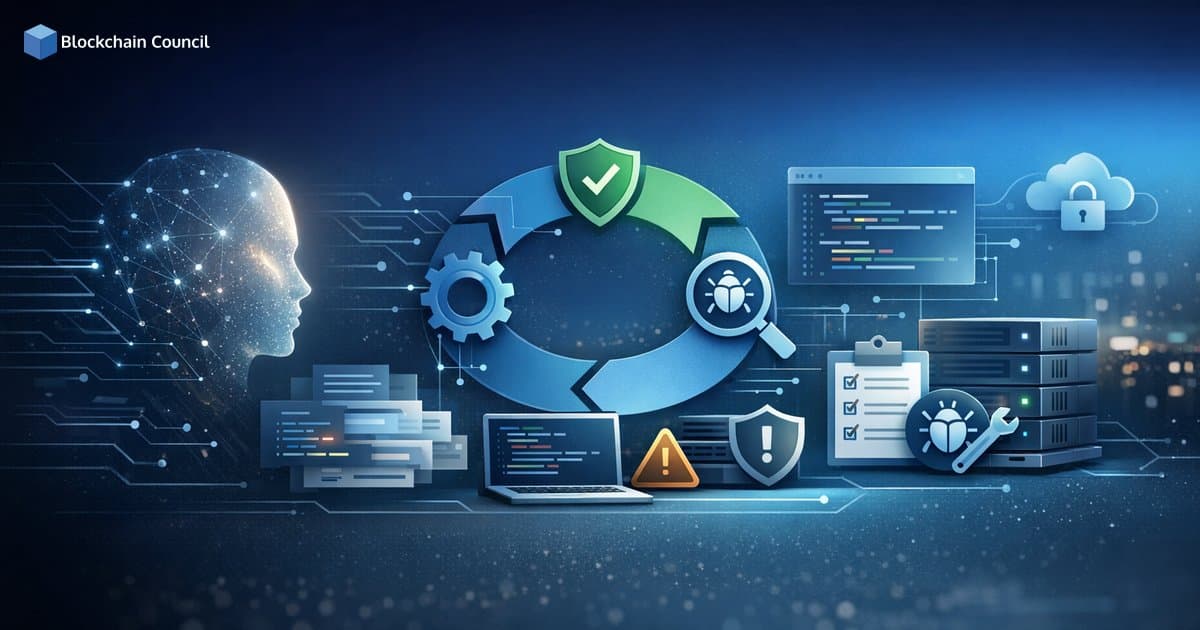
DevSecOps with Claude AI is reshaping how teams embed security into everyday development work. Rather than treating security reviews as a late-stage gate, Claude Security and Claude Code introduce AI-assisted scanning, policy-as-code enforcement, and remediation guidance directly inside the software development lifecycle (SDLC). This matters because developer adoption of AI tooling is now mainstream, and governance and security budgets are rising in response to new risks that AI-assisted development introduces.
This article explains how DevSecOps with Claude AI works in practice, how it supports shift-left security, where policy-as-code fits, and what governance controls enterprises need to deploy it safely.

What is DevSecOps with Claude AI?
DevSecOps with Claude AI refers to integrating Anthropic's Claude Security capabilities into DevSecOps pipelines so that security checks, secure coding guidance, and vulnerability remediation occur continuously across the SDLC. Claude Security has expanded from a limited research preview to a broader enterprise beta, with features designed for developer workflows and CI/CD automation.
Key capabilities reported across industry coverage and Anthropic's announcements include:
Automated security reviews via a /security-review command for rapid, repeatable assessments
GitHub Actions integration for pull request-level scanning and inline feedback
Intelligent patch generation to speed up remediation and reduce back-and-forth with AppSec teams
Detection coverage for common web and application issues including SQL injection, XSS, authentication flaws, insecure data handling, and dependency weaknesses
Why AI-Driven DevSecOps is Accelerating Now
AI is no longer a niche development tool. CIO.com reports that 84% of developers integrate AI tools into their workflows. Gartner projections indicate AI governance issues could drive up to $29 billion in additional security budget in 2026 compared with 2025. The combined signal is clear: software teams are moving faster with AI, and security teams are being asked to govern more risk at higher velocity.
DevSecOps with Claude AI is one response to that gap. It aims to scale secure development practices without relying solely on scarce manual reviewers.
Automating Security Checks Across the SDLC
Traditional SAST and rule-based scanners often struggle with context. They generate noisy findings, miss cross-file issues, and require heavy tuning. A central claim of DevSecOps with Claude AI is that a larger context window helps the model reason across multiple files and architectural layers, which can reduce false positives and surface more subtle weaknesses.
1) Inner-Loop Security Checks for Developers
Shift-left security becomes practical when developers can run checks before code ever reaches a pull request. Teams using terminal-initiated scans during active development catch issues earlier, which reduces rework and prevents security reviews from becoming a deployment bottleneck.
2) Pull Request-Level Automated Reviews with GitHub Actions
Claude Code includes GitHub Actions support to scan changes when a pull request is opened, apply customizable rules, and post inline comments with recommended fixes. This PR-native approach benefits both speed and accountability because findings are tied to specific diffs, code owners, and review discussions.
Practical outcomes include:
Consistent coverage on every pull request, not just high-risk releases
Faster triage because suggested fixes appear directly where developers work
Lower operational friction by integrating into existing CI/CD patterns
3) Higher-Signal Vulnerability Discovery
Anthropic has reported that Claude Opus 4.6 detected more than 500 vulnerabilities in production open-source codebases that had gone undetected for years despite expert review. Every organization should validate findings in its own environment, but this result suggests AI-assisted review can complement traditional tooling by surfacing non-obvious patterns and cross-cutting logic flaws.
Policy-as-Code with Claude AI: From Guidelines to Enforceable Rules
Policy-as-code turns security expectations into executable checks. In DevSecOps with Claude AI, policy-as-code becomes actionable through CI/CD integrations, including configurable rules in GitHub Actions workflows. Customizable rules can filter known issues and reduce false positives, which is essential for large enterprises where generic scanning can overwhelm security teams.
What to Encode as Policy First
When starting policy-as-code for AI-driven security reviews, prioritize policies that are clear, testable, and aligned to your threat model:
Authentication and authorization patterns - for example, centralized auth middleware and deny-by-default checks
Input handling - validation, encoding, and parameterized queries
Secrets handling - no hard-coded keys and approved vault usage
Dependency controls - blocked licenses, high-severity CVEs, and provenance expectations
Logging and data handling - PII redaction and least-privilege telemetry
How Policy-as-Code Improves Security Outcomes
Consistency: every team follows the same baseline, even across different repositories and languages
Auditability: enforcement rules are visible in version control and change-managed
Faster onboarding: developers learn security expectations through actionable pull request feedback
For teams building skills in this area, internal training pathways that combine secure SDLC fundamentals with AI governance are worth establishing. Relevant Blockchain Council certifications include the Certified DevSecOps Expert, Certified Cybersecurity Expert, and AI-focused programs such as the Certified AI Engineer for teams building and governing AI-enabled pipelines.
Vulnerability Remediation with Claude AI: From Findings to Fixes
DevSecOps with Claude AI extends beyond detection. It also supports remediation through patch recommendations and developer-invoked fixes, allowing developers to request remediation guidance during development rather than waiting for downstream approvals.
Common Vulnerability Categories Addressed
Reported detection areas include:
SQL injection risks
Cross-site scripting (XSS)
Authentication and authorization weaknesses
Insecure data handling practices
Dependency and supply chain weaknesses
Where Remediation Automation Helps Most
Repetitive fixes such as safer query patterns, output encoding, and input guardrails
Consistency refactors such as standardizing authentication checks across endpoints
Secure-by-default templates for new services, endpoints, and infrastructure definitions
Governance and Risk Controls Before Scaling
Claude Security can increase development velocity, but enterprises must address the governance gap that comes with LLM-based security tooling. Analysts have noted that LLMs can produce fluent but incorrect conclusions, creating false confidence when outputs are not independently validated.
Key Risks to Manage
Accuracy vs. fluency: well-written findings can still be wrong or incomplete
Explainability and audit: regulated environments need traceable reasoning and review artifacts
SDLC integrity: AI-generated patches may introduce subtle logic regressions or insecure defaults
Data exposure: code and intellectual property sent to external systems requires clear data handling rules and residency alignment
Supply chain expansion: AI services become dependencies inside your assurance pipeline
A Practical Governance Checklist
Treating AI security tooling as critical security infrastructure rather than a productivity add-on produces more defensible outcomes. A baseline governance framework includes:
Bounded pilots: start with non-production repositories where security teams can validate outputs before broader rollout
Human-in-the-loop gates: require human review for high-impact changes covering authentication, cryptography, payments, and IAM
Validation playbooks: define how to confirm findings, test patches, and measure false positive rates
Data flow documentation: map what code, logs, and metadata leave your environment and under what conditions
Policy-as-code ownership: assign clear owners for rules, exceptions, and approval workflows
Third-party risk review: evaluate vendor security posture and incident response processes before integration
DevSecOps vs. DevSecEng: Why the Model is Evolving
Some analysts argue that cloud-era DevSecOps is no longer sufficient for AI-era attack surfaces, proposing a shift toward DevSecEng. The premise is that AI introduces new governance and operational requirements, including faster adversary automation and new classes of system behavior that demand engineering rigor rather than pipeline controls alone.
For organizations, this means DevSecOps with Claude AI should be implemented alongside stronger engineering practices:
Threat modeling updated for AI-assisted development and AI-assisted attacks
Stronger testing discipline for AI-generated patches, including regression and security test coverage
Continuous monitoring of tool performance, output drift, and failure modes
Implementation Roadmap for Enterprises
Phase 1 (0-90 Days): Start Safely
Define a minimal AI security governance policy covering audit, validation, and data handling
Pilot Claude-driven security reviews on a limited set of repositories
Integrate pull request scanning with GitHub Actions and establish triage SLAs
Phase 2 (6-18 Months): Operationalize Policy-as-Code
Expand coverage to additional repositories and standardize rule sets per product line
Implement measurable metrics covering false positive rates, time-to-remediate, and escaped defects
Train developers and AppSec engineers on secure remediation patterns and review workflows
Phase 3 (18+ Months): Mature into DevSecEng
Build continuous monitoring and periodic red-teaming of AI-assisted security workflows
Harden supply chain and vendor dependency controls for AI services embedded in CI/CD
Prepare for emerging standards and regulatory expectations around AI governance
Conclusion
DevSecOps with Claude AI brings security checks, policy-as-code enforcement, and vulnerability remediation closer to where code is written and reviewed. With GitHub-native scanning, contextual analysis across multiple files, and AI-assisted patch guidance, teams can reduce bottlenecks and catch common vulnerability classes earlier in the SDLC. Governance, however, cannot be deferred: enterprises need to validate AI outputs, manage data exposure and supply chain risk, and keep humans accountable for high-impact changes.
Organizations that treat AI security tooling as critical infrastructure, invest in structured policy-as-code, and evolve toward DevSecEng practices will be best positioned to scale secure development as AI accelerates the pace of software delivery.
Related Articles
View All
Claude Ai
Claude Fable 5 Responsible AI: Security, Ethics, and Governance
Explore Claude Fable 5 Responsible AI considerations, including security guardrails, ethical risks, governance controls, and enterprise best practices.

Claude Ai
How to Use Claude Fable 5.1 for Free
Find out whether Claude Fable 5.1 is available for free, which Claude plans provide access, and what users need to know before trying Anthropic’s latest AI model.
Claude Ai
Anthropic's New Claude Fable 5.1 and Mythos 5.1 Update: What's New?
Anthropic’s Claude Fable 5.1 and Mythos 5.1 update brings stronger coding, long-running agentic workflows, research, vision, and knowledge-work capabilities. Fable 5.1 is generally available and introduces cheaper cache reads, potentially reducing typical workload costs by about 25% and highly agentic workloads by up to 45%. Mythos 5.1 uses the same underlying model but offers expanded cybersecurity and biology capabilities to vetted organizations through trusted-access programs.
Trending Articles
The Role of Blockchain in Ethical AI Development
How blockchain technology is being used to promote transparency and accountability in artificial intelligence systems.

Can DeFi 2.0 Bridge the Gap Between Traditional and Decentralized Finance?
The next generation of DeFi protocols aims to connect traditional banking with decentralized finance ecosystems.
Claude AI Tools for Productivity
Discover Claude AI tools for productivity to streamline tasks, manage workflows, and improve efficiency.