

Claude AI for Infrastructure as Code (IaC): Safe Terraform and CloudFormation Generation, Review, and Refactoring
 Suyash Raizada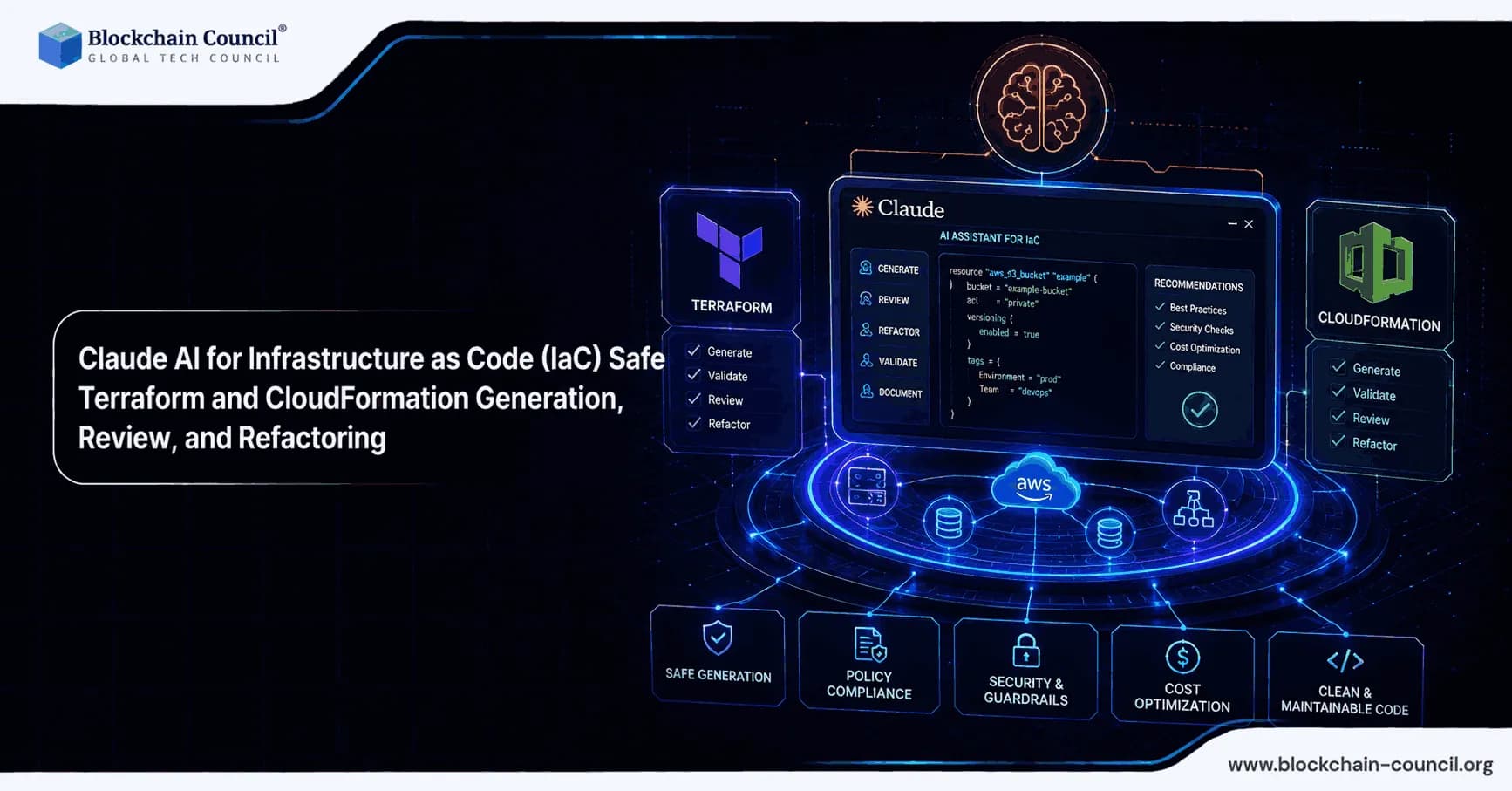
Claude AI for Infrastructure as Code (IaC) is becoming a practical tool for DevOps teams looking to generate, review, and refactor Terraform and CloudFormation with greater consistency and fewer security gaps. Rather than using a general-purpose LLM as a raw code generator, modern workflows pair Claude with specialized skills and agentic pipelines that enforce Terraform conventions, validate plans, and run security and cost checks before anything reaches production.
This article explains how Claude AI fits into modern IaC workflows, what is realistically safe to automate, and how to structure guardrails for Terraform and CloudFormation so teams gain speed without losing control. Use Claude AI to generate, review, and refactor Terraform and CloudFormation templates safely for scalable cloud infrastructure management by building expertise through an AI certification, automating IaC workflows and cloud analysis using a Python certification, and improving cloud operations with a Digital marketing course.

Why Claude AI Matters for Infrastructure as Code
Infrastructure as Code is well-suited to AI assistance because it is declarative, repetitive, and standards-driven. Terraform works particularly well with Claude because HCL is human-readable and modular by design. However, unguided AI output tends to fail in predictable ways: hardcoded values, monolithic files, permissive IAM policies, missing encryption, and no automated tests or policy checks.
The more effective pattern is to pair Claude with purpose-built IaC skills and tooling. Community and vendor initiatives have introduced Claude Code Skills for IaC, HashiCorp Agent Skills for Terraform and Packer, and agentic DevOps workflows that run validation, linting, security scanning, and cost estimation as part of the generation loop. These approaches reduce hallucinations by grounding output in product-specific schemas, documentation, and best practices from Terraform and HashiCorp.
What Is New in 2025-2026: Claude Skills and Agentic IaC
As of early 2026, the most credible improvements in Claude AI for Infrastructure as Code come from specialized skills and multi-agent workflows:
Claude Code Skills for IaC that guide module structure, remote state practices with locking, environment isolation via workspaces, and GitOps-style workflows.
HashiCorp Agent Skills that encode Terraform and Packer conventions, generate Terraform tests, refactor modules, and support Terraform Stacks for multi-environment orchestration.
Agentic DevOps workflows that split responsibilities into subagents covering planning, security review, IAM analysis, and cost checks, while integrating tools such as tflint, tfsec, and infracost.
In benchmark comparisons shared by Terraform-focused skill authors, unguided AI output is more likely to produce monolithic, hardcoded configurations. Skill-backed workflows, by contrast, push variable-driven, modular code with tests, safer defaults such as encryption by default, and CI steps that include security and cost analysis.
Where Claude Is Strongest: Terraform Generation with Guardrails
Terraform dominates AI-assisted IaC because it encourages composable modules and consistent patterns across cloud providers. Claude can generate Terraform quickly, but the safe approach requires Claude to follow a structured engineering loop and a consistent repository layout.
A Safe Terraform Workflow: Generate, Validate, Plan, Review
Use Claude to draft code, but require tool-backed checks before any merge. A practical loop looks like this:
Generate Terraform modules and root configuration from a structured prompt covering requirements, providers, regions, naming conventions, tags, and constraints.
Initialize and validate using terraform init and terraform validate, requiring Claude to fix any errors found.
Plan using terraform plan and have Claude summarize the output in plain terms: resources created, exposed surfaces, IAM changes, networking, encryption, and logging.
Review with automated checks covering formatting, linting, security scanning, and cost estimation.
Human approval for production changes, particularly those involving IAM and network boundary modifications.
This loop mirrors what experienced Terraform practitioners do manually. The advantage is that Claude can accelerate each stage, especially module scaffolding, documentation, and plan summarization.
Example: Production VPC Generation, Still Subject to Review
In a 2025 demonstration, Claude generated and deployed a production-ready AWS VPC - including public and private subnets, security groups, and VPC flow logs - in under 10 minutes from a single prompt, then verified the deployment in the AWS Console and launched an EC2 instance. Demonstrations like this show what is possible, but the production lesson is clear: speed must be paired with policy checks, least-privilege IAM, and controlled state management.
Reviewing Terraform Safely: Claude as Security and Plan Reviewer
One of the most practical uses of Claude AI for Infrastructure as Code is review automation. Claude can read Terraform code, plan output, and scanner results, then produce a developer-friendly summary that is easier to act on than raw tool output.
What Claude Should Flag in Terraform Reviews
IAM overreach: wildcard actions, wildcard resources, missing conditions, and absent role separation.
Encryption gaps: S3 buckets without default encryption, unencrypted EBS volumes, RDS instances without KMS, and missing TLS settings.
Network exposure: overly permissive security groups (0.0.0.0/0), public subnets used for private workloads, and missing egress controls where required.
Logging and audit: missing VPC flow logs, CloudTrail gaps, and absent access logs on critical endpoints.
State and secrets hygiene: plaintext secrets in variables, missing remote state locking, and leaking outputs.
Security research published in 2025 found that a significant share of LLM-generated IaC contains high-severity vulnerabilities. This is why reviewers should require scanner integration - for example tfsec - and treat Claude as a summarizer and fixer rather than the sole source of truth.
Recommended Automated Checks to Pair with Claude
tflint for Terraform linting and provider-specific issue detection
tfsec for security posture checks and misconfiguration detection
infracost for pre-merge cost estimation and budget guardrails
terraform test or module-level tests where applicable
Claude can also convert tool outputs into a prioritized action list categorized as blocker, high, or medium severity, along with a concrete remediation plan.
Refactoring Terraform Safely: From Monoliths to Reusable Modules
Refactoring is where skilled Claude workflows deliver lasting value. Many Terraform repositories begin as a single root module that grows into a brittle monolith over time. HashiCorp's Agent Skills emphasize refactoring into reusable modules and introducing Terraform Stacks for multi-environment orchestration.
Refactor Checklist for Claude-Assisted Terraform
Module boundaries: isolate VPC, IAM, compute, data, and observability into separate modules with clearly defined inputs and outputs.
Variable-first design: remove hardcoded names, CIDRs, instance sizes, and tags.
Consistent naming and tagging: enforce organization-wide conventions to support cost allocation and governance.
Null-safe and optional inputs: use safe defaults and conditional expressions to avoid brittle logic.
Backwards-compatible migration: use state moves and careful rollouts to prevent destructive resource replacements.
A key principle emphasized by community practitioners: AI-generated IaC should be maintainable for years, not just deployable today. Treat Claude's output as a starting point that must meet the same engineering standards as human-written code.
CloudFormation with Claude: Useful, but Less Mature Than Terraform
Claude can generate CloudFormation templates from natural language prompts, but support is generally less mature than for Terraform. CloudFormation templates are more verbose - often JSON or YAML with deep nesting - and the ecosystem offers fewer Claude-specific skills compared to the Terraform toolchain.
Safe Ways to Use Claude for CloudFormation Today
Template scaffolding: generate baseline templates for common patterns such as VPC, IAM roles, S3, and Lambda.
Review and explanation: ask Claude to explain resource relationships, permissions, and potential blast radius before deployment.
Hybrid workflows: convert CloudFormation to Terraform using tools such as cfn2tf, then standardize on a single pipeline for scanning and review.
If your organization is committed to CloudFormation, Claude still adds value as a reviewer and refactoring assistant. Expect more manual validation steps and stricter CI checks compared to Terraform workflows. Learn how Claude AI enhances Infrastructure as Code workflows with secure template validation, refactoring assistance, and deployment optimization by mastering AI-driven cloud automation through an AI certification, building infrastructure tooling using a Node JS Course, and scaling cloud-native businesses using an AI powered marketing course.
Practical Guardrails for Claude AI in IaC Pipelines
The difference between fast and safe is operational discipline. Use Claude inside a workflow that constrains risk at each stage.
1. Constrain Prompts and Require Explicit Assumptions
Use a structured prompt template that forces Claude to state assumptions and non-goals. Include:
Cloud provider, account, region(s), and environment (dev, staging, prod)
Security constraints covering encryption, least privilege, and logging requirements
Networking constraints including CIDR ranges and inbound rules
State backend requirements such as S3 with DynamoDB locking or equivalent
2. Treat Plans as Review Artifacts
Require Claude to summarize terraform plan output and highlight risky changes: resource replacements, IAM expansions, public exposure, and data plane modifications.
3. Enforce CI Gates
Make merges conditional on:
terraform fmt and terraform validate passing
tflint and tfsec passing, or explicitly waived with documented justification
infracost thresholds, for example monthly delta limits
4. Keep Secrets Out of the Model Context
Do not include credentials, private keys, or sensitive customer data in prompts. Reference secrets through secret managers, variables, or data sources instead.
5. Require Human Approval for Production Apply
Even robust agentic workflows should keep a human in the loop for production applies, particularly those touching IAM, network perimeters, and data stores.
Skills and Learning Paths to Support Claude-Assisted IaC
To operationalize Claude AI for Infrastructure as Code effectively, teams benefit from a solid foundation across Terraform, cloud security, and DevOps processes. Relevant Blockchain Council programs that support this skill set include:
DevOps Certification covering CI/CD pipelines, GitOps workflows, and automation fundamentals
Certified Cloud Security Engineer covering security controls, IAM, logging, and posture management
Certified Blockchain Developer for teams managing infrastructure that supports Web3 nodes, key management, and secure deployment patterns
AI Certifications focused on applied AI adoption and safe integration in enterprise workflows
Conclusion: Claude AI Can Accelerate IaC, but Safety Comes from Workflow Design
Claude AI for Infrastructure as Code (IaC) is most effective when used as part of a controlled engineering system rather than as a standalone generator. The components that matter are structured prompts, skill-backed conventions, validation loops, scanner-integrated CI, cost estimation, and human approval for high-risk changes. Terraform currently offers the most mature ecosystem for Claude-assisted generation, review, and refactoring - particularly with HashiCorp and community skills that encode best practices and reduce hallucinations. CloudFormation can still benefit from Claude, but typically requires more manual validation and stronger CI guardrails.
With the right constraints in place, teams can realistically achieve significant productivity gains while improving consistency, security defaults, and long-term maintainability across their infrastructure codebase.
FAQs
1. What is Claude AI for Infrastructure as Code?
Claude AI for Infrastructure as Code means using Claude to generate, review, and refactor IaC files such as Terraform and CloudFormation. It can help teams create modules, summarize plans, detect risky changes, and improve configuration quality. The safest approach is to use Claude with validation tools and human approval gates.
2. Why is Claude useful for IaC workflows?
Claude is useful because IaC is structured, repetitive, and rule-driven. It can quickly draft configurations, explain resource relationships, and identify missing security controls. This saves time while reducing some of the delightful human misery caused by endless YAML and HCL reviews.
3. Why does Terraform work well with Claude AI?
Terraform works well with Claude because HCL is readable, modular, and widely standardized. Claude can generate reusable modules, variables, outputs, and documentation from structured requirements. However, the code still needs validation, scanning, planning, and review before deployment.
4. Can Claude generate production-ready Terraform?
Claude can generate strong Terraform drafts, but teams should not treat them as automatically production-ready. Generated code must pass terraform fmt, terraform validate, terraform plan, security scans, and cost checks. Production applies should always require human approval.
5. What are the risks of unguided AI-generated IaC?
Unguided AI-generated IaC may include hardcoded values, overly broad IAM policies, missing encryption, weak logging, and monolithic files. It may also skip tests, state management, and cost controls. This is why Claude should operate inside a controlled workflow, not as a magical infrastructure vending machine.
6. What are Claude Skills for IaC?
Claude Skills for IaC are specialized instructions and workflows that guide Claude toward safer infrastructure practices. They can enforce module structure, remote state rules, environment isolation, and GitOps-style processes. Skills reduce ambiguity and improve consistency across teams.
7. What are HashiCorp Agent Skills?
HashiCorp Agent Skills encode Terraform and Packer conventions into AI-assisted workflows. They help generate tests, refactor modules, support Terraform Stacks, and follow safer infrastructure patterns. These skills make Claude more useful for real DevOps environments.
8. What is a safe Terraform workflow with Claude?
A safe workflow starts with structured requirements, then uses Claude to generate Terraform modules and root configurations. Teams should run validation, planning, linting, security scanning, and cost estimation before review. Only after approval should infrastructure changes move toward production.
9. Why is terraform plan important when using Claude?
terraform plan previews what infrastructure changes will happen before they are applied. Claude can summarize the plan and highlight risky changes such as IAM expansion, public exposure, or resource replacement. This makes review easier and reduces unpleasant surprises in production.
10. How can Claude help review Terraform code?
Claude can review Terraform code for IAM overreach, encryption gaps, network exposure, logging issues, and state hygiene problems. It can also turn scanner output into a prioritized action list. Human reviewers should still verify the findings because confidence is not the same as correctness.
11. What Terraform security issues should Claude flag?
Claude should flag wildcard IAM permissions, public security groups, unencrypted storage, missing audit logs, and plaintext secrets. It should also identify missing remote state locking and unsafe outputs. These issues can create serious cloud security and compliance risks.
12. What tools should be paired with Claude for Terraform checks?
Claude should be paired with tools such as tflint, tfsec, infracost, terraform validate, and terraform test. These tools provide objective checks for formatting, security, cost, and module behavior. Claude can then summarize results and suggest fixes.
13. How does Claude help with Terraform refactoring?
Claude can help split large Terraform files into reusable modules for networking, IAM, compute, data, and observability. It can replace hardcoded values with variables and improve naming, tagging, and outputs. Refactoring should be done carefully to avoid destructive resource replacements.
14. Why is backward compatibility important in IaC refactoring?
Backward compatibility prevents existing infrastructure from being accidentally recreated, deleted, or replaced. Claude-assisted refactoring should use careful state moves and gradual rollouts. Infrastructure refactors are not a playground, unless downtime is your organization’s preferred learning method.
15. Can Claude work with CloudFormation?
Yes, Claude can generate, explain, and review CloudFormation templates. It is useful for scaffolding VPCs, IAM roles, S3 buckets, Lambda functions, and other AWS resources. However, CloudFormation workflows usually need stricter validation because the ecosystem is less mature for Claude-assisted automation.
16. Why is CloudFormation less mature than Terraform for Claude workflows?
CloudFormation templates are often more verbose and deeply nested than Terraform configurations. There are also fewer Claude-specific skills and workflows around CloudFormation compared with Terraform. This means teams should apply stronger CI checks and more manual review.
17. What guardrails should teams use with Claude AI for IaC?
Teams should use structured prompts, explicit assumptions, validation loops, CI gates, scanner integration, and human approval. Prompts should include provider, region, environment, security constraints, network rules, and state backend requirements. These guardrails keep Claude’s output closer to usable engineering work.
18. Why should secrets stay out of Claude prompts?
Secrets should stay out of prompts because credentials, private keys, and customer data can create serious exposure risks. IaC should reference secrets through secret managers, variables, or secure data sources. Copying secrets into an AI prompt is basically handing your keys to a very articulate stranger.
19. How can Claude support cost control in IaC?
Claude can summarize cost estimates from tools like infracost and flag expensive changes before merge. It can also recommend smaller instance types, better tagging, and more efficient architecture patterns. Cost checks help prevent infrastructure bills from mutating into horror literature.
20. What is the best way to use Claude AI for IaC safely?
The best way is to use Claude as part of a controlled engineering workflow, not as a standalone generator. Combine structured prompts, IaC skills, Terraform plans, security scanners, cost checks, and human approvals. This allows teams to gain speed while maintaining security, reliability, and long-term maintainability.
Related Articles
View All
Claude Ai
How to Use Claude Fable 5.1 for Free
Find out whether Claude Fable 5.1 is available for free, which Claude plans provide access, and what users need to know before trying Anthropic’s latest AI model.
Claude Ai
Anthropic's New Claude Fable 5.1 and Mythos 5.1 Update: What's New?
Anthropic’s Claude Fable 5.1 and Mythos 5.1 update brings stronger coding, long-running agentic workflows, research, vision, and knowledge-work capabilities. Fable 5.1 is generally available and introduces cheaper cache reads, potentially reducing typical workload costs by about 25% and highly agentic workloads by up to 45%. Mythos 5.1 uses the same underlying model but offers expanded cybersecurity and biology capabilities to vetted organizations through trusted-access programs.

Claude Ai
Fable 5 vs Claude vs ChatGPT: Which AI Model Should You Choose?
Compare Fable 5, Claude, and ChatGPT across coding, research, DevOps, cost, context, and governance to choose the right AI model.
Trending Articles
The Role of Blockchain in Ethical AI Development
How blockchain technology is being used to promote transparency and accountability in artificial intelligence systems.
How Blockchain Secures AI Data
Understand how blockchain technology is being applied to protect the integrity and security of AI training data.
What is AWS? A Beginner's Guide to Cloud Computing
Everything you need to know about Amazon Web Services, cloud computing fundamentals, and career opportunities.