

Building Claude-Powered CI-CD Pipelines for Intelligent Code Reviews, Release Notes, and Deployment Gates
 Suyash Raizada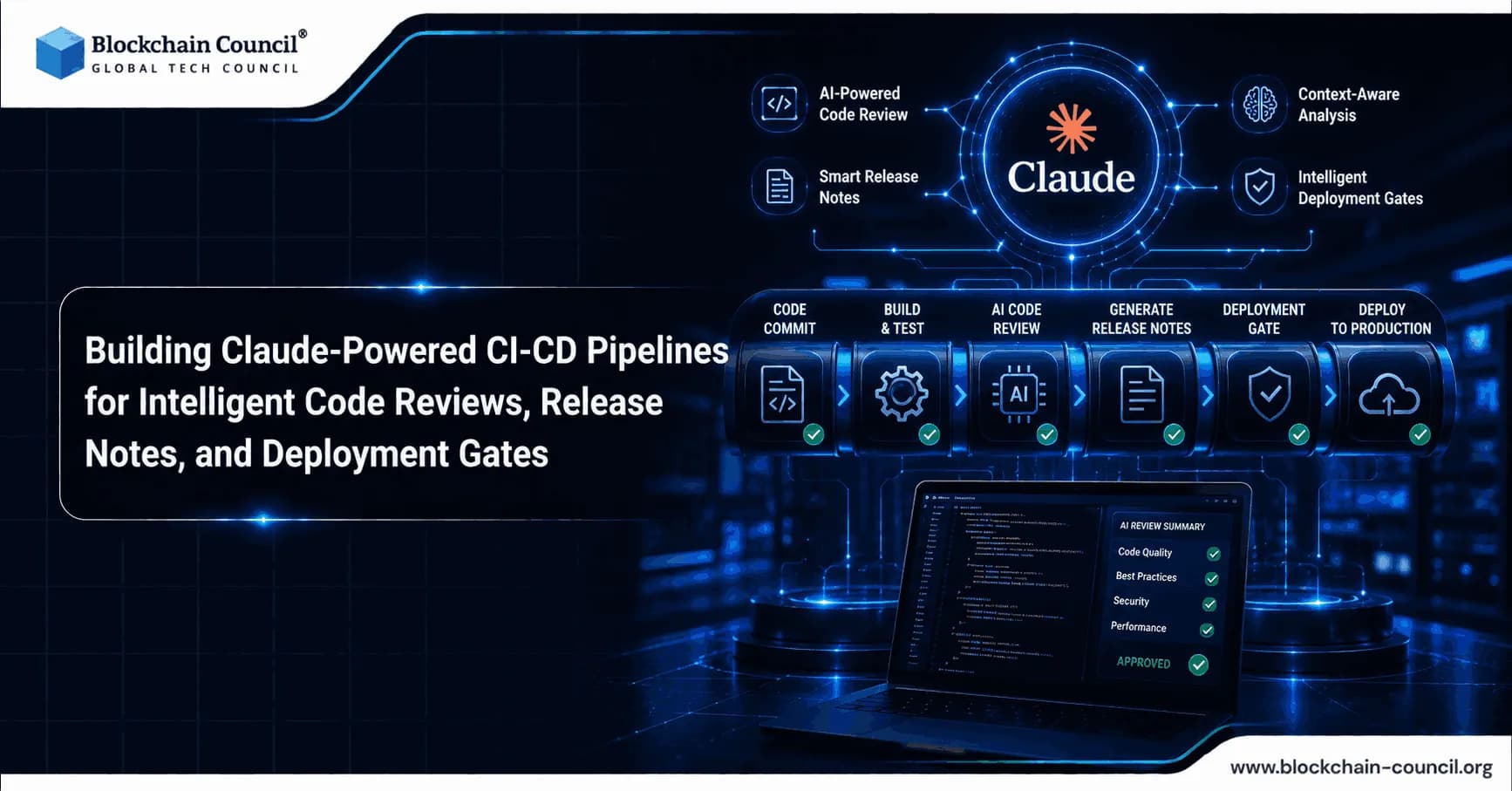
Claude-powered CI-CD pipelines are becoming a practical pattern for teams that want faster reviews, higher quality releases, and safer deployments without adding manual toil. By integrating Anthropic's Claude models into your DevOps toolchain, you can automate intelligent code review comments, generate release notes directly from merge requests, and enforce deployment gates that evaluate both deterministic tests and semantic quality checks. Enterprise capabilities like extended context windows, prompt caching, and enterprise plugins have moved this pattern from experimentation into production-ready workflows.
For DevOps engineers, platform teams, and AI practitioners looking to implement these capabilities effectively, a Claude AI Expert certification can provide structured knowledge of Claude-powered automation, enterprise AI integration, and best practices for deploying intelligent CI/CD workflows at scale.

If you are learning through an Agentic AI Course, a Python Course, or an AI powered marketing course, this guide will help you build intelligent CI/CD pipelines.
What Makes Claude-Powered CI-CD Pipelines Different
Traditional CI-CD assumes deterministic outputs: compile passes, unit tests pass, deploy happens. Modern software delivery increasingly includes non-deterministic components like LLM prompts, retrieval pipelines, and agent workflows. A Claude-powered CI-CD pipeline adds an orchestration layer that can:
Read and reason over large change sets using long context windows (Opus and Sonnet models support up to 1M tokens; Haiku supports up to 200k tokens).
Generate actionable code review feedback specific to your repository conventions, security requirements, and architecture.
Produce release notes that map changes to user impact, risks, and rollout steps.
Act as a deployment gate by evaluating evidence across logs, tests, policies, and change risk.
Claude Opus 4 has demonstrated strong performance on reasoning and software engineering benchmarks, including results on SWE-bench Verified that reflect genuine capability on multi-step engineering tasks. For CI-CD, benchmark numbers matter less as leaderboard credentials and more as a proxy for reliability when you ask the model to interpret diffs, test failures, and multi-service dependencies.
Key Capabilities You Can Operationalize in CI-CD
1. Intelligent Code Reviews as a First-Class Pipeline Job
A high-impact use case is an automated review job triggered on merge requests (MRs) or pull requests (PRs). With enterprise plugins like GitLab's live integration, Claude can analyze the MR diff, understand repository context, and provide:
Security findings (auth flows, secrets handling, injection risks, unsafe deserialization, dependency risks).
Reliability and performance risks (timeouts, retry storms, missing circuit breakers).
Maintainability feedback (complexity hotspots, missing tests, refactoring suggestions).
Compliance-aware guidance (coding standards, regulated data handling, audit trails).
In regulated sectors, Claude Enterprise features such as data residency controls support governance requirements while still enabling automated analysis. For time-sensitive workflows, fast-mode can prioritize lower latency, which is valuable when review feedback is meant to influence active developer iteration.
Implementation tip: treat AI review as additive, not authoritative. The pipeline should post structured comments with confidence levels and evidence (file paths, lines, referenced policy rules), then require a human approval step for high-risk categories.
2. Automated Release Notes from Merge Requests and Issue Context
Release notes are often delayed because they require cross-referencing tickets, PR descriptions, and commit messages. Claude can generate consistent release notes by pulling together:
MR titles and descriptions
Linked issues and labels (feature, fix, breaking change, security)
Commit summaries and affected components
Migration notes and rollout steps
With long context support, you can include multiple MRs, changelog history, and product documentation snippets in a single generation pass. For large monorepos, hybrid retrieval patterns can fetch only the most relevant architecture docs or runbooks. Improvements to Claude's contextual retrieval have been reported to reduce failed information retrieval significantly, which translates into fewer missing details and fewer incorrect assumptions in generated notes.
Practical output formats include markdown for GitHub or GitLab releases, Jira-friendly summaries, and customer-facing notes with technical details separated into an internal section.
3. Deployment Gates That Go Beyond Pass-Fail Tests
Deployment gates are where a Claude-powered pipeline can deliver the highest risk reduction. In addition to standard gates (unit tests, integration tests, SAST, dependency scanning), consider AI-aware gates such as:
Semantic evaluation: LLM-as-judge checks for prompt quality, policy compliance, and output correctness on representative test cases.
Prompt injection and data leakage testing: evaluate whether the app or agent reveals secrets, system prompts, or PII under adversarial inputs.
RAG quality checks: verify citations, retrieval relevance, and groundedness against known sources.
Change risk scoring: analyze the diff and deployment surface area to recommend canary or progressive rollout strategies.
For continuous delivery, progressive delivery patterns like canary releases reduce blast radius. Claude can help select a rollout plan by combining signals from change type, historical incident data, and dependency criticality, then enforcing a gate such as: proceed to 50% traffic only if error budget burn rate stays under threshold and semantic evaluation scores remain stable.
Reference Architecture: A Practical Claude-Powered CI-CD Flow
Below is a typical workflow that teams implement in GitLab or GitHub Actions, with Claude invoked via API or an enterprise plugin:
MR opened: pipeline triggers lightweight checks (lint, unit tests) and a Claude review job.
Claude review job: model reads the diff, key policies, and recent incidents; posts structured comments and a risk score.
Build and package: Claude can assist by generating or updating Dockerfiles and pipeline definitions when they are missing. GitLab Duo Agent Platform examples include generating full CI-CD steps for container builds and registry deployment directly from an MR.
Release notes job: Claude summarizes merged MRs into release notes, including breaking changes and migration steps.
Pre-deploy gate: semantic evals, injection tests, PII checks, and standard security scans run. Claude aggregates results into a go-no-go recommendation.
Progressive deployment: canary rollout with automated monitoring. Claude reviews telemetry summaries and evaluates whether criteria are met to proceed.
Post-deploy tasks: scheduled Claude tasks generate weekly security audit summaries, test coverage reports, or PR digests.
Model Selection for CI-CD: Opus vs Sonnet vs Haiku
Choosing the right model involves balancing cost, latency, and output quality:
Claude Opus: best for deep reasoning, large repository analysis, and high-stakes gates. Opus supports extended context windows and higher output token limits, making it suitable for complex architectural reviews.
Claude Sonnet: a strong default for day-to-day code review and release notes at lower cost than Opus. It supports comparable context lengths and handles most standard review depth requirements.
Claude Haiku: best for fast, frequent tasks such as formatting checks, small diffs, and log summarization. It offers a smaller context window and significantly lower cost per token.
Operational pattern: run Haiku for quick feedback, Sonnet for standard review depth, and Opus for security-critical or architecture-impacting changes.
Security, Reliability, and Governance Guardrails
Because AI outputs are non-deterministic, your pipeline should be explicit about guardrails and auditability:
Policy as code: store review rubrics, secure coding rules, and release note templates in version control.
Evidence requirements: Claude must cite file paths, test names, or log excerpts as plain text references for each recommendation.
Redaction and data minimization: strip secrets and sensitive payloads before sending to any model endpoint.
Human-in-the-loop approvals: require human sign-off for security issues, permission changes, and production gates.
Prompt caching: use caching for stable repository context to reduce latency and cost. Prompt caching has been reported to cut latency significantly and reduce costs for repeated contexts.
Agentic Operations: Scheduled Tasks and Parallel Agents
Recent Claude releases introduced more autonomous operational capabilities, including scheduled tasks, parallel agents, plugins, and project-aware memory. In CI-CD, this enables patterns like:
Parallel agents that run security scans while a separate agent drafts documentation updates and a third validates API compatibility.
Scheduled pipeline intelligence such as weekly dependency risk reviews, incident retrospectives summarized from monitoring events, and continuous compliance checks.
This is where enterprises are positioning Claude as an orchestration layer, moving beyond code completion into end-to-end workflow automation that can meaningfully reduce operational load on engineering teams.
If you are learning through an Agentic AI Course, a Python Course, or an AI powered marketing course, this approach explains automation in DevOps workflows.
Conclusion: Make CI-CD Smarter, Not Riskier
Claude-powered CI-CD pipelines can deliver measurable improvements in developer throughput and release quality when implemented with the right gates and governance. Use Claude for what it excels at: reading large contexts, synthesizing change impact, producing structured review feedback, and evaluating deployment readiness across many signals. Pair it with deterministic testing, progressive delivery, and security guardrails to maintain reliability. As plugins and agent capabilities mature, teams that treat AI as an orchestration layer in CI-CD will be best positioned to ship faster while maintaining production-grade controls.
FAQs
1. What is a Claude-powered CI/CD pipeline?
A Claude-powered CI/CD pipeline integrates Anthropic's Claude AI models into continuous integration and continuous delivery (CI/CD) workflows to assist with software development tasks. Depending on the implementation, Claude can support code reviews, release note generation, documentation, security analysis, test recommendations, and deployment decision support while human teams retain responsibility for final approvals.
2. How does Claude integrate with CI/CD platforms?
Claude can be integrated through APIs, SDKs, automation platforms, or custom orchestration workflows within CI/CD systems such as GitHub Actions, GitLab CI/CD, Jenkins, Azure DevOps, CircleCI, and other enterprise automation tools. Organizations typically define prompts, policies, and approval workflows that determine when AI-generated analysis is performed.
3. What role does Claude play in intelligent code reviews?
Claude can analyze pull requests to identify potential code quality issues, readability improvements, documentation gaps, inconsistent coding patterns, and possible security concerns. AI-generated reviews can complement traditional static analysis and peer reviews but should not replace developer judgment or formal security testing.
4. How can Claude generate release notes automatically?
Claude can summarize merged pull requests, commit histories, issue trackers, and changelogs into structured release notes. Generated summaries may include new features, bug fixes, known issues, breaking changes, upgrade guidance, and contributor highlights, helping development teams reduce manual documentation work.
5. What are AI-powered deployment gates?
AI-powered deployment gates are automated decision points within a CI/CD pipeline that evaluate deployment readiness using predefined criteria. Claude can assist by reviewing build outputs, test results, security findings, infrastructure changes, and documentation before recommending whether additional human review may be appropriate.
6. How does Claude improve developer productivity?
Claude can automate repetitive development tasks such as summarizing code changes, explaining complex pull requests, generating documentation, reviewing configuration files, suggesting test cases, and identifying areas that may require additional attention. This allows developers to spend more time on design, implementation, and problem-solving.
7. Can Claude help improve software quality?
Yes. Claude can help identify maintainability concerns, inconsistent coding practices, incomplete documentation, duplicated logic, potential edge cases, and opportunities for code refactoring. These suggestions should be validated through human review, automated testing, and established engineering practices.
8. How does Claude support DevSecOps workflows?
Claude can assist DevSecOps teams by explaining security scan results, identifying common coding weaknesses, recommending secure coding practices, summarizing vulnerability reports, and helping developers understand remediation guidance. AI assistance complements, rather than replaces, dedicated security tools and expert review.
9. What CI/CD platforms commonly integrate with Claude?
Organizations may integrate Claude with GitHub Actions, GitLab CI/CD, Jenkins, Azure DevOps Pipelines, CircleCI, Bitbucket Pipelines, Buildkite, TeamCity, Argo CD, Spinnaker, and Kubernetes-based deployment workflows using APIs and automation services.
10. How can Claude improve release management?
Claude can summarize release risks, generate deployment checklists, draft stakeholder communications, organize release documentation, compare release candidates, and identify unresolved issues from project repositories. These capabilities can improve collaboration and reduce manual coordination efforts.
11. How does Claude assist with documentation in CI/CD?
Claude can generate API documentation, update changelogs, summarize architectural changes, explain infrastructure modifications, document deployment procedures, and produce onboarding materials based on repository content. Human review remains important to verify technical accuracy before publication.
12. How does Claude complement other DevOps automation tools?
Claude works alongside source control systems, testing frameworks, static analysis tools, security scanners, infrastructure-as-code platforms, and observability solutions. Rather than replacing these tools, Claude adds natural language reasoning and contextual summaries that can improve developer understanding and decision-making.
13. What security considerations apply when integrating Claude into CI/CD pipelines?
Organizations should protect API credentials, sanitize sensitive inputs, restrict access using least-privilege principles, avoid exposing confidential source code unnecessarily, implement audit logging, review AI-generated outputs, and comply with organizational security and data governance policies when integrating AI services.
14. How should organizations govern AI-assisted CI/CD workflows?
Effective governance includes defining approved AI use cases, establishing human approval requirements for production deployments, maintaining audit trails, validating AI-generated recommendations, monitoring model performance, enforcing data handling policies, and periodically reviewing prompts and automation workflows.
15. Which industries benefit from Claude-powered CI/CD pipelines?
Industries adopting AI-assisted DevOps include software development, financial services, healthcare, telecommunications, retail, manufacturing, government, cybersecurity, cloud services, education, gaming, and enterprise technology organizations managing complex software delivery pipelines.
16. What challenges should organizations consider?
Potential challenges include protecting proprietary code, preventing prompt injection attacks, managing AI hallucinations, maintaining regulatory compliance, controlling operational costs, integrating with existing DevOps tools, validating AI-generated recommendations, and ensuring engineers remain accountable for deployment decisions.
17. What trends are shaping AI-powered CI/CD in 2025-2026?
Key trends include AI-assisted code reviews, autonomous documentation generation, intelligent deployment risk assessment, policy-aware release automation, infrastructure analysis, AI-enhanced DevSecOps, multi-agent software engineering workflows, secure AI governance, and deeper integration with enterprise software development platforms.
18. What are best practices for implementing Claude in CI/CD pipelines?
Best practices include starting with low-risk automation tasks, validating AI-generated outputs, combining AI reviews with automated testing and static analysis, protecting sensitive data, implementing approval workflows, monitoring model performance, maintaining version-controlled prompts, and continuously improving governance policies.
19. What should engineering leaders evaluate before deploying Claude in CI/CD?
Engineering leaders should assess security requirements, compliance obligations, supported integrations, data privacy policies, infrastructure compatibility, developer workflows, cost considerations, governance controls, audit requirements, and measurable success metrics before deploying AI into production software delivery pipelines. AI should augment engineering teams rather than replace established review and testing processes.
20. What is the future of Claude-powered CI/CD pipelines?
Claude-powered CI/CD pipelines are expected to become increasingly capable as large language models, software engineering agents, and enterprise automation platforms continue to evolve. Future pipelines may deliver more contextual code reviews, smarter deployment recommendations, richer release documentation, and stronger collaboration between developers and AI while preserving human oversight for critical production decisions. Even the most intelligent deployment gate should still respect the timeless engineering tradition of someone asking, "Did we test this in production?"
Related Articles
View All
Claude Ai
Claude in CI/CD: Securing Agentic Pipelines
Explore the Claude Code GitHub Action case and learn how developers can secure CI/CD pipelines against prompt injection, secret leakage, and agentic risks.

Claude Ai
Fable 5 for AI Agents and Automation: Building Smarter Workflows
Learn how Fable 5 for AI agents supports long-horizon automation, multi-agent workflows, coding tasks, document processing, safety, and cost control.

Claude Ai
Claude Sonnet 5 for Developers: Building Smarter AI Agents and Enterprise Applications
Claude Sonnet 5 for Developers is a practical guide to building AI agents, coding workflows, and enterprise applications with Anthropic's latest Sonnet model.
Trending Articles
How Blockchain Secures AI Data
Understand how blockchain technology is being applied to protect the integrity and security of AI training data.
What is AWS? A Beginner's Guide to Cloud Computing
Everything you need to know about Amazon Web Services, cloud computing fundamentals, and career opportunities.

Can DeFi 2.0 Bridge the Gap Between Traditional and Decentralized Finance?
The next generation of DeFi protocols aims to connect traditional banking with decentralized finance ecosystems.