

Building an AI-Powered Java Spring Boot Backend with Claude: Chat, Summarization, and RAG
 Suyash Raizada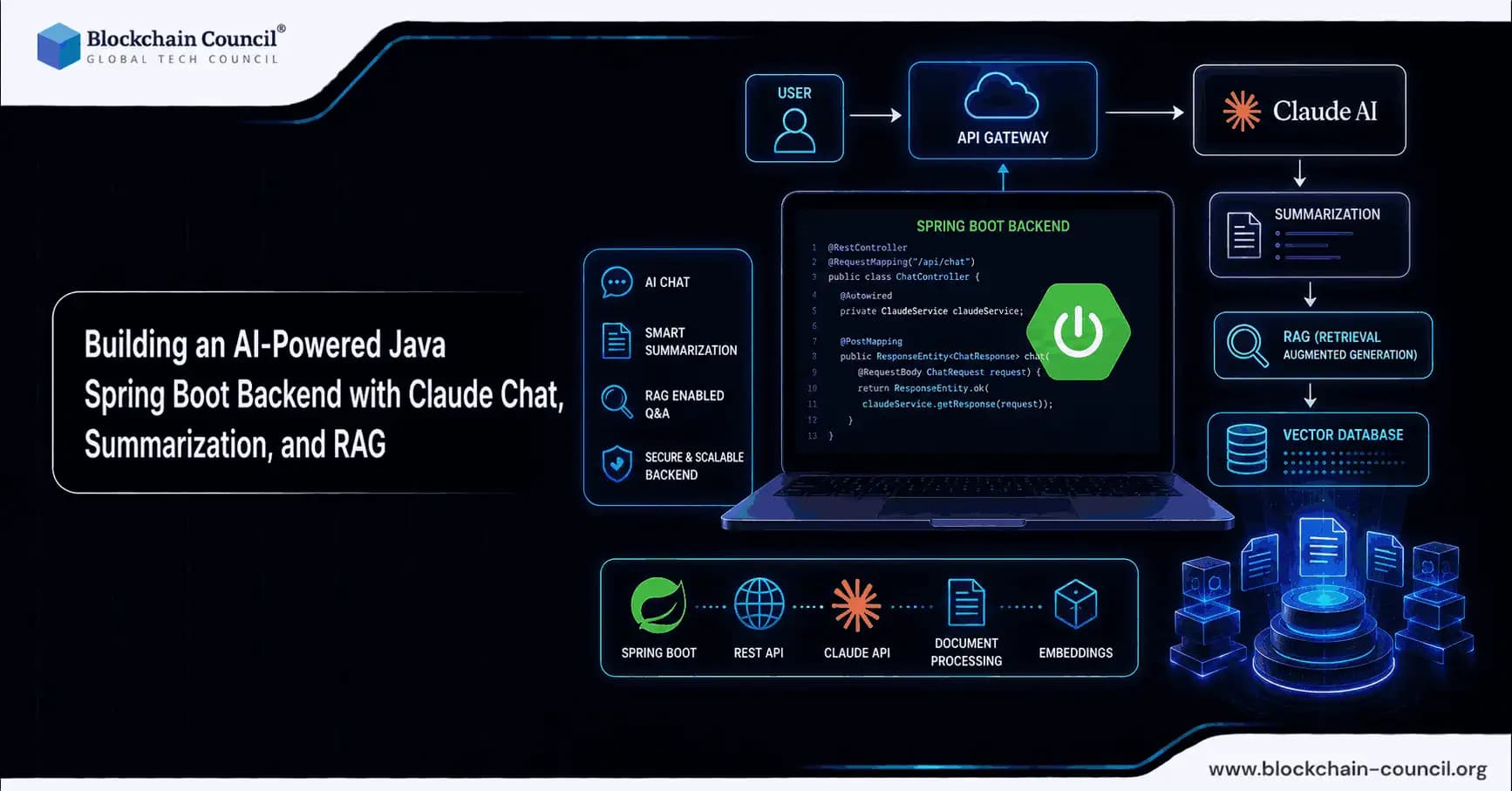
Building an AI-powered Java Spring Boot backend with Claude is now a practical, production-oriented path for teams that want chat experiences, reliable summarization, and Retrieval-Augmented Generation (RAG) inside familiar enterprise architecture. As of early 2026, Anthropic Claude integrations have matured through agentic workflows (Claude Code) and tool integration patterns like the Model Context Protocol (MCP), alongside rapid adoption of Spring AI and ecosystem extensions such as Spring AI Alibaba. The result is a backend approach where Spring Boot remains the system of record, while Claude provides natural language capabilities with strong tooling and test-first automation. Build AI-powered Java Spring Boot backends with Claude for chatbots, summarization, and retrieval-augmented generation (RAG) workflows by gaining expertise through an AI certification, automating AI pipelines and data handling using a Python certification, and scaling AI applications with a Digital marketing course
This guide covers a modern architecture for chat, summarization, and RAG in Spring Boot, including patterns, performance considerations, and verification practices for enterprise delivery.

Why Claude for Spring Boot Backends in 2026?
Claude is increasingly used as both a runtime model (chat, summarization, RAG generation) and a build-time assistant (scaffolding and refactoring) for Spring Boot systems. Consistent drivers reported across the Java community and platform providers include the following:
Agentic scaffolding with quality gates: Claude Code templates for Spring Boot follow phased workflows that include planning, implementation, security, and QA, commonly targeting 85%+ test coverage with JaCoCo and iterative fixes via JUnit execution.
MCP tool use in Spring apps: With MCP servers and Spring AI integrations, Claude can call backend tools such as APIs, retrieval functions, and domain services during a session, enabling structured tool-driven chat flows.
Accelerated delivery: Developer adoption signals indicate broad usage of AI agents among Spring developers, with significant reductions in time spent on CRUD and baseline service setup.
Enterprise-aligned patterns: Community and ecosystem practitioners emphasize adherence to established Java standards such as the Google Java Style Guide, Domain-Driven Design (DDD), and Clean Architecture, shifting human effort from boilerplate to domain logic and RAG design.
Reference Architecture: Chat, Summarization, and RAG in One Backend
A practical blueprint for building an AI-powered Java Spring Boot backend with Claude typically includes these layers:
API layer: Spring MVC or WebFlux controllers exposing endpoints like /chat, /summarize, and /rag.
AI orchestration layer: A service that builds prompts, selects tools, applies safety rules, and manages session context.
Retrieval layer (for RAG): Embedding generation, vector store operations, and document chunking pipelines.
Domain layer: Business services, validation, policy rules, and data access via JPA or reactive repositories.
Observability and testing: Structured logs, request tracing, prompt and retrieval telemetry, and unit and integration tests including Testcontainers.
Choosing Spring MVC vs. WebFlux
Both options work well depending on your requirements. Spring MVC is simpler for most enterprise applications. WebFlux suits high-concurrency chat streaming and SSE-based experiences. Claude Code templates and recent community examples support reactive endpoints, async processing, and cloud-native deployments verified via mvn verify.
Implementing Chat with Claude in Spring Boot
Chat is the most straightforward entry point and serves as a foundation for tool use. A typical approach uses Spring AI abstractions such as a ChatClient configured with your Claude model provider, plus optional tool registration when using MCP.
Recommended Chat Endpoint Design
POST /api/chat accepting a message, optional conversationId, and optional system instructions.
Server-side session store using Redis or a database when durable conversation history is required.
Streaming responses via SSE for lower perceived latency when your front end supports it.
Tool Use with MCP in Spring AI
MCP enables Claude to call your registered tools, such as weather lookups, inventory queries, entitlement checks, or retrieval functions. In the Spring AI Alibaba ecosystem, an MCP server can be published in SSE mode and tools are injected into Claude through Spring beans such as ToolCallbackProvider. A client can then configure defaultTools(tools) so Claude can invoke them during a chat session. Platform guidance indicates that MCP tool sessions can support 100 or more tool calls per session with sub-2-second chat latency when implemented using Spring WebClient and well-tuned timeouts.
Adding Summarization: Fast Value with Clear Guardrails
Summarization is often the highest-ROI capability after chat because it is straightforward to validate and can be tightly scoped. Common backend use cases include summarizing support tickets, meeting notes, product reviews, and compliance documents.
Summarization Endpoint Pattern
POST /api/summarize with input text or a document reference.
Controls: desired length, bullet vs. paragraph format, extractive vs. abstractive constraints, and required language.
Safety: redact sensitive data before sending text to the model and enforce tenant isolation for multi-tenant applications.
Evaluation and Regression Testing
Unlike CRUD endpoints, summarization quality is harder to unit test deterministically. Practical strategies include:
Golden datasets of documents and expected key points to verify coverage.
Structured output using JSON with fields such as summary, key_points, and risks to reduce ambiguity.
Automated checks for length, required sections, and prohibited content.
Teams using Claude Code style workflows often set high test coverage targets, and template-driven generation can include QA phases that run tests and fix failures iteratively.
Implementing RAG in Spring Boot: Retrieval First, Generation Second
RAG is where an AI-powered Java Spring Boot backend with Claude becomes genuinely enterprise-specific. The goal is to ground model responses in trusted knowledge sources and reduce hallucinations by supplying relevant context.
Core RAG Pipeline in Spring Boot
Ingest: Load documents from sources such as databases, S3, SharePoint exports, or internal APIs.
Chunk: Split content into semantically meaningful segments by heading, paragraph, or token count.
Embed: Generate embeddings for each chunk.
Store: Save embeddings to a vector store such as PGVector (PostgreSQL), Pinecone, Weaviate, or another supported option.
Retrieve: For each query, compute query embeddings and fetch top-k chunks, optionally with metadata filters for tenant, product line, or region.
Augment prompt: Provide retrieved context along with citations or source identifiers.
Generate with Claude: Instruct Claude to answer using only the provided context and to acknowledge when evidence is missing.
Using MCP Tools for Retrieval
MCP fits RAG naturally because retrieval can be exposed as a tool. Rather than embedding retrieval logic directly into prompt assembly, you can provide Claude with a tool such as searchKnowledgeBase(query, filters). Claude decides when to call it and how to incorporate results, which is useful in multi-step workflows covering troubleshooting, policy checks, or product comparison.
Grounding and Hallucination Mitigation
Practical controls for reducing hallucinations in RAG systems include:
Evidence constraints: Instruct Claude to answer only from retrieved passages and to quote relevant snippets where appropriate.
Source attribution: Return source IDs, document titles, and timestamps to support audits.
Retrieval quality metrics: Track hit rate, top-k overlap, and user feedback to identify missing or low-quality content.
Fallback behavior: When retrieval returns low-confidence results, route to a clarifying question or a human review workflow.
Production Readiness: Security, Observability, and Cost Control
Moving from a prototype to production requires consistent enterprise controls. Recent Spring Boot agent templates emphasize OAuth2/JWT security, Testcontainers, and Kubernetes manifests, all of which extend naturally to AI endpoints.
Security Checklist for AI Endpoints
Authentication and authorization: Protect chat and RAG endpoints with OAuth2/JWT and enforce per-tenant data boundaries.
Prompt injection defenses: Separate system instructions from user content, and treat retrieved documents as untrusted input.
Data minimization: Avoid sending secrets, credentials, or unnecessary PII to the model.
Rate limiting: Guard against abuse and unexpected cost spikes.
Observability You Should Not Skip
Latency breakdown: measure retrieval time, model time, and tool call time separately.
Token usage: track and cap consumption to manage spend.
Retrieval telemetry: record which sources were used and how often they contributed to helpful answers.
How Claude Code Accelerates Spring Boot Delivery
Claude Code has popularized a workflow where describing requirements in natural language produces production-grade Spring Boot structure: controllers, services, repositories, database migrations, Docker builds, CI pipelines, and tests. Community examples highlight generation of CRUD APIs with Swagger documentation and Postman collections, plus iterative verification. Structured, multi-phase planning documents and automated test execution are particularly effective in microservices environments where consistency across services matters. Learn how to integrate Claude with Spring Boot for conversational AI, document retrieval, and enterprise-grade backend systems by mastering AI architecture through an AI certification, developing scalable APIs and AI services using a Node JS Course, and promoting AI-powered products using an AI powered marketing course.
Conclusion
Building an AI-powered Java Spring Boot backend with Claude is no longer confined to prototypes. With Spring AI integrations, MCP tool patterns, and agentic scaffolding via Claude Code, teams can implement chat, summarization, and RAG in a way that fits enterprise architecture and delivery practices. The strongest outcomes come from treating RAG as an engineering discipline with a focus on retrieval quality, grounding rules, security boundaries, and measurable evaluation. With those foundations in place, Claude provides a reliable natural language layer while Spring Boot handles correctness, compliance, and scale.
FAQs
1. What is an AI-powered Java Spring Boot backend with Claude?
An AI-powered Java Spring Boot backend with Claude is a backend system that uses Claude for chat, summarization, and RAG features. Spring Boot handles APIs, business logic, security, and data access, while Claude adds natural language intelligence. This setup helps teams build enterprise-ready AI applications inside a familiar Java architecture.
2. Why is Claude useful for Spring Boot backends?
Claude is useful because it can support chat, summarization, retrieval-based answers, and tool-driven workflows. It works well with Spring AI and enterprise backend patterns, making it easier to integrate AI into Java applications. Teams can use it without replacing their existing Spring Boot systems.
3. What are the main use cases of Claude in Spring Boot?
The main use cases include chatbots, document summarization, internal knowledge assistants, and Retrieval-Augmented Generation systems. Claude can also help with tool-based workflows when connected to backend services. These use cases are valuable for customer support, compliance, product documentation, and enterprise automation.
4. What is the role of Spring Boot in this architecture?
Spring Boot acts as the main backend framework that manages APIs, services, security, databases, and deployment logic. Claude provides language-based responses, but Spring Boot remains responsible for structure, control, and reliability. This separation keeps AI features easier to manage and scale.
5. What is RAG in a Spring Boot backend?
RAG, or Retrieval-Augmented Generation, is a method that retrieves trusted information before asking Claude to generate an answer. In Spring Boot, this often involves document ingestion, chunking, embeddings, vector storage, and top-k retrieval. It helps reduce hallucinations by grounding responses in approved sources.
6. How does chat work with Claude in Spring Boot?
A chat feature usually starts with an endpoint that accepts a user message, conversation ID, and optional instructions. The backend sends the request to Claude through Spring AI or another integration layer. Responses can be returned normally or streamed to improve the user experience.
7. What is the recommended chat endpoint design?
A practical chat endpoint can use POST /api/chat with fields such as message, conversationId, and system instructions. Conversation history can be stored in Redis or a database when long-term memory is needed. Streaming through Server-Sent Events is also useful for faster perceived response times.
8. How can Claude summarize documents in Spring Boot?
Claude can summarize documents through an endpoint such as POST /api/summarize. The request may include input text, document references, length preferences, output format, and language requirements. Developers should add safeguards such as sensitive data redaction and tenant isolation.
9. Why is summarization considered a high-value AI feature?
Summarization is valuable because it is easy to apply to support tickets, meeting notes, reviews, and compliance documents. It can save teams time while producing clear and consistent outputs. Compared with more complex AI workflows, summarization is usually easier to validate and deploy.
10. What is MCP in Claude and Spring Boot workflows?
MCP, or Model Context Protocol, allows Claude to call registered backend tools during a session. In Spring Boot, these tools can include APIs, retrieval functions, entitlement checks, or domain services. This makes chat workflows more useful because Claude can work with real backend data instead of guessing.
11. How does MCP improve tool use in Spring applications?
MCP helps expose backend capabilities as controlled tools that Claude can call when needed. This allows the model to trigger functions such as searching a knowledge base or checking inventory. It keeps business actions inside Spring Boot, which is safer than letting AI behave like an unsupervised intern with database access.
12. Should developers use Spring MVC or WebFlux?
Spring MVC is a good choice for most standard enterprise applications because it is simpler and widely used. WebFlux is better suited for high-concurrency workloads, streaming chat, and reactive systems. The choice depends on traffic needs, performance goals, and team experience.
13. What are the main layers in this backend architecture?
The main layers include the API layer, AI orchestration layer, retrieval layer, domain layer, and observability layer. Each layer has a clear responsibility, from handling requests to managing prompts, retrieving documents, and tracking system behavior. This structure helps teams avoid turning AI integration into architectural soup.
14. How can teams reduce hallucinations in RAG systems?
Teams can reduce hallucinations by instructing Claude to answer only from retrieved context. They should also return source IDs, timestamps, document titles, and relevant snippets for verification. Tracking retrieval quality and using fallback workflows further improves response reliability.
15. What vector stores can be used for RAG?
Common vector store options include PGVector, Pinecone, Weaviate, and other supported databases. These systems store document embeddings and help retrieve relevant chunks for user queries. The best option depends on cost, scale, latency, and existing infrastructure.
16. What security practices are important for AI endpoints?
AI endpoints should use authentication, authorization, tenant boundaries, and rate limiting. Developers should also separate system instructions from user content to reduce prompt injection risks. Sensitive data, credentials, and unnecessary personal information should not be sent to the model.
17. Why is observability important in AI-powered Spring Boot apps?
Observability helps teams understand latency, token usage, retrieval quality, and tool-call performance. Without tracking these areas, costs can rise and response quality can decline quietly. Good telemetry also helps debug bad answers and improve the system over time.
18. How can teams test summarization quality?
Teams can test summarization using golden datasets, expected key points, and structured output checks. Automated tests can verify length, required sections, prohibited content, and JSON format. Since summaries are not always deterministic, testing should focus on coverage and correctness rather than exact wording.
19. How does Claude Code help Spring Boot development?
Claude Code can help generate Spring Boot controllers, services, repositories, tests, Docker files, and CI pipeline structures. It supports phased workflows that include planning, implementation, security, and quality checks. This can speed up development while still requiring human review because software does not magically become reliable just because an AI typed it.
20. Is Claude with Spring Boot production-ready?
Claude with Spring Boot can be production-ready when teams use strong architecture, security, testing, and monitoring practices. Spring Boot handles correctness, compliance, and scalability, while Claude provides natural language capabilities. The best results come from treating AI integration as engineering work, not as a shiny shortcut glued onto an API.
Related Articles
View All
Claude Ai
Claude Sonnet 5 for Developers: Building Smarter AI Agents and Enterprise Applications
Claude Sonnet 5 for Developers is a practical guide to building AI agents, coding workflows, and enterprise applications with Anthropic's latest Sonnet model.

Claude Ai
Claude Sonnet 5 in AI-Powered Crypto Trading: Opportunities, Risks, and Best Practices
Claude Sonnet 5 can support AI-powered crypto trading through research, monitoring, and strategy support, but execution needs strict controls.

Claude Ai
Claude Fable 5 for Developers: Building Smarter AI Applications and Assistants
Learn how Claude Fable 5 helps developers build smarter AI applications, coding agents, analytics copilots, and safe multimodal assistants.
Trending Articles
The Role of Blockchain in Ethical AI Development
How blockchain technology is being used to promote transparency and accountability in artificial intelligence systems.
AWS Career Roadmap
A step-by-step guide to building a successful career in Amazon Web Services cloud computing.
What is AWS? A Beginner's Guide to Cloud Computing
Everything you need to know about Amazon Web Services, cloud computing fundamentals, and career opportunities.