

What Does a Blockchain Product Manager Do? Roles, Skills, and Career Path

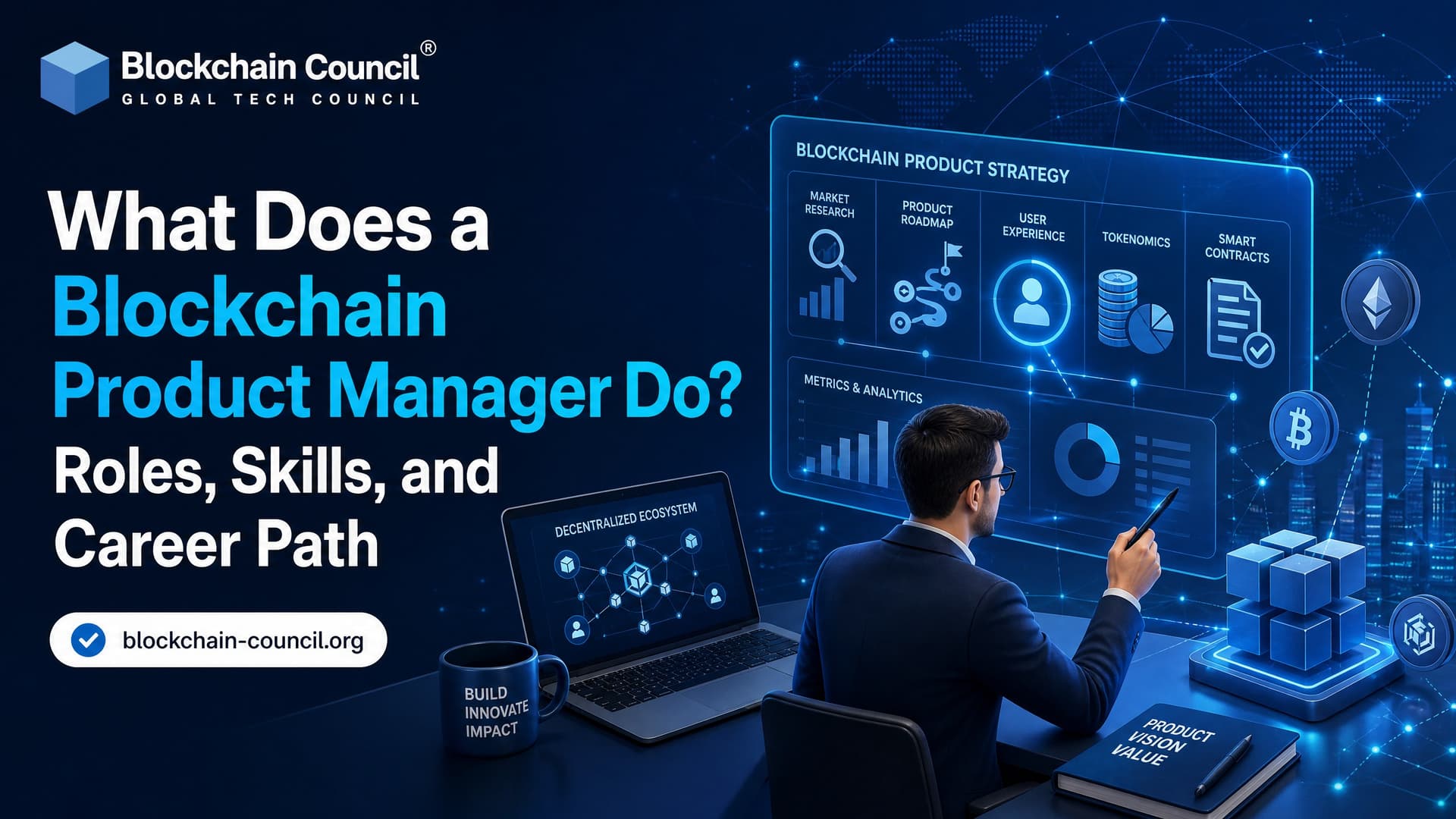
A blockchain product manager turns blockchain ideas into products people can actually use, trust, and pay for. The job sits between product strategy, engineering, compliance, token design, and user research. If you enjoy product management but also want to work close to wallets, smart contracts, crypto payments, DeFi, tokenization, or Web3 infrastructure, this is one of the more serious career paths in the blockchain industry.
It is also not a role for people who only like whitepapers. A blockchain product manager has to make hard calls: what belongs on-chain, what should stay off-chain, which risks legal must review, and whether a blockchain is needed at all. Sometimes the right product decision is to use a normal database. To be blunt, that judgment is part of the job.

What Is a Blockchain Product Manager?
A blockchain product manager guides the strategy, design, launch, and improvement of products that use blockchain or crypto infrastructure. That can include crypto wallets, exchanges, NFT platforms, DeFi protocols, tokenization tools, payment rails, on-chain analytics products, and enterprise blockchain systems.
The role combines classic product management with technical literacy. You still write requirements, prioritize features, study users, manage roadmaps, and work with engineering. But you also need to understand smart contracts, consensus mechanisms, gas fees, private keys, custody, liquidity, token incentives, and regulation.
Most job descriptions frame the role as guiding the development of products built on or using blockchain technology. That framing is fair, but it hides the messy part: execution. The day-to-day is less about vision decks and more about defending design choices in front of engineers and compliance.
Core Responsibilities of a Blockchain Product Manager
Define Product Strategy and Vision
Your first responsibility is to decide what problem the product solves and why blockchain helps. A supply chain provenance tool might use blockchain for auditability. A stablecoin payment product might use it for faster settlement. A game might use NFTs for player-owned assets. Each case has a different product logic.
A good blockchain PM asks:
- Who is the user?
- What trust problem are we solving?
- Does decentralization add real value?
- What should be on-chain versus off-chain?
- How will the product make money or sustain itself?
You then turn those answers into a roadmap, milestones, launch scope, and measurable goals.
Translate Blockchain Concepts Into Product Requirements
This is where many new PMs struggle. Blockchain features need precise requirements because small design choices can create user losses, high fees, compliance issues, or failed transactions.
Take a wallet transfer flow. It is not just a Send button. You need to define supported chains, token standards such as ERC-20 and ERC-721, gas estimation, failed transaction states, transaction hashes, confirmations, balance refresh timing, and what happens when a user is on the wrong network. Anyone who has tested MetaMask has hit the painful error: insufficient funds for gas * price + value. Your UX should explain that before support tickets pile up.
On local Ethereum development networks, Hardhat uses chain ID 31337 by default. Ethereum mainnet uses chain ID 1. That tiny difference matters when you are testing wallet flows, signatures, and network switching. A PM does not need to write every smart contract, but you should know enough to spot requirements that are too vague.
Lead Delivery Across Teams
Blockchain product managers work with engineering, design, compliance, security, marketing, sales, customer support, and external partners. In crypto payment products, you may also coordinate with banks, payment service providers, custodians, liquidity providers, and infrastructure vendors.
Typical delivery work includes:
- Writing user stories and acceptance criteria
- Managing sprint planning, backlog refinement, demos, and retrospectives
- Working with engineers on APIs, indexing, smart contract integration, and backend architecture
- Coordinating security reviews and smart contract audits
- Preparing launch plans and support documentation
- Tracking adoption, reliability, and transaction success rates after release
In crypto infrastructure roles, the product may be mostly backend. A payment PM might own order lifecycle management, T+0 or T+1 settlement rules, multi-currency reconciliation, bank rail integration, or clearing modules. Not glamorous. Very important.
Manage Compliance, Risk, and Security
Regulation is now part of blockchain product work. PMs in crypto must understand KYC, AML, sanctions screening, data privacy, custody rules, and asset classification risks. In Europe, MiCA, the Markets in Crypto-Assets Regulation, directly affects many crypto asset products. GDPR matters when user data is involved. In the United States, SEC positions on crypto assets can shape what a platform can list, market, or offer.
You are not the lawyer. Still, you must know when to bring legal and compliance into the room. Waiting until launch week is a rookie mistake.
Security is just as serious. Smart contracts are hard to change after deployment. Bridges, admin keys, oracle design, and upgrade permissions are product decisions as much as technical decisions. If users can lose funds, security belongs in the roadmap.
Key Skills You Need
Product Management Fundamentals
Start here. Blockchain knowledge will not compensate for weak product craft. You need to know how to identify user needs, prioritize work, run discovery, define metrics, write clear requirements, and make trade-offs under pressure.
Core PM skills include:
- Roadmap planning
- User research and market analysis
- Prioritization frameworks
- Agile or Kanban delivery
- Data analysis and experimentation
- Stakeholder communication
Many employers prefer candidates with product experience in fintech, payments, SaaS, or infrastructure because those domains map well to blockchain products.
Blockchain and Crypto Literacy
You do not need to be a protocol engineer, but you do need working knowledge of the stack. Learn block structure, Proof of Stake, transaction finality, wallet signing, gas fees, token standards, bridges, oracles, and smart contract risk.
Solidity 0.8.x, for instance, added built-in overflow and underflow checks. Older Solidity code often pulled in SafeMath for that reason. This kind of detail helps you read engineering estimates and audit comments instead of treating them as black boxes.
If you want structured learning, Blockchain Council courses such as the Certified Blockchain Expert™, Certified Blockchain Developer™, and Certified Smart Contract Developer™ can help you build technical confidence.
Domain Knowledge
Blockchain PM roles are becoming more specialized. A DeFi PM needs to understand liquidity, collateral ratios, governance, oracle risk, and protocol incentives. A payments PM needs settlement, reconciliation, chargebacks, compliance, and fiat rails. An NFT gaming PM needs asset standards, marketplace design, royalties, and game economy balance.
Pick a lane. General Web3 enthusiasm is not enough for senior roles.
Communication and Judgment
The best blockchain PMs explain complex systems without making people feel stupid. You will often speak with executives, engineers, auditors, regulators, customers, and community members in the same week. Each group needs a different level of detail.
Judgment matters too. If the team wants to put every action on-chain and gas costs will wreck the user experience, say so. If a token is being added only because it sounds marketable, challenge it.
Common Products Blockchain PMs Work On
- Crypto exchanges and brokerage platforms: trading flows, KYC, fiat on-ramps, custody, risk controls, reporting, and liquidity.
- Wallets: onboarding, seed phrase education, transaction signing, token display, multi-chain support, and recovery.
- DeFi protocols: lending, DEXs, yield products, derivatives, governance, and incentive programs.
- Payments and remittances: stablecoin settlement, merchant payments, payout systems, and bank integration.
- NFT and gaming platforms: minting, marketplace flows, player assets, royalties, and community features.
- Tokenization platforms: real estate, securities, invoices, commodities, and other real-world assets.
- Enterprise blockchain tools: audit trails, supply chain systems, permissioned networks, analytics, and APIs.
Career Path: How to Become a Blockchain Product Manager
Entry Routes
There is no single path. Many blockchain PMs come from traditional product roles in fintech, payments, SaaS, or cloud infrastructure. Others move from software engineering, data analytics, consulting, operations, or startup founding.
If you are early in your career, aim for associate product manager, product analyst, business analyst, technical project manager, or customer success roles in crypto or fintech. Get close to real users and product decisions.
Career Progression
- Associate or Junior Product Manager: Own small features, write specs, support research, and learn delivery habits.
- Blockchain Product Manager: Own a wallet module, NFT marketplace component, KYC flow, payment feature, or analytics product.
- Senior Product Manager: Own a product line, manage larger teams, define strategy, and handle complex stakeholder groups.
- Lead PM, Head of Product, VP Product, or CPO: Shape portfolio strategy, partnerships, product operating models, and company direction.
Crypto PM listings commonly ask for 5 to 6 years of product management experience, Agile proficiency, analytical skill, and regulatory awareness. Senior payment infrastructure roles on Web3 job boards often ask for 6 to 10 or more years of experience. That tells you something: core blockchain PM work is usually not entry-level.
Salary and Market Demand
Demand is real, especially in exchanges, payments, infrastructure, custody, analytics, and tokenization. Web3 job boards regularly list thousands of blockchain product manager openings worldwide, including roles tied to major crypto companies and infrastructure teams. Niche boards such as CryptocurrencyJobs also maintain dedicated crypto product manager categories.
Compensation reflects the difficulty of the role. U.S. blockchain product manager salaries, based on Glassdoor data, average roughly USD 167,000 per year, though the range is wide. Startup roles may include equity or token-based compensation. Treat token packages carefully. Ask about vesting, liquidity, lockups, and whether the token has real utility.
Future Outlook for Blockchain Product Managers
The role is likely to become more specialized. DeFi PMs, stablecoin payment PMs, RWA tokenization PMs, institutional custody PMs, and enterprise infrastructure PMs already have different skill profiles.
Regulatory fluency will also become a bigger advantage. MiCA, privacy rules, licensing regimes, and securities analysis are shaping product decisions. The PM who can work productively with compliance and still ship user-friendly products will stand out.
Another shift is clear: more products will target non-crypto-native users. That means hiding complexity without hiding risk. Your job is not to make blockchain invisible at all costs. Your job is to make the right parts understandable at the right moment.
How to Start Building the Right Skill Set
If you want this role, build a small portfolio. Create a wallet onboarding teardown. Write a product requirements document for an ERC-20 payment flow. Compare gas fees and confirmation experiences across Ethereum and a layer 2 network. Map the KYC flow of a crypto exchange. Ship something small, even if it is only a prototype.
Then add structured learning. For product-minded professionals, start with the Certified Blockchain Expert™ to build a foundation. If you work closely with engineers, add the Certified Smart Contract Developer™ or Certified Blockchain Developer™. If your target role is in strategy or enterprise architecture, the Certified Blockchain Architect™ is a logical next step.
Your next step is simple: choose one blockchain product type, study its users, write a real product spec, and learn enough of the technology to defend your decisions in front of engineers, compliance, and customers.
Related Articles
View All
Blockchain
Blockchain Product Manager Career Path: From Associate PM to Head of Product
Explore the Blockchain Product Manager career path from Associate PM to CPO, including skills, salary ranges, role scope, and learning steps.

Blockchain
What Does a Blockchain Product Manager Do? Roles, Skills, and Career Outlook
Learn what a blockchain product manager does, the skills needed, typical responsibilities, career outlook, and how to start building the right expertise.

Blockchain
Blockchain Product Manager Certification Guide: Best Credentials to Advance Your Career
A practical guide to Blockchain Product Manager Certification paths, including blockchain, product, agile, and finance credentials for Web3 careers.
Trending Articles
The Role of Blockchain in Ethical AI Development
How blockchain technology is being used to promote transparency and accountability in artificial intelligence systems.
Blockchain in Supply Chain Provenance Tracking
Supply chains are under pressure to prove not just efficiency, but also authenticity, sustainability, and fairness. Customers want to know if their coffee really is fair trade, if the diamonds are con
How to Create Claude Skills?
Claude Skills are one of the most important features Anthropic has introduced for users who want automation that is structured, consistent and reusable. Instead of giving Claude long instructions ever