

What Does a Blockchain Product Manager Do? Roles, Skills, and Career Outlook

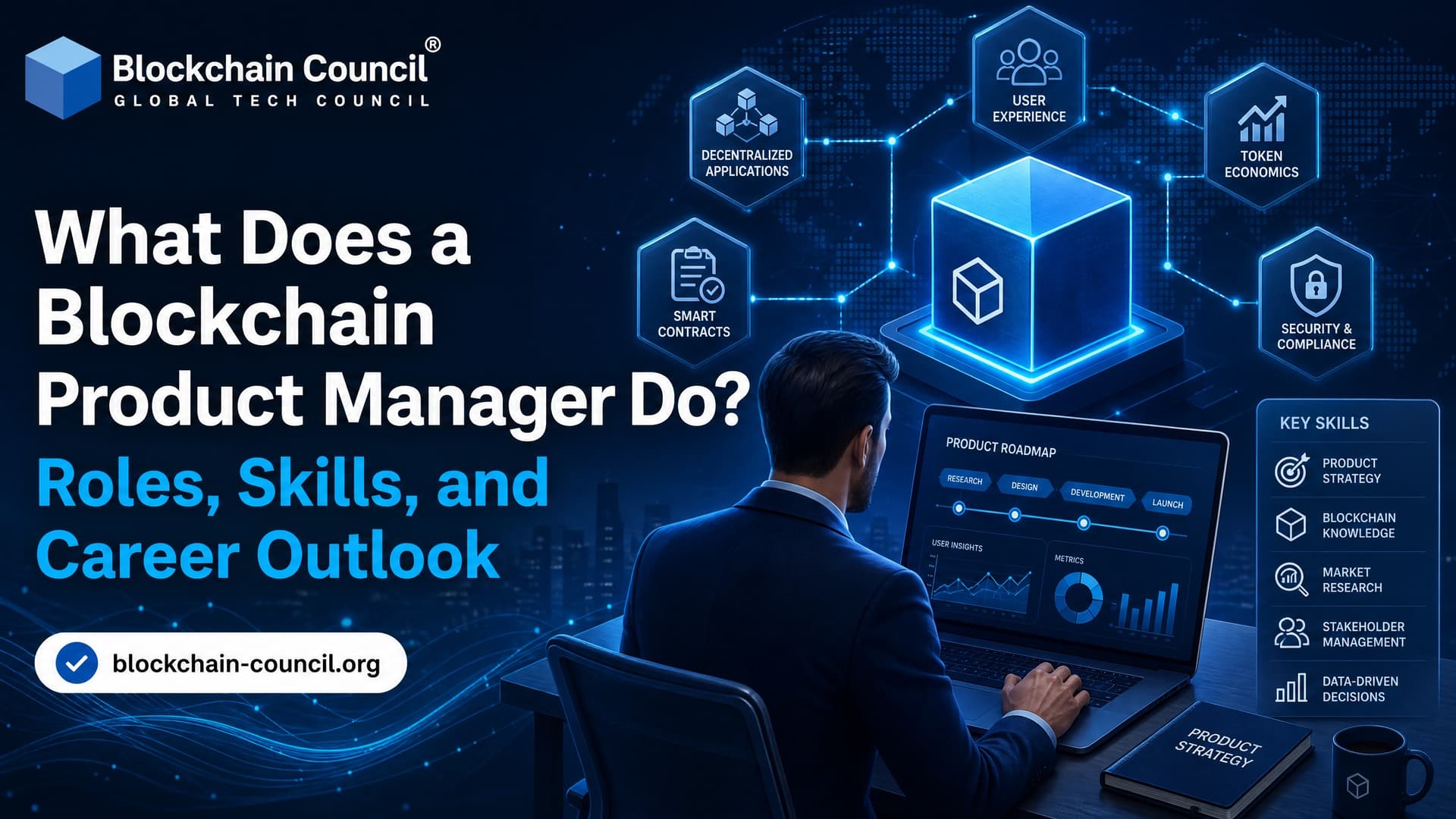
A blockchain product manager turns a blockchain idea into a working product that users trust, understand, and keep using. That could mean a DeFi yield product, a crypto exchange feature, a wallet flow, a tokenized payments system, or an on-chain analytics dashboard. The job sits between product strategy, engineering, security, compliance, and community behavior.
It is not just traditional product management with crypto terminology bolted on. You need to know why a transaction fails, what gas fees do to conversion, how smart contract risk changes release planning, and when blockchain is the wrong architecture. To be blunt, many Web3 products would be better as normal databases. A good blockchain PM can say that early.

What Is a Blockchain Product Manager?
A blockchain product manager owns the end-to-end lifecycle of a product built on, or deeply connected to, blockchain technology. You define the problem, shape the roadmap, write product requirements, coordinate teams, launch features, measure adoption, and improve the product after release.
The difference is the operating environment. A normal fintech PM worries about payments, onboarding, fraud, retention, and compliance. A blockchain PM worries about all of that plus wallets, private keys, chain support, token standards, smart contract audits, transaction finality, bridges, liquidity, governance, and users who may be managing real assets from day one.
Typical products include:
- Crypto wallets and custody tools
- Centralized and decentralized exchanges
- DeFi lending, staking, and yield products
- NFT marketplaces and tokenized asset platforms
- Blockchain payment networks
- On-chain analytics and compliance tools
- Enterprise blockchain and supply chain systems
Core Responsibilities of a Blockchain Product Manager
1. Define Product Strategy and Vision
Your first job is to decide what should be built and why. In blockchain, that means asking a hard question: does decentralization create real value here?
Blockchain makes sense when the product needs shared settlement, programmable assets, auditability, user-owned assets, or coordination between parties that do not fully trust each other. It is weaker when the product only needs a fast private database, simple user accounts, and low-cost transactions.
A blockchain PM translates market movement into product direction. Say a payments company is exploring stablecoin settlement. You have to evaluate user demand, regulatory constraints, chain selection, liquidity, wallet support, and integration costs before engineering writes a line of code.
2. Conduct Market and Competitive Research
Crypto markets move fast. You need to watch competitor launches, token incentive changes, protocol upgrades, wallet trends, exchange behavior, and user sentiment across Discord, Telegram, X, governance forums, and on-chain data.
For a DeFi product, market research is not just reading reports. You may compare APYs, total value locked, withdrawal restrictions, smart contract audit history, governance token utility, and liquidity depth. If a competitor offers high yield through unsustainable token emissions, you need to spot that before you copy the model.
3. Write Product Requirements for On-chain Features
Requirements in blockchain products must be precise. A vague user story can become an expensive mistake once a contract is deployed.
A good requirement may specify:
- Supported chains, such as Ethereum mainnet, Polygon, or BNB Smart Chain
- Token standards, such as ERC-20, ERC-721, or ERC-1155
- Wallet connection behavior through MetaMask or WalletConnect
- Smart contract permissions, upgradeability, and admin controls
- Events emitted for analytics and indexing
- Error states users will see when a transaction fails
Here is a practitioner detail that matters: if a user retries a pending Ethereum transaction with too little extra gas, wallets or RPC providers may return replacement transaction underpriced. If your product does not explain what happened, the user thinks funds are lost. They are usually not. The transaction replacement simply did not meet the node's pricing rule.
4. Coordinate Engineering, Design, Legal, Security, and Growth
Blockchain product work is cross-functional by default. You work with smart contract engineers, backend teams, frontend developers, UX designers, legal counsel, security auditors, marketing, community managers, and sometimes external protocol partners.
Release planning is also different. You cannot treat a mainnet contract deployment like a normal backend push. You need testnet validation, code review, audit scope, bug bounty planning, deployment runbooks, multisig approvals, monitoring, and a rollback strategy where rollback is even possible.
5. Own Tokenomics and Incentive Design
Not every blockchain PM designs a token, but many need to understand token economics. Tokenomics covers supply, allocation, vesting, utility, rewards, governance rights, and incentives for users, validators, liquidity providers, or ecosystem partners.
This is where weak product thinking does real damage. A token with no real utility can create short-term activity and long-term churn. High emissions may grow deposits for a few weeks, then collapse when rewards fall. A blockchain PM should model the behavior, not just the launch announcement.
6. Manage Security, Risk, and Compliance
Security is product work in Web3. Private key theft, phishing, malicious approvals, oracle manipulation, bridge exploits, smart contract bugs, and compliance gaps all affect user trust.
You do not need to be the auditor, but you must know the risk vocabulary. If a contract uses an upgradeable proxy, who controls upgrades? If a DeFi protocol depends on a price oracle, what happens during low-liquidity manipulation? If a wallet flow asks for unlimited ERC-20 approvals, why?
Compliance also shapes the roadmap. Exchange products, payment networks, and yield products may face KYC, AML, sanctions screening, tax reporting, securities law, or jurisdiction-specific restrictions.
Skills You Need to Become a Blockchain Product Manager
Product Management Fundamentals
You still need the classic PM toolkit:
- Customer discovery and problem framing
- Roadmap planning and prioritization
- Metrics design and funnel analysis
- Stakeholder communication
- Experimentation and iteration
- Clear product requirements and release planning
Data matters. For an exchange product, you may track retention rate, session frequency, trading activation, deposit success rate, wallet connection failure, lifetime value, and support tickets per feature release.
Blockchain Technical Literacy
You should understand the basics well enough to earn engineering trust. Learn accounts, keys, signing, gas, consensus, smart contracts, nodes, RPC providers, block explorers, token standards, and the transaction lifecycle.
If you work with Ethereum or EVM chains, know that Ethereum mainnet uses chain ID 1, EIP-1559 introduced base fees and priority fees, and Solidity 0.8.x includes built-in overflow and underflow checks. Watch tool changes too. In ethers.js v6, many values moved from BigNumber patterns to native bigint, which quietly breaks older examples and dashboards if teams miss it.
DeFi and Web3 Domain Knowledge
For DeFi PM roles, learn liquidity pools, automated market makers, lending markets, staking, slashing, bridges, governance, liquidation, impermanent loss, and oracle risk. You do not need to trade every new token. You do need to understand why users behave the way they do when real money is on the line.
Security and UX Judgment
Good Web3 UX reduces irreversible mistakes. Show network names clearly. Warn users before signing high-risk approvals. Explain pending transactions. Avoid hiding fees until the last step. Make recovery and support flows honest, especially when the product cannot reverse an on-chain action.
Typical Background and Qualifications
Most blockchain PM roles are not entry-level. Current job descriptions commonly ask for two or more years of product management experience, often with hands-on blockchain or DeFi project work. Job boards such as Web3.career list thousands of Web3 product manager openings, including roles at crypto-native companies and larger financial firms testing blockchain products.
Common backgrounds include:
- Software product managers moving into crypto
- Engineers transitioning into product roles
- Fintech PMs specializing in digital assets
- Startup operators with Web3 project experience
- Consultants working on blockchain implementation
A computer science degree helps for technical platform roles, but it is not the only path. A portfolio can be just as persuasive. Build a wallet prototype, analyze a DeFi protocol, contribute to an open-source dashboard, or write a product teardown of a major exchange onboarding flow.
Career Outlook for Blockchain Product Managers
The outlook is strong for people who combine real PM ability with blockchain fluency. Hiring now spans exchanges, DeFi protocols, infrastructure companies, payment networks, analytics platforms, and traditional enterprises testing tokenized assets or stablecoin payments.
The role is also getting more specialized. You can already see separate tracks for DeFi and earn products, exchange engagement, on-chain consumer experiences, enterprise infrastructure, and AI-powered decentralized applications. Platform PM roles increasingly mention AI agents, retrieval-augmented generation, and DevSecOps workflows alongside blockchain infrastructure.
That said, this is not a low-risk career bet. Crypto hiring moves in cycles. Token prices affect budgets. Regulations can pause entire product lines. The safest profile is not a hype-driven Web3 generalist. It is a product manager with transferable skills, technical depth, and enough judgment to work across fintech, security, data, and blockchain systems.
How to Start Building the Skill Set
- Learn the fundamentals. Study how blockchains process transactions, how wallets sign messages, and how smart contracts store state.
- Use the products. Connect a wallet, bridge small test assets, inspect transactions on Etherscan, and read contract events.
- Build one small project. A simple ERC-20 dashboard or NFT minting flow teaches more than a month of passive reading.
- Study security failures. Read postmortems from DeFi exploits and ask what product decisions made the attack easier or harder.
- Create a product portfolio. Write a roadmap, PRD, metrics plan, and risk register for a blockchain product idea.
For structured learning, Blockchain Council courses can help you build the technical and domain base. Consider Certified Blockchain Expert™ if you need broad blockchain fluency, Certified Blockchain Developer™ if you want to work closely with engineering teams, Certified Smart Contract Developer™ for deeper contract knowledge, and Certified DeFi Expert™ if your target role is in lending, staking, exchanges, or yield products.
Is Blockchain Product Management Right for You?
Choose this path if you like messy product problems, technical trade-offs, market analysis, and high-stakes UX. You will spend one hour discussing retention metrics and the next asking whether a smart contract permission should sit behind a multisig.
Your next step: pick one blockchain product you use, map its onboarding funnel, inspect one transaction on a block explorer, and write a one-page PRD for improving the riskiest step. If that exercise feels interesting rather than painful, start formal training and build a small portfolio project to support your first blockchain product manager application.
Related Articles
View All
Blockchain
Blockchain Product Manager Salary, Job Outlook, and Career Opportunities
Blockchain product manager salary ranges, job outlook, skills, and career paths for professionals moving into Web3, DeFi, wallets, and enterprise blockchain.

Blockchain
What Does a Blockchain Product Manager Do? Roles, Skills, and Career Path
Learn what a blockchain product manager does, the skills required, typical responsibilities, salary outlook, and how to build a career in Web3 product management.

Blockchain
Blockchain Product Manager Certification Guide: Best Credentials to Advance Your Career
A practical guide to Blockchain Product Manager Certification paths, including blockchain, product, agile, and finance credentials for Web3 careers.
Trending Articles

Top 5 DeFi Platforms
Explore the leading decentralized finance platforms and what makes each one unique in the evolving DeFi landscape.
What is AWS? A Beginner's Guide to Cloud Computing
Everything you need to know about Amazon Web Services, cloud computing fundamentals, and career opportunities.
Claude AI Tools for Productivity
Discover Claude AI tools for productivity to streamline tasks, manage workflows, and improve efficiency.