

How to Become a Blockchain Product Manager: A Step-by-Step Career Guide

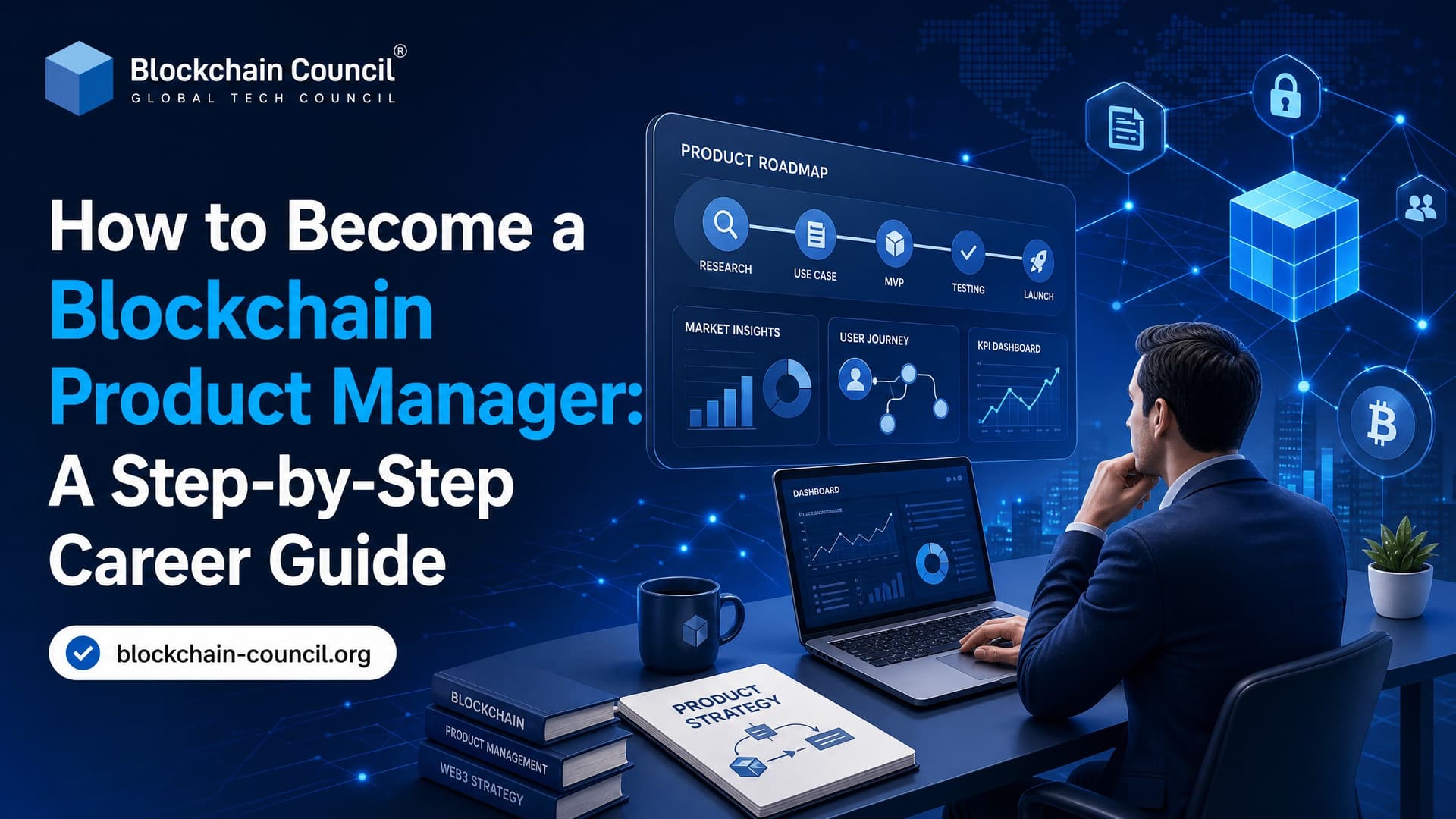
A blockchain product manager turns blockchain ideas into products people actually use: wallets, payment rails, DeFi apps, token platforms, custody tools, compliance workflows, and enterprise blockchain systems. The job is not just writing user stories for engineers. You need product judgment, crypto fluency, risk awareness, and enough technical depth to challenge weak assumptions before they turn into expensive launches.
Demand is real. Public listings on Web3.career have shown thousands of blockchain product manager roles at once, spread across companies like Mastercard, Binance, Charles Schwab, exchanges, fintech firms, and infrastructure providers. Many postings ask for 6 to 10+ years of product management experience, especially in payments, backend platforms, wallets, or financial systems. That tells you something useful. This is usually not an entry-level Web3 job. It is a specialist PM path.

What Does a Blockchain Product Manager Do?
A blockchain product manager owns the product lifecycle for blockchain-enabled products, from discovery and validation to launch, growth, iteration, and sometimes shutdown. The difference from traditional product management is the operating environment. You deal with smart contracts, wallets, token incentives, settlement timing, gas fees, security reviews, regulatory questions, and communities that can be brutally public when something breaks.
Typical responsibilities
- Identifying valid blockchain use cases instead of forcing blockchain into products that do not need it.
- Defining product strategy for wallets, exchanges, token products, payment systems, DeFi protocols, or enterprise blockchain solutions.
- Working with engineering teams on APIs, smart contracts, custody architecture, transaction flows, and integrations.
- Coordinating with legal and compliance on KYC, AML, token classification, market access, and jurisdiction-specific restrictions.
- Improving user experience around wallet setup, signing, transaction status, gas fees, recovery, and failed transactions.
- Monitoring post-launch performance through product analytics, on-chain data, user feedback, and incident reviews.
- Managing community expectations, especially in tokenized products where users may also be investors, governance participants, or validators.
Here is a practical example. If a user sees execution reverted: ERC20: insufficient allowance, a regular PM might shrug and call it an engineering issue. A good blockchain PM knows the actual user problem. The user likely tried to spend an ERC-20 token before approving the contract, or the allowance was lower than the transaction amount. That insight changes the product requirement: show allowance state, explain the approval step, cut unnecessary approvals, and warn users before they pay gas for a transaction that will fail.
Skills You Need to Become a Blockchain Product Manager
You do not need to be a Solidity engineer. You do need enough depth to understand trade-offs. If an engineer says an action must be on-chain, you should be able to ask why. If a founder proposes a token, you should be able to ask what incentive problem it actually solves.
Core product management skills
- Customer discovery and problem framing
- Roadmap planning and prioritization
- MVP definition and release planning
- Data analysis and experimentation
- Stakeholder management across engineering, design, legal, finance, marketing, and support
- Clear writing: PRDs, user stories, launch notes, incident summaries, and decision memos
Blockchain-specific skills
- Blockchain architecture: blocks, nodes, consensus, finality, forks, validators, and network fees.
- Smart contracts: what they can and cannot do, common standards such as ERC-20 and ERC-721, and why audits matter.
- Wallets and signing: private keys, seed phrases, account abstraction, hardware wallets, MetaMask, WalletConnect, and custody models.
- DeFi mechanics: AMMs, lending, staking, stablecoins such as DAI, collateralization, liquidation, and governance tokens.
- Payments and ledgers: settlement, reconciliation, fund flows, order states, chargebacks where fiat is involved, and multi-currency reporting.
- Security and privacy: phishing risk, approval risk, oracle risk, smart contract vulnerabilities, and data exposure.
- Regulatory awareness: KYC, AML, sanctions screening, securities questions, tax reporting, and jurisdiction limits.
Ethereum mainnet uses chain ID 1. That small fact matters when you design wallet prompts, network switching, testnet behavior, and transaction support flows. EIP-1559 also changed Ethereum fee mechanics by introducing a base fee and a priority fee, so product copy that still says users simply pick a gas price is outdated. These details look minor until your support queue fills up.
Step-by-Step Guide to Becoming a Blockchain Product Manager
Step 1: Build real PM fundamentals first
If you are not already in product, do not try to become a PM and move into Web3 at the same time. It can be done, but it is the harder route. A cleaner path is to move into a traditional product role first, preferably in fintech, payments, developer tools, data platforms, cybersecurity, or infrastructure.
Good feeder roles include business analyst, software engineer, QA analyst, solutions consultant, growth marketer, project manager, or product operations specialist. Your goal is to prove you can define problems, work with engineers, make trade-offs, ship features, and measure outcomes.
Step 2: Learn blockchain fundamentals systematically
Do not rely only on crypto Twitter or scattered YouTube videos. Build a structured base. Study decentralization, consensus mechanisms, Proof of Stake, smart contracts, token standards, scalability, Layer 2 networks, oracles, bridges, and custody models.
For structured learning paths, Blockchain Council certifications such as the Certified Blockchain Expert, Certified Blockchain Developer, Certified Web3 Expert, and Certified Cryptocurrency Expert are relevant options to explore. If your target is DeFi or token products, add the Certified DeFi Expert to your shortlist. If you work closely with smart contract teams, the Certified Smart Contract Developer can help you follow engineering conversations with more confidence.
Step 3: Use Web3 products yourself
This is non-negotiable. You cannot design wallet UX from a slide deck.
- Create a wallet with MetaMask or another widely used wallet.
- Write down how seed phrase backup is explained to you. Is it clear, or scary?
- Send a small transaction on a testnet such as Sepolia.
- Swap a small amount on a reputable decentralized exchange, if allowed in your jurisdiction.
- Try an approval flow with an ERC-20 token, then review token allowances.
- Use a block explorer such as Etherscan to inspect transaction status, gas used, nonce, and contract interaction details.
Keep notes like a PM. Where did you hesitate? What language confused you? Did the wallet warn you before signing? Did you understand whether you were approving, swapping, bridging, staking, or delegating? Those observations can become portfolio material.
Step 4: Build a blockchain product portfolio
You do not need to launch a protocol to show competence. Create two or three strong case studies. Make them specific.
- Analyze onboarding for a wallet and propose a safer recovery flow.
- Map the order lifecycle for a crypto on-ramp: created, pending KYC, payment initiated, funds received, crypto delivered, failed, refunded.
- Compare two DeFi lending products on collateral, liquidation UX, risk warnings, and user education.
- Write a PRD for a transaction status page that covers mempool pending, confirmed, failed, replaced transaction, and wrong-network cases.
- Design a reconciliation dashboard for a multi-currency payment platform using T+0 and T+1 settlement assumptions.
To be blunt, a generic Web3 enthusiasm paragraph on your resume will not carry much weight. A sharp case study with real flows, screenshots, metrics, and trade-offs will.
Step 5: Develop fintech and compliance literacy
Many blockchain PM jobs are not pure crypto roles. They sit between traditional finance and digital assets. Public job descriptions often mention payment middle platforms, clearing modules, order systems, settlement, reconciliation, ledger systems, and fund verification.
If you have payments experience, use it. If you do not, study the basics: authorization, settlement, chargebacks, ACH, card networks, SWIFT, stablecoin transfers, custody, and ledger design. Learn how compliance changes product decisions. A beautiful feature that legal cannot approve is not a roadmap win.
Step 6: Network where builders spend time
Blockchain companies tend to value visible proof that you understand the space. Join Ethereum, DeFi, NFT, Layer 2, security, or protocol-specific communities. Attend meetups, conferences, demo days, and hackathons. Contribute thoughtfully. Ask better questions than wen token?
Open-source contribution is not only for developers. PMs can help with documentation, user research, issue triage, competitive analysis, governance proposals, onboarding guides, and product feedback.
Step 7: Apply to the right roles
Search for titles such as Blockchain Product Manager, Crypto Product Manager, Web3 Product Manager, Product Manager - Wallet, Product Manager - Payments, Product Manager - Exchange, and Product Manager - DeFi.
Tailor your pitch to your strongest bridge:
- Fintech background: target payments, stablecoins, on-ramps, custody, and reconciliation roles.
- Developer tools background: target wallets, APIs, node infrastructure, analytics, and smart contract platforms.
- Consumer PM background: target wallets, NFT products, gaming, loyalty, and creator platforms.
- Compliance or risk background: target exchanges, custody providers, institutional platforms, and regulated tokenization projects.
Common Mistakes to Avoid
- Chasing hype instead of user problems: Not every product needs a token, NFT, or public chain.
- Ignoring security: A rushed launch can expose users to irreversible loss.
- Underestimating wallet UX: Signing, gas, network switching, seed phrases, and approvals are still major friction points.
- Treating regulation as someone else's job: Legal and compliance constraints shape product scope from day one.
- Skipping hands-on practice: Interviewers can tell when you have never used a wallet or read a transaction on a block explorer.
Future Outlook for Blockchain Product Managers
The strongest opportunities are likely to be hybrid roles: payments plus blockchain, compliance plus crypto, enterprise systems plus tokenization, and consumer UX plus self-custody. As institutions expand work in stablecoins, tokenized assets, custody, and settlement infrastructure, product managers who understand both financial systems and blockchain architecture will stand out.
Expect more specialization too. DeFi PMs need incentive design and risk knowledge. Wallet PMs need security psychology. Enterprise blockchain PMs need procurement patience and integration skills. Exchange PMs need liquidity, market structure, KYC, AML, and incident response discipline.
Your Next Step
If you are serious about becoming a blockchain product manager, make one practical move this week: use a wallet, inspect a transaction, and write a one-page product teardown. Then pick a structured learning path. For broad credibility, start with the Certified Blockchain Expert. If your target is Web3 applications, add the Certified Web3 Expert. If you want to work on DeFi products, study the Certified DeFi Expert and build a portfolio around lending, staking, swaps, risk, and governance.
Related Articles
View All
Blockchain
Blockchain Product Manager Certification Guide: Best Credentials to Advance Your Career
A practical guide to Blockchain Product Manager Certification paths, including blockchain, product, agile, and finance credentials for Web3 careers.

Blockchain
How to Become a Blockchain Product Manager: A Step-by-Step Guide
Learn how to become a blockchain product manager with practical steps, core skills, portfolio advice, career paths, and certification options.

Blockchain
Product Discovery for Blockchain Products: A Step-by-Step Guide for Web3 Product Managers
A practical Web3 product discovery guide covering wallet behavior, token validation, governance, security, metrics, and testnet pilots.
Trending Articles
The Role of Blockchain in Ethical AI Development
How blockchain technology is being used to promote transparency and accountability in artificial intelligence systems.
Can DeFi 2.0 Bridge the Gap Between Traditional and Decentralized Finance?
The next generation of DeFi protocols aims to connect traditional banking with decentralized finance ecosystems.
How to Create Claude Skills?
Claude Skills are one of the most important features Anthropic has introduced for users who want automation that is structured, consistent and reusable. Instead of giving Claude long instructions ever