

Blockchain Product Manager Skills Checklist for Beginners and Professionals

The work of a blockchain product manager starts with one hard question: should this product use blockchain at all? If you cannot explain why users need ownership, transparency, programmable settlement, or composability, a normal database may be the better product decision. That judgment is what separates a blockchain product manager from a PM who only knows the vocabulary.
A blockchain product manager owns strategy, roadmap, feature definition, and launch outcomes for products built around wallets, smart contracts, tokens, on-chain data, or distributed networks. You still need classic product skills. You also need enough blockchain, security, compliance, tokenomics, and analytics knowledge to make good tradeoffs with engineers, legal teams, designers, founders, and communities.

What Does a Blockchain Product Manager Actually Do?
The role sits between product strategy and protocol reality. You define who the product serves, what problem it solves, which blockchain components are needed, and what success looks like after launch. Not just after token generation. Not just after mainnet.
Typical responsibilities include:
- Running market and user research for exchanges, wallets, DeFi apps, NFT platforms, DAOs, or enterprise blockchain products.
- Defining product vision, positioning, roadmap, requirements, and release plans.
- Translating user needs into flows involving wallet connection, signing, gas fees, staking, swaps, minting, custody, or governance.
- Working with engineers on smart contracts, APIs, nodes, RPC providers, indexers, and security reviews.
- Coordinating with legal and compliance teams on KYC, AML, sanctions screening, data privacy, custody, and jurisdictional restrictions.
- Measuring adoption through both off-chain analytics and on-chain activity.
Here is a practical example. A beginner PM may specify a simple wallet connection flow. A senior PM will also ask what happens when MetaMask returns insufficient funds for gas * price + value, when the user is on Ethereum mainnet chain ID 1 instead of Sepolia chain ID 11155111, and whether the app should block, warn, or route the user to a bridge or on-ramp.
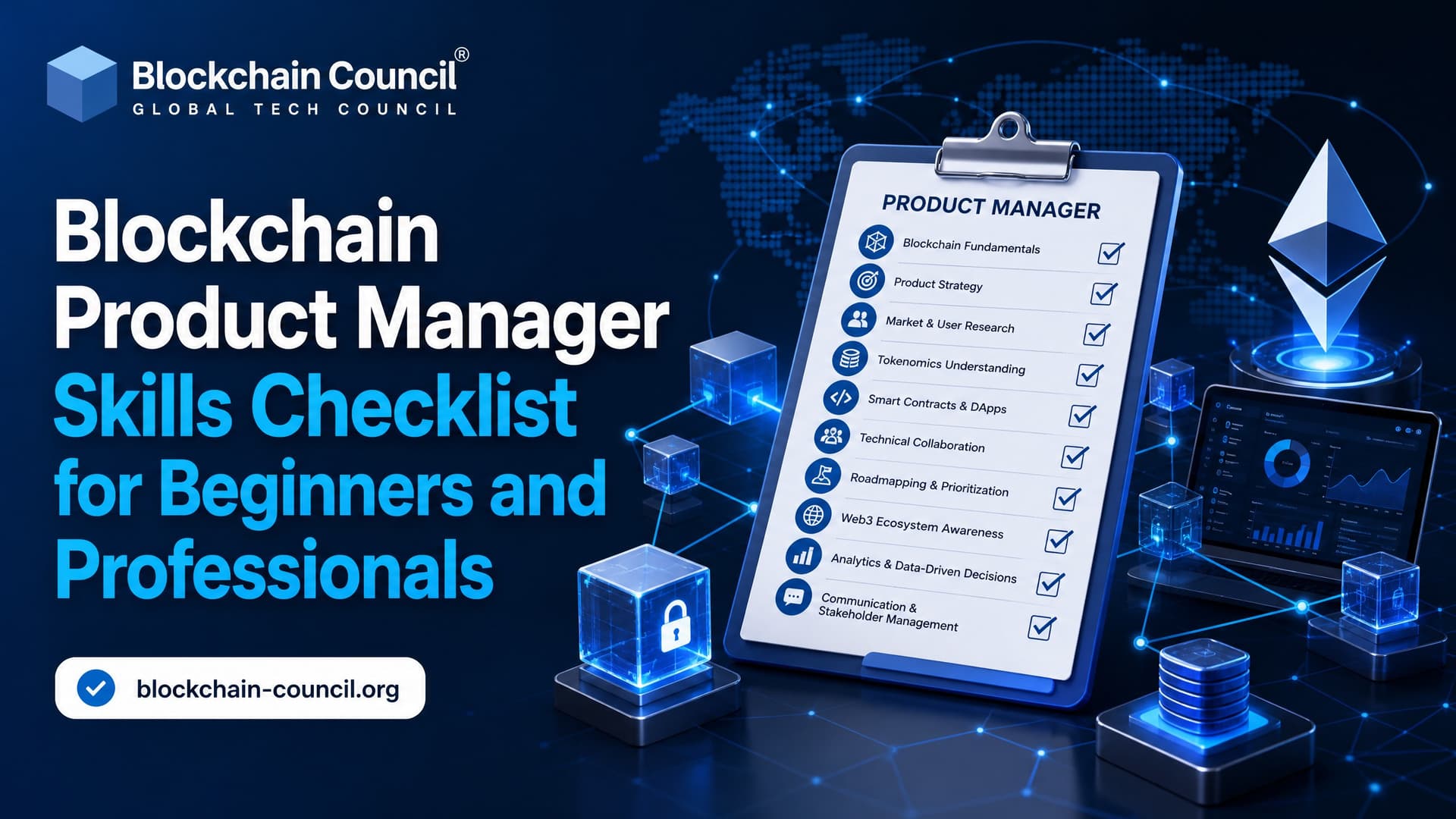
Beginner Blockchain Product Manager Skills Checklist
Core Product Management Skills
Start here. Blockchain does not excuse weak product thinking.
- Product strategy: Define the user, the problem, the value proposition, and the business model.
- User research: Run interviews, surveys, usability tests, and problem validation sessions.
- Roadmapping: Sequence features by user value, risk, engineering effort, compliance impact, and market timing.
- Prioritization: Use methods such as RICE, opportunity scoring, or cost of delay, but do not treat frameworks as math theater.
- Metrics: Track activation, retention, conversion, revenue, failed transactions, and support tickets.
- Collaboration: Work clearly with engineering, design, compliance, operations, marketing, and customer support.
If you are new, do not try to design a token economy before you can write a sharp product requirements document. Boring skill first. Then crypto complexity.
Blockchain Fundamentals
You do not need to be a Solidity engineer to become a blockchain PM, but you must understand enough to avoid bad requirements.
- Distributed ledgers, blocks, hashes, finality, and transaction confirmation.
- Consensus mechanisms, especially Proof of Stake and validator incentives.
- Public, private, and permissioned blockchain networks.
- Smart contract basics, including deployment, upgradeability, audits, and common failure modes.
- Token standards such as ERC-20 for fungible tokens and ERC-721 for NFTs.
- Wallet flows, private keys, seed phrases, signatures, gas, and network switching.
Learn gas mechanics early. Ethereum's EIP-1559 introduced base fees and priority fees, and this matters for product copy, transaction estimation, and user trust. A vague message like transaction failed is not acceptable in a financial flow.
Tokenomics and Crypto Market Basics
Beginners should understand the difference between utility tokens, governance tokens, payment tokens, stablecoins, and NFTs. You should also know the basic mechanics of swaps, staking, lending, liquidity pools, slippage, and protocol fees.
Be careful here. Tokenomics is often overhyped. A token cannot fix poor retention, weak demand, or a product with no real reason to be decentralized. Your job is to test incentives, not decorate a roadmap with a token.
Security and Risk Awareness
Security is not only an engineering concern. Product decisions create risk.
- Know common attack and loss patterns: phishing, private key loss, approval abuse, oracle manipulation, bridge failures, rug pulls, and smart contract bugs.
- Build security reviews into the roadmap before launch pressure begins.
- Write requirements for risk warnings, transaction previews, spending approvals, and recovery flows.
- Understand why crypto and financial products have near-zero tolerance for careless errors.
A small UI choice can be expensive. If a swap screen hides price impact until the final step, you may reduce drop-off for a week and increase angry users forever.
Regulatory and Compliance Literacy
You are not expected to act as legal counsel. You are expected to ask better questions.
- What user data is collected during onboarding?
- Does this product require KYC or AML checks?
- Are sanctions screening or travel rule obligations relevant?
- Who has custody of assets?
- Which jurisdictions are blocked or restricted?
- Could token features create securities, gambling, lending, or consumer protection issues?
This matters most for exchanges, wallets, custody products, tokenized assets, DeFi interfaces, and enterprise blockchain networks.
Professional Blockchain Product Manager Skills Checklist
Multi-Quarter Strategy and Ecosystem Planning
Experienced blockchain PMs manage more than feature lists. You align protocol upgrades, token events, liquidity plans, partner launches, audits, governance votes, and regulatory milestones.
You also decide when not to ship. If liquidity is thin, oracle coverage is weak, or an audit found unresolved high-severity issues, delaying launch is the right call. To be blunt, senior PMs are paid to protect the product from excitement.
Advanced Technical Fluency
Professional PMs should be able to discuss architecture without pretending to be the lead engineer. You need working fluency in:
- Ethereum, Solana, Polkadot, and major layer 2 networks.
- Rollups, bridges, cross-chain messaging, and interoperability risks.
- RPC providers, self-hosted nodes, indexers, oracles, and data availability tradeoffs.
- Gas modeling, latency, finality, throughput, and reliability.
- Smart contract upgrade patterns and the product risks of admin keys.
A common beginner mistake is treating RPC providers as interchangeable. They are not. Rate limits, archive data access, regional latency, and outage history can all change the user experience during peak demand.
Governance and Token Design
Senior PMs may help design or evaluate governance models, token incentives, fee switches, staking rewards, delegation systems, and DAO proposal processes. The skill is not just economic modeling. It is behavior design.
Ask practical questions:
- Who votes, and why would they participate?
- Can whales dominate governance?
- What happens if rewards attract mercenary liquidity?
- How are emergency decisions handled?
- Are incentives sustainable after launch subsidies end?
For deeper grounding, look at Blockchain Council programs such as the Certified DeFi Expert™, Certified Web3 Expert™, and Certified Blockchain Expert™.
Analytics Across Product and Chain Data
Traditional analytics is not enough. A blockchain PM should combine product funnels with on-chain behavior.
- Off-chain metrics: sign-ups, wallet connects, activation, retention, conversion, support volume, churn, and revenue.
- On-chain metrics: transaction count, unique active wallets, total value locked, liquidity depth, trading volume, failed transactions, governance turnout, and token holder concentration.
- Segmentation: traders, liquidity providers, NFT collectors, DAO contributors, validators, institutions, and first-time wallet users.
Do not over-read wallet counts. One person can control many addresses, and one address can represent a fund, bot, exchange, or multisig. Treat on-chain data as evidence, not truth by default.
Crisis Management and Incident Response
Professional blockchain PMs need calm operational judgment. Exploits, chain congestion, oracle delays, frontend compromises, bridge outages, and regulatory notices can all become product incidents.
Your checklist should include:
- Incident severity levels and owner roles.
- Pre-approved user communication templates.
- Pause or circuit-breaker decision rules where applicable.
- Coordination paths for engineering, legal, compliance, security, support, and community teams.
- Post-incident analysis that changes the roadmap, not just the status page.
Skills by Product Type
Crypto Exchanges and Trading Platforms
You need deep awareness of liquidity, order flow, fees, slippage, custody, market abuse controls, KYC, AML, and jurisdictional rules. A trading PM who ignores compliance will not last.
Wallets and Custody
Focus on key management, signing clarity, transaction simulation, recovery, hardware wallet support, on-ramp and off-ramp flows, and phishing resistance. UX and security are inseparable here.
DeFi Products
You need fluency in AMMs, lending, staking, yield, oracle risk, liquidation mechanics, governance, and liquidity incentives. This is not the right path if you dislike financial detail.
NFT, Gaming, and Consumer dApps
Prioritize minting flows, royalties, asset ownership, marketplace behavior, user education, and wallet onboarding. Watch regulatory issues around gambling-like mechanics and speculative promotion.
Enterprise Blockchain
Permissioned networks require a different mindset. Integration, data access, identity, auditability, vendor management, and legacy systems matter more than token culture.
How to Build These Skills Without Wasting Time
- Master classic PM practice first. Learn discovery, strategy, roadmaps, prioritization, metrics, and stakeholder management.
- Study blockchain fundamentals. Cover wallets, consensus, smart contracts, ERC-20, ERC-721, gas, nodes, RPC providers, oracles, bridges, and layer 2s.
- Build a small testnet product. A wallet-connected app on Sepolia will teach you more than ten whitepapers.
- Read smart contract audit reports. Focus on how product assumptions turn into technical risk.
- Compare real protocols. Study how DeFi platforms, NFT marketplaces, and DAOs handle incentives and governance.
- Add compliance literacy. Learn enough KYC, AML, custody, privacy, and sanctions concepts to work well with specialists.
- Use on-chain data tools. Practice reading transaction activity, token holders, liquidity, and governance participation.
If you want a structured path, related Blockchain Council certifications map cleanly to each stage: the Certified Blockchain Expert™ for fundamentals, the Certified Blockchain Developer™ or Certified Smart Contract Developer™ for technical depth, the Certified DeFi Expert™ for protocol and finance concepts, and the Certified Web3 Expert™ for broader ecosystem knowledge.
Beginner vs Professional Checklist at a Glance
- Beginner: Understand product basics, blockchain fundamentals, wallet flows, token types, basic compliance, common risks, and simple analytics.
- Professional: Own multi-quarter strategy, integrate regulation and security into roadmap decisions, design governance and token systems, combine off-chain and on-chain analytics, manage incidents, and lead across ecosystem partners.
Pick one product type, such as a wallet, DeFi dashboard, NFT marketplace, or enterprise tracking app, then write a one-page PRD for a testnet version. Include the user problem, target segment, wallet flow, chain choice, risks, metrics, and compliance questions. If you can do that clearly, you are already practicing the real work of a blockchain product manager.
Related Articles
View All
Blockchain
Blockchain Product Manager Skills: What You Need in 2026
A practical guide to the blockchain product manager skills needed in 2026, from DeFi and AI to compliance, UX, analytics, and security.

Blockchain
What Does a Blockchain Product Manager Do? Roles, Skills, and Career Outlook
Learn what a blockchain product manager does, the skills needed, typical responsibilities, career outlook, and how to start building the right expertise.
Blockchain
Top Blockchain Product Manager Skills You Need in 2026
Learn the top blockchain product manager skills for 2026, from strategy and on-chain analytics to tokenomics, UX, security, compliance, AI, and leadership.
Trending Articles
The Role of Blockchain in Ethical AI Development
How blockchain technology is being used to promote transparency and accountability in artificial intelligence systems.
How Blockchain Secures AI Data
Understand how blockchain technology is being applied to protect the integrity and security of AI training data.

Can DeFi 2.0 Bridge the Gap Between Traditional and Decentralized Finance?
The next generation of DeFi protocols aims to connect traditional banking with decentralized finance ecosystems.